


Stand on a café terrace in central Athens and look up. Above the traffic and tram lines, the Acropolis rises on its limestone rock, crowned by the Parthenon. For most visitors this is an unmissable photo stop. For ancient Athenians, it was something more: the visible home of their patron goddess, Athena. To understand Athens today, from its street names to its summer festivals, you need to understand the city’s intimate, enduring relationship with the goddess who gave it both its name and its character.
Get the latest updates straight to your inbox!
Athena and the Naming of Athens
The story that every Athenian schoolchild still learns begins with a contest. According to ancient authors, both Athena, goddess of wisdom and war strategy, and Poseidon, god of the sea, wanted to be patron of the young city on the rocky hill of Attica. The gods agreed that whichever deity offered the more useful gift to the people would lend their name and protection to the city. Versions of this myth were told by writers such as Herodotus and Pausanias in antiquity, and the broad outline is the same: a public competition, a judging assembly of early Athenians, and a decisive choice that would shape the city’s future.
Pleased with his own power, Poseidon was the first to act. Striking the rock of the Acropolis with his trident, he caused a saltwater spring to surge from the ground, sometimes described as a small sea or pool. It was a dramatic, noisy gift that asserted his control of the waters and promised naval strength. Athena’s response was quieter but more far-reaching. She planted a seed in the rock and from it grew the first cultivated olive tree. The people, or in some versions their king Cecrops, judged Athena’s gift more useful: olives could feed citizens, oil could light lamps and treat wounds, wood could build homes and tools, and surplus oil could be traded with other Mediterranean ports.
The decision gave the city its identity. Athena became the city’s guardian, and the settlement came to be known as Athens. Modern scholarship suggests the name of both city and goddess may reach back to a pre-Greek language, but in cultural terms it was this myth that Athenians themselves repeated to explain who they were. Even today, walking through the city, you see her name and image everywhere, from the bronze Athena statue outside the Academy of Athens to souvenir shop magnets in Plaka showing the goddess in helmet and aegis.
The Olive Tree Myth and Why It Still Matters
In antiquity, Athenians pointed to a specific tree on the Acropolis as the descendant of Athena’s original olive. A travel writer of the 2nd century AD, Pausanias, mentions a sacred olive tree near the Erechtheion, the temple that housed cults of both Athena and Poseidon. This tree, he notes, was treated as living proof of the goddess’s gift and was carefully tended by the city. The ancient state controlled “moriai,” sacred olive trees thought to be offshoots of Athena’s, and landowners could face penalties if they damaged them. Olive oil from Attica’s groves filled the large ceramic amphorae given as prizes in the city’s Panathenaic Games.
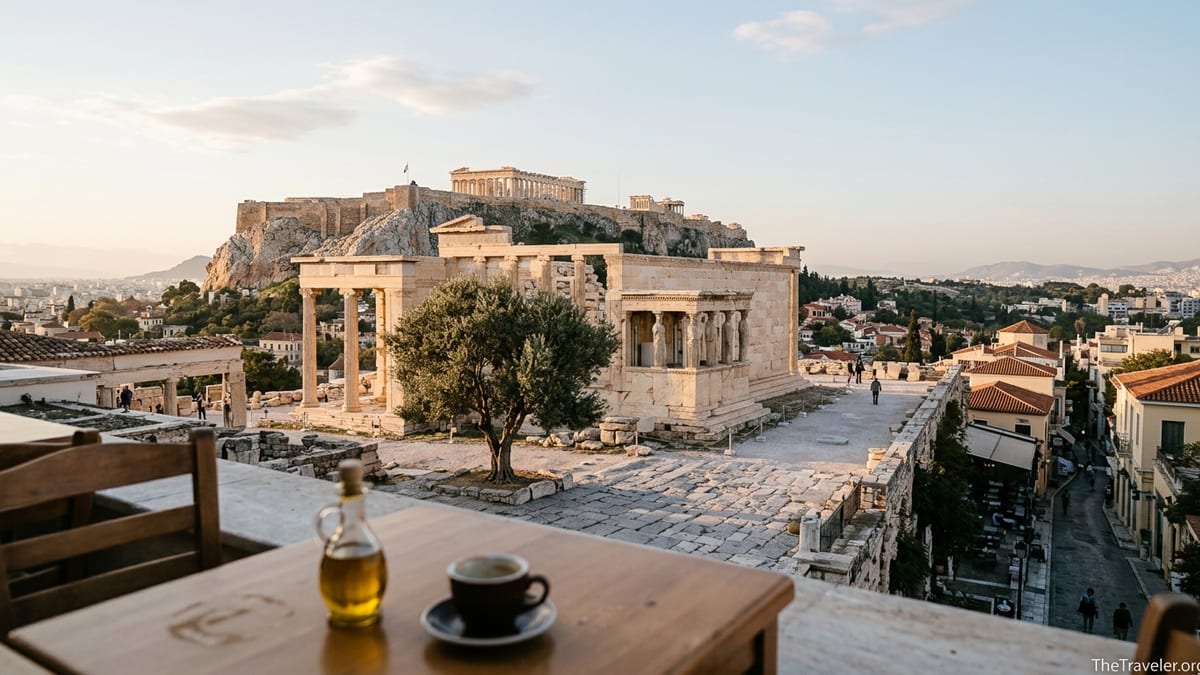
As a traveler today, you can see how this mythology still shapes the landscape and economy. On the Acropolis, just south of the Erechtheion’s famous Caryatid porch, a solitary olive tree grows in a paved courtyard. The current tree has been replanted several times after damage in wars and fires, but local guides will tell you it stands where Athena’s sacred tree once grew. Many visitors notice locals pausing there for a quiet photo rather than a quick selfie: it feels more like a living monument than a prop.
Beyond the hill, Attica remains thick with olive groves. A day trip northeast of the city toward Marathon or south toward Sounion takes you past silvery-green trees that have been cultivated for generations. Many tour operators and small family businesses now offer olive-focused experiences. For example, a half-day olive oil tasting in an Attica estate typically costs a modest fee, including transfers, a walk among the groves, and a guided tasting of different oils paired with local bread and tomatoes. Hosts often mention Athena’s gift when explaining why Greeks treat olive oil almost as a sacred ingredient rather than a simple fat.
The myth is also echoed in modern cultural events. One international olive oil competition held in Greece deliberately chose “Athena” as its name and bases part of its identity on the story of the goddess planting the first tree on the Acropolis. The organizers describe the olive as a gift of peace, wisdom, and prosperity, positioning contemporary olive oil producers as heirs to that original, legendary tree. For visitors, attending such events or simply browsing the shelves of a Kolonaki deli filled with premium Attic oils can feel like stepping into a living continuation of Athena’s myth.
The Acropolis as Athena’s Sacred Rock
The Acropolis is not just a picturesque ruin; it is the physical stage on which Athena’s story with Athens was continually performed. The rock held several cult sites connected to the goddess: the Parthenon, where a towering gold-and-ivory statue of Athena Parthenos once stood; the Erechtheion, associated with the contest with Poseidon and the sacred olive tree; and smaller shrines, such as those devoted to Athena Nike, the goddess in her aspect as bringer of victory. Together, these built a kind of three-dimensional map of Athena’s role: protector in war, patron in peace, and guarantor of the city’s continuity.
Modern archaeology and careful restoration have made these connections more visible than ever. Climbing the marble steps past the Propylaea, you first encounter the delicate Temple of Athena Nike perched on a bastion to your right. Its friezes once showed scenes of victorious battles, reminding visitors that Athena defended Athens against enemies. Further up, the Parthenon dominates the plateau. Although its interior statue has long vanished, the temple’s very scale still transmits the confidence of a city at the height of its power in the 5th century BC, dedicating an enormous project to its goddess.
Seek out the Erechtheion on the north side of the Acropolis plateau to feel the intimate, cultic side of the myth. This irregularly shaped building housed ancient altars to both Athena and Poseidon, acknowledging that although Athena won the contest, the sea god still commanded respect. Inside stood sacred objects related to the city’s founding myths, and outside grew the olive tree linked to Athena’s original gift. Today, visitors photograph the Caryatids that support the southern porch, but a short walk around the building brings you to the quiet courtyard where the modern olive stands, and where guides often recount the story of the competing gods.
Even details of the rock itself were woven into the myth. Some ancient descriptions mention marks in the stone of the Erechtheion area as traces of Poseidon’s trident blow, and a saltwater well inside the sanctuary as evidence of his spring. While geologists and archaeologists offer natural explanations for these features, the fact that Athenians saw the landscape as a divine record is what matters for understanding how tightly the city’s identity was bound to Athena’s story.
The Contest with Poseidon: Sculpture, Ritual, and Memory
The contest between Athena and Poseidon was not an abstract tale for philosophers; it was carved in stone above the heads of anyone entering the Parthenon. The west pediment of the temple depicted the moment of the dispute, with Athena and Poseidon lunging away from each other, their chariots and attendants filling the triangular space. Fragments of these sculptures are preserved today in the Acropolis Museum in Athens and in the British Museum in London. Museum labels and reconstructions explain that the scene likely included the olive tree and the bursting spring, along with personifications of local rivers Ilissos and Kephisos, rooting the story firmly in the Attic landscape.
When you visit the Acropolis Museum at the foot of the hill, make time for the Parthenon Gallery on the top floor. The sculptures are arranged in the same order they appeared on the temple. Standing before the surviving pieces of the west pediment, you can see how central the story of the contest was to the temple’s message. This was the first view that greeted ancient visitors approaching the Parthenon from the main entrance, ensuring that the choice of Athena over Poseidon framed their entire experience of the sacred precinct.
Rituals reinforced the story annually. The Panathenaic Festival, celebrated every summer, included a grand procession from the city’s outskirts up to the Acropolis. Citizens carried a newly woven robe, or peplos, to clothe an ancient wooden statue of Athena Polias, the city-protecting aspect of the goddess. The festival also featured athletic competitions and music contests, with winners receiving large storage jars filled with olive oil from sacred groves dedicated to Athena. The symbolism was clear: the city’s prosperity, its religious life, and its international prestige were all tied to the goddess who had once planted an olive tree on their rock.
Echoes of the Panathenaic procession survive today in the way visitors move through the modern city. The route of the ancient procession roughly matches the path many tourists now walk: from the Kerameikos cemetery and the lower city streets up the gentle slope toward the Acropolis. During summer evenings, the pedestrianized Dionysiou Areopagitou promenade fills with street musicians, performers dressed as hoplites, and vendors selling olive-wood carvings and small statues of Athena. Without realizing it, many travelers retrace the ancient movement of Athenians paying homage to their patron goddess.
Athena’s Values in the City’s Identity
Athena was not simply a war goddess; she was a deity of strategy, crafts, and civic wisdom. Ancient Athenians liked to see their political institutions as guided by her virtues: reasoned debate rather than brute force, innovation in arts and technology, and careful planning in war. The famous birth myth of Athena, springing fully armed from the head of Zeus, underlined her identity as a figure of intellect and clear-sighted action rather than impulse.
You can see how this ideal has been woven into Athens’s modern self-image. Contemporary promotional material for the city often highlights it as a place of ideas, education, and creativity. The national university, known in English as the National and Kapodistrian University of Athens, uses Athena in its emblem. Statues of the goddess top the 19th-century neoclassical buildings of the so-called Athenian Trilogy along Panepistimiou Street, symbolizing knowledge and learning. For a visitor, simply walking this avenue and looking up at the sculpted Athena figures holding spears and shields can help you connect the ancient values to the modern city’s scholarly ambitions.
Athena’s association with crafts and skilled labor also still resonates. Traditional artisans in neighborhoods like Monastiraki and Psiri work with olive wood, ceramics, and textiles in ways that recall ancient crafts dedicated to the goddess. Many small workshops sell hand-woven textiles patterned with meanders and owls, Athena’s sacred bird, or hand-carved chess sets featuring the goddess opposite Poseidon. While these are contemporary products aimed at travelers, they are rooted in an old pattern: Athenians expressing their city’s identity through the imagery and attributes of their patron goddess.
In a more metaphorical way, modern Athenians sometimes invoke Athena when talking about the city’s resilience. After financial crises, wildfires in Attica, or social unrest, local media and commentators often describe Athens as drawing on a kind of quiet wisdom and staying power symbolized by the olive tree. For travelers, this context can add depth to conversations with guides or hosts, who may casually reference Athena when explaining how the city has survived difficult decades while continuing to attract visitors and students from around the world.
Experiencing Athena in Today’s Athens
For a traveler interested in culture and mythology, Athens offers many ways to experience Athena’s presence beyond the standard Acropolis visit. Start with the Acropolis Museum, where clear displays explain the myths and cults surrounding the goddess using original sculptures, models, and short texts. Audio guides and small group tours are available in multiple languages and often include stories of the contest with Poseidon, making the visit more vivid than a quick walk-through.
From there, step outside and walk up the pedestrian approach to the Acropolis itself in the late afternoon, when the light softens and the crowds thin. Having just seen the pediments and friezes up close in the museum, you can better appreciate their original placement on the Parthenon. Look toward the west end of the temple to imagine the scene of Athena and Poseidon that once dominated the skyline. Then circle to the north side to find the Erechtheion and the olive tree courtyard. Spending a quiet few minutes here, away from the main flow of visitors, can bring the myth alive in a way that no textbook summary can.
Elsewhere in the city, keep an eye out for Athena’s symbols. The owl appears on everything from metro station mosaics to the logos of bookstores and galleries. Several modern sculptures of Athena are scattered across central Athens, including one atop the Academy building and another near the Archaeological Society. Local guides sometimes build custom “Athena walks” that link these sites with stops at traditional workshops, a tasting of olive-based dishes in a family-run taverna, and a visit to an olive oil specialist shop where staff explain how to judge a high-quality extra virgin oil.
If your visit coincides with cultural festivals, you may catch performances or exhibitions that directly reference the goddess. Contemporary theater productions held in small venues in Exarchia or Kypseli occasionally stage modern retellings of myths about Athena and other Olympians, exploring issues such as the role of reason in politics or the tension between war and peace. Even if you do not speak Greek, many productions offer surtitles in English, and the program notes often explain how Athena’s ancient traits resonate with modern concerns.
The Takeaway
Understanding Athena’s role in the story of Athens turns sightseeing into something richer. The Acropolis stops being just a photogenic ruin and becomes the stage where a city once defined itself through its relationship with a goddess of wisdom and strategy. The olive tree on the rock, the sculptures of the Parthenon’s west pediment, and the quiet interior of the Erechtheion are not isolated attractions. They are chapters of a long narrative that still shapes how Athenians see themselves and present their city to the world.
As you wander through Athens, try to look at everyday details through this lens. The prevalence of olive oil in every meal, the owls adorning shop signs, the university buildings crowned with statues of a helmeted woman: all these are living echoes of the decision, real or imagined, that the people once made on their high rock. Choosing Athena’s olive over Poseidon’s saltwater spring was a way of choosing a certain kind of city: one that prized thoughtful strategy over raw display, sustainable resources over fleeting spectacle, and civic identity over individual power.
For travelers, tuning into this story can make even a short stay feel more connected. Sitting in the shade of a plane tree in the National Garden, sampling a peppery, green Attic olive oil on fresh bread, or watching the Acropolis glow at sunset from a rooftop bar, you are participating in a landscape and culture that have been reading themselves through Athena’s myth for nearly three thousand years. To know Athens is, inescapably, to know Athena.
FAQ
Q1. Why was Athens associated with Athena rather than Poseidon?
Athens chose Athena after a mythical contest in which she offered the olive tree, a gift of lasting food, oil, and trade, judged more useful than Poseidon’s dramatic saltwater spring.
Q2. Can I see the olive tree linked to Athena’s myth today?
Yes. On the Acropolis, beside the Erechtheion, a cultivated olive tree marks the traditional spot of Athena’s sacred tree, replanted over time but still treated with symbolic respect.
Q3. Where is the contest between Athena and Poseidon shown on the Acropolis?
The myth was carved on the west pediment of the Parthenon. The original sculptures now survive in fragments, displayed in the Acropolis Museum and other collections.
Q4. What is the Erechtheion, and how is it connected to Athena?
The Erechtheion is an ancient temple on the Acropolis that housed cults of Athena and Poseidon. It stood near the sacred olive tree and the supposed marks of Poseidon’s trident.
Q5. How did Athena influence the character of ancient Athens?
Athenians saw Athena as a goddess of wisdom, strategy, and crafts, so they linked her to democracy, skilled workmanship, and thoughtful military planning rather than brute force.
Q6. Are there modern festivals in Athens that honor Athena?
The ancient Panathenaic Festival no longer exists, but its memory lives on in museum displays, and modern cultural events often reference Athena in exhibitions, theater, and branding.
Q7. How can I explore Athena’s legacy during a short visit?
Visit the Acropolis Museum, the Acropolis itself, and the Academy of Athens area, then seek out olive oil tastings and artisan workshops using Athena’s symbols in their crafts.
Q8. Why is olive oil so important in Athenian and Greek culture?
Olive oil is central to Greek cuisine, trade, and ritual. The myth of Athena’s olive tree reinforces its status as a sacred, life-sustaining product rather than a simple cooking ingredient.
Q9. Did Athenians still honor Poseidon after choosing Athena?
Yes. Poseidon continued to receive worship, especially in the Erechtheion and in coastal sanctuaries, acknowledging the city’s dependence on the sea despite Athena’s patronage.
Q10. Is Athens named after the goddess Athena, or is it the other way around?
Ancient Athenians believed the city was named in honor of Athena after her victory in the contest. Modern scholars debate linguistic details, but culturally that mythic explanation prevailed.