


More news on this day
Flights at Hartsfield-Jackson Atlanta International Airport were operating without any FAA ground stops or airport-wide delay programs on Friday, November 27, 2026, following a turbulent week of technology failures, a rare nationwide ground stop and severe Thanksgiving weather that caused hundreds of delays and cancellations for travelers passing through the world’s busiest hub.
Get the latest news straight to your inbox!
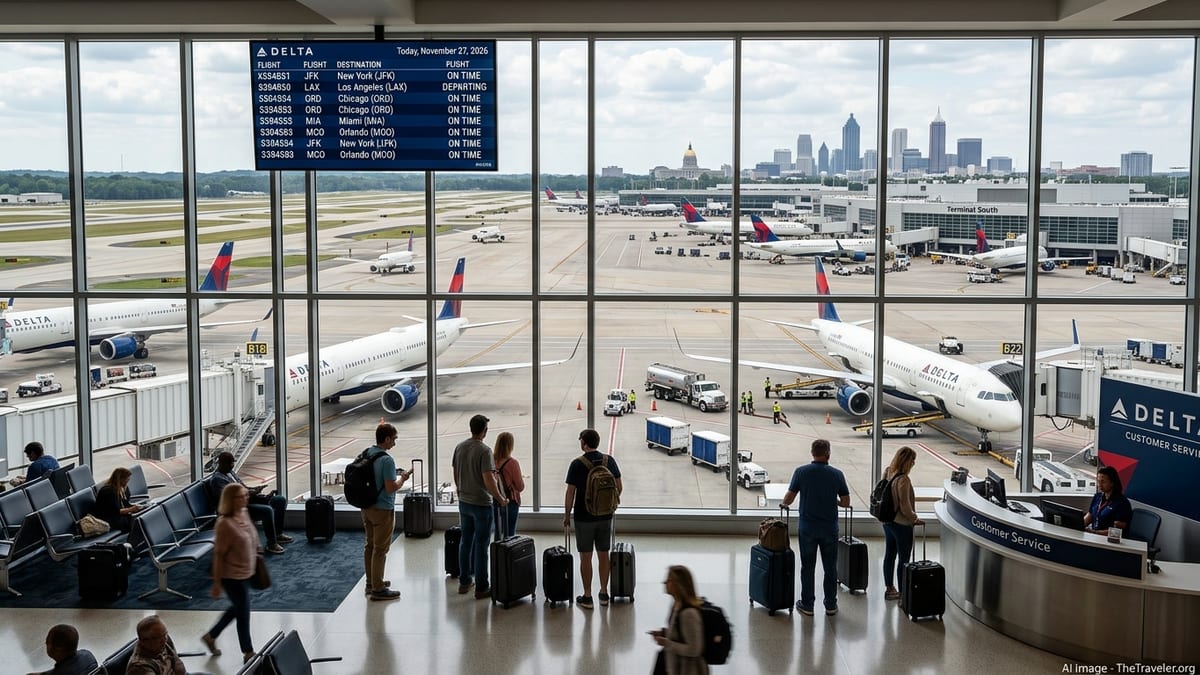
Current status at Atlanta: no systemwide FAA delays today
As of Friday afternoon, November 27, 2026, federal air traffic data showed no ground stop, ground delay program or general departure delay in effect for Atlanta’s Hartsfield-Jackson airport. FAA traffic advisories listed only minor gate-hold and taxi waits of 15 minutes or less, which are typical for a major hub rather than a sign of broader disruption. Independent trackers that mirror the FAA’s National Airspace System feed also reported no active airport-wide restrictions for Atlanta, meaning the problems of the past week have largely moved into the recovery phase.
Real-time flight status boards on tracking platforms indicated that delays and cancellations at Atlanta on Friday were scattered across individual departures rather than concentrated at specific banks of flights or routes. That pattern points to a mix of airline-level issues, late-arriving aircraft from other parts of the country and residual knock-on effects from earlier disruptions, instead of a new local crisis. Travelers still face the risk of late or canceled flights, particularly on overbooked holiday weekend services, but the sources of those problems are now flight-specific rather than airport-wide.
Weather, which often drives large-scale delays during the Thanksgiving period, was not triggering any federal traffic management program for Atlanta as of Friday. National outage monitors tracking FAA ground stops and delay programs showed no restrictions tied to storms over the Southeast, even as other airports in the system, such as Boston earlier in the day, saw structured delay programs introduced to meter arrivals. For passengers in Atlanta, that means the main challenges at the end of the week are residual congestion and airline operations rather than new airspace constraints.
How a Delta automation failure snarled Atlanta on November 22
The most acute Atlanta-specific disruption of the current holiday travel period occurred on Sunday, November 22, when an automation failure at Delta Air Lines triggered a carrier-specific ground stop for Delta flights bound for Hartsfield-Jackson. According to FAA-based reports and subsequent summaries of the November 2026 technology outages, the Federal Aviation Administration ordered an approximately hour-long halt on selected Delta flights into Atlanta, later converting it into a ground delay program. That meant that instead of coming to a full stop, many Delta departures toward Atlanta were held at their origin airports with metered release times.
Local coverage and passenger accounts from that Sunday described a rapid buildup of disruption at Atlanta once the automated system problem took hold. With Delta operating its largest hub at Hartsfield-Jackson, the automation failure translated into several hundred delayed flights touching Atlanta in some way, either as arrivals, departures or through aircraft and crew rotations. One widely cited figure circulated at the time indicated that more than 300 Delta-operated flights linking to Atlanta experienced delays that morning, although precise counts varied by data source and the number fluctuated as cancellations were added later in the day.
The FAA’s own characterization of the November 22 Delta issue placed it within a broader sequence of technology-driven disruptions affecting the U.S. aviation system in November 2026. The limited, airline-specific ground stop at Atlanta came less than ten days after a much larger nationwide FAA ground stop linked to an air traffic system upgrade, magnifying its impact on already strained airline schedules. Delta’s Atlanta hub, with its dense wave structure of flights and tight connection windows, was particularly vulnerable to cascading effects once the automation glitch prevented normal dispatch and routing processes from functioning for part of the morning.
Ripple effects from the November 13 nationwide FAA ground stop
Atlanta’s recent challenges cannot be separated from the nationwide ground stop ordered by the FAA on Friday, November 13, 2026, after a technology upgrade interfered with key air traffic communication systems. Federal briefings and subsequent analyses described the event as only the second systemwide ground stop since the shutdown of U.S. airspace on September 11, 2001. For roughly several hours, most civil departures across the country were halted while engineers isolated and corrected the fault, which was traced to a new router overwhelming older equipment within the air traffic control network.
Because of its role as the world’s busiest passenger hub and Delta’s primary connecting center, Atlanta played a central part in the disruption that followed the nationwide ground stop. Flight tracking data and local reports from the day after the outage indicated that on Saturday, November 14, Atlanta was still dealing with several hundred cancellations and dozens of delays as airlines repositioned aircraft and crews and tried to accommodate passengers who had missed connections during the shutdown. The recovery timeline varied by carrier, but the concentration of connecting traffic through Atlanta meant that residual issues there persisted longer than at some smaller origin-and-destination airports.
The nationwide ground stop also shaped how federal agencies and airlines managed subsequent problems, including the November 22 Delta automation failure and this week’s weather-related disruptions. Transportation officials highlighted new tools intended to predict and alleviate congestion in the airspace, along with internal “tiger teams” focused on smoothing peak holiday operations. However, those measures could not eliminate knock-on effects entirely. By the time Thanksgiving week began, many airlines were still operating with thinner margins for error due to aircraft and crew imbalances that had their roots in the mid-November nationwide halt.
Thanksgiving storms and how they affected Atlanta traffic
Heavy rain, strong winds and coastal flooding along parts of the East Coast on Thanksgiving itself added another layer of complexity to air travel across the U.S. Major travel hubs in the Northeast and Mid-Atlantic faced weather-related delays, with thousands of flights nationwide running late and several hundred canceled on Thursday, November 26. Those conditions created a difficult environment for airlines already working to stabilize their schedules after the earlier technology disruptions.
For Atlanta, the weather story was more nuanced. Federal aviation updates in the lead-up to Thanksgiving mentioned only limited weather-related delays at a handful of other major airports, and travelers at Hartsfield-Jackson reported relatively smooth operations compared with some coastal hubs. Although individual Atlanta flights were delayed or canceled due to thunderstorms, high winds or weather problems at their destination airports, the FAA did not impose an airport-wide ground delay program on Atlanta solely because of local conditions.
Even without a formal ground delay program, the combination of storms elsewhere and earlier systemwide disruptions could still translate into longer waits for some passengers at Atlanta. Aircraft scheduled to feed key bank departures sometimes arrived late from storm-affected airports, and crews that had already absorbed delays earlier in the week occasionally timed out under duty rules, forcing airlines to reschedule flights. For travelers, the practical result was a patchwork of late departures, gate changes and occasional cancellations rather than the kind of uniform, clearly signposted restrictions that accompany an official FAA traffic management program.
What Atlanta travelers should watch for over the coming days
Looking ahead to the remainder of the Thanksgiving weekend, the most important point for travelers is that Atlanta is not currently under any FAA ground stop or airport-wide delay program. However, airlines are still operating through one of the busiest travel periods of the year with schedules that have been stressed by both technology outages and severe weather in other regions. That combination increases the risk that even apparently routine flights could face day-of-travel disruptions if an aircraft or crew fails to arrive on time from an earlier segment.
Passengers with itineraries touching Atlanta over the next several days should therefore focus less on airport-wide status labels and more on the details of their specific bookings. The most current information about whether a particular flight is delayed, canceled or swapped to a different aircraft type will come from the operating airline’s own channels, including mobile apps, text alerts and airport departure boards. Because residual disruptions can affect connection windows, travelers with tight layovers in Atlanta may wish to proactively review their options, particularly on the busiest return-travel days when empty seats on later flights are limited.
Travelers planning trips in the coming weeks should also be aware that aviation regulators are revisiting how the causes of delays and cancellations are categorized and reported, with new federal rules on delay categories now scheduled to take effect in early 2027. Those changes will not alter operations at Atlanta in the short term, but they are intended to give passengers clearer insight into whether future disruptions at major hubs stem from weather, air traffic capacity constraints, airline scheduling decisions, technology failures or other factors. For now, the immediate takeaway for those flying through Hartsfield-Jackson is that conditions have improved markedly from the worst disruptions seen earlier in November, even if the system as a whole remains under heavy seasonal strain.