


More news on this day
A FedEx Express MD-11 freighter arriving from Memphis overran a runway at Miami International Airport on the evening of November 25, 2026, forcing the temporary closure of most runways, triggering a Federal Aviation Administration ground stop and causing hundreds of delays for passengers traveling at the start of the busy U.S. Thanksgiving holiday period.
Get the latest news straight to your inbox!
What happened to FedEx Flight 910 at Miami
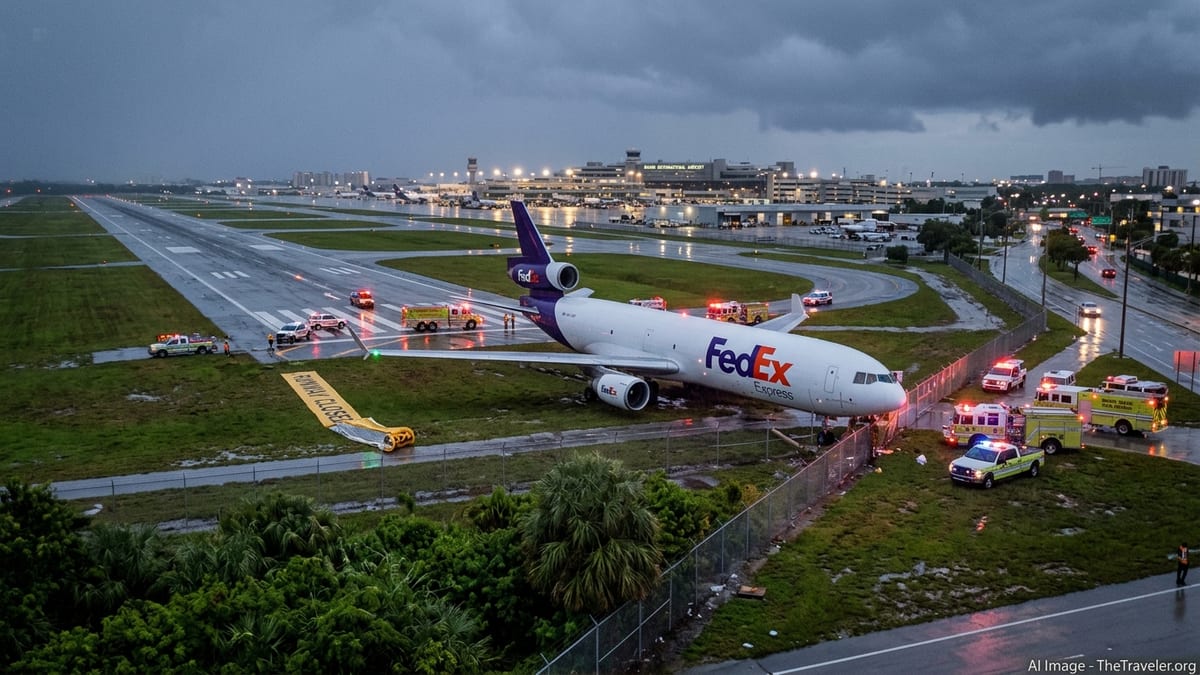
According to the Federal Aviation Administration and airport officials, FedEx Express Flight 910, a McDonnell Douglas MD-11F operating from Frederick W. Smith International Airport in Memphis to Miami, landed on Miami International Airport’s Runway 26R at around 8:30–8:40 p.m. local time on Wednesday, November 25, 2026. The aircraft failed to stop before the end of the 8,600-foot runway and continued into the engineered safety area, coming to rest on grass near the airport’s perimeter fence along Northwest 67th Avenue.
Multiple official and local reports describe the incident as a runway overrun or excursion. Images and video shared by airport agencies and local media show the three‑engine freighter upright, with its nose pointed slightly left of the runway centerline and its landing gear intact, surrounded by fire and rescue vehicles. There was no fire, and authorities said there were no injuries among the flight crew and no injuries reported on the ground.
FedEx confirmed the incident and said the crew was safe, adding that the company is cooperating with investigators. The FAA has opened an incident investigation, and the National Transportation Safety Board is expected to review data and cockpit recordings; as of November 27, no preliminary cause has been identified. Officials have not publicly released detailed information on weather, braking performance or aircraft weight beyond acknowledging that the event occurred during rain at the airport.
Runway closures and impact on operations at MIA
Runway 26R, also designated 8L/26R, is the shortest of Miami International Airport’s four runways, measuring about 2,621 meters (8,600 feet). Following the overrun, airport management and the FAA ordered an immediate ground stop for all flights bound for Miami, beginning shortly after the incident and lasting roughly an hour and a half on Wednesday evening. During this time, departing and arriving flights were held at their origin airports or delayed on the ground while emergency crews secured the scene and assessed the runway safety area and surrounding infrastructure.
The disabled FedEx aircraft remained in the safety area near the end of Runway 26R, which required that runway to be closed to traffic. For several hours after the incident, three of Miami’s four runways were taken out of service while emergency vehicles and investigators worked at the site, leaving just one runway, generally reported as Runway 9R, available for takeoffs and landings. As inspections were completed, airport authorities progressively reopened additional runways, but 8L/26R remained closed into Thursday while recovery planning and surface checks continued.
Data from the FAA’s traffic management advisories and flight-tracking services show that the combination of the ground stop and reduced runway capacity led to significant congestion. At the height of the disruption late Wednesday and into early Thursday, delays for flights touching Miami were commonly reported in the range of 40 to 80 minutes. Some flights diverted to other South Florida airports, including Fort Lauderdale-Hollywood International and Palm Beach International, while others were canceled or held at origin until Miami lifted restrictions.
Scale of delays for Thanksgiving travelers
The timing of the overrun amplified its effect. The incident occurred on the eve of the U.S. Thanksgiving holiday, traditionally one of the busiest travel periods of the year. Miami is a major hub for both domestic and international flights, and while FedEx Flight 910 was a cargo operation, its runway excursion constrained capacity for all types of traffic, from long-haul international services to short‑haul domestic flights within Florida.
By late Wednesday and through Thursday morning, flight-status boards and independent tracking sites showed hundreds of delays and a smaller number of cancellations associated with Miami’s reduced runway availability. One widely cited operational summary put the number of affected departures and arrivals at more than 1,000 flights cumulatively, though figures vary depending on how disruption windows are defined. Typical delay averages were reported at roughly three‑quarters of an hour, with some services waiting significantly longer while departure slots were metered and arrival spacing increased.
Travelers across the United States and internationally felt the knock-on effects, even if they were not flying directly to or from Miami. Aircraft and crews scheduled to operate onward legs were late into their next destinations, and some early‑morning services on Thanksgiving Day departed behind schedule while airlines repositioned aircraft. As operations normalized through Thursday, the FAA and Miami International Airport reported that three of the four runways were back in use, easing congestion, although Runway 8L/26R stayed closed pending removal of the freighter and detailed pavement inspections.
Context: another cargo overrun in Miami and ongoing safety probes
The FedEx overrun is the second serious runway excursion involving a cargo aircraft at Miami International Airport in less than three months. On September 6, 2026, a Boeing 767 freighter operated by cargo carrier 21 Air overshot Runway 30 during landing and continued beyond the paved surface, striking ground vehicles outside the runway safety area. That earlier accident caused fatalities and significant structural damage to the aircraft. The NTSB subsequently opened a major investigation into the September crash, which remains ongoing.
In contrast, initial reports about FedEx Flight 910 indicate no fire, no structural breakup of the MD‑11F and no injuries, although the aircraft’s landing gear, lower fuselage and engines will require careful inspection. The NTSB’s standard process in such incidents includes documenting runway conditions, aircraft performance data, crew training and decision‑making, as well as airport infrastructure such as lighting, navigational aids and runway safety areas. Investigators will also consider any overlap with issues identified in previous MD‑11 and Miami runway incidents, but there is presently no official indication that the two cargo overruns at Miami share a common cause.
The MD‑11 has been the subject of past safety scrutiny involving landing performance, including a 1997 FedEx crash at Newark and an unrelated FedEx Flight 910 accident in 2016, when a different aircraft type with the same flight number suffered a landing‑gear failure and fire at Fort Lauderdale-Hollywood International Airport. However, today’s MD‑11 freighter fleet has operated for decades in cargo service worldwide, and U.S. regulators have not suggested any new restrictions on the type following the Miami excursion. As of November 27, authorities have characterized the event as an isolated runway overrun under investigation rather than evidence of a broader systemic issue.
What travelers should know and check now
As of Friday, November 27, Miami International Airport reports that flight operations have largely resumed their normal pattern, with the exception of Runway 8L/26R, which remains closed while recovery and inspection work continues. Airlines are again using multiple runways for arrivals and departures, which reduces the likelihood of continued large-scale delays, but residual knock‑on effects may still ripple through some schedules, especially for aircraft and crews that were out of position on Thanksgiving Day.
Passengers with flights to, from or through Miami over the weekend following the incident should closely monitor their airline’s app or website and sign up for real‑time alerts, as gate assignments and departure times may still change at short notice if recovery operations or weather affect runway availability. Travelers connecting through Miami should allow additional buffer time between flights where possible, particularly for international-to-domestic connections that require security screening or immigration and customs formalities.
Those departing from nearby South Florida airports such as Fort Lauderdale or Palm Beach could also see minor schedule adjustments if airlines reposition aircraft or adjust routings in response to the Miami disruption. However, with the FAA ground stop lifted and three runways active at Miami, carriers and airport officials expect the busiest period of Thanksgiving travel to proceed with typical seasonal congestion rather than the widespread delays seen immediately after the FedEx overrun. A more detailed understanding of why FedEx Flight 910 overran Runway 26R will only emerge after investigators issue formal preliminary and final reports, which typically take weeks to months to complete.