


More news on this day
Direct Jeddah–Baku flights operated by Azerbaijan Airlines and Saudi carrier flynas are reinforcing Azerbaijan’s rapid tourism growth and deepening travel links with one of its fastest-rising source markets, Saudi Arabia.
Get the latest news straight to your inbox!
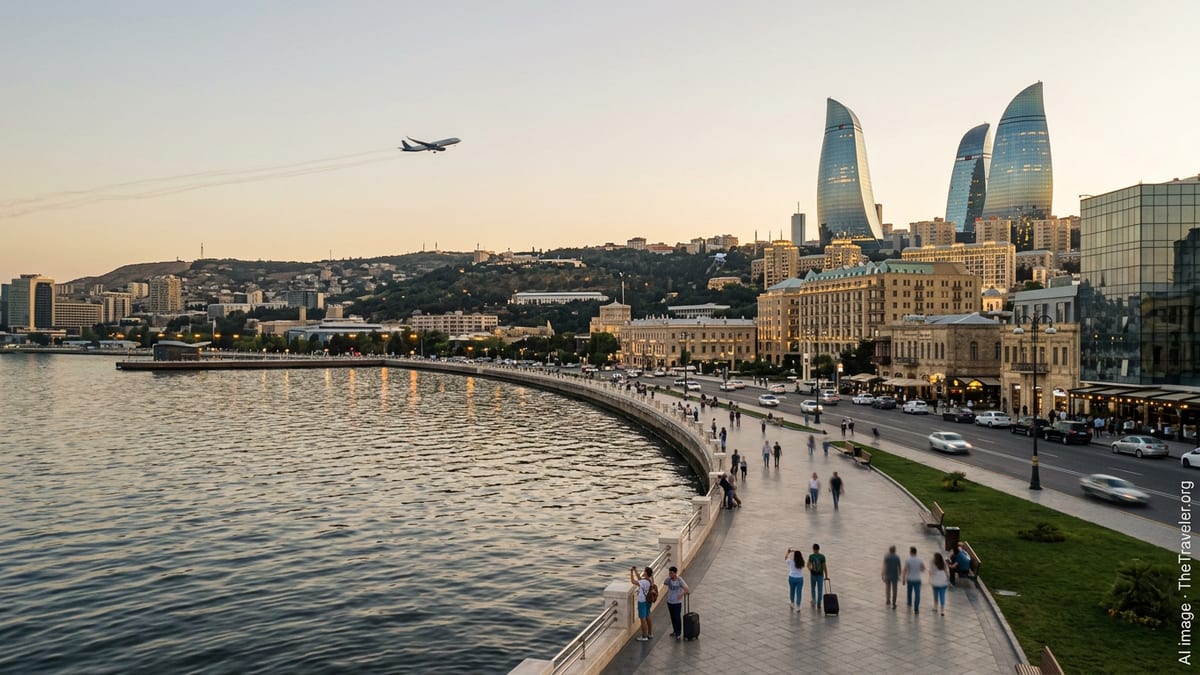
Nonstop Jeddah–Baku Services Back in the Skies
Published schedules show that both Azerbaijan Airlines and Saudi low-cost carrier flynas now operate nonstop services between Jeddah’s King Abdulaziz International Airport and Baku’s Heydar Aliyev International Airport, restoring a key air corridor between the two countries. Flight comparison data lists the route as a direct connection with a block time of just over four hours, underlining its role as a short-haul link between the Red Sea hub and the Caspian capital.
Information on Azerbaijan Airlines’ network confirms Jeddah among the carrier’s Saudi destinations, alongside other major cities in the Kingdom. The airline’s own route information highlights regular direct flights on the Jeddah–Baku pairing, positioning the service as a primary gateway for Saudi visitors heading to Azerbaijan for leisure or business.
Flynas, one of Saudi Arabia’s largest low-cost carriers, also promotes direct Jeddah–Baku operations, with published guidance indicating a typical flight time of around three hours and 40 minutes and arrivals into Baku’s main international airport. Together, the two airlines’ nonstop offerings expand capacity on the corridor and give Saudi residents more choice in timing, pricing, and onboard product.
Route-tracking data indicates that the Jeddah–Baku service is among a growing number of direct links between Saudi Arabia and Azerbaijan, reflecting broader network expansion strategies in both countries. By tightening connectivity on this route, carriers are enabling more short-break travel and facilitating multi-destination itineraries that combine the Gulf and the Caucasus.
Saudi Visitors Emerging as a Core Market for Azerbaijan
Recent figures from Azerbaijan’s State Statistical Committee show that Saudi Arabia is now one of the country’s top inbound tourism markets. Official data for 2024 indicates that Saudi travelers account for approximately 3.7 percent of all foreign arrivals, putting the Kingdom among the leading individual source countries for visitors to Azerbaijan.
Separate coverage of tourism flows notes that arrivals from Saudi Arabia have grown strongly year on year. According to a national statistical release tracking inbound dynamics, the number of travelers coming from Saudi Arabia increased by more than 20 percent compared with the previous year, underscoring robust demand despite wider economic and geopolitical uncertainty.
Regional tourism analysis further highlights the weight of Gulf spending in Azerbaijan. Local business reporting points to visitors from Gulf Cooperation Council states as among the highest-spending segments, with Saudi nationals identified as the single largest contributor within that group. These travelers are associated with longer stays, family-oriented trips, and strong interest in both capital-city attractions and mountain resort experiences.
The direct Jeddah–Baku link plays a central role in this trend by reducing travel time and eliminating the need for connections through other regional hubs. For Saudi residents in the western part of the Kingdom, Jeddah’s proximity and extensive ground transport links make the flight a convenient entry point into the South Caucasus.
Tourism Strategies Align in Baku and Riyadh
The strengthening air bridge between Jeddah and Baku comes as both Azerbaijan and Saudi Arabia prioritize tourism as a pillar of economic diversification. Azerbaijan’s national tourism initiatives emphasize attracting higher-yield international visitors and promoting year-round products, from culture and gastronomy in Baku to ski and nature tourism in regions such as Shahdag.
According to information from Azerbaijan’s tourism authorities, targeted promotional events have been organized across several major Saudi cities, including Jeddah, to showcase the country’s leisure offer. These campaigns have focused on family-friendly travel, halal-compliant hospitality, and easy visa processes for Gulf visitors, positioning Azerbaijan as a familiar yet distinct alternative to more traditional regional destinations.
Saudi Arabia, for its part, continues to scale up outbound and inbound tourism as part of its broader Vision 2030 agenda. International statistical reports and Saudi government publications describe tourism as one of the Kingdom’s fastest-growing sectors, with tens of millions of international visitors recorded in recent years and significant investment flowing into aviation and hospitality infrastructure.
Within this context, Azerbaijan’s visibility in Saudi travel marketing has increased, with the Jeddah–Baku route acting as a tangible expression of closer tourism ties. The expansion of direct air service fits with Riyadh’s strategy to broaden Saudis’ outbound travel options while supporting reciprocal flows of visitors to the Kingdom.
Rising Gulf Flows Bolster Azerbaijan’s Tourism Numbers
Azerbaijan’s broader tourism recovery provides the backdrop for the renewed focus on Saudi connectivity. State border data for 2024 show that Azerbaijan received roughly 2.6 million foreign visitors, an increase of about 26 percent over the previous year. Officials attribute a significant share of this growth to strong demand from key regional markets, including the Gulf states.
Within this overall total, Saudi Arabia stands out for its accelerating contribution. National statistics indicate that arrivals from the Kingdom grew by more than one fifth compared with the previous period, part of a wider surge in Gulf visitors that includes the United Arab Emirates, Kuwait, and other GCC members. Industry summaries note that the Gulf market has become one of the most important drivers of Azerbaijan’s tourism revenues.
Sector-focused reporting suggests that Gulf visitors, and Saudis in particular, are attracted by a combination of cooler summer temperatures, mountain landscapes, and the relative proximity of Baku to Jeddah, Riyadh, and Dammam. The presence of direct flights is frequently cited as a key factor in destination choice, along with language familiarity and the availability of Arabic-speaking staff in hotels and tour operations.
The increase in passengers from Saudi Arabia is also visible in aviation statistics. Local media, drawing on data from the State Tourism Agency, report that Saudi Arabia ranks among the top foreign markets by air passenger volume into Azerbaijan, with six-figure traffic levels recorded in the most recent full-year period. As capacity on the Jeddah–Baku route grows, this share is expected to rise further.
Connectivity Outlook Between the Red Sea and the Caspian
Looking ahead, industry observers see potential for additional growth on the Jeddah–Baku corridor if current demand trends continue. Travel platforms already list multiple weekly frequencies by the two operating airlines, and the route’s mid-haul length makes it suitable for further seasonal capacity adjustments or schedule refinements in response to peak holiday periods in both markets.
Analysts also point to the increasing integration of Azerbaijan into regional air networks as a supportive factor. Baku’s position as a transfer hub for connections into Central Asia and Eastern Europe means that Saudi passengers can use the Jeddah–Baku flight as the first leg of broader itineraries, while inbound travelers from those regions can access Saudi Arabia through convenient onward options on Saudi carriers.
Tourism promotion agencies in both countries continue to highlight the complementary nature of their offers: Saudi Arabia as a rapidly evolving religious and leisure destination on the Red Sea, and Azerbaijan as a Caucasus gateway blending European and Asian influences. Publicly available information on recent roadshows, joint marketing campaigns, and airline partnerships indicates that this complementary positioning is a core message in outreach to travelers.
As long as air links remain stable and visa and entry procedures stay comparatively straightforward, the restored Jeddah–Baku flights are expected to remain a backbone of Saudi–Azerbaijan tourism ties. For Azerbaijan, the route provides a direct line into a high-spending, fast-growing source market; for Saudi Arabia, it opens an accessible escape to a nearby, contrasting landscape on the Caspian coast.
State Statistical Committee of the Republic of Azerbaijan – Current state of tourism
Azerbaijan Airlines – Flights from Jeddah to Baku
flynas – Jeddah to Baku route information
Azerbaijan Tourism Board – Gulf outbound destination overview