


More news on this day
Azerbaijan is accelerating its push to become a regional aviation hub, expanding routes, boosting capacity and using air connectivity as a central lever in its next phase of tourism growth.
Get the latest news straight to your inbox!
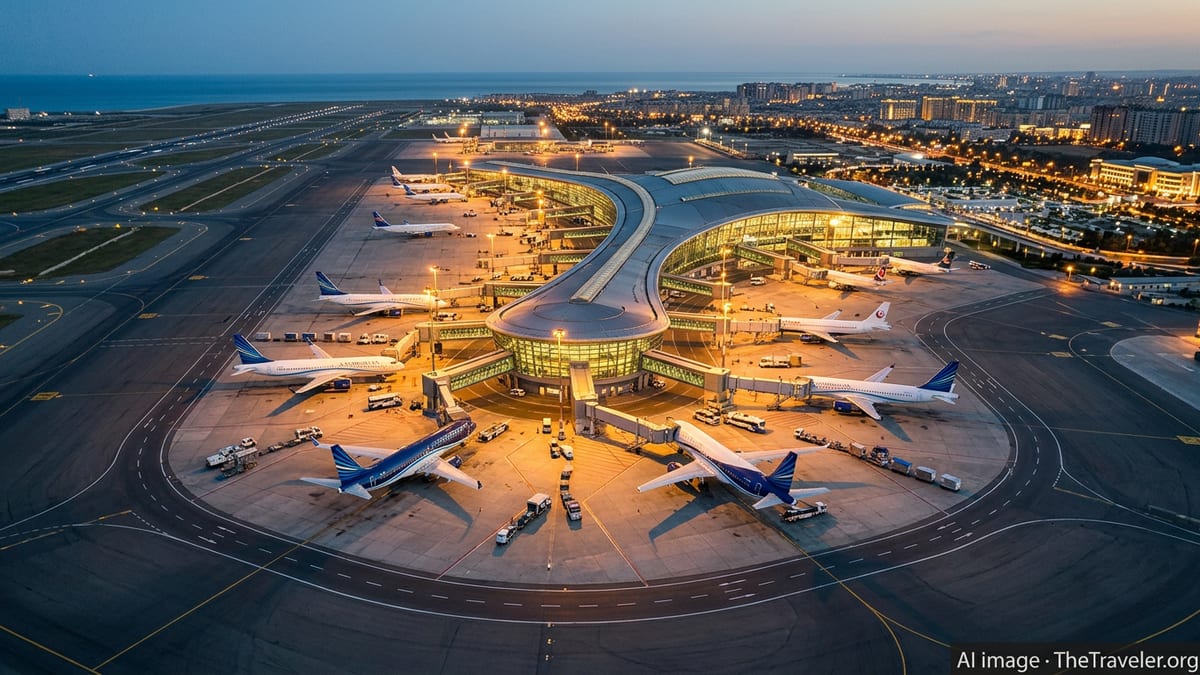
New Routes Put Baku at the Center of Regional Flows
Recent schedule changes and route announcements are underscoring Baku’s emergence as a key junction for travelers moving between Europe, Asia and the Middle East. Publicly available information from Heydar Aliyev International Airport shows that by 2025 flights were being operated to around 75 international destinations by roughly 40 foreign airlines, alongside services from national carrier Azerbaijan Airlines.
New and restored routes have been concentrated on strengthening links with Europe and Central and Eastern Asia. Airport announcements for the 2025 spring and summer season highlighted expanded services to popular leisure and business destinations such as Athens, Rome, Istanbul, Kuwait and Riyadh, together with additional frequencies that aim to smooth connections through Baku. Separate coverage has pointed to the launch of direct services from Baku to cities including Bratislava as part of a wider effort to tie Azerbaijan more closely into Central Europe’s air network.
The strategy is not limited to long-haul or flagship routes. Flight programme changes show that short and medium haul services into the Caucasus, the Gulf and wider Middle East are being layered on top of traditional point to point links. Analysts note that this density of regional connections is critical for Baku’s ambition to function as a transfer point for travelers whose journeys do not begin or end in Azerbaijan, but who pass through the country as part of multi leg itineraries.
Industry observers state that these moves build on Azerbaijan’s position along some of the busiest corridors between Europe and Asia, with international carriers already using the airspace above the country as a preferred path when alternatives are constrained. Adding more physical services to the ground network is seen as the logical next step in turning that geographic advantage into measurable tourism gains.
Tourism Agencies Align Marketing With Air Growth
Tourism bodies in Azerbaijan are closely linking their international outreach to the pattern of new and expanded air services. Information issued by the State Tourism Agency shows that the number of visitors arriving from Central Asian markets reached more than 180,000 in 2024, an increase of around one third compared with the previous year. Officials have attributed a portion of this growth to the build up of direct flights operated by carriers such as Azerbaijan Airlines, Air Astana, FlyArystan and Uzbekistan Airways on routes connecting Baku with Almaty, Astana, Aktau, Bishkek, Tashkent and Dushanbe.
Similar efforts are underway further east. Tourism promotion campaigns in South Korea have been timed to coincide with seasonal direct flights between Baku and Seoul, operated by Azerbaijan Airlines. Public data indicates that in the first ten months of 2024, arrivals from South Korea almost doubled year on year, a trend that sector specialists connect to improved non stop access and targeted marketing around culture, nature and events in Azerbaijan.
Partnerships with airlines are being used as a vehicle to co promote destinations and experiences beyond the capital. Authorities have highlighted multi city itineraries that link Baku with regions such as Karabakh, Shusha and the Caspian coast, positioning air arrivals as the first step in wider exploration. With more direct routes in place, tourism planners argue that Azerbaijan can pitch itself as a standalone holiday destination rather than a stopover, while still benefiting from transfer traffic.
Market observers say this alignment of aviation and tourism strategies reflects a broader shift across the region, in which countries are treating air connectivity as a core element of destination competitiveness. For Azerbaijan, the current phase of route expansion is emerging as a test of how quickly new capacity can be translated into sustained visitor flows and higher spending.
Regional Airports Join the Connectivity Push
While Baku remains the primary international gateway, regional airports are moving into sharper focus as Azerbaijan widens its skies. Airport announcements for the 2025 spring summer schedule indicated an increase in flights from secondary airports around the country, along with new seasonal and charter services designed to deliver visitors closer to resort areas and mountain destinations.
Gabala, in particular, has been positioned as a low cost and leisure oriented entry point. Earlier seasons saw the launch of direct services from Abu Dhabi by a budget carrier, opening a new channel for tourists from the United Arab Emirates and beyond. Aviation enthusiasts and local commentators have pointed to Gabala’s potential as a future base for more low fare operations, which could diversify Azerbaijan’s airline mix and appeal to price sensitive travelers from the Gulf, Europe and South Asia.
In the liberated territories, airport development is being framed as both a practical connectivity measure and a symbol of reconstruction. New facilities such as Fuzuli International Airport, described in official materials as a gateway to Karabakh and surrounding regions, are intended to shorten access times for visitors interested in heritage, nature and emerging eco tourism products. Although commercial traffic is still developing, sector analysts see these airports as long term anchors for regional tourism economies.
Together, the strengthening of Baku and the gradual activation of regional gateways suggest a multi node aviation strategy. Instead of channelling all visitor flows through a single hub, Azerbaijan appears to be laying the groundwork for a network in which different airports serve distinct segments, from business and conferences to ski trips, spa stays and rural escapes.
Passenger Numbers Climb as Capacity Expands
Traffic statistics from Heydar Aliyev International Airport and the national carrier provide a numerical backdrop to Azerbaijan’s connectivity plans. Airport reporting indicates that Baku handled approximately 7.5 million passengers in 2024, a figure that marked one of the highest totals in its history and reflected strong post pandemic recovery. Subsequent updates have highlighted continued growth into 2025, with the aviation sector described as experiencing sustainable expansion and new forms of international recognition.
Figures for Azerbaijan Airlines show parallel momentum. The carrier transported more than 4 million passengers in 2025, according to data shared by the airport operator and the company’s parent holding. The airline notes that it now operates to more than 50 destinations and has received regional awards for service quality, which industry analysts say can reinforce the country’s image among potential visitors choosing between competing hubs.
Beyond sheer numbers, the distribution of passengers is shifting. The rise in travelers from Central Asia, South Korea and selected Gulf markets suggests that Azerbaijan’s visitor base is diversifying beyond traditional source countries in Russia and neighboring states. Tourism strategists interpret this as a sign that new routes are not only attracting first time visitors but also encouraging repeat trips from regional markets that value short flight times and visa facilitation.
However, sector publications also point to structural challenges. Business reports have highlighted the impact of landing fees and airport charges on the ability of foreign carriers to add capacity or launch budget friendly services. Industry groups have recommended further reforms to pricing policies and incentive schemes if Azerbaijan aims to compete aggressively with other hubs across the Caucasus and wider Middle Corridor.
Connectivity as a Cornerstone of Future Tourism Strategy
Azerbaijan’s widening air links are unfolding against a broader backdrop of transport initiatives that position the country as a bridge between regions. Policy papers and regional analyses describe Azerbaijan as a critical segment along east west trade and travel corridors, with aviation now joining ports, rail lines and highways as strategic tools for economic diversification.
Within tourism, the emphasis on air connectivity is expected to shape product development in the years ahead. Planners are focusing on themes that align with new and prospective routes, from city breaks and medical tourism for visitors arriving on short haul flights, to extended cultural and nature itineraries targeting long haul markets such as East Asia. New attractions and hospitality investments are increasingly evaluated on their proximity to international airports and the ease with which tour operators can integrate them into air based packages.
Observers note that the next phase of growth will likely be determined by how effectively Azerbaijan can balance aviation expansion with sustainability and service quality. Maintaining efficient ground handling, minimising congestion and ensuring seamless transfers are seen as essential if Baku and the regional airports are to keep pace with rising passenger volumes. For now, the trajectory of new routes and rising visitor numbers suggests that opening the skies wider is becoming one of Azerbaijan’s most significant moves in its evolving tourism story.