


Suvarnabhumi Airport is the main international gateway to Thailand, and for many travelers it can feel intense on arrival or departure: long walks, big crowds, new digital forms, and strict rules on liquids, visas, and duty free goods. With a bit of preparation, however, the process through security, immigration, and customs is usually smooth and predictable. This guide walks you step by step through what really happens at Suvarnabhumi in 2026, using concrete examples to help you avoid delays, fines, or stressful surprises.
Get the latest updates straight to your inbox!
Understanding the Layout and Typical Passenger Flow
Suvarnabhumi is a large hub airport with multiple concourses feeding into central immigration and security zones. On arrival, everyone is funneled from the gates through a series of moving walkways and corridors down to the main immigration hall. It is not unusual to walk 10 to 15 minutes from a distant gate, especially if you land at the newer satellite terminal used by several long‑haul carriers. On departure, all passengers eventually converge on the main security and outbound immigration checkpoints on the fourth floor of the terminal.
The key to staying calm is to know the order of formalities. On arrival you go: aircraft to immigration, then baggage claim, then customs, then landside transport. On departure the flow is reversed: airline check‑in and hold baggage drop first, then outbound security, then outbound immigration, then you enter the airside departures area with shops and boarding gates. Keeping this sequence in mind helps you understand why certain documents are checked at each stage and where delays are most likely to occur.
Time of day has a major impact on queues. Early afternoon and late evening waves of long‑haul arrivals from Europe and East Asia can create 30 to 60 minute waits at immigration, while late morning or mid‑afternoon arrivals might breeze through in 15 minutes. Similarly, very early morning departures around 06:00 to 08:00 and late‑night red‑eyes often see heavier security and immigration crowds. When booking flights or planning connections at Suvarnabhumi, aim for at least a 2.5 to 3 hour window for international transfers and longer if you must change airlines and recheck bags.
Signage inside the airport is generally clear and in English as well as Thai. Overhead signs distinguish between Transfers, Immigration, and Baggage Claim. If you have a through‑ticket connection and your bags are checked to your final destination, you will usually follow “Transfer” signs and may go through a separate security or immigration process inside the transit area, whereas point‑to‑point arrivals follow “Immigration” and “Baggage Claim.” When in doubt, ask an airline or airport staff member before leaving the secure transit area; going landside by mistake can mean having to clear immigration and security again.
Security Screening: What Really Happens at Suvarnabhumi
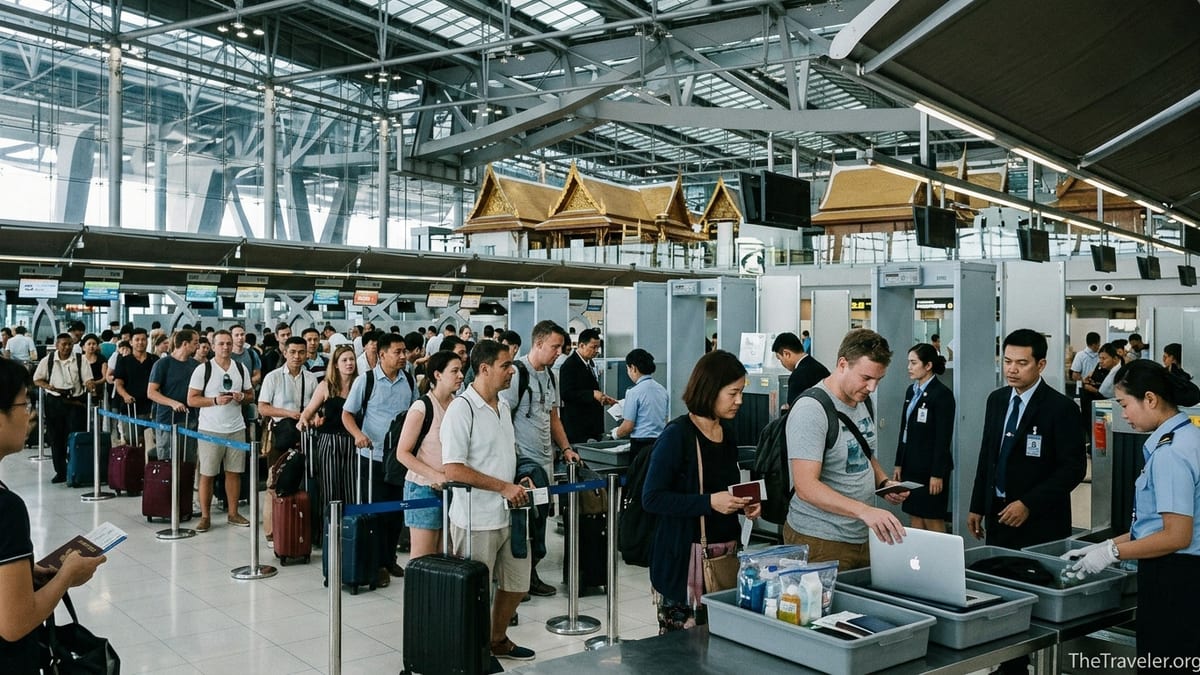
Security at Suvarnabhumi follows international standards with some local nuances. For departing passengers, the main checkpoint after check‑in uses walk‑through metal detectors or body scanners plus x‑ray screening for all cabin baggage. Security officers expect you to remove laptops and larger electronics from your bag, place them in separate trays, and empty your pockets of coins, keys, and mobile phones. Power banks must travel in carry‑on luggage only, and staff do occasionally pull bags aside where they see multiple batteries or unusual electronics shapes.
Liquids, aerosols, and gels are subject to the widely used 100 millilitre rule for carry‑on luggage. Suvarnabhumi applies this quite strictly. Each container must be no larger than 100 millilitres and all must fit inside a transparent resealable plastic bag of up to about one litre. For example, a 150 millilitre bottle of sunscreen that is half full can still be confiscated because the container itself exceeds 100 millilitres. Local specialties like curry pastes, chili sauces, and coconut‑based desserts are often treated as liquids or semi‑liquids and are regularly removed from hand luggage if the container is larger than allowed, even if bought in town before your flight.
If you buy drinks or duty free liquids inside the airport, the rules depend on where and when you bought them. A 600 millilitre bottle of water purchased before security will be taken away at the checkpoint, but the same size bottle bought airside near your gate is typically allowed on board unless your airline imposes extra restrictions. Duty free spirits and perfumes bought airside or on board that are over 100 millilitres must be sealed in a tamper‑evident duty free bag with a same‑day receipt. This is particularly important if you are connecting through another airport on the same itinerary; for example, a traveler flying Paris to Bangkok to Sydney with a 1 litre bottle of whisky from Bangkok duty free should keep it sealed and present it during any further transit screenings.
Security staff in Thailand usually explain issues politely but firmly. If an item is prohibited, you will normally be given a choice between discarding it or, if time permits and the item is valuable, returning to the check‑in area to place it in checked baggage. In practice, many travelers decide to forfeit inexpensive toiletries or food products rather than risk missing their flight. To reduce friction, pack all non‑essential liquids over 100 millilitres in checked luggage and keep electronics and power banks easy to remove from your cabin bag.
Arrival Immigration: Documents, Queues, and Common Pitfalls
On arrival, immigration is the first serious checkpoint you meet after leaving the aircraft. Queues can vary enormously, from almost no wait late at night on a quiet day to more than an hour when multiple wide‑body flights arrive together. Large electronic signs above each immigration lane indicate whether it is for Thai nationals, ASEAN passport holders, visa‑exempt visitors, or other categories such as diplomatic or crew. Foreign tourists normally follow the “Foreign Passport” or “Visa on Arrival” lanes, depending on their nationality and whether they already hold a visa.
Thailand has gradually moved from paper arrival forms to digital pre‑arrival systems. In practice, airlines and immigration staff now focus on three things: your valid passport, your visa or visa exemption eligibility, and your recent travel/biographic details stored electronically. Many visitors complete a digital arrival card before flying, either through airline apps or Thailand‑linked platforms promoted in pre‑departure emails. For example, a traveler from Germany flying on a major carrier may be prompted to fill in their accommodation address, contact details, and flight number online within 72 hours of travel. At Suvarnabhumi, immigration officers can then pull this information up on their screens, reducing the amount of questioning at the desk.
When you reach the counter, you will be asked to present your passport, remove hats or large headphones, and briefly lower masks or face coverings so the officer can compare your face to the passport photo. Officers typically check that you have a confirmed outbound ticket within the permitted stay period, adequate remaining passport validity, and an accommodation address in Thailand, even if it is just your first hotel booking. Travelers who cannot show proof of onward travel or a place to stay have occasionally been taken aside for additional questioning and in rare cases refused entry, so keeping printed or easily accessible digital confirmations is wise.
Real‑world examples show how much this matters. A backpacker arriving from Kuala Lumpur with only a one‑way ticket and vague plans to “decide later” on their next destination reported being asked for bank statements on their phone to prove funds and being cautioned that next time they might be refused entry. By contrast, a family from Australia with return flights three weeks later and a clear hotel itinerary passed immigration in less than two minutes once they reached the desk. Preparation does not guarantee speed, because you are still subject to queue length and random checks, but it dramatically reduces the chance of problems.
Departure Immigration: Timing, Exit Stamps, and Overstay Risks
Outbound immigration at Suvarnabhumi sits immediately after the main security checkpoint. After your cabin bags are screened, you join lines for departure immigration where officers stamp you out of Thailand. For most visitors this is straightforward, but poor timing or visa issues can create major stress. Airlines serving Suvarnabhumi generally recommend arriving at the airport at least three hours before an international flight and more at peak periods or if you need to claim VAT refunds or drop off oversize baggage before check‑in.
The core checks at the outbound desk are simple: officers look at your passport, verify your entry stamp or digital record, confirm that you have not overstayed, and capture a facial image or briefly scan fingerprints depending on the lane. Overstays are taken seriously. Even one extra day beyond your permitted stay can lead to a fine on departure, and longer or repeated overstays can trigger entry bans. For example, a traveler who inadvertently stayed four extra days after their exemption expired reported paying a noticeable fine at the airport and being warned that a future overstay could lead to a multi‑year ban from Thailand.
Lines for departure immigration can back up quickly when several large flights leave close together, particularly late at night to Europe and the Middle East. There have been real reports of travelers who reached security only 60 minutes before departure, then faced 25 minutes at security and another 30 minutes at immigration, leaving them sprinting for their gate during final boarding calls. To avoid this, aim to complete check‑in at least 2.5 hours before departure and to be joining the security queue no later than 90 minutes before your scheduled flight time.
Some passengers qualify for dedicated fast track lanes at Suvarnabhumi through premium cabin tickets, elite frequent flyer status, or pre‑arranged meet‑and‑assist services. For example, a business class ticket on a major Middle Eastern or Asian carrier often lists “Fast Track” on the boarding pass, allowing access to shorter security and immigration lines. Separately, paid fast track services meet you at the aircraft door on arrival or at the curb on departure, escort you through priority queues, and help with baggage and customs. These services do not override Thai immigration or customs regulations but can substantially shorten wait times, which is particularly valuable for tight connections or travelers with mobility challenges.
Customs on Arrival: Green Channel, Red Channel, and What You Can Bring
After collecting your luggage on arrival you walk toward the customs area, where you choose between the green channel for “Nothing to declare” and the red channel for “Goods to declare.” Thailand’s duty free allowances are typical for the region but enforced consistently. Each adult passenger may bring in a limited quantity of tobacco products, such as up to around 200 cigarettes or an equivalent amount of other tobacco. For alcohol the usual allowance is roughly one litre of spirits or wine per person. Gifts, souvenirs, and personal items are allowed up to a value threshold quoted in Thai baht; in simple terms, a typical visitor bringing a normal suitcase of clothes, a laptop, a phone, a camera, and a few mid‑priced souvenirs will not attract attention.
Exceeding those limits can lead to confiscation, fines, or both. A common real‑world example is travelers returning from duty free shops with multiple cartons of cigarettes or several large bottles of spirits. At Suvarnabhumi, customs officers periodically pull aside passengers whose luggage x‑rays clearly show commercial quantities of tobacco or alcohol. In such cases, officers may calculate duty and penalties on the excess or require the passenger to abandon the extra goods. A traveler arriving from a neighbouring country with three cartons of cigarettes, for instance, may be allowed to keep one carton within the allowance and forced to surrender or pay duty on the remaining two.
Beyond alcohol and tobacco, Thai customs is strict on prohibited and restricted items. Illegal drugs, unlicensed firearms, certain categories of knives, counterfeit goods, and obscene material can lead to arrest and prosecution. Some everyday items also fall under restrictions: certain prescription medicines, herbal products, seeds, plants, and animal products may require prior permits or health certificates. In practice, ordinary travelers bringing a few boxes of legally prescribed medicine for personal use, accompanied by a doctor’s letter and original packaging, do not encounter problems, while those carrying bulk quantities or substances banned in Thailand risk serious consequences.
Food products are an area where many tourists are uncertain. Packaged snacks, tea, coffee, and most commercially sealed sweets generally pass without issue, and it is common to see passengers arriving with boxes of chocolates or regional snacks to give friends in Bangkok. Raw or fresh meat, large quantities of dairy, and some fresh fruits and plants are more problematic and may be confiscated or require inspection. If you are carrying unusual foods or agricultural products, it is safer to declare them in the red channel and let customs decide; voluntarily declaring items usually leads to a more lenient outcome than having them discovered on x‑ray.
Transit and Transfer: Staying Airside Versus Entering Thailand
Suvarnabhumi functions as a major transit hub, so many passengers never officially enter Thailand but simply connect to another international flight. If your itinerary is on a single ticket and your bags are checked through to your final destination, you will normally follow “Transfer” signs after disembarking, pass a security screening inside the transit zone, and proceed to your next gate without visiting immigration. For instance, a passenger flying London to Bangkok to Phuket on one ticket with a full‑service airline will usually clear immigration in Bangkok only once before the domestic connection, while a passenger on London to Bangkok to Singapore through‑ticketed with bags checked to Singapore may remain fully airside.
Problems arise when separate tickets or terminal changes are involved. Consider a traveler arriving from Tokyo into Suvarnabhumi on a low‑cost carrier with a later, separately booked flight from Bangkok to Siem Reap. Because the second airline will not have access to the first airline’s baggage system, the passenger must collect their checked luggage in Bangkok, clear immigration into Thailand, go through customs, then check in again for the onward flight and clear security and departure immigration a second time. In this case, a connection of at least four to five hours is advisable to provide a buffer for delays and long queues.
Domestic transfers after an international arrival work slightly differently. If both flights are on the same ticket and airline group, bags are often tagged through to the domestic destination, and you may see signs for “Domestic Transfer” that guide you through a combined process. You still pass immigration at Suvarnabhumi, because that is your point of entry into Thailand, but your checked luggage may be automatically routed to the domestic belt for re‑loading. Airline staff at the boarding gate of your first flight can usually confirm whether you must pick up your bags in Bangkok or not, and this is worth checking before you land to avoid confusion.
Long layovers in Suvarnabhumi also raise the question of whether to stay airside or enter Bangkok. For a same‑ticket international to international connection of six hours or less, many travelers choose to remain in the terminal, especially if they have lounge access. For longer layovers, it can be tempting to go into the city using the Airport Rail Link. If you do, remember that you will need to clear immigration into Thailand, go through customs, and then complete the full outbound security and immigration process when you return. Give yourself generous time margins when re‑entering the airport, particularly during evening rush hours.
Practical Tips to Avoid Delays or Problems
A little forethought goes a long way at Suvarnabhumi. Before you travel, check that your passport has enough remaining validity beyond your intended stay and that it has at least one blank page for entry and exit stamps. Many airlines will refuse boarding if your passport does not meet Thailand’s requirements, and even if you are allowed to fly, immigration officers in Bangkok can still deny entry. Print or download offline copies of your first hotel booking, your outbound ticket, and any key travel insurance or medical documents so you are not dependent on airport Wi‑Fi at the immigration counter.
Pack with security and customs in mind. Place liquids over 100 millilitres, local foods in glass jars, and bulky souvenirs like carved wooden items or metal decorations in checked baggage instead of your carry‑on. Keep a small, clear plastic bag in your cabin bag with travel‑size toiletries, making it easy to place on the x‑ray belt. If you intend to bring back duty free alcohol or cartons of cigarettes, know the approximate allowances and plan to stay within them. For example, rather than buying two one‑litre bottles of whisky for personal use, consider buying one bottle in duty free and one later in Thailand at a supermarket during your trip, consuming or gifting it before you fly home.
At the airport, manage your timing conservatively. For a typical international departure from Suvarnabhumi, arriving at the terminal three hours before your flight provides a comfortable margin for check‑in lines, security, immigration, a short meal, and a walk to a distant gate. Families with young children, travelers requiring wheelchair assistance, or passengers on separate tickets should consider arriving even earlier. On arrival, build in at least 60 to 90 minutes from scheduled landing to reaching the public taxi or train area, and longer if you need to purchase a local SIM, exchange money, or resolve baggage issues.
Finally, remember that Thai officials at security, immigration, and customs are used to dealing with nervous or confused tourists. Remaining polite, patient, and cooperative usually leads to the best possible outcome within the rules. If you are unsure whether something needs to be declared, ask an officer or use the red channel. If you realize you have overstayed by a small number of days, be upfront at departure and prepared to pay the appropriate fine. Transparency and a calm attitude will not erase mistakes, but they often make the difference between a minor inconvenience and a trip‑altering problem.
FAQ
Q1. How long does it usually take to clear arrival immigration at Suvarnabhumi?
At quiet times you might clear immigration in 15 to 20 minutes once you reach the hall, but during peak periods when several wide‑body flights land together it can stretch to 45 to 60 minutes or more. Plan on around one hour from leaving the aircraft to reaching baggage claim, and longer if you have not completed any digital arrival forms in advance.
Q2. What are the liquid rules for carry‑on bags at Bangkok Suvarnabhumi?
Liquids, aerosols, and gels in cabin baggage must be in containers of 100 millilitres or less, all fitting in a clear resealable plastic bag of about one litre. The limit is per container, not by how full it looks, so a 200 millilitre bottle that is half empty can still be taken. Larger liquid items should go in checked luggage, and duty free liquids over 100 millilitres must be in sealed tamper‑evident bags with the same‑day receipt.
Q3. How much alcohol and cigarettes can I bring into Thailand through Suvarnabhumi?
The standard allowance for adults is roughly one litre of alcoholic beverages and up to around 200 cigarettes or an equivalent amount of other tobacco products for personal use. Bringing more than that risks confiscation and possible fines at customs. If you are carrying extra cartons or bottles, it is safer to declare them in the red channel and let customs decide the duty or whether they must be surrendered.
Q4. Do I still need to fill out a paper arrival card for Thailand?
Thailand has been phasing in digital systems in place of the old paper arrival card, and many airlines now collect key data electronically before you fly. In practice, most visitors arriving at Suvarnabhumi in 2026 are not asked to hand over a paper arrival form, but you should follow any instructions from your airline and be ready to provide your accommodation address and onward travel details at the immigration desk.
Q5. What happens if I overstay my visa and depart from Suvarnabhumi?
If you overstay by even a single day, you can be fined when you depart, and the fine increases with the length of overstay up to a maximum cap. Longer or repeated overstays can result in bans on re‑entering Thailand for a period of years. If you realize you have stayed beyond your permitted time, arrive at the airport early, be honest with immigration, and be prepared to pay the fine before passing through outbound immigration.
Q6. Can I stay airside during a long connection without clearing immigration?
If your flights are on a single ticket and your luggage is checked through to your final destination, you can normally follow “Transfer” signs and remain airside, going only through transit security. If you booked separate tickets or need to change terminals or airlines that do not interline bags, you will usually have to clear immigration, collect your bags, clear customs, and then check in again for your next flight.
Q7. Are power banks and electronics allowed in checked baggage at Suvarnabhumi?
Power banks and loose lithium batteries are not allowed in checked baggage and must be carried in your cabin bag. Laptops, tablets, cameras, and other standard electronics may go either in checked or carry‑on luggage, but anything containing large lithium batteries is safer and often required to be in your carry‑on so it can be removed for security screening and managed more safely during the flight.
Q8. How early should I arrive at Suvarnabhumi for an international flight?
Aim to arrive at the terminal at least three hours before a standard international departure, and earlier during holiday periods, on weekends, or if you are traveling with children or have special needs. This allows time for possible queues at airline check‑in, security, and outbound immigration, as well as the sometimes long walk to distant gates. For separate‑ticket connections, build in at least four hours between flights.
Q9. What should I do if I am unsure whether something needs to be declared at customs?
If you are carrying items that might exceed duty free allowances or fall into restricted categories, it is safest to use the red channel and declare them. Customs officers may decide that your goods are within personal allowances and let you pass without payment, calculate and collect duty, or require you to leave the items. Voluntary declaration generally leads to a smoother and more lenient process than having undeclared goods discovered on x‑ray.
Q10. Are there fast track options for security and immigration at Suvarnabhumi?
Yes. Many business and first class tickets, as well as some elite frequent flyer tiers, include access to fast track security and immigration lanes. In addition, several companies sell meet‑and‑assist services that escort you via priority lines on arrival or departure. These services cannot change Thai laws or waive checks, but they can significantly reduce waiting times at busy hours.