


Bangkok Suvarnabhumi Airport is the main international gateway to Thailand and one of Southeast Asia’s busiest hubs. Its glass and steel terminal is impressive, but the size and crowds can overwhelm first-time visitors. This guide pulls together the most current, on-the-ground information so you know exactly what to expect at BKK in 2026, with concrete tips on transport, arrivals, departures, money, SIM cards, and making tight connections.
Get the latest updates straight to your inbox!
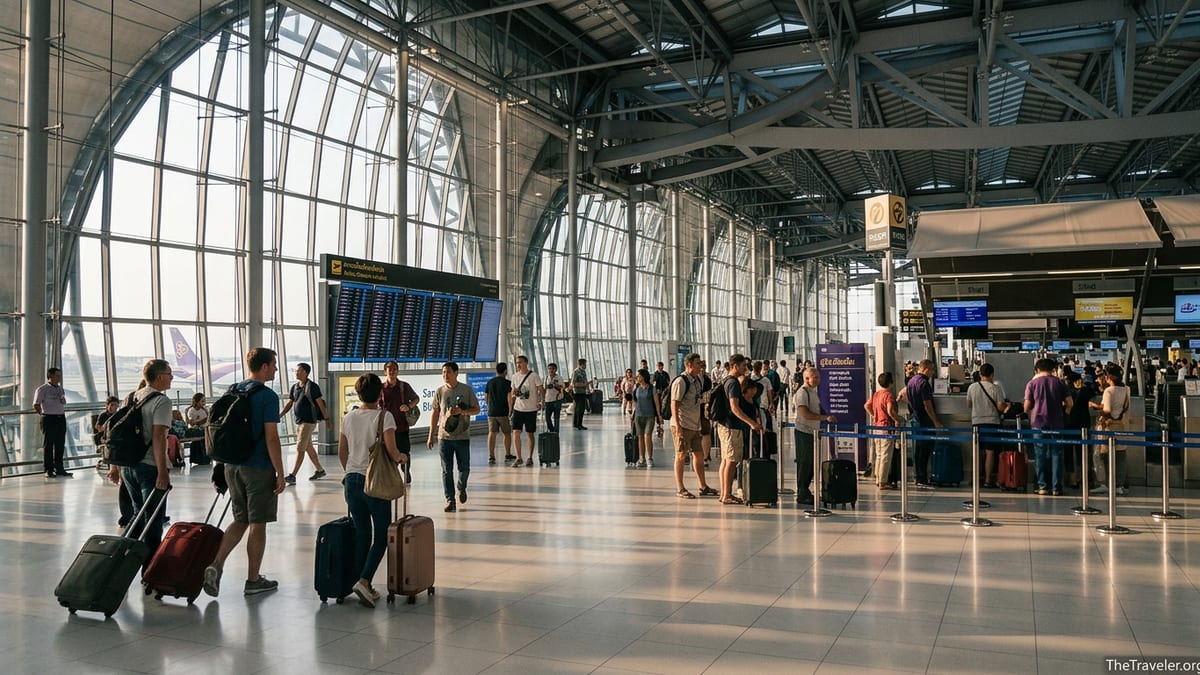
Getting Your Bearings at Suvarnabhumi
Suvarnabhumi Airport (code BKK) sits about 25 kilometers east of central Bangkok and handles tens of millions of passengers each year. The main terminal is a single huge building with multiple concourses plus a newer satellite terminal called SAT-1, which has added more gates and walking distance. International and domestic flights share the overall complex, so you may arrive on an international concourse and depart from a different pier or from SAT-1.
Arrivals are on the lower levels and departures are on the upper levels. After landing, you usually face a 10 to 20 minute walk from your gate to immigration, sometimes longer if your flight uses a remote gate and bus transfer. Long connecting corridors, glass walls, and overhead signs in Thai and English make navigation straightforward, but the scale surprises many visitors, so factor walking time into any tight connections.
The public transport area, Airport Rail Link station, and official taxi stands are reached from the lowest levels. If you are meeting a driver from a hotel or transfer company, they usually wait on Level 2 (Arrivals) near specific gate numbers, holding printed signs. It helps to agree in advance which door to meet at, for example “Gate 4 on Level 2,” to avoid wandering the busy arrivals hall.
Free airport Wi-Fi is available throughout the terminal, typically requiring a simple registration with your name and email. Speeds vary, but it is usually good enough for messaging apps and ride-hailing. Many travelers use it immediately after landing to order a Grab or Bolt car or to message their hotel about arrival time.
Arrivals, Immigration, and Baggage Claim
When you land at Suvarnabhumi on an international flight, follow the “Immigration / Passport Control” signs. Expect long queues at busy times such as early morning (around 4:00 to 7:00) and late evening (roughly 21:00 to midnight), when long-haul flights from Europe, the Middle East, and East Asia arrive within a short window. At these peaks, it can easily take 45 to 90 minutes to clear immigration, while off-peak midday arrivals might pass through in 15 to 30 minutes.
Make sure you have your passport, completed arrival information if required, and hotel address ready before you reach the counter. Thailand currently uses an electronic arrival card system, and many travelers are asked to complete a digital form rather than a paper TM.6 card, but requirements can vary slightly by airline and time, so it is safest to check during your flight and follow the cabin crew’s instructions. Immigration officers often ask for a rough itinerary or proof of onward travel, so having your return ticket on your phone can speed things up.
After immigration, you pass through a brief customs area where bags may be scanned at random, though most travelers simply walk through the “Nothing to Declare” channel. Baggage claim is directly after passport control, with large overhead screens showing carousel numbers by flight. It is common for baggage to be on the belt already if you faced a long immigration queue, so check the screens and move directly to your belt.
If your luggage is delayed or damaged, airline baggage offices are located beside the carousels. For example, major carriers such as Thai Airways, Emirates, Qatar Airways, and Singapore Airlines have clearly marked lost baggage counters here. File a report before you exit through customs, as it is much harder to resolve missing luggage once you leave the secure area.
Transport Into Bangkok: Trains, Taxis, and Transfers
Once you enter the arrivals hall, your next priority is getting into the city. The three most common options are the Airport Rail Link train, official metered taxis, and pre-arranged private transfers or ride-hailing apps. Your choice depends on your destination, time of day, budget, and how much luggage you have.
The Airport Rail Link (ARL) is usually the fastest and most predictable choice during rush hour. The City Line connects Suvarnabhumi to Phaya Thai station in central Bangkok in about 26 to 30 minutes, with stops such as Makkasan, Ramkhamhaeng, and Hua Mak on the way. Trains generally run from around 5:30 to midnight, and fares are inexpensive, typically in the range of about 15 to 45 baht depending on distance. For example, most visitors heading to the Sukhumvit or Siam areas will ride to Phaya Thai and then change onto the BTS Skytrain for a few more stops.
To reach the ARL, follow signs for “Airport Rail Link” down to the basement level. You can buy single-journey tokens from machines that accept coins and small banknotes, or from ticket counters. If you plan to use Bangkok’s rail system extensively, it can be convenient to pick up a stored-value card such as a Rabbit card once you reach a BTS station, though these are not sold directly at the ARL station itself. Travelers with large suitcases sometimes find the train crowded during commuter peaks between about 7:30 and 9:30 in the morning and 17:00 and 19:30 in the evening.
Official metered taxis are located on the first floor (Level 1). You join a machine-controlled queue where you press a button and receive a slip with a bay number, then walk to the assigned taxi stand. There is a fixed airport surcharge added to the metered fare, and you pay any expressway tolls on top. A typical metered ride to central Sukhumvit or Silom off-peak might cost around 300 to 400 baht including tolls and surcharge, but during heavy traffic the meter can climb higher. Ignore anyone inside the terminal who approaches you offering a taxi at a “special price”; these informal drivers tend to overcharge.
Ride-hailing apps such as Grab and Bolt operate at Suvarnabhumi and can be cheaper or more comfortable depending on promotions and vehicle type. Many hotels also arrange private transfers, which might cost in the region of 1,000 to 1,600 baht for a sedan or van, often with an English-speaking driver holding a sign in the arrivals hall. This is a popular option for families or late-night arrivals who want a simple door-to-door service to areas like the Old Town, Thonglor, or riverside hotels.
Domestic Connections, Transfers, and Layovers
Suvarnabhumi is a common hub for onward flights within Thailand and around Asia. If your itinerary is on a single ticket, such as London to Bangkok to Chiang Mai with the same airline group, you will usually stay airside and follow “Transfer” signs, passing through a security check before entering the departures area again. Your checked bags are tagged through to your final destination and do not need to be collected. Even then, you should still allow at least 1.5 to 2 hours between flights because of the long walking distances, possible queues at security, and the time required to reach faraway gates in SAT-1.
If you booked separate tickets, for example flying into Bangkok with a low-cost carrier and then connecting to Siem Reap or Luang Prabang with another airline, you are effectively doing a self-transfer. In that case you must clear immigration, collect your luggage, exit into the public area, then go upstairs to departures to check in again for your onward flight. This process can easily take two or more hours, and during busy periods three to four hours is a safer buffer. Travelers who tried to self-connect in under 90 minutes at BKK frequently report missing flights due to immigration queues and baggage delays.
For domestic flights from Suvarnabhumi to popular Thai destinations such as Phuket, Chiang Mai, Krabi, and Ko Samui, check which airport your domestic airline uses before booking. Full-service airlines like Thai Airways and Bangkok Airways operate mainly from Suvarnabhumi, while many low-cost carriers such as AirAsia and Nok Air use Don Mueang (DMK), which is across town. If you arrive at Suvarnabhumi and depart from Don Mueang, you must factor in at least 1.5 to 2 hours of road travel between the two airports, plus time for check-in.
On long layovers of 6 to 10 hours, some travelers choose to leave the airport for a quick taste of the city. You can take the Airport Rail Link to Phaya Thai, connect to the BTS, and explore malls around Siam or markets near Victory Monument, then return to the airport a few hours before your onward flight. Remember you must clear immigration and customs to exit and go through all formalities again to re-enter, so keep enough margin to avoid stressful sprints back to the gate.
Departures, Check-in, and Security
For international departures from Suvarnabhumi, it is sensible to arrive at the airport about three hours before your scheduled departure time, especially for long-haul flights to Europe, North America, or Australia. During holiday peaks such as Songkran in April, Christmas, and New Year, some travelers prefer to add another half hour. For domestic flights, two hours is usually sufficient, though early morning bank of departures can be busy.
The departures hall on Level 4 is organized by check-in zones designated by letters. Large flight information boards show which zone handles your airline. For instance, Thai Airways long-haul flights might use a different zone from low-cost carriers or regional airlines. Check-in desks typically open around three hours before departure, and some airlines operate dedicated premium counters for business class and elite status passengers, which can significantly shorten queuing time.
Once you have checked in and dropped your luggage, you proceed to outbound immigration and then security. Many travelers find outbound immigration at Suvarnabhumi faster than arrivals, but queues of 20 to 40 minutes are not unusual during evening peaks. Electronic passport gates are sometimes available for certain nationalities, but not consistently, so it is best not to rely on them. After passport control, you pass through centralized security screening before entering the main departures concourse lined with shops and eateries.
Unlike some airports where each gate has its own security, at Suvarnabhumi you generally clear security once before entering the airside area and then have full access to restaurants, toilets, and shops up until boarding. This means you can comfortably have a last bowl of tom yum or a coffee before walking to your gate. Boarding for international flights usually starts around 40 to 50 minutes before departure, but if your flight leaves from a far end of a pier or from SAT-1, the walk can take 15 to 20 minutes, so time your move accordingly.
Money, SIM Cards, Food, and Facilities
After baggage claim and customs, you enter a bright arrivals hall filled with currency exchange counters, mobile phone operators, convenience stores, and fast food. Exchange rates at airport counters are usually less favorable than in central Bangkok money changers, but they are convenient if you need immediate cash for transport. Many visitors withdraw baht directly from ATMs instead; machines from major Thai banks such as Bangkok Bank, Krungsri, and Kasikornbank are widely available in the terminal. Remember that foreign card withdrawals often incur both a Thai bank fee and a fee from your home bank.
SIM cards and eSIM activation services are offered at several official mobile operator booths, commonly including AIS, TrueMove H, and DTAC. Typical tourist packages might offer around 15 to 50 GB of data for 8 to 15 days at prices in the region of a few hundred baht. Staff are used to setting up phones for foreign visitors and can usually install the SIM, activate it, and make sure you have working data before you leave the counter. If you prefer eSIM, many travelers now purchase tourist eSIMs online in advance and simply scan a QR code upon landing, using airport Wi-Fi.
Food options at Suvarnabhumi range from grab-and-go chains to Thai-style food courts. In the public arrivals area, you find international fast food brands, cafés, and a few mid-range restaurants, as well as a 24-hour convenience store where you can pick up snacks, drinks, and basic toiletries. Inside departures, especially after security, there are more choices including noodle shops, coffee chains, bakeries, Thai curry stalls, and sit-down restaurants. Prices are higher than in the city; for instance, a basic noodle soup might cost twice what you would pay at a street stall downtown.
The airport provides a variety of additional facilities that can be handy on long travel days. These include prayer rooms, children’s play corners, smoking rooms, and medical clinics. There are also several pay-per-use lounges accessible via day passes or premium credit cards, which offer showers, buffet food, and quiet seating. A few hotels near the airport, and at least one connected via short shuttle or walkway, sell daytime packages for travelers wanting a proper bed and shower between flights, often popular with passengers arriving from overnight long-haul sectors.
Sleeping, Lounges, and Staying Comfortable
For late-night arrivals, early-morning departures, or long layovers, Suvarnabhumi can be made reasonably comfortable with a bit of planning. Inside the secure area, some travelers stretch out on padded benches in quieter corners of the concourses. While not officially a sleeping zone, overnight dozing on seats is common, especially near gates far from the central shopping area where lighting is slightly dimmer and announcements less frequent.
If you prefer more privacy or need real rest, pay-per-use lounges are a good option. Several international lounge brands operate at Suvarnabhumi, typically offering comfortable armchairs, hot and cold buffets, alcoholic and soft drinks, Wi-Fi, showers, and sometimes nap rooms. Entry can be purchased for a few hours for a fee, or you may access them through airline status, business-class tickets, or cards such as Priority Pass. For example, a passenger on a regional economy ticket might buy a three-hour lounge access before an overnight flight to Europe to shower and eat before boarding.
Travelers with daytime layovers of 6 hours or more often choose an airport hotel. A number of properties within a short shuttle ride of the terminal offer “day room” rates, so you can sleep for half a day, shower, and repack in peace. This is particularly appreciated by travelers who land from a long overnight flight and continue onwards to places like Phuket or Chiang Rai the same evening.
Regardless of where you rest, pack a light jacket or scarf for the airport. Suvarnabhumi’s air conditioning can be strong, and many travelers find the seating areas noticeably cooler than the tropical heat outside. Noise-cancelling headphones or earplugs also make a surprising difference when you are trying to nap near busy gate areas.
Practical Safety, Scams, and Local Etiquette
Suvarnabhumi is generally considered a safe airport by international standards, but typical big-hub precautions apply. Keep your passport, wallet, and phone in secure pockets or a money belt, particularly in crowded immigration queues, on escalators, or when juggling luggage on the Airport Rail Link. Pickpocketing is not rampant but can happen where people are distracted and tired.
The most common annoyance is informal taxi touts in the arrivals hall who offer “cheap” or “VIP” rides into the city. These drivers often quote flat fares that end up more expensive than a metered taxi, and they may pressure you once you engage. The easiest way to avoid problems is to walk directly past them and use the official taxi counters on Level 1 or a reputable app like Grab or Bolt. If someone insists the meter is “broken” and tries to negotiate a high fixed fare, politely decline and choose another car.
Airport staff usually speak at least basic English, and signage is clear in both Thai and English. When dealing with officials such as immigration officers and security personnel, a calm and polite attitude goes a long way, even if language barriers arise. Thailand places cultural importance on patience and avoiding open confrontation, so raising your voice or displaying anger is unlikely to help and can occasionally cause problems.
Smoking is allowed only in designated smoking rooms, and vaping rules are strict in Thailand. Do not attempt to vape inside the terminal or in toilets, and avoid bringing large quantities of vaping equipment, as regulations have been actively enforced on some visitors. Alcohol purchases from duty free must also respect Thai customs limits; staff at the shops can advise you on current allowances if you plan to bring spirits or wine into the country.
The Takeaway
Bangkok Suvarnabhumi Airport is big, busy, and occasionally chaotic, but with a little preparation it becomes a manageable and even enjoyable part of your trip. Knowing in advance how long immigration can take, where to find the Airport Rail Link, and what to expect from metered taxis or ride-hailing services removes much of the stress from arrival.
For onward travel, build generous buffers for self-transfers, pay attention to which Bangkok airport your domestic or regional flight uses, and consider an airport hotel or lounge if you face a long layover. Simple habits like using official transport queues, organizing your documents before passport control, and arranging a Thai SIM or eSIM on arrival help your journey into the city run smoothly.
By treating Suvarnabhumi as your first taste of modern Bangkok rather than an obstacle, you can turn arrival and departure days into surprisingly efficient parts of your itinerary. Armed with realistic expectations and the practical tips in this guide, you will step off the plane in 2026 ready to navigate Thailand’s main gateway with confidence.
FAQ
Q1. How long does it take to get from Suvarnabhumi Airport to central Bangkok?
In typical conditions, the Airport Rail Link takes around 30 minutes to reach Phaya Thai station. A metered taxi to areas like Sukhumvit or Silom usually takes 30 to 60 minutes depending on traffic.
Q2. How early should I arrive at Suvarnabhumi before my flight?
For international flights, aim to arrive about three hours before departure, and during busy holiday periods consider 3.5 hours. For domestic flights, two hours is generally enough.
Q3. Is the Airport Rail Link safe for solo travelers with luggage?
Yes, the Airport Rail Link is widely used by locals and visitors and is considered safe. Just keep your bags close, avoid blocking doors, and try to travel outside the most crowded rush-hour windows if you have large suitcases.
Q4. Are there 24-hour food options at Suvarnabhumi?
There are usually some 24-hour convenience stores and fast-food outlets in the public areas, and at least a few cafés and snack spots stay open overnight airside. Selection is more limited in the small hours, so do not rely on full restaurant service at 3 a.m.
Q5. Where can I buy a Thai SIM card at the airport?
Official booths from major operators such as AIS, TrueMove H, and DTAC are located in the arrivals hall. Staff can sell and activate tourist SIMs on the spot, and many travelers are online within minutes of landing.
Q6. Is it worth booking an airport hotel for a long layover?
If your layover is longer than about six hours and you value sleep and a shower, an airport hotel or nearby hotel with a day-rate can be worthwhile. For shorter layovers, a lounge with showers and comfortable seating is often enough.
Q7. Can I easily transfer between Suvarnabhumi and Don Mueang airports?
It is possible, but you should allow at least 1.5 to 2 hours for the road journey plus time for check-in and security. Because of unpredictable traffic, many travelers avoid tight connections that involve switching airports.
Q8. Are there lockers or luggage storage facilities at Suvarnabhumi?
Yes, there are paid luggage storage services in the terminal where you can leave bags for a few hours or several days. Prices vary by bag size and duration, but many travelers use them when taking short side trips from Bangkok.
Q9. What is the best way to avoid taxi scams at Suvarnabhumi?
Use the official taxi queue on Level 1 or reputable ride-hailing apps. Insist that the driver uses the meter, and if they refuse or quote a high flat fare, simply decline and choose another car.
Q10. Is Suvarnabhumi a good airport for families with children?
Yes, although it is large and busy, the airport has family bathrooms, some play areas, and plenty of food choices. A lightweight stroller helps with the long walks, and many families appreciate using a lounge or nearby hotel on long travel days.