


Bangkok’s Suvarnabhumi Airport can feel overwhelming on a first visit. It is vast, busy at almost any hour, and packed with competing services vying for a share of your jet-lagged attention. With a little preparation, though, you can move from the aircraft door to a taxi or train into the city with surprising ease, avoid common scams, and start your Thailand trip on the right foot.
Get the latest updates straight to your inbox!
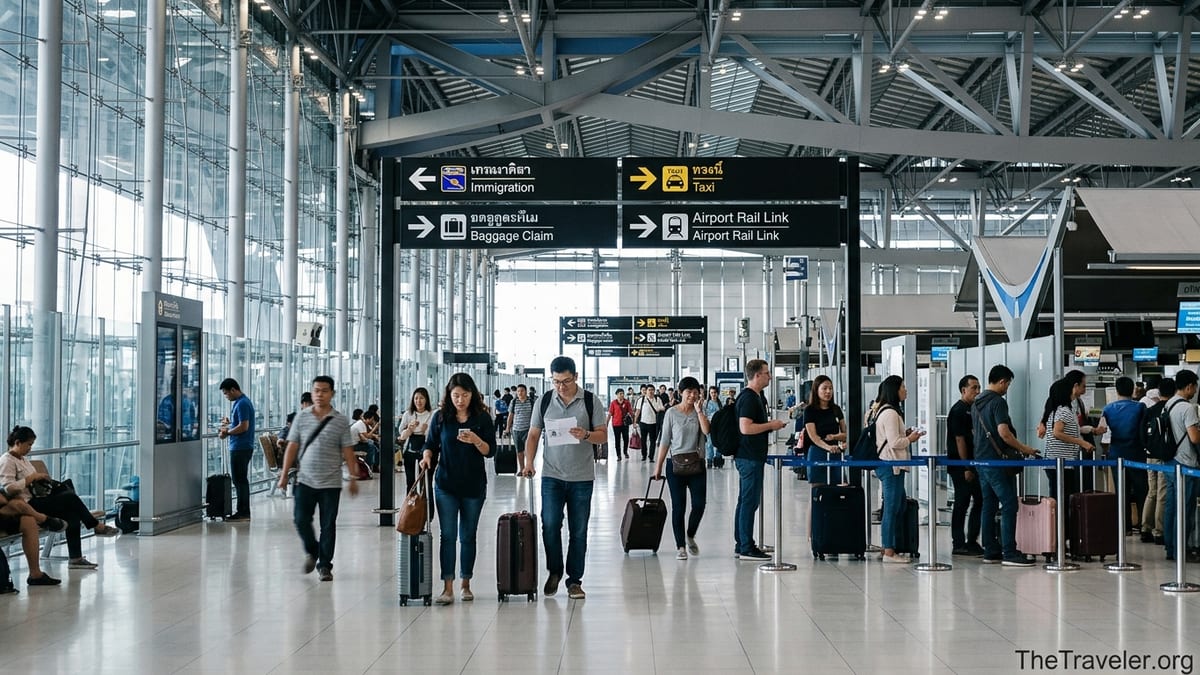
Understanding Suvarnabhumi’s Layout Before You Land
Suvarnabhumi (airport code BKK) is Thailand’s main international gateway and one of Asia’s busiest hubs, handling more than 60 million passengers a year. The airport is built around a single large terminal with multiple concourses, which means that while you may walk a fair distance from gate to immigration, you will not need to switch buildings or shuttle trains. For most international arrivals, you will disembark on an upper level and follow signs down toward immigration and baggage claim.
As you leave the aircraft, look immediately for the large purple and white “Immigration” signs overhead. Ignore anyone who approaches you in the corridors offering “fast track” or “VIP” services unless it is a staff member from your airline who was clearly assisting you at the gate. First-time travelers sometimes follow strangers thinking they are walking toward immigration only to be diverted to expensive services or unnecessary detours. Staying within the main passenger flow and following the signs keeps you in the secure, monitored areas of the terminal.
The arrivals level where you will exit customs is officially Level 2. Above you on Level 4 are the check-in counters and departures, while below you are Levels 1 and B, where you will find most public ground transport, including the Airport Rail Link and public taxis. Before your trip, it is worth opening an image of the Suvarnabhumi terminal map and saving a screenshot to your phone so you can quickly confirm where you are relative to exits, ATMs and transport options when you arrive.
Wayfinding signage is generally clear and in both Thai and English, but distances can still be long. If you have mobility concerns, request wheelchair assistance through your airline before travel so a staff member can meet you at the aircraft door and escort you through immigration and baggage claim.
Beating Immigration Lines and Clearing Customs Smoothly
Immigration is often the slowest part of arrival at Suvarnabhumi. At peak times, especially late evening and early morning when multiple long-haul flights land together, queues can easily stretch to 45 to 90 minutes. Recent travelers have reported particularly heavy queues on weekend late-morning arrivals. Whenever possible, choose flights that land mid-afternoon or late at night to reduce waiting time, and avoid tight onward connections from Bangkok if you are arriving on a separate ticket.
To speed things up, complete any arrival forms given to you on the plane before landing and keep them with your passport, along with your hotel address and return or onward flight details. Officers sometimes ask first-time visitors to show proof of onward travel or a rough itinerary. Have your accommodation confirmation and onward ticket ready on your phone. If you are eligible for Thailand’s e-visa or visa exemption and have already applied, keep screenshots of approval emails as backup, even though they should already be in the system.
When you reach the immigration hall, follow signs for “Foreign Passports.” Queue etiquette is straightforward: lines are clearly roped off, and staff will direct you. You will be photographed and your fingerprints may be taken. Be prepared to remove hats and masks briefly. This part is usually quick once you reach the desk; most of the waiting happens in line. If you are connecting onward on a separate ticket and must clear immigration, plan at least three to four hours between flights to cover potential queues, baggage claim, customs and a second round of security upstairs.
Customs in Thailand is usually a formality for most tourists. After collecting your luggage from the carousel, you will walk through either the green channel (Nothing to Declare) or red channel (Goods to Declare). Random bag checks do occur, particularly for travelers arriving with several large suitcases or bulky boxes, but many passengers simply walk through without being stopped. Do not agree to carry packages for strangers and avoid bringing restricted items like e-cigarettes, which have drawn increased scrutiny in recent years.
Money, SIM Cards and Essential Errands on Arrival
Once you exit customs onto the public arrivals level, you will find yourself in a long hall filled with currency exchange kiosks, mobile operator booths, convenience stores and hotel counters. This is where many first-time travelers make costly decisions, often exchanging too much money at poor rates or signing up for expensive tourist SIM packages without comparing options.
If you need Thai baht immediately for a taxi or snack, exchanging a small amount at the airport is fine, but rates at many front-row counters are less favorable than what you can find in the city. A practical strategy is to change or withdraw only enough for your first day, for example 2,000 to 3,000 baht, then use better-rate exchange shops in central areas like Sukhumvit, Silom or Pratunam later. ATMs from major Thai banks are located throughout the arrivals hall and on the lower levels; they usually charge a fixed withdrawal fee for foreign cards, so it is more economical to withdraw a larger amount less frequently.
For mobile data, you will see branded counters from Thai operators such as AIS, True and dtac situated along the arrivals corridor. They offer tourist SIM packages that typically include generous data allowances (for example 50 to 100 GB) for 7 to 30 days, with some including local call minutes. Prices are often in the range of 200 to 800 baht depending on validity and data. Staff can install the SIM and configure your phone within minutes. If your phone supports eSIM, ask whether a digital option is available so you can avoid swapping physical cards. Compare at least two counters before committing, as promotions change frequently and staff are usually happy to tell you the exact data and hotspot limits included.
There are several 24-hour convenience stores such as 7-Eleven or similar Thai chains on the lower levels, particularly near the Airport Rail Link entrance and bus stops. These are excellent places to pick up bottled water, a local transit card if available, or a small snack before heading into the city. Prices are similar to city branches, and buying here helps you avoid overpriced drinks at some hotel minibars later that evening.
Getting from Suvarnabhumi to the City: Train, Taxi or Ride-hailing
The three most practical ways for a first-time visitor to reach central Bangkok from Suvarnabhumi are the Airport Rail Link, official metered taxis and app-based ride-hailing services. Your best choice depends on your arrival time, luggage, budget and hotel location.
The Airport Rail Link, located on Basement Level B, operates roughly from 6:00 to midnight. Trains run every 10 minutes during weekday peak hours and every 15 minutes off-peak, and the ride from the airport to Phaya Thai station in the city takes about 30 minutes. Fares are inexpensive, generally around 15 to 45 baht depending on distance. You can buy paper tokens from machines or tap contactless bank cards directly at the gates, which is particularly convenient if you arrive with no local cash. The train connects to the BTS Skytrain at Phaya Thai and to the MRT at Makkasan or nearby Phetchaburi, which makes it ideal if your hotel is near those lines and you are traveling with light baggage.
For door-to-door convenience, especially if you are tired or carrying large suitcases, the official metered taxis are often the easiest option. Follow signs that say “Public Taxi” down to Level 1, where you will take a queue ticket from a machine and wait at the designated bay number. By regulation, the meter should start at 35 baht, with per-kilometer charges increasing based on distance. There is a fixed 50 baht airport surcharge added at the end of the ride, and if you choose to use the expressways into town, you will also pay tolls directly at booths, typically around 25 to 75 baht per toll gate. In normal traffic, a metered ride to most central areas such as Sukhumvit, Silom or Sathorn usually works out to roughly 250 to 450 baht inclusive of surcharge and tolls, and takes about 30 to 45 minutes.
App-based services like Grab or Bolt operate in Bangkok and are popular with travelers who prefer seeing an upfront estimated fare and route. To use them, you will need mobile data and an account set up in advance. Many travelers order a car from the departures level or a designated ride-hailing pick-up area after purchasing a SIM card. At busy times, surge pricing or longer waits can make ride-hailing more expensive than a metered taxi, but it offers the advantage of in-app navigation and payment, plus the ability to share your live route with friends or family back home.
If you are on a tight budget and not in a rush, public buses from Level 1 serve various districts on the outskirts of central Bangkok and connect to the BTS and MRT. Fares are low compared with taxis, but routes are less intuitive for first-time visitors and can be crowded, especially during commuter hours. Consider them only if you are comfortable with local buses or traveling with Thai-speaking companions.
How to Avoid Common Scams and Overpaying for Transport
Most arrivals at Suvarnabhumi are uneventful, but because it is the main gateway to Thailand, it also attracts touts and a minority of dishonest drivers. The first rule is simple: ignore anyone who approaches you inside the terminal asking if you need a taxi or offering a “special price.” Official public taxis are accessed only via the signed queue system on Level 1. Touts may quote you flat fares three or four times higher than the metered rate for central Bangkok, sometimes in the 800 to 1,200 baht range for journeys that normally cost less than 500 baht including tolls.
When you reach your taxi, check that the driver resets the meter to 35 baht as you depart. If the driver insists on a flat rate that is clearly higher than the approximate cost you expect, politely decline and return to the queue to request another taxi. You can say firmly but calmly “meter please” before you get in. If you feel pressured, note the taxi’s license plate and bay number. Airport staff stationed near the queue machines can mediate disputes, and taxi drivers found to be overcharging risk losing access to airport jobs, which is a strong deterrent.
Another tactic involves “broken meters” or scenic routes. If a driver claims the meter is broken after departure and proposes an inflated flat fare, you are within your rights to ask to return to the terminal or negotiate a more reasonable rate. Having a maps app open on your phone, even offline, lets you see whether you are being taken on an unnecessarily long route. For a ride to popular areas like Asok, Nana or Sala Daeng, the journey should generally not exceed an hour in heavy traffic, and in moderate conditions you may arrive in 30 to 40 minutes using expressways.
Currency exchange and SIM card upselling are subtler forms of overpaying. Staff might suggest higher-priced data plans or talk you into exchanging a large amount of cash on the grounds that “the rate is the same everywhere.” It usually is not. A grounded approach is to purchase a mid-range SIM plan that comfortably covers your expected data use and top up later if needed, and to convert only the cash necessary for immediate expenses, using competitive exchangers in town once you are rested and have had time to compare.
Layovers, Late-Night Arrivals and Sleeping at the Airport
Many flights from Europe, Australia and the Middle East arrive in Bangkok late at night or early in the morning. Suvarnabhumi remains active 24 hours a day, but services thin out in the small hours. If you land after midnight, the Airport Rail Link will not be running, so your realistic options become taxis, ride-hailing or, for some travelers with short layovers, remaining airside until your next flight.
For overnight layovers where you cannot stay airside, there are several hotels near the airport, including a full-service hotel physically connected to the terminal building via a short walkway, and numerous budget hotels reachable by short taxi rides that cost around 100 to 200 baht. These can be more comfortable and often cheaper than attempting to sleep in the terminal. If you choose to remain at the airport, be aware that while there are some padded benches and quieter corners in upper levels and less busy concourses, they can fill up quickly during late-night banks of flights.
Showers and day rooms are available in some airport lounges and in a few landside facilities for a fee. If you have lounge access through a frequent flyer program or credit card, it can be worth using it for a few hours to shower, eat and rest between flights rather than venturing into the city during a short layover. Travelers with layovers of six hours or more during daytime often choose to clear immigration, leave their larger luggage at left-luggage counters inside the terminal and take the Airport Rail Link into town for a meal or quick sightseeing before returning.
When planning your onward journey, remember that queues for immigration and security can be unpredictable. For early-morning departures, many locals aim to arrive at the airport about three hours before international flights and at least ninety minutes before domestic ones. If you are traveling during major holidays or local festivals, building in an extra half-hour or more is a sensible precaution, particularly if you need to check bags.
Staying Connected, Comfortable and Safe Inside the Terminal
Suvarnabhumi is modern and generally comfortable, but first-time visitors are sometimes surprised by long walking distances and limited seating at certain gates. Wearing comfortable shoes and packing a light jacket or sweater in your hand luggage can make a noticeable difference, as terminal air conditioning can feel cool after stepping off a hot street or connecting flight from a tropical destination.
Free Wi-Fi is available in the terminal for short sessions, usually requiring a basic registration with your passport number or email. This is often enough to message family upon arrival, check your hotel reservation, or order a ride-hailing car before you purchase a local SIM. Charging points are scattered around departure gates and some seating areas, although they can be busy, so carrying a small power bank is wise if you rely heavily on your phone for navigation and translation.
Food options in the public areas range from fast-food chains and coffee shops to Thai food courts where you can try inexpensive dishes such as pad thai, rice with basil chicken, or noodle soups for prices similar to those in the city. Most outlets accept both cash and cards, though some smaller vendors may prefer cash or require you to load value onto a card specific to that food court. If you are sensitive to spice or have dietary restrictions, use translation apps to show common phrases such as “no spicy,” “vegetarian” or “no peanuts” to staff.
In terms of safety, Suvarnabhumi has a visible security presence, and violent crime inside the terminal is extremely rare. The main risks are petty theft and simple forgetfulness, such as leaving bags unattended. Always keep valuables such as passports, wallets and electronics either on your person or in a bag you can see. If you misplace something, airport information counters can direct you to the appropriate lost and found desk, and cleaning staff and security officers are accustomed to helping travelers locate missing items when possible.
The Takeaway
For many travelers, Bangkok’s Suvarnabhumi Airport is the first real contact with Southeast Asia. Its size, crowds and constant motion can feel disorienting after a long flight, but experience shows that a little knowledge goes a long way. Understanding the layout, preparing for immigration lines, handling your first money and SIM card decisions wisely, and choosing the right way into the city can turn a potentially stressful arrival into a smooth, almost routine process.
If you remember a few core principles, you will already be ahead of most first-time visitors: follow the official signs, not strangers; use the regulated taxi queue or the Airport Rail Link instead of unsolicited offers; keep a modest amount of cash ready and your key documents accessible; and allow more time than you think you need for queues and transfers. With those basics in place, Suvarnabhumi becomes far less intimidating and far more like what it is at heart: a gateway to some of the world’s most rewarding urban and island experiences.
FAQ
Q1. How long does it usually take to get through Suvarnabhumi Airport on arrival?
For most travelers, expect around 45 to 90 minutes from landing to exiting customs, depending on immigration queues, baggage delivery and the time of day.
Q2. Is the Airport Rail Link better than taking a taxi into Bangkok?
The Airport Rail Link is faster and cheaper, especially during rush hour and if you have light luggage. Taxis are more convenient for door-to-door travel or late-night arrivals when the train is not running.
Q3. How much should a taxi from Suvarnabhumi to central Bangkok cost?
In normal traffic, official metered taxis to areas like Sukhumvit or Silom typically cost around 250 to 450 baht including the 50 baht airport surcharge and expressway tolls.
Q4. Are late-night arrivals at Suvarnabhumi safe?
Yes, the terminal is staffed and active 24 hours a day. While services are reduced overnight, official taxis still operate and the airport is generally considered safe with normal precautions.
Q5. Can I get a local SIM card at the airport, and is it more expensive?
Major Thai operators sell tourist SIM or eSIM packages at arrival halls. Prices are slightly higher than some in-city shops but still reasonable, and installation help makes it convenient after a long flight.
Q6. Should I exchange a lot of money at the airport?
It is usually best to exchange or withdraw only enough for your first day’s expenses and use better-rate exchange booths in the city later, where you can compare rates more easily.
Q7. What is the easiest way to avoid taxi scams at Suvarnabhumi?
Always use the official taxi queue on Level 1, insist that the driver uses the meter, and decline unsolicited offers from touts inside the terminal who propose flat fares.
Q8. How early should I arrive at Suvarnabhumi for departure?
Plan to arrive at least three hours before international flights and around ninety minutes before domestic flights, adding extra time during holidays or peak travel periods.
Q9. Is there luggage storage at Suvarnabhumi for layovers?
Yes, there are paid left-luggage counters inside the terminal where you can store bags for several hours or days, which is useful if you plan a short trip into the city during a layover.
Q10. Can I sleep at Suvarnabhumi Airport during a long layover?
Many travelers sleep at the airport on long layovers, using quieter corners and benches, or by paying for lounge access or nearby hotels connected by short taxi rides.