


More news on this day
Widespread flight cancellations and rolling delays across the Middle East are disrupting travel for hundreds of thousands of passengers as conflict-related airspace closures and damage at key hubs continue to reshape global aviation patterns.
Get the latest news straight to your inbox!
Airspace Closures Push Airlines Onto Narrow Corridors
Publicly available aviation and security briefings indicate that large sections of airspace across Iran and neighboring states remain restricted or closed due to the ongoing regional conflict, forcing airlines to reroute traffic onto a limited number of alternative corridors. Industry analyses describe two main pathways now absorbing much of the displaced traffic: a northern arc via the Caucasus and Central or South Asia, and a southern arc tracking over Egypt and Saudi Arabia.
The loss or restriction of multiple east-west overflight options is adding significant distance and time to many long-haul routes between Europe, Asia, and Africa. Longer tracks require extra fuel and careful payload management, prompting some carriers to cap passenger numbers, block off seats, or add technical stops for refueling. These adjustments, while preserving safety, are contributing to a pattern of cascading delays as aircraft and crew struggle to stay on schedule.
Analysts tracking commercial schedules report that thousands of flights have already been canceled or heavily delayed since the first wave of airspace closures in March 2026, with additional disruptions accumulating as the conflict drags on. Airlines that rely heavily on Middle Eastern overflight rights or hub connections are among the most affected, but carriers in Europe, Asia, and North America are increasingly feeling the knock-on effects.
Aviation risk assessments also highlight increased congestion along the remaining open corridors, where traffic densities have risen sharply. Air traffic flow management restrictions, including in sectors far from the core conflict zone, are further slowing operations and reinforcing the cycle of delay.
Key Gulf Hubs Struggle With Capacity and Damage
Major Gulf airports that typically serve as high-volume transfer points between continents have seen some of the sharpest disruptions. Open-source reporting on the conflict indicates that Dubai International and Abu Dhabi International have both experienced periods of suspended operations and reduced capacity after being affected by missile and drone strikes earlier in the year.
While services have partially resumed at many of these hubs, infrastructure repairs, heightened security procedures, and intermittent airspace restrictions are limiting how quickly full schedules can be restored. Airlines based in the Gulf have canceled or consolidated frequencies on multiple routes, particularly those serving conflict-adjacent destinations or relying on airspace that remains fragile and subject to sudden closure.
Travel advisories issued by governments and multinational organizations in recent months have also led to reduced demand on certain city pairs, prompting additional schedule cuts. In some cases, carriers are operating with reduced frequencies but fuller aircraft, making it difficult for disrupted passengers to secure rebookings within a reasonable time frame.
Regional carriers are attempting to preserve core trunk routes connecting Europe, Asia, and Australasia through their hubs, but they continue to adjust timetables at short notice. This dynamic environment is leaving many travelers unsure whether their itineraries will operate as planned until shortly before departure.
Spillover Effects Across Europe, Africa, and Asia
Although the most visible disruptions are centered on Middle Eastern airports and airspace, performance data and industry monitoring show that the impact now extends well beyond the region. European air traffic management briefings for July 2026 point to additional en-route delays linked to traffic complexity associated with the Middle East crisis, particularly in sectors handling rerouted flows between Europe and Asia.
Countries on the periphery of the conflict-affected area, including Greece and parts of southeastern Europe, are contending with busier skies as airlines divert around closed or high-risk airspace. Reports on network performance note higher average en-route delays in several of these sectors compared with the same period a year earlier, partly attributed to conflict-driven rerouting and the need for more conservative separation and flow-control measures.
Across North and East Africa, where many carriers operate long north-south or transcontinental routes, additional track miles and limited alternate routings are compounding existing capacity and weather challenges. Extended flight times can push crews toward duty-time limits sooner, increasing the likelihood of last-minute cancellations when rotations can no longer be completed legally.
In Asia, some airlines have shifted connecting flows away from Gulf hubs toward alternative gateways in South and Southeast Asia. While this strategy reduces exposure to the most volatile airspace, it also concentrates demand at airports already operating near capacity, generating fresh pockets of delay and longer connection times for travelers.
Passengers Face Long Delays, Rebookings, and Rerouting
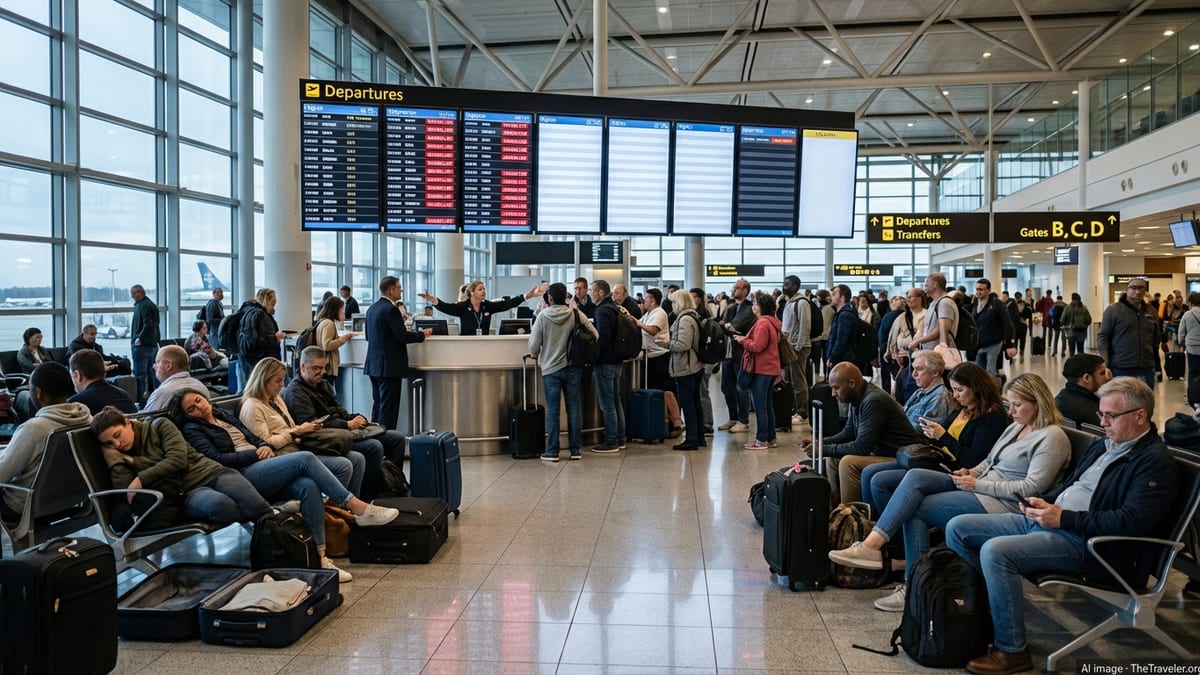
For travelers, the operational complexity behind these disruptions translates into long queues, missed connections, and itineraries that change repeatedly in the days or even hours before departure. Passenger accounts shared across public forums and social platforms describe experiences of overnight airport stays, multiple schedule changes, and last-minute cancellations attributed to airspace restrictions, crew availability, or revised security assessments.
According to published coverage by major news organizations, some travelers attempting to reach or transit the Gulf have opted for lengthy overland detours to alternative airports in Saudi Arabia or Oman when flights have been suspended. Others have abandoned trips entirely after being unable to secure timely rebookings or facing sharply higher fares on unaffected routes.
Travel management companies and corporate travel departments are advising clients to build extended buffers into itineraries that cross the region, allowing extra time for missed connections and schedule alterations. Some are temporarily steering high-priority or mission-critical trips away from Middle Eastern routings altogether, even when it requires significant backtracking or additional stops.
Insurance considerations are also becoming more prominent. Policy wording around war, civil unrest, and government-ordered airspace closures can be restrictive, and publicly available guidance suggests that not all disruption linked to the current conflict is automatically covered. Travelers are being urged to review coverage details carefully before departure and to retain documentation of cancellations and delays.
Airlines Adjust Networks While Monitoring Security Landscape
Airlines are continuing to recalibrate their networks as the security situation evolves, balancing operational safety, regulatory directives, and commercial pressures. Schedule databases and public timetable updates show patterns of capacity reductions on routes transiting the most contested airspace, alongside selective additions on alternative city pairs that can bypass the region.
Some long-haul carriers have introduced seasonal or temporary services that connect Europe and Asia via airports outside the Middle East, effectively recreating pre-Gulf hub routings. These workarounds can be less efficient from a cost perspective but provide options for passengers unwilling or unable to travel via traditional Gulf mega-hubs while disruptions persist.
Aviation analysts note that the conflict is accelerating trends that were already under discussion in the industry, including diversification of connecting hubs and a greater focus on point-to-point flying where demand and aircraft range allow. At the same time, the importance of Middle Eastern hubs to global connectivity means that a full, long-term shift away from the region remains unlikely unless airspace restrictions become significantly more protracted or severe.
For now, network maps, booking data, and publicly available operational updates suggest a highly fluid situation in which flight schedules can change quickly in response to new security assessments. Travelers planning to cross the region in the coming weeks are being encouraged by airlines and travel advisors to monitor their bookings frequently, ensure contact details are up to date, and consider flexible tickets or backup routings where budgets allow.