


If you are planning a Great Smoky Mountains trip, chances are someone has told you that you “have to” drive Cades Cove or Roaring Fork. Both are classic Smokies experiences, both are in Tennessee, and both are easily reachable from Gatlinburg or Townsend. Yet they offer very different feels on the road, from the type of scenery out your windshield to how long you will sit in traffic. This guide compares Cades Cove Loop Road and the Roaring Fork Motor Nature Trail in real-world terms so you can decide which one gives you more of what you want from a Smokies scenic drive.
Get the latest updates straight to your inbox!
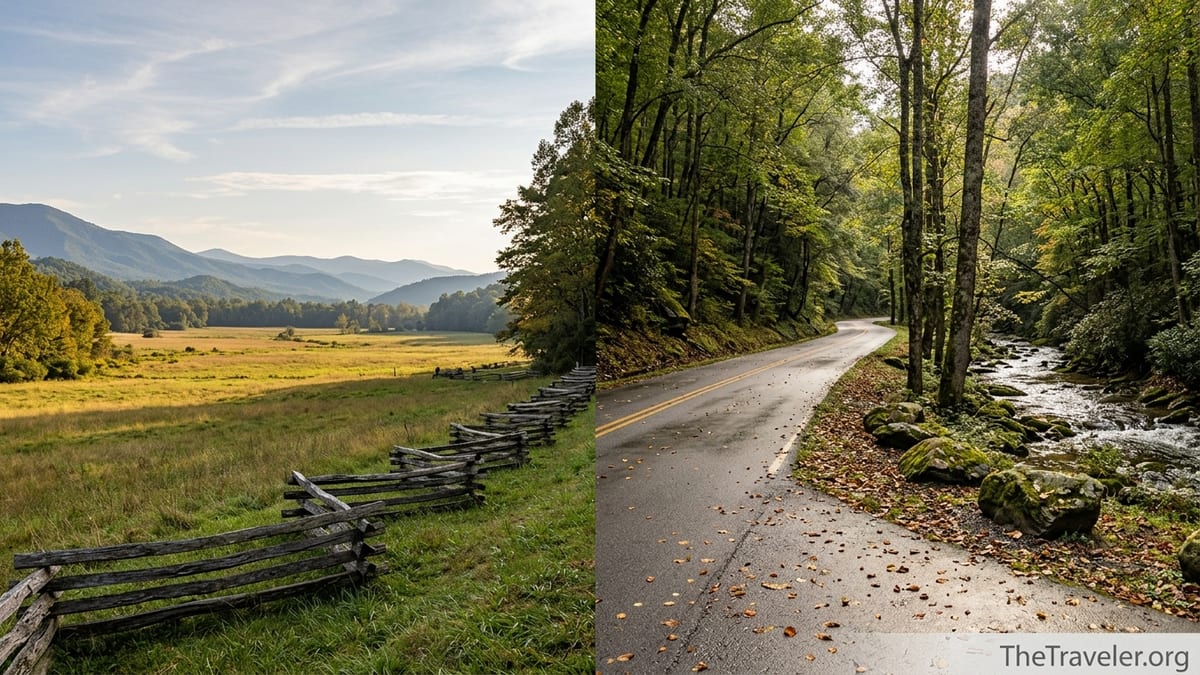
The Basics: Two Very Different Smokies Drives
Cades Cove Loop Road is an 11 mile, one way paved loop through a broad mountain valley on the western side of Great Smoky Mountains National Park. It is the park’s single most popular destination, drawing several million visitors a year, so it feels like its own mini district of the park rather than just a road. Expect wide open pastures ringed by hazy blue ridges, historic churches and cabins set back in meadows, and frequent stops for wildlife watching.
The Roaring Fork Motor Nature Trail is shorter and tighter. This one way paved scenic road leaves directly from Gatlinburg’s back streets and winds about 5.5 to 6.5 miles, depending how you measure the loop, through deep forest along a rushing mountain stream. Instead of big valley views, Roaring Fork gives you mossy boulders, cascades right beside the pavement, and a series of restored mountain homesteads only a few steps from your car.
Both drives sit inside Great Smoky Mountains National Park, which does not charge an entrance fee, but you now need a paid parking tag if you park for more than 15 minutes anywhere in the park. For most visitors that means picking up a daily tag, currently just a few dollars per vehicle, at a visitor center, kiosk, or participating local businesses before you start your drive so you can stop legally at overlooks, churches, or trailheads.
Seasonal access is another basic difference. Cades Cove Loop Road is typically open year round, although winter storms and occasional maintenance can cause temporary closures. Roaring Fork, by contrast, is a classic seasonal road that normally opens in mid April and closes by late November, and it is fully closed in winter. That makes Roaring Fork more of a spring to fall experience, while Cades Cove is a four season destination.
Scenery Showdown: Wide Open Cove vs Intimate Forest
If your dream Smokies photo is a broad field with a split rail fence and smoky blue ridges on the horizon, Cades Cove delivers. The loop circles a flat valley floor where nineteenth century farmers once worked; today, the National Park Service keeps many of those fields open, so you get unobstructed views that are unusual in this heavily forested park. Around sunrise and sunset, morning fog sometimes pools in the cove while the surrounding peaks catch pink light, a prime time for photographers setting up tripods near Sparks Lane or Hyatt Lane.
Roaring Fork offers a very different type of beauty. Here your windshield is filled with tulip poplars, hemlocks, rhododendron, and the white froth of the creek. After a good rain, the sound of water is constant, with side streams and seeps creating mini waterfalls wherever you look. One of the most photographed spots on the road, the Place of a Thousand Drips, is literally at the edge of the pavement, so you can see a veil of water spilling over rock without leaving your car, though there is a pullout if you want to step out for a closer look.
In autumn, both drives shine but in different ways. Cades Cove’s fields turn golden while surrounding ridges glow with oaks and maples, and you can frame barns and churches against the mountains for classic fall postcards. Roaring Fork becomes a tunnel of color, with fallen leaves collecting in potholes and on wet rocks in the creek. If your priority is big mountain vistas and layered ridgelines, Cades Cove has the edge. If you prefer intimate forest scenes, streams, and close-up textures like mossy logs and fungi, Roaring Fork feels richer.
For visitors with limited mobility, both roads offer scenic value right from the vehicle, but Cades Cove’s open meadows make it easier to see wildlife and distant peaks while remaining in the car. Roaring Fork’s highlights are sometimes just around a bend or slightly below road level, so brief stops at pullouts provide a better experience than simply driving through without stopping.
Wildlife and History: Where the Smokies Come Alive
Cades Cove is one of the best places in the park to see white tailed deer, wild turkey, and, with luck, black bears from the safety of your car. That reputation is well earned. On a peak summer evening, it is not unusual to see several bear jams, where traffic crawls to a halt because someone has spotted a bear grazing in a field or crossing the road. Coyotes, foxes, and a wide variety of birds also frequent the open habitat. Because visibility is so good across the cove, even casual wildlife watchers can spot animals without binoculars.
Roaring Fork has wildlife too, but its dense forest makes animals harder to see. Squirrels, birds, and the occasional deer are common, and there are bears in the area, but you are more likely to hear pileated woodpeckers or catch a flash of a salamander near the stream than to have the sort of broad daylight bear viewing that gives Cades Cove its reputation. If wildlife viewing is your primary goal and you are willing to be patient in traffic, Cades Cove clearly offers more potential.
Historically, both drives are rich, but Cades Cove has more high profile structures. Along the loop you can tour multiple churches with old cemeteries, the Cable Mill historic area with its working gristmill and visitor center, a blacksmith shop in season, plus a string of log cabins like the John Oliver Cabin and the Tipton Place. You can step inside many of them to see hand hewn logs and simple furnishings, giving a tangible sense of nineteenth century Appalachian life. Families often budget at least half a day here specifically to let kids explore multiple buildings.
Roaring Fork’s history is more compact but still fascinating. The Noah Bud Ogle Cabin, barn, and tub mill sit right at the entrance road. Farther along, you can walk short paths to the Jim Bales Place and the Ephraim Bales Cabin, simple mountain homes tucked into small clearings. These stops are less crowded than their Cades Cove counterparts and feel more intimate, with the sound of the stream never far away. If your historical interest leans toward farm complexes and multiple churches, Cades Cove gives you more quantity. If you prefer quieter, more reflective historic sites with fewer people, Roaring Fork may feel more rewarding.
Driving Experience, Traffic, and Time Commitment
The most practical difference between the two drives for many travelers is traffic and how much time you want to spend behind the wheel. On a busy summer Saturday or during October leaf season, it can easily take three hours or more to complete Cades Cove’s 11 mile loop, especially if wildlife is visible near the road. It is common for visitors based in Gatlinburg to spend 45 minutes to an hour simply getting over to the Loop Road via Little River Road, then another several hours driving, stopping, and negotiating congestion.
By contrast, Roaring Fork sits practically inside Gatlinburg. From the main Parkway, you follow Historic Nature Trail Road and Cherokee Orchard Road a short distance uphill before the one way loop begins. Even with stops, many visitors complete the drive in 1.5 to 2 hours. The road is narrow, curvy, and in places feels almost like a lane and a half. There are no buses, RVs, or trailers allowed, which helps limit very slow vehicles, but you should still expect a leisurely pace, especially when parking areas for popular trailheads like Grotto Falls overflow and drivers wait for spots.
If you are not comfortable with steep, tight curves and low stone bridges, Roaring Fork can feel a bit nerve wracking, especially after heavy rain when leaves or gravel on the pavement can be slick. Cades Cove is technically easier driving. The loop is paved, relatively gentle, and wide enough for two vehicles where needed, though the sheer number of cars and frequent stops can test your patience. For first time mountain drivers or families with nervous passengers, Cades Cove usually feels less intimidating behind the wheel, provided you are prepared for long delays.
In practical terms, many visitors treat Cades Cove as a half or full day outing and Roaring Fork as a half day or even late afternoon excursion. If you only have a weekend in Gatlinburg and want time for other attractions like the Gatlinburg SkyLift or aquarium, Roaring Fork’s shorter drive and closer location often fit more neatly into a tight schedule.
Hikes, Picnics, and Side Adventures Along Each Route
Both scenic drives double as trailheads for some of the park’s best hikes, which can tip the scales depending on your interests. From Cades Cove, popular hikes include the trails to Abrams Falls, a roughly 5 mile round trip hike to a picturesque waterfall with a powerful flow, and the Rich Mountain Loop for a more strenuous, less trafficked route to ridge top views. Shorter walks to individual cabins or churches, often just a few minutes from the parking areas, make it easy for families to mix driving with small bursts of activity.
Roaring Fork shines for waterfall and creekside hikes. The trail to Grotto Falls leaves directly from a large parking area along the motor nature trail and leads to a rare walk behind waterfall, about 3 miles round trip, that is especially popular on hot summer days. Trillium Gap Trail also begins here and continues far beyond Grotto Falls toward Mount Le Conte for strong hikers. Other options like the short trail at the Place of a Thousand Drips or the Ogle Place nature trail provide bite sized walks that still feel like you have stepped into the backcountry.
Picnic options differ as well. Cades Cove has a large picnic area with tables and charcoal grills near the loop entrance, plus many fields where families spread blankets for a casual lunch between wildlife stops. Because Roaring Fork is more hemmed in by forest and steep slopes, dedicated picnic facilities are limited, and roadside shoulders can be narrow. Many travelers pick up sandwiches in Gatlinburg, drive Roaring Fork, and then eat back in town or at a larger picnic area such as Chimneys or Metcalf Bottoms on the main park roads.
If you are traveling with kids who need frequent chances to get out of the car, both drives can work, but Cades Cove’s open fields and visitor center area provide more obvious running-around space. Roaring Fork’s trailheads often require crossing the narrow road and walking near moving vehicles, which calls for closer supervision of young children.
Crowds, Seasons, and When Each Drive Shines
The Great Smoky Mountains is the most visited national park in the United States, and both Cades Cove and Roaring Fork reflect that popularity. Summer, fall color season, holiday weekends, and clear weekend days in general are busy. That said, they do not peak in exactly the same way, and understanding those patterns can help you choose.
Cades Cove tends to feel crowded most of the year, with pronounced peaks on Saturdays and during June, July, and October. Midday is often the worst. If you drive the loop at 2 p.m. on a sunny Saturday in October, you should fully expect a long line of vehicles and frequent stop and go traffic, especially if several bears are visible in the fields. Early morning starts, such as entering the loop shortly after sunrise, can dramatically reduce stress and may give you dramatic fog and wildlife activity.
Roaring Fork, being so close to Gatlinburg lodging and cabins, sees heavy use in the middle of the day and early afternoon, particularly when families return from morning hikes in other parts of the park and decide to “fit in a scenic drive.” Parking near Grotto Falls or other trailheads often fills by mid morning in peak season. Starting your loop before 9:30 a.m. or waiting until late afternoon, after many day hikers have left, usually results in a smoother experience. Because the road is seasonal, shoulder periods in April and early November can offer quieter days, though weather is more variable.
Seasonally, Cades Cove’s open fields change character more dramatically. In spring, wildflowers and white dogwood blossoms dot the edges of the meadows. In summer, the grass grows tall and green around the historic buildings. Winter can bring frost and, occasionally, snow that outlines the fences and cabins against bare trees. Roaring Fork’s deep forest means it remains lush and green through much of the warm season. After heavy summer thunderstorms the creek surges, and photographers often time their visits a day after rain to capture saturated colors and high flows without active downpours.
Logistics, Costs, and First Timer Tips
In terms of out of pocket costs, both scenic drives are similar. There is no separate entrance fee beyond the park wide parking tag if you plan to stop. Renting bicycles for Cades Cove vehicle free days, available from local outfitters near Townsend or inside the cove when services are operating, typically runs in the tens of dollars per bike for half day use, comparable to bike rentals in other national park gateway towns. Roaring Fork does not have on site rentals, so your costs there are limited to fuel, parking tag, and whatever food or snacks you bring along.
The new parking tag system is worth planning for. If you stop to walk a trail, explore buildings, or wait for wildlife, you will easily cross the 15 minute threshold in either location, so most travelers should assume they need a tag for the day. You can buy daily tags at Great Smoky Mountains visitor centers like Sugarlands or Cades Cove and at some local businesses near Gatlinburg and Townsend. Having the tag already displayed on your windshield before you enter either loop keeps your day simple and avoids potential fines.
One unique logistical feature of Cades Cove is the weekly vehicle free day during the warm months, when the loop closes to motor vehicles all day on Wednesdays from early May through late September. On those days, pedestrians and cyclists have the road to themselves. That can completely change the experience: instead of idling behind a line of cars, you might be pedaling a rented cruiser bike past fields of deer in the morning light. It does, however, require more effort and planning, and parking at the start of the loop can still fill early.
For both drives, check the official park road status on the day of your visit, especially after storms or in shoulder seasons. Temporary closures for maintenance or fallen trees are not uncommon. Cell service is spotty to nonexistent once you are on either loop, so download maps ahead of time or pick up a paper park newspaper that shows the road layout and points of interest. Pack water and snacks even if you think you will only be out for an hour or two; delays and enticing trailheads have a way of stretching timelines in the Smokies.
So Which Scenic Drive Gives You More?
Whether Cades Cove or Roaring Fork offers “more” depends on what you value most in a scenic drive. If your priorities are open views, frequent wildlife sightings, a large collection of historic buildings, and you do not mind investing a half or full day with potential for long traffic delays, Cades Cove will likely feel like the richer experience. It is the place many visitors picture when they think of pastoral Smoky Mountain scenes, and it lends itself to slower, more immersive exploration with multiple stops.
If, on the other hand, you prefer a shorter time commitment, lush forest, rushing water, and easier access from Gatlinburg, Roaring Fork often feels like the better trade. You may not see bears in a meadow, but you can combine the drive with a hike to a waterfall, take in a handful of historic cabins, and be back in town in time for dinner without spending most of the day in your car. For travelers on a tight schedule or those who do not want to brave Cades Cove’s legendary congestion, Roaring Fork can deliver a satisfying Smokies sampler.
Many repeat visitors eventually do both and then repeat their favorite. Anecdotally, travelers who are serious photographers or wildlife enthusiasts tend to return to Cades Cove, timing visits for sunrise or late evening, while families with small children and people staying in Gatlinburg gravitate to Roaring Fork for its convenience and variety. If your trip budget allows, building both into your itinerary on different days is ideal: one day devoted to the wide open valley, another to the quiet roar of the creek.
If you must choose, use a simple rule of thumb. For big views, history, and bears, pick Cades Cove and go early or on a vehicle free Wednesday if you are willing to bike or walk. For shaded roads, waterfalls, and a taste of the deep woods without a long drive from town, choose Roaring Fork and start early or late in the day to avoid the busiest window.
The Takeaway
Cades Cove and Roaring Fork are not competing versions of the same experience so much as complementary windows into different sides of Great Smoky Mountains National Park. One is broad and social, a valley filled with cars, bicycles, and families exploring churches and fields where wildlife still grazes. The other is narrow and intimate, a ribbon of pavement following a mountain creek past moss covered boulders and quiet homesteads just a stone’s throw from bustling Gatlinburg.
If you arrive expecting both roads to offer the same thing, you risk disappointment. If you see them as two distinct options and match your choice to your time, interests, and tolerance for traffic, either can become a highlight of your Smokies trip. For many travelers, Cades Cove offers more in terms of iconic scenery, wildlife, and historic sights, while Roaring Fork offers more in terms of convenience, deep forest atmosphere, and pairing with a half day waterfall hike.
Whichever you choose, a little planning goes a long way. Pick your time of day carefully, secure a parking tag before you go, bring patience along with your camera, and remember that the slow pace is part of the experience. In the Smokies, even a line of cars can deliver unexpected moments: a bear crossing the road ahead, sunlight filtering through branches over Roaring Fork, or a sudden break in the clouds revealing layers of blue ridges around Cades Cove.
FAQ
Q1. Which drive is better for first time visitors, Cades Cove or Roaring Fork?
For a classic introduction to the park, Cades Cove is usually the better first choice thanks to its open valley views, abundant historic buildings, and higher chance of seeing wildlife from the road.
Q2. How long does it take to drive Cades Cove compared to Roaring Fork?
On a typical busy day, expect Cades Cove to take two to three hours or more with stops, while Roaring Fork often takes around 1.5 to 2 hours including pullouts and short walks.
Q3. Which scenic drive is less crowded?
Neither road is empty in peak seasons, but Roaring Fork is often less congested than Cades Cove, particularly early in the morning, on non holiday weekdays, and in the shoulder months.
Q4. Do I need a parking tag for both Cades Cove and Roaring Fork?
Yes, if you plan to park longer than 15 minutes anywhere in the park, including at overlooks, churches, trailheads, or picnic areas along either drive, you should have a valid parking tag displayed.
Q5. Which drive is better for seeing bears and other wildlife?
Cades Cove is generally better for wildlife viewing, especially deer, turkey, and black bears in the fields, thanks to its open terrain and long sightlines across the valley.
Q6. Is either road suitable for RVs or trailers?
Roaring Fork does not allow RVs, buses, or trailers due to its narrow, winding nature, while standard size RVs can drive Cades Cove, though tight parking and heavy traffic make it less relaxing.
Q7. Which scenic drive is better if I want to include a hike?
If you want a waterfall hike close to Gatlinburg, Roaring Fork pairs well with Grotto Falls or Trillium Gap Trail, while Cades Cove works best with hikes like Abrams Falls or Rich Mountain Loop.
Q8. Are there restrooms and services on these drives?
Cades Cove has restrooms and a visitor center near Cable Mill, along with a large picnic area, while Roaring Fork has more limited facilities and no visitor center directly on the loop.
Q9. When is the best time of day to drive Cades Cove or Roaring Fork?
Early morning or late afternoon typically offer lighter traffic and better light for photography on both drives, while midday tends to be the most crowded and least pleasant.
Q10. If I only have half a day, which drive should I choose?
With only half a day and a base in Gatlinburg, Roaring Fork is often the more efficient choice, while Cades Cove is better reserved for when you can dedicate most of a day to the experience.