


More news on this day
Rail travel across a key north–south corridor in England remained severely disrupted on Saturday after two East Midlands Railway passenger trains collided near Bedford, killing a driver, injuring dozens and triggering a major incident response that is testing emergency planning on one of the country’s busiest lines.
Get the latest news straight to your inbox!
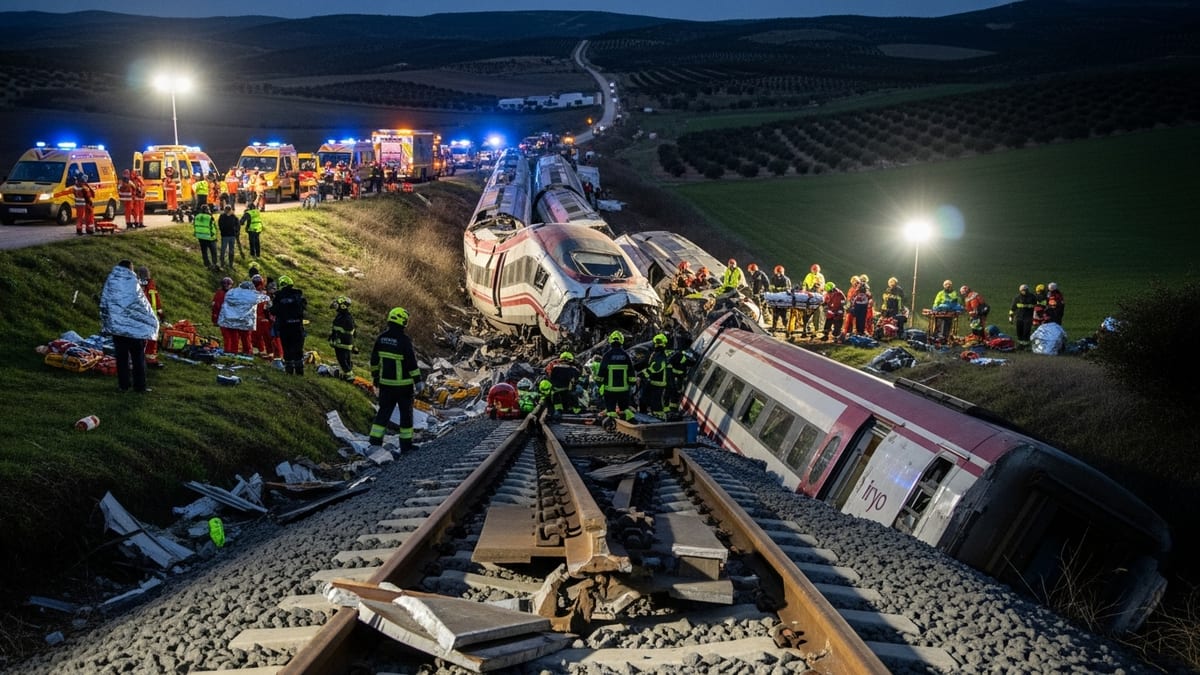
Collision Near Bedford Turns Routine Commute Into Crisis
Publicly available information indicates that the crash occurred late on Friday afternoon, 19 June, on the Midland Main Line just south of Bedford, around 90 kilometres north of central London. Two southbound East Midlands Railway services bound for London St Pancras were involved, with one train reported to have run into the rear of another in the Bedford area.
Coverage from British and international outlets describes the impact as severe, with one of the train drivers confirmed dead and a large number of passengers suffering injuries ranging from minor to critical. Early tallies reported in the British media point to several dozen serious and minor injuries, with rail users describing scenes of damaged carriages, shattered interiors and passengers helping one another to escape.
Reports from the scene describe emergency braking and a sudden jolt rather than a prolonged slowdown, consistent with a rear-end collision on a busy corridor where services run at relatively high speed. Images shared by passengers and local media show at least one modern East Midlands Railway intercity unit, part of the operator’s new Aurora fleet, standing damaged on the line.
Rail tracking data cited in published coverage suggests that one of the London-bound trains had stopped unexpectedly on the approach to Bedford before being struck from behind by a following service. Commentators on specialist rail platforms have pointed to the role of onboard safety systems, but investigators have not yet released a public account of the sequence of technical events.
Major Incident Declared As Emergency Crews Converge
The collision was quickly declared a major incident, prompting a large-scale response from ambulance, fire and police services across Bedfordshire and surrounding counties. Public information released by regional health providers indicates that hospitals in the area moved to emergency footing, with Bedford’s main hospital asking residents to avoid accident and emergency departments unless absolutely necessary so that resources could be focused on casualties from the crash.
According to published summaries from news outlets such as the Associated Press, multiple ambulances, specialist hazardous area response teams and at least one air ambulance were deployed to the scene along the railway south of Bedford. Photos taken from nearby fields and overbridges show long lines of emergency vehicles flanking the tracks while rescue teams work along the length of the trains.
Injured passengers were treated on site before being transferred to hospitals across the region. Accounts shared with broadcasters and on social platforms describe travellers walking along the ballast to reach safe assembly points, some with visible cuts and bruises, others supported by fellow passengers and rescue workers. Portable lighting was later brought in as crews continued operations into the evening.
Officials involved in the emergency planning process have referred to the complexity of responding to a high-casualty incident in an area where access is constrained by railway infrastructure and surrounding farmland. The scale of the response, and the decision to classify the event as a major incident, reflects both the casualty numbers and the importance of the line for regional and national transport.
East Midlands Railway Services Severely Disrupted
The crash has caused substantial disruption across the East Midlands Railway network at the start of a busy summer travel period. Operator updates and network bulletins late on Friday reported that all EMR services between London St Pancras and key cities such as Nottingham, Sheffield and Corby were suspended or heavily curtailed, with trains terminating short of the affected area and replacement road transport put in place where possible.
Published reports note that services on other operators using the same corridor, including commuter and airport-connect routes between Bedford, Luton and London, have also faced cancellations, diversions and extended journey times. With the main line south of Bedford partially blocked, capacity into St Pancras has been dramatically reduced, forcing timetable alterations across a wide geographic area.
Passengers attempting to travel on Friday evening and into Saturday have reported crowded concourses, limited information and long waits for alternative services. Travel advice from rail companies and network planners has urged customers to avoid non-essential journeys on the affected routes and to check for last-minute changes throughout the weekend.
The Bedford collision follows a series of separate disruption events on busy UK rail arteries in recent months, including earlier incidents near Luton and Hitchin that affected both East Midlands Railway and Thameslink operations. While those events were unrelated to Friday’s crash, the combination has renewed attention on how quickly a single failure can reverberate through interconnected passenger and freight networks.
Investigators Focus On Signaling, Safety Systems And New Fleet
Investigations into the cause of the Bedford crash are still in the early stages, but publicly available commentary indicates that attention is centering on signalling systems, train protection technology and operational procedures on the congested approach to London. Rail enthusiasts and industry observers have highlighted suggestions that one train may have come to a standstill because of a safety system intervention before being struck by the following service.
Modern British main line trains are typically equipped with layered protection systems designed to prevent collisions caused by missed signals or excessive speed. These include traditional Automatic Warning System equipment and more advanced train protection technologies on parts of the network. The circumstances of a rear-end crash on a relatively straight, well-signalled section of track are therefore likely to form a central part of the Rail Accident Investigation Branch’s work.
The involvement of East Midlands Railway’s new Aurora intercity fleet is also attracting scrutiny. These trains, introduced to modernise long-distance services from St Pancras, have been the focus of close attention from both passengers and technical specialists since their rollout. While there is no publicly available evidence at this stage linking the design of the trains to the cause of the collision, investigators are expected to examine how the rolling stock performed in terms of crashworthiness and passenger protection.
Comparisons are already being drawn in the media with past rear-end and signalling-related collisions in the United Kingdom and overseas, where inquiries have resulted in significant changes to signalling layouts, driver training and maintenance regimes. Analysts note that any recommendations arising from the Bedford investigation could influence safety practices well beyond the immediate area, including on other high-density intercity corridors.
Passengers, Communities And The Wider Rail Network React
For passengers caught up in the collision, the immediate focus has been on recovery and reconnection with family and friends. Social media posts and televised interviews show travellers describing how a routine Friday journey from cities such as Nottingham and Corby to London turned, within seconds, into a scene of confusion, injury and damaged carriages.
Communities along the Bedford corridor have responded with offers of support, including reports of local residents providing water, blankets and phone charging to stranded passengers. Local authorities have used public information channels to direct concerned relatives toward official helplines and to discourage sightseers from travelling to the crash location, citing the need to keep access routes clear for emergency vehicles.
Across the wider rail industry, the Bedford crash is being viewed as a serious test of emergency preparedness at a time of growing passenger numbers and ongoing investment in new rolling stock and infrastructure. Commentators in specialist rail publications are already asking how incident response, passenger communication and network resilience can be strengthened, particularly on lines that combine intercity, commuter and airport traffic.
As investigators begin the detailed work of reconstructing the events south of Bedford, attention from travellers and the travel trade is likely to remain fixed on how quickly services can be restored and what lessons will be applied across the United Kingdom’s rail network. For now, the section of line that carries thousands of passengers each day stands as the focus of one of the most serious rail emergencies the country has faced in recent years.