


More news on this day
Rail passengers are facing days of altered timetables, diversions and reduced services after a power substation fire disrupted key parts of the network, forcing operators to rewrite schedules at short notice while engineers work to stabilise the electricity supply.
Get the latest news straight to your inbox!
Power failure cascades into network-wide disruption
According to published coverage, the fire broke out at an electrical substation supplying a busy rail corridor, cutting power to signalling and traction equipment and triggering an automatic shutdown of services in the surrounding area. Initial reports indicate that the blaze was contained relatively quickly, but damage to cables and switching gear has had a longer lasting effect on the railway’s ability to run its normal timetable.
Rail infrastructure data shows that substations form a critical node between the wider electricity grid and the overhead lines or third-rail systems that power trains. When one is taken out of service, operators often have to limit the number of trains drawing current at any given time, which in turn reduces how many services can safely operate on affected routes. That technical constraint is now being reflected directly in timetable changes, with off-peak services thinned out and some peak trains retimed or combined.
Network status summaries published since the incident describe a pattern of disruption radiating beyond the immediate vicinity of the fire. Even lines that still have power are seeing indirect effects as control centres re-route trains, turn services short and prioritise long-distance or high-demand routes over more lightly used stopping patterns. Passengers are being advised to assume that regular journey planners and printed timetables are unreliable until further notice.
Operators are emphasising that safety systems are functioning as designed and that no passenger injuries have been reported. However, the loss of redundancy in the traction power supply means that the network is operating with less margin for further faults, prompting a more conservative, slower timetable until repairs are complete and the system has been tested at full load.
Rewritten timetables, diversions and bus replacements
Temporary timetables published by train companies show a mix of measures intended to keep as much of the network moving as the constrained power supply will allow. On key intercity and commuter routes, services are running fewer times per hour, with additional recovery time built into schedules so that minor delays do not cascade into wider disruption. Some early morning and late evening trains have been withdrawn altogether to reduce overall power demand and allow engineering access.
In the affected power zone, several operators are diverting trains over alternative routes that have a more robust electrical feed, even where this adds significant minutes to end-to-end journey times. On certain corridors, longer distance trains are being routed away from their usual fast lines onto slower tracks shared with stopping services, resulting in a noticeable increase in journey times for both local and through passengers.
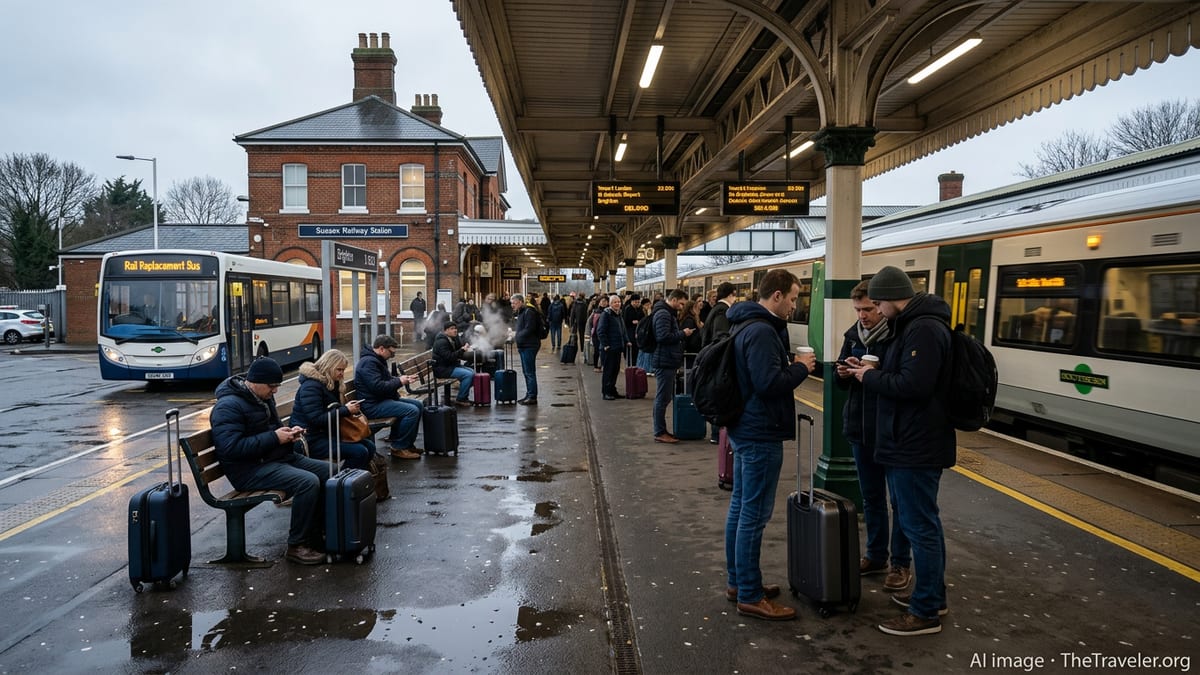
Where diversions are not technically feasible, rail replacement buses are being used to bridge short gaps in the network. Publicly available information indicates that these substitute services are focused on linking major hubs, such as key regional interchange stations, rather than attempting to mirror every intermediate stop. Travellers to smaller stations are being told to expect longer connection times and, in some cases, to travel in the opposite direction to pick up alternative routes.
Freight operators are also adapting to the revised passenger timetable, with some overnight freight paths temporarily withdrawn or re-timed to avoid the most constrained periods. Industry updates suggest that priority is being given to time-sensitive cargo such as supermarket supplies and fuel, while bulk freight that is less sensitive to timing is being rescheduled or rerouted to secondary lines where capacity allows.
Impact on passengers and practical advice for travel
For travellers, the most immediate impact of the substation fire is increased uncertainty. Schedules that have been stable for years have changed with little warning, and in some cases are being adjusted again on a day-by-day basis as engineers gain a better understanding of how much power can safely be drawn from the compromised section of the network. Commuters who normally rely on set departure and arrival times are having to build in extra margin for delays and missed connections.
Passenger watchdogs and transport-focused media are advising travellers to check journey details immediately before departure, as some operators are updating digital timetables late in the evening for the following day. Travellers are also being urged to pay close attention to platform announcements, as trains may use different platforms than usual or terminate short of their planned destination to keep traffic flowing through congested junctions.
Weekend leisure travel is particularly affected, with several popular routes to coastal and tourist destinations operating on reduced frequencies. Families planning day trips are being told to consider earlier departures, as the combination of slower journeys and reduced evening service can make it harder to return at preferred times. Some operators are offering flexible ticketing, allowing passengers to travel on earlier or later services than originally booked without penalty during the disruption period.
Accessibility advocates are highlighting that replacement buses and improvised platform changes can be especially challenging for passengers with mobility needs or those travelling with luggage, prams or bicycles. Public information encourages affected travellers to allow extra time for assistance, and to contact operator help lines ahead of travel where possible so that staff can be deployed to key stations during the busiest periods.
Repair work, power resilience and next steps
Engineering updates indicate that teams are working on parallel tracks: repairing the damaged substation equipment and reviewing the resilience of the wider power supply architecture. Early assessments suggest that some components will need full replacement rather than repair, a process that can take days or weeks depending on the availability of specialist parts and the need for safety testing.
While those physical repairs continue, timetable planners are using real-time monitoring of voltage and load across the network to fine-tune how many trains can operate simultaneously without risking further trips of protection systems. This technical work is being translated into staged timetable changes, with operators likely to restore additional services in phases rather than switching back to the full pre-incident schedule in one step.
Transport analysts note that the incident has once again drawn attention to the dependency of modern railways on a complex electrical backbone. Previous studies of similar failures have recommended greater redundancy in substation layouts, investment in remote monitoring technology and closer coordination with national grid operators so that alternative feeds can be activated more rapidly when faults occur.
Industry commentary suggests that regulators and operators may now revisit plans for additional cross-feeding between substations, on-site backup transformers and smarter protection settings that can isolate damage more locally. However, such upgrades are typically long-term projects that require significant planning and funding, meaning that travellers in the current disruption will continue to feel the effects of this single substation fire for at least several more days.
What travellers should watch in the coming days
In the short term, the clearest indicator of improvement will be the gradual reintroduction of off-peak stopping services and the shortening of journey times on the main intercity and commuter corridors. Operators generally prioritise restoring the busiest peak services first, followed by filling in gaps in the daytime and evening timetable once engineers are confident that the power system can handle additional load.
Passengers are being advised to monitor operator bulletins for references to test trains or trial services, which often signal that infrastructure teams are checking repaired equipment before authorising a full return to normal operation. It is common for a railway to run slightly more conservative schedules for a short period even after technical repairs are complete, as controllers confirm that the system behaves as expected under real-world conditions.
Travel experts also point to seasonal factors that could influence how quickly the timetable stabilises. Warmer weather can increase overall power demand and place additional strain on electrical equipment, while upcoming holiday periods may encourage operators to keep some contingency in their timetables to cope with fluctuating passenger numbers. As a result, a full restoration of services may come in stages rather than on a single announced date.
For now, rail users are being encouraged to treat journey planning as a live process rather than a fixed schedule. Regularly checking updates on the morning of travel, allowing additional time for connections and being prepared to use alternative routes or replacement buses remain the most practical strategies while the network continues to adjust to the consequences of the substation fire.