


More news on this day
Rail passengers face days of altered timetables and curtailed services after a fire at a trackside electrical substation damaged key power equipment, forcing operators to thin out services and reroute trains while engineers stabilise the network.
Get the latest news straight to your inbox!
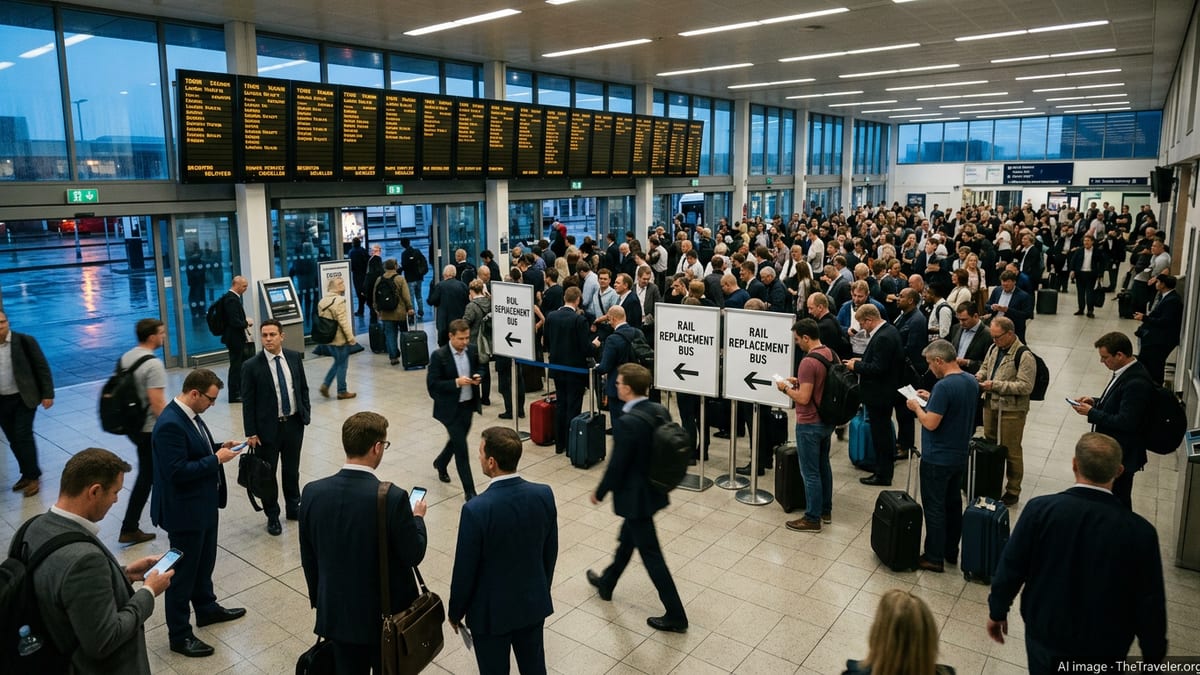
Power failure triggers sudden timetable overhaul
The blaze, which broke out at an electrical installation adjacent to a busy commuter corridor, affected the high-voltage feeds that supply traction power to multiple routes. Publicly available information indicates that trains were halted in both directions at the height of the incident, with operators switching to emergency timetables once limited power was restored.
Initial disruption centred on the immediate area around the damaged substation, where signalling checks and safety inspections were required before any movements could resume. As services restarted, operators adopted reduced stopping patterns and lengthened journey times to stay within the constrained electrical capacity of the route.
Reports indicate that some long-distance and regional services were terminated short of their usual destinations, with passengers asked to change onto other lines or rail replacement buses. The approach mirrors previous UK infrastructure incidents where fires near critical power equipment have led to widespread timetable changes rather than a full network shutdown.
According to published coverage on similar power-related events, such as the Hayes substation fire that disrupted rail access to Heathrow Airport in 2025, network managers typically prioritise restoring a basic pattern of trains before gradually rebuilding frequency. The current response follows that pattern, with operators warning that amended timetables are likely to remain in force beyond the initial emergency phase.
Routes, frequencies and journey times affected
The substation serves a corridor that carries a mix of commuter, regional and airport-bound services, magnifying the impact of the fire on daily travel. Early indications from operator updates show that peak-hour frequencies have been cut on several routes, with off-peak patterns operating closer to a Sunday-style timetable.
Stopping services are among the most affected, as their frequent accelerations demand more power than limited-stop trains. To keep the overall load within safe limits while repairs progress, some local trains have been removed from the schedule or combined into fewer, busier services. Passengers are being advised through public channels to check journey planners on the day of travel and to allow extra time for connections.
Long-distance intercity services are also seeing extended journey times where they traverse the constrained section. Timetables show additional pathing time built into schedules to reduce the risk of congestion when trains are slowed or held to manage power flows. Where possible, some services are being diverted over alternative routes, but capacity on parallel lines is limited.
Recent experience from other corridors affected by engineering works and power restrictions, including stretches of the East Coast and TransPennine routes, suggests that such amended patterns can significantly reduce overall capacity even when headline route availability appears unchanged. Travellers may therefore encounter more crowded trains despite the network technically remaining open.
Operational strategies under constrained power
Railway infrastructure managers routinely plan for degraded power scenarios, but a fire-damaged substation removes a key element of redundancy. With one major feed partially or fully out of use, controllers must manage how many trains accelerate simultaneously within the affected electrical section, often by thinning the timetable and imposing temporary speed restrictions.
Academic research on power-constrained rail corridors has highlighted how blunt section-wide limits are commonly used to keep demand below critical thresholds, at the cost of timetable robustness. Under those conditions, even small delays can ripple across the network as trains queue to enter restricted areas. The current emergency timetables appear designed to keep headways generous enough to prevent such knock-on effects while the infrastructure is fragile.
In practice, this means prioritising certain flows, such as airport or major-city commuter services, while less-used trains are withdrawn or turned back short. Operators then adjust stock and crew diagrams around this skeleton plan. According to publicly accessible industry performance reports, similar strategies have been deployed during past incidents in which fires, flooding or extreme heat compromised key substations and feeder stations.
As repairs progress, planners typically move through several stages of timetable recovery, from the initial emergency pattern to a more stable interim schedule before full service is restored. Each step requires revalidation of paths, platforming and crew availability, so changes tend to be rolled out in phases rather than overnight.
Passenger guidance and contingency options
Passengers are being encouraged through electronic journey planners, station information screens and social media feeds to verify train times shortly before departure. In many cases, the usual clockface patterns no longer apply, with gaps at times when services would normally be frequent. Some first and last trains of the day have been removed from the schedule, affecting workers with early or late shifts.
Where entire sections of line remain under tighter power constraints, operators are turning to rail replacement buses to bridge the gap between functioning railheads. This arrangement has already become familiar on other UK routes during prolonged engineering work, and similar arrangements are now being used to maintain basic connectivity in communities that would otherwise be left without any rail service.
For travellers heading to airports or long-distance connections, public information channels recommend building in substantial contingency time, as missed onward trains or flights are more likely while amended timetables are in effect. Flexible tickets and acceptance on alternative operators’ services are being used in some cases to give passengers more options, although capacity on diverted routes can be tight.
Travel demand itself is also shifting, with some commuters choosing to work remotely on the worst affected days. Experience from previous large-scale incidents suggests that such behavioural changes can help ease pressure on the truncated timetable, but can also delay the visible return to normality even as infrastructure is brought back into full use.
Repair work, resilience questions and longer-term changes
Engineering teams are now focused on assessing the full extent of damage to the substation equipment, including transformers, switchgear and protection systems. Replacement of high-voltage components is a complex process that often relies on specialist parts and factory testing, which can stretch well beyond the visible clean-up at the site of the fire.
Past infrastructure incidents have shown that temporary repairs can restore a significant share of capacity relatively quickly, but full resilience is not recovered until permanent equipment is installed and commissioned. During this period, precautionary limits on the number of trains drawing power in the affected zone are likely to remain, prolonging the need for modified timetables.
The fire is also prompting renewed scrutiny of how resilient rail power supplies are to single-point failures. Recent national reviews of critical infrastructure resilience have highlighted substations and feeder stations as potential weak links, particularly where rapid growth in service frequencies has not been matched by equivalent investment in duplicate feeds and modern protection systems.
In the longer term, the incident may influence how future timetable changes are planned on electrified corridors, with more emphasis on modelling worst-case power constraints and building contingency paths into the working timetable. For passengers, that could eventually translate into slightly lower planned peak frequencies on some of the busiest sections, traded for higher confidence that the service can be maintained when infrastructure problems arise.