


More news on this day
Rail passengers are facing disrupted journeys and emergency timetable changes after a substation fire damaged key power and signalling equipment, forcing operators to curtail and reroute services while repairs continue.
Get the latest news straight to your inbox!
Power failure triggers widespread timetable changes
The substation fire led to an immediate loss of traction power and signalling in the affected corridor, prompting rail operators to suspend services and implement an emergency timetable. Publicly available information indicates that services on both regional and intercity routes have been reduced, with some trains terminating short of their usual destinations.
Initial reports describe a rapid response in which infrastructure managers isolated the damaged equipment and began running limited services using diesel units where possible. Electric services have been particularly affected, with diagrams reworked to keep compatible rolling stock away from the damaged section of line. As a result, passengers are seeing extended journey times and gaps in the usual pattern of departures.
In the hours after the incident, operators published temporary timetables showing reduced frequencies at peak times and longer intervals during off peak periods. Some paths have been reassigned to allow priority for essential commuter and long distance services, while discretionary and lightly used trains are cancelled.
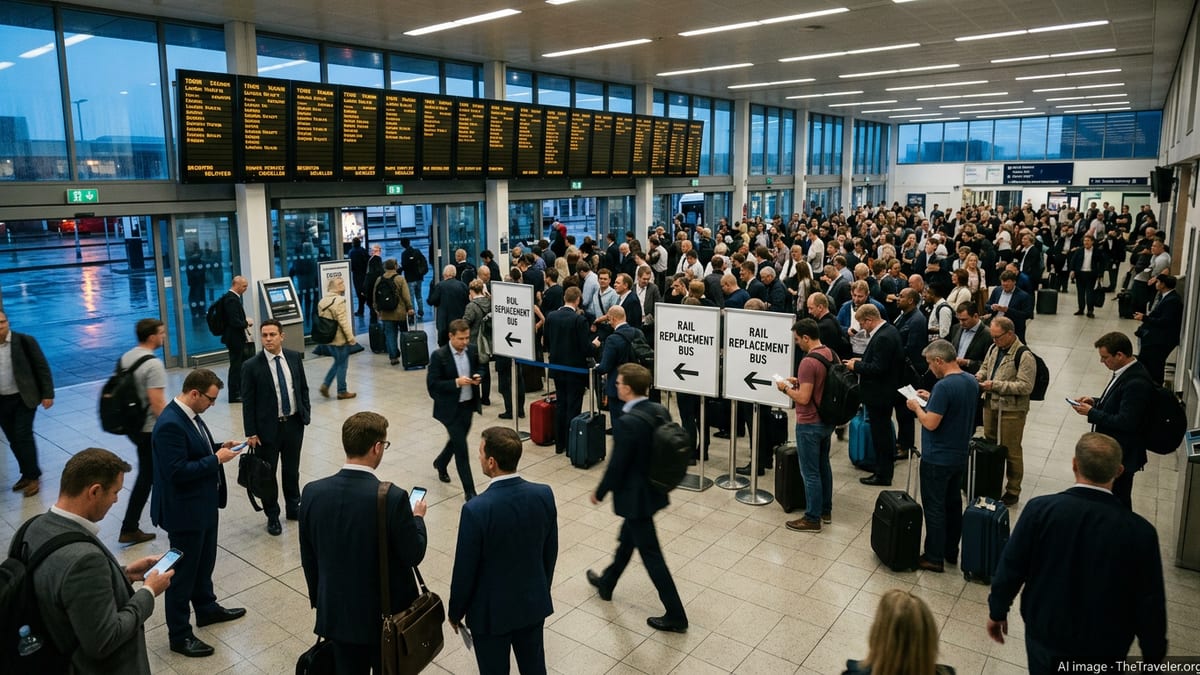
Replacement buses have been deployed on sections where the railway currently cannot operate at all. These road connections add extra time to journeys and in some cases require passengers to change more than once, increasing journey complexity and reducing overall capacity compared with the normal rail timetable.
Key routes affected and how services are running
On the main line through the affected substation area, long distance intercity services are being diverted via alternative routes where capacity allows. This has led to additional congestion on parallel lines and knock on timetable changes for trains that would normally use those corridors. Some express services now make additional stops to compensate for cancelled stopping trains, further altering journey times.
Regional routes that depend on the damaged infrastructure are bearing the brunt of the disruption. Reports indicate that commuter lines into major urban centres are operating at a reduced frequency, with some services starting later in the morning and finishing earlier in the evening. On certain branches, only an hourly shuttle is operating, timed to connect with main line services that still have available paths.
Timetable summaries published by operators highlight a pattern of targeted cuts rather than a full shutdown. Early morning and late evening services are particularly vulnerable, with several first and last trains removed from the schedule to free up rolling stock and crew for busier periods. Weekend leisure services are also reduced, reflecting lower demand and the need to preserve capacity for weekday commuters.
International and long distance passengers are advised through public channels to check journey planners on the day of travel, as diversion routes and stopping patterns can change at short notice. Some cross border connections now require transfers between different operators at intermediate stations, where through services previously ran without a change.
Operational challenges in restoring a stable timetable
From an operational perspective, the substation fire has created a complex set of problems that reach beyond the immediate loss of power. Rolling stock diagrams have to be rewritten so that trains and crews end each day in locations where they can start revised services the following morning. Delays caused by diversions and reduced speeds can quickly cascade, leading to further cancellations if units and drivers are out of position.
Infrastructure managers are working within established timetable planning rules that normally assume stable conditions. Emergency alterations of this scale require rapid negotiation between track managers and operators to agree which services receive priority access to the remaining capacity. Publicly available information shows that freight services are also being rerouted or retimed, which can limit the options for passenger trains on shared sections of line.
Another challenge lies in striking a balance between publishing reliable information and retaining flexibility. If timetables are changed too frequently, passengers lose confidence in journey planners and station departure boards. However, if the emergency timetable is kept rigid, there may be missed opportunities to add services once repairs progress or temporary workarounds, such as mobile generators, are put in place.
Staffing is an additional constraint. Crews trained only on electric stock may not be able to operate the diesel units redeployed to maintain connectivity, while route knowledge requirements limit where drivers can be reassigned. These factors make it harder to use spare staff and rolling stock efficiently as the situation evolves.
What rail travellers should expect in the coming days
According to published coverage, engineers are assessing the extent of the damage to the substation and associated cabling before committing to a precise repair timetable. In similar incidents, temporary solutions such as sectional feeding arrangements or portable equipment have allowed partial restoration of power while full rebuilding work continues in the background. The pace at which such measures can be implemented will shape how quickly a more regular timetable can return.
Passengers should expect continued short notice alterations, especially in the early mornings and late evenings, when infrastructure managers may need to take additional possessions to carry out intensive repair work. Journey planners may show provisional services that are later amended, so travellers are being encouraged through public information channels to recheck their trains shortly before departure and to allow extra time for connections.
Season ticket holders and regular commuters are likely to experience crowding on remaining peak services, as reduced frequencies concentrate demand into fewer trains. Some operators are advising travellers to consider flexible working patterns or alternative routes where possible until the infrastructure has been stabilised and a more robust timetable can be introduced.
Once repairs advance, operators are expected to introduce a phased return to normal service rather than a single changeover. Initial steps may include reinstating key peak trains, followed by off peak services and late night departures. Even after the physical repairs are complete, fine tuning of the working timetable is likely to continue for several weeks as planners address residual delays and adjust margins to improve punctuality.
Longer term lessons for network resilience
The substation fire has renewed attention on the vulnerability of modern rail networks to single point failures in power and signalling systems. Many corridors rely on a limited number of high capacity substations, and damage to one of these installations can quickly ripple through the timetable far beyond the immediate area. Transport analysts note that similar incidents in recent years have already prompted reviews of redundancy and remote switching arrangements.
Publicly available documents indicate that infrastructure managers are investing in more resilient designs, including additional feeders, improved fire protection and better condition monitoring for high voltage equipment. The current disruption is likely to add urgency to these programmes, particularly on busy mixed traffic routes where both passenger and freight services depend on uninterrupted electricity supply.
For passengers, the episode underscores the importance of accurate, timely communication around timetable changes. Clear maps of affected routes, straightforward descriptions of replacement bus arrangements and realistic journey time estimates can mitigate some of the frustration caused by unavoidable disruption. Travel industry observers suggest that integrating live capacity information into journey planners would further help travellers make informed choices when services are reduced.
As the network recovers, attention will turn to how lessons from this incident are incorporated into future timetable planning and emergency preparedness. The experience is likely to feed into updated contingency plans, with an emphasis on faster reconfiguration of services, improved coordination between operators and infrastructure managers, and additional investment in critical substations that support some of the busiest routes on the network.