


More news on this day
A serious electrical substation fire on a major rail corridor has triggered emergency timetable changes, with reduced services, diverted trains and replacement buses affecting thousands of passengers on one of the region’s busiest routes.
Get the latest news straight to your inbox!
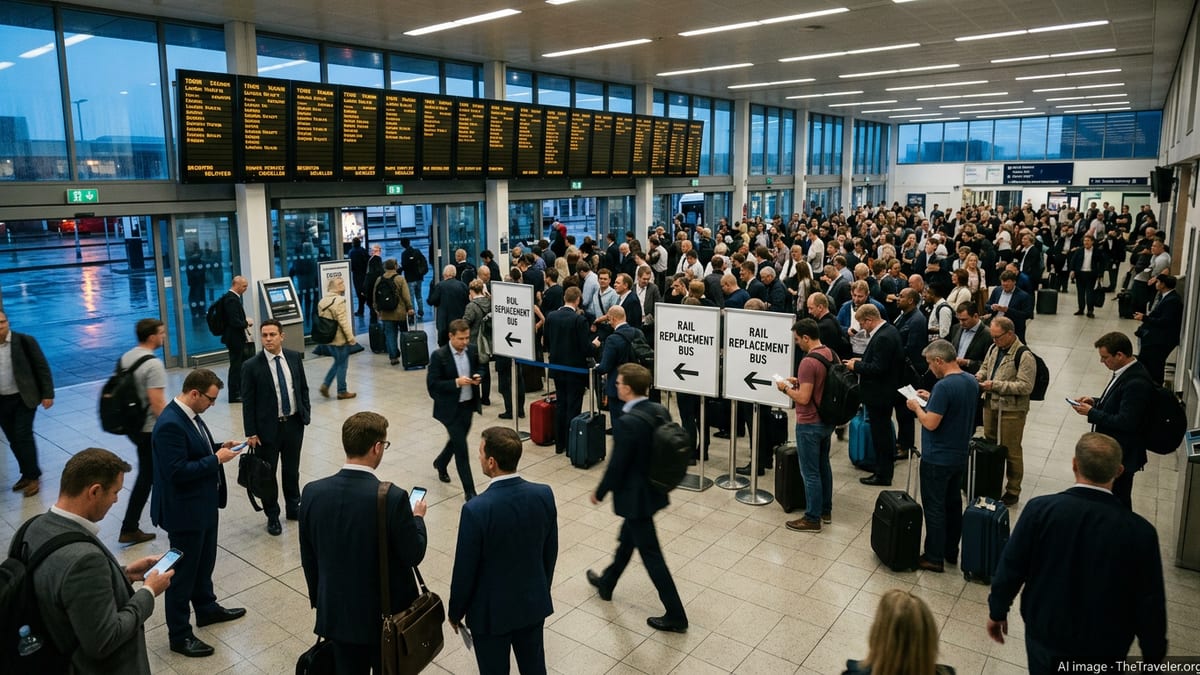
Service cuts, diversions and replacement buses on core line
Publicly available information from operators and infrastructure managers indicates that the fire, which damaged critical traction power equipment near a busy junction, has left parts of the network without sufficient electrical capacity to run the normal timetable. In response, planners have introduced a reduced service pattern on the affected main line, prioritising peak-hour commuter and intercity trains while scaling back off‑peak frequencies.
Several stopping services that usually run through the damaged area are temporarily terminating short or being diverted over parallel routes. This is creating new interchange points at intermediate hubs, where passengers are being asked to change trains or board rail‑replacement buses to complete their journeys. Journey planners show that end‑to‑end travel times on some flows have increased by 20 to 40 minutes.
According to published coverage, the emergency timetable also affects overnight and early‑morning operations. A number of first and last trains have been withdrawn so that rolling stock can be repositioned around the constrained section and to allow extended engineering access at the substation site. Travellers catching flights or making time‑critical connections are being advised to build in additional margin and to recheck their departure times on the day of travel.
While high‑speed and intercity services are largely being kept running, they are in some cases using alternative routings that add intermediate stops or require running on slower tracks shared with regional trains. This is contributing to crowding on services that are still operating and to occasional knock‑on delays far beyond the immediate area of the fire.
Power constraints reshape train planning and rolling stock use
The damaged substation is understood, from technical briefings published by rail infrastructure bodies, to be one of several power supply points feeding the electrified corridor. With its capacity temporarily unavailable, neighbouring substations are carrying a heavier load, limiting the number of electric trains that can be in the affected section at any one time without risking voltage drops or automatic shutdowns.
Timetable planners have responded by thinning out train paths through the constrained zone and by staggering departures so that services do not enter the critical area in close succession. In practical terms, this has meant moving from a regular “clockface” timetable, where trains leave at predictable repeating minutes past the hour, to a more irregular pattern dictated by available power margins and single‑line working around the damaged infrastructure.
Publicly available diagrams suggest that operators are also reshuffling fleets to make better use of diesel or bi‑mode trains that can operate away from the electrified sections if needed. On some routes, electric services are being turned back before the affected zone, with diesel sets operating shuttles or replacement diagrams beyond. This approach helps to maintain at least a basic level of connectivity for smaller communities that would otherwise be left without rail service.
Industry bulletins highlight that crew and depot planning have had to be revised at short notice to reflect the new operating pattern. Train crews who normally sign specific routes are being re‑rostered onto alternative diagrams, while maintenance depots are adjusting schedules to cope with units returning at different times of day and with different mileage balances than originally planned.
Knock‑on disruption spreads beyond immediate fire site
Although the damage is physically concentrated around a single substation, the operational impact of the fire is extending across a much wider geography. According to journey‑time analyses shared in rail industry updates, delays and cancellations are radiating along the corridor as disrupted services miss key crossing points and platform slots at busy junction stations.
Passengers on secondary branches feeding into the main line are encountering short‑notice platform changes and irregular gaps in service where connections no longer line up with the revised main‑line timetable. In some cases, local trains are being held to protect crucial intercity links, resulting in extended dwell times and frustration for travellers on shorter hops.
There are also reports of increased crowding at park‑and‑ride stations and regional hubs where passengers are adjusting their travel patterns to work around the disruption. Some commuters are driving to alternative lines that still have near‑normal service, while others are being encouraged via operator channels to travel outside traditional peaks where possible.
Freight operations are being affected as well, with published pathing information showing that several overnight and off‑peak freight trains have been re‑routed or retimed to avoid the constrained section. This reduces pressure on the electrified corridor but can introduce delays and additional mileage for logistics operators, with potential implications for supply chains that depend on just‑in‑time deliveries.
Information challenges for domestic and international travellers
For many passengers, one of the most visible consequences of the substation fire is the speed at which timetables have changed, and then changed again, as engineers refine repair plans and operators adjust service levels. Travel apps and printed schedules have struggled at times to keep up, leading to discrepancies between advance‑purchase itineraries and the trains that actually run on the day.
Rail commentators note that this kind of infrastructure failure can be particularly disruptive for visitors and occasional travellers who are less familiar with the network. International passengers planning rail‑based itineraries around the region may find that long‑booked journeys now involve bus transfers, extra changes or different departure stations, even if their tickets remain valid.
According to consumer‑focused travel coverage, ticketing rules have become a key concern. Some operators are offering additional flexibility, allowing passengers to use tickets on alternative routes or at different times, while others are applying standard disruption policies. Refunds and rebooking options vary by fare type, leaving some travellers with limited options if their preferred train is cancelled.
Travel advisers are urging passengers to monitor operator announcements closely on the days leading up to travel, not just at the time of booking. They also recommend allowing extra time for transfers between rail and onward transport such as flights, cruise departures or long‑distance buses, given the increased risk of late‑running services along the affected corridor.
Repair timeline, contingency plans and what comes next
Engineering statements published by infrastructure managers suggest that repairs at the fire‑damaged substation will take several weeks, involving the removal of burnt equipment, installation of new transformers and switchgear, and comprehensive testing before the site can safely rejoin the power grid for train operations. Weather conditions, supply chain lead times and the complexity of onsite civil works are all cited as factors that could influence the exact timeline.
Until full power capacity is restored, the temporary timetable is expected to remain under continuous review. Operators are indicating through public updates that they may introduce incremental improvements, such as reinstating selected peak‑time trains, as additional resilience is built into the system or as nearby substations are reconfigured to share more of the load.
Once normal service is closer to being restored, a further round of timetable adjustments is likely, as planners seek to unwind the emergency pattern and reintroduce the pre‑fire schedule. Industry analysts point out that this transition phase can itself be bumpy, as the network readjusts and any latent issues with rolling stock and crew availability resurface when frequencies climb back toward usual levels.
For now, travellers using the affected corridor face an extended period of altered routines, with earlier departures, revised routes and unfamiliar interchange points becoming part of daily journeys. The incident has underlined how dependent modern rail networks are on a relatively small number of critical power assets, and how a single substation failure can reshape rail timetables across an entire region.