


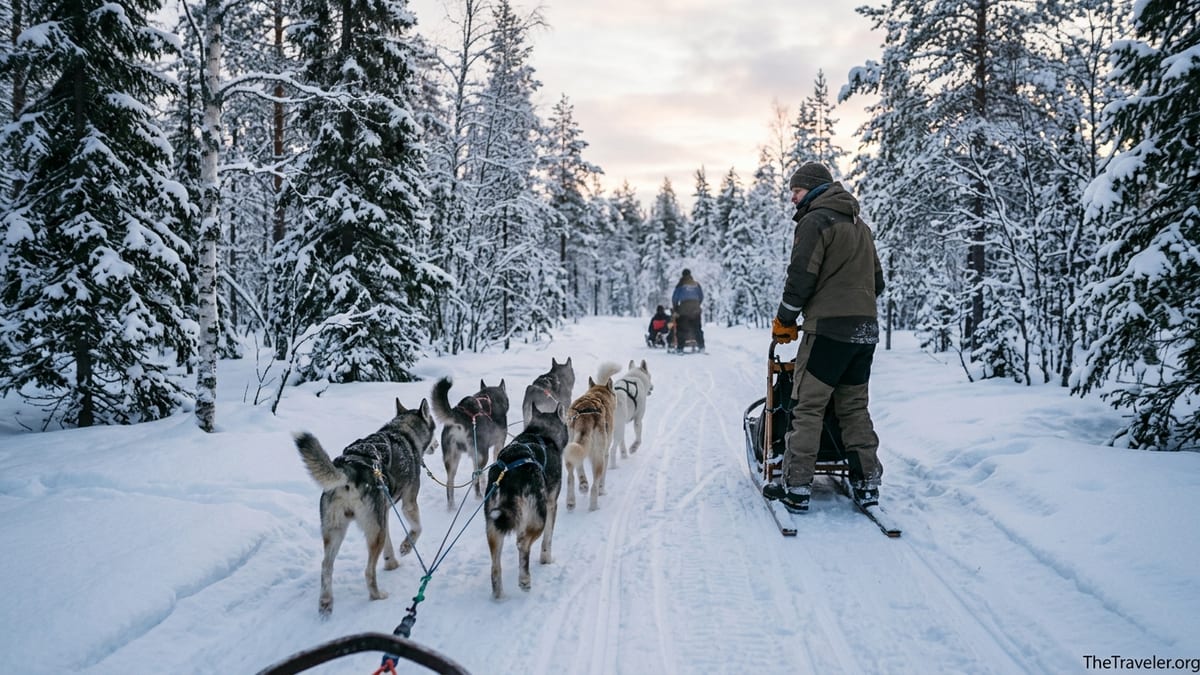
A husky safari is one of those bucket-list Arctic experiences that looks effortlessly magical in photos: a narrow trail through snow-laden forest, excited dogs, and a pale winter sun hanging low on the horizon. Yet many travelers step off the sled wishing they had known a lot more about what they were actually booking, how the dogs are treated, and what the experience really feels like in minus 20 degrees. If you are planning a trip to Finnish Lapland, northern Norway, Sweden or Canada, understanding a few practical realities will help you choose an ethical operator and a safari that matches both your expectations and your budget.
Get the latest updates straight to your inbox!
Short Ride or Real Safari: Know What You Are Buying
One of the biggest surprises for first-time visitors is discovering that not all husky safaris are created equal. In places like Rovaniemi in Finnish Lapland, there is a huge difference between an eight-minute husky loop beside Santa Claus Village and a proper self-drive safari that runs through forest 25 to 35 kilometers outside town. Recent price lists from Rovaniemi tour companies show short passenger rides of about 2 to 2.5 kilometers lasting 8 to 12 minutes, compared to 6 to 10 kilometer safaris that keep you out for two to three hours door to door. Those short rides can feel more like a theme park attraction than the wilderness adventure many people imagine.
Standard self-drive safaris in Lapland typically range from 5 to 10 kilometers on the trail, with around 15 to 50 minutes actually standing on the sled runners depending on snow conditions and group speed. Operators such as Bearhill Husky, Wild About Lapland or Harriniva in Finland commonly describe these as their “classic” or “forest escape” tours. A 10 kilometer safari sold by one Rovaniemi-based company is priced around 190 to 200 euros per adult and lasts about four hours including transfers, kennel visit and safety briefing, while a 5 kilometer option can start closer to 120 euros. Understanding the distance and drive time before you pay helps avoid that deflated feeling of spending a few hundred euros on what turned out to be a quick spin around a field.
Longer expeditions are a different category entirely. In northern Finland and Swedish Lapland, full-day and multi-day husky tours cover 20 kilometers or more, often including lunch cooked over an open fire or overnights in wilderness cabins. Prices commonly start around 300 euros per person for a full day in the 2025–2026 winter season and can climb significantly for multi-day expeditions. These trips are physically more demanding and better suited to travelers who are comfortable being outside for many hours in deep winter cold.
The key is to read the description with care and compare the essentials: total distance, actual sledding time, whether you drive or just sit, and group size. If an offer seems much cheaper than others in the same region, there is usually a reason, such as shorter distance, no self-driving or no transfers and clothing included.
What Husky Safaris Really Cost (And Why)
Sticker shock is common. A couple in Rovaniemi in early 2026 described realizing too late that their “afternoon out” with huskies had quietly turned into a 400 euro line on the credit card, once they multiplied the per-person price and added transfers. Current price surveys of Lapland activities show adult rates for a standard 6 to 10 kilometer self-drive safari in the 2025–2026 season typically falling between about 145 and 200 euros per person, with children’s tickets often 30 to 60 euros cheaper. Extended 12 to 18 kilometer safaris cluster in the 200 to 300 euro range.
The most important detail for budget planning is that almost all husky safaris in Lapland, Norway and Sweden are priced per person, not per sled. Many travelers expect to pay “per sled” because they see two people sharing one team of dogs, but an adult couple will nearly always be charged two individual fares. Single supplements are rare, yet solo travelers still pay the full adult rate. To complicate matters, peak Christmas dates in early December and the New Year period often bring a small surcharge, sometimes 5 to 10 euros extra per person compared with late January.
What you get for that money varies, and that is where reading the inclusions closely pays off. Higher-end operators in Lapland usually include transfers from central hotels, full thermal overalls, heavy boots, mittens, wool socks if needed, a kennel tour and hot berry juice and cookies around a fire. Budget offerings or short rides attached to big visitor attractions might not include clothing or transport, and guests are expected to arrive fully kitted out. When you factor in the rental cost of proper winter gear for those cheaper rides, the price advantage often disappears.
Travelers also underestimate how far ahead popular slots sell out. In Rovaniemi and Levi, for example, operators report that prime morning departures around Christmas and New Year often sell out months in advance. Leaving booking until arrival can mean paying more for the only remaining evening slot or settling for a five-minute ride at a roadside farm when what you wanted was a half-day out in the forest.
Ethics and Dog Welfare: Questions You Should Ask
In recent seasons, ethical concerns around husky safaris have moved from niche discussion forums into mainstream trip planning. Investigations by Finnish animal welfare groups and research into sled-dog operations have highlighted patchy standards across the industry. While Finland and Norway have relatively strict animal welfare laws that cover kennel sizes, shelter from the elements and the need for regular exercise, they do not automatically guarantee that every individual operator provides a good quality of life for their dogs. Local tourism boards in Lapland now publish guidelines encouraging visitors to ask questions and choose responsible providers rather than booking on price alone.
On the ground, there are practical signs that travelers can look for. Ethical kennels usually keep dogs in roomy enclosures or on long tethers with insulated dog houses, rather than short chains and tiny boxes. Staff can explain how often each dog runs, how many rest days they receive and what happens to dogs when they retire from work. At reputable kennels in Lapland, visitors are commonly told that healthy adult sled dogs run a limited number of tours per day and have scheduled off days, with regular vet checks. Some operators, including well-known names in northern Finland, have pursued third-party sustainability labels or animal welfare certifications, which typically involve audits of housing, feeding and veterinary care.
Travelers who have visited several kennels often describe the dogs’ behavior at harness time as a telling sign. In positive settings, the dogs are noisy, jumping and straining to run, visibly keen to work. In less positive operations, guests sometimes report listless or underweight animals, overcrowded yards and staff who avoid detailed questions. If you arrive at a kennel and notice a strong smell of waste, dogs with obvious injuries, or animals that seem fearful of their handlers, it is reasonable to walk away and raise your concerns with local tourism authorities later.
Before booking, it is worth sending a short email asking specific questions: how many dogs does the kennel have, how many tours does each dog run on a typical winter day, whether they use positive reinforcement in training and what their policy is on breeding and rehoming retired dogs. Ethical operators are usually transparent and happy to answer, while vague or defensive replies can be a red flag.
Cold, Comfort and Who Should Not Go
A husky safari looks gentle from the outside, but physically it can be more demanding than many visitors expect. Drivers stand on narrow runners for up to an hour at a time, brake firmly on downhill sections and sometimes push or jog behind the sled on inclines. Operators in Lapland advise that you do not need to be an athlete, but you should have reasonably good balance and be able to stand for extended periods. Travelers with chronic knee or hip issues, significant back problems or very poor balance may find driving uncomfortable or risky, and often choose to ride as passengers instead.
The cold is another factor people underestimate, especially on fast-moving sleds. On a clear January morning in Finnish Lapland, temperatures of minus 15 to minus 25 degrees Celsius are not unusual, and wind chill while sledding makes it feel even colder. Families often report that young children enjoy the first 10 or 15 minutes and then quickly become chilled and tired. Quality operators provide heavy thermal suits and boots, but you still need proper base layers, warm socks and face protection of your own. A common regret among travelers is not packing thin glove liners to wear under the provided mittens so they can comfortably use a camera without freezing their fingers.
There are also cases where guides advise against joining. Pregnant travelers are often discouraged from driving because the sleds can hit bumps and frozen ruts with some force, and sudden falls are always a possibility. Many operators clearly state that pregnant guests participate at their own risk and may only ride as passengers. People with serious heart conditions or unmanaged asthma should talk to their doctor before booking, as the combination of cold air and bursts of exertion when pushing the sled can be challenging.
Age limits vary by operator and country but, in Lapland for example, children as young as four or five are often allowed as passengers accompanied by an adult, while the minimum age to drive a team is usually 16 or 17. Older children who are strong and coordinated may be invited to help on gentle sections, but insurance rules mean the guide has the final say on who is allowed to take the runners.
Seasonality, Snow Conditions and Timing Your Trip
Husky safaris are highly seasonal, and travelers are sometimes surprised to discover that the “winter” they booked does not always match their expectations. In Finnish Lapland and northern Sweden, most kennels begin running sleds on snow sometime between November and early December when trails are safe and frozen. Early-season trips can be magical with soft, deep snow and pastel skies, but they can also be vulnerable to weather disruptions. Autumn “husky on wheels” experiences, where dogs pull wheeled carts on forest tracks, are increasingly common from September to November for visitors keen on meeting the dogs before snow arrives.
Peak season for classic snowy safaris in Lapland usually runs from mid-December to late March. In January and February, you can expect the most reliable snow cover and the coldest temperatures, with short daylight hours that create that blue Arctic twilight so many travelers dream about. In March and early April, the days lengthen and the sun feels stronger, which many families with children find more comfortable. In coastal Norway around Tromsø, milder maritime weather means more frequent freeze-thaw cycles, which can occasionally force cancellations when trails become icy or bare. Operators generally state that safety decisions sit with the musher: if conditions are unsafe, the tour is shortened, rerouted or refunded.
Recent winters have seen more volatile weather patterns, and operators across the Arctic report increasing numbers of rain-on-snow events and midwinter thaws. This reality makes flexible planning more important than ever. Travelers who schedule a husky safari for their first full day in Lapland have the rest of their stay as a buffer in case they need to move the booking. Those who leave it to the final day risk missing out if warm weather suddenly washes the trails.
Time of day also shapes the experience. Morning departures often offer better light for photography and slightly firmer trails. Twilight rides in midwinter can feel very atmospheric, but the combination of lower temperatures and darkness is not for everyone, especially small children and people sensitive to cold.
How to Read the Fine Print and Avoid Disappointment
When travelers say “I wish I had known,” they are usually talking about the small details hidden in the terms and conditions or buried halfway down a tour description. One common surprise is the driving format. Many Lapland operators use shared sleds, where two adults ride with one team of dogs and take turns: one drives, the other sits in the sled. That arrangement works well for couples and parents, but single travelers occasionally discover they are expected to share with a stranger unless they pay a supplement or the guide arranges a special setup.
Cancellation policies are another point where expectations and reality diverge. Direct bookings with kennels sometimes offer better prices than large international platforms, yet those savings can come with stricter conditions. While a global marketplace might allow free cancellation up to 24 hours before departure for a standard 10 kilometer safari in Rovaniemi, the same tour booked directly might impose a 7-day or 48-hour deadline. For trips in the busy Christmas period, some operators request non-refundable deposits. If your itinerary is complex or you are traveling during a time of unstable weather, paying slightly more for a flexible ticket can be worthwhile.
The fine print also covers weight and health limits. A few operators include maximum combined weight per sled for safety and animal welfare, which can affect larger adults who plan to ride together. Very rarely, travelers discover at check-in that they exceed published limits and need to switch to separate sleds or adjust the plan. If weight, mobility or health is a concern, it is better to raise it before you book and keep a copy of the operator’s written confirmation.
Finally, review what is not included. In some Scandinavian regions and in Canada, tipping guides is customary and can add a meaningful amount to the total cost for families. Photo packages, professional images or optional add-on activities at kennels, such as feeding puppies or combining the safari with snowmobiling, also increase the price. People often leave feeling they spent more than expected simply because they had not added up all the extras in advance.
The Takeaway
For many travelers, a husky safari ends up being the single most vivid memory of a winter trip to the Arctic, whether that is racing through silent spruce forest in Lapland or gliding across a frozen lake in northern Norway. Those who come home satisfied almost always share a few common threads: they understood the difference between a short ride and a real safari, they checked how the dogs were treated and they chose a distance and time of day that matched their fitness and tolerance for cold.
If you are planning to book, start by being honest with yourself about what you want. Is it a quick taste of standing on the sled behind a happy team of dogs, or an all-day expedition deep into wilderness? How important is it to you that the kennel can explain its welfare standards and show you clean, spacious living conditions for the dogs? Are you prepared for sub-zero temperatures for an hour or more at a time? Once you have answered those questions, compare operators, read the inclusions line by line, ask a few direct questions and resist the temptation to book the very cheapest option on offer.
In a world where winter seasons are becoming less predictable and animal welfare is under increasing scrutiny, thoughtful choices matter. A well-researched, ethically run husky safari not only delivers the storybook experience you have seen in photographs, but also supports kennels that invest in their dogs’ long-term health and happiness. That is the kind of memory that feels good long after the snow melts.
FAQ
Q1. Is husky sledding ethical, or should I avoid it altogether?
Husky sledding is not inherently unethical, but standards vary widely between kennels. In regions like Lapland and northern Norway, many operators work hard to meet or exceed national animal welfare laws, giving dogs regular rest days, proper shelter and veterinary care. The ethical burden falls on travelers to choose kennels that are transparent about how their dogs live and work, and to walk away from places where the animals look stressed, injured or neglected.
Q2. How much should I budget for a husky safari?
For a standard 6 to 10 kilometer self-drive safari in Lapland in the 2025–2026 winter season, most adults should expect to pay in the region of 145 to 200 euros per person, with children typically 30 to 60 euros less. Short rides of around 10 minutes near major attractions are cheaper, often around 60 euros per adult, while extended 12 to 18 kilometer safaris and full-day expeditions can cost from 200 euros to well over 300 euros per person. Remember to factor in any extras such as tips, photos and winter clothing rental if not included.
Q3. Do I need previous experience to drive a husky sled?
No prior experience is usually required. Guides in Lapland, Scandinavia and Canada routinely take complete beginners and provide a briefing on how to stand, brake and steer before you set off. The dogs know the trail and do most of the work, but you must be comfortable standing for up to an hour and reacting quickly if the sled begins to tip. First-time visitors who are nervous about driving can often ride as passengers and switch places mid-tour if they feel confident.
Q4. What should I wear on a husky safari in winter?
Dress as if you will be standing still in very cold weather for longer than you think. That means a moisture-wicking base layer, a warm mid layer such as fleece or wool, and an insulated outer layer. Most quality operators in Lapland provide thick thermal overalls, heavy boots and mittens, but you will still want warm socks, a hat that covers your ears, a neck gaiter or balaclava and thin glove liners under the mittens so you can handle cameras or phones briefly without exposing bare skin. Avoid cotton, which traps moisture and makes you feel colder.
Q5. How can I tell if a kennel is treating its dogs well?
There is no single sign, but a combination of clues helps. Look for clean yards, sturdy shelter for each dog, and animals that appear alert, well-muscled and keen to run. Ethical kennels can explain their feeding routines, how many tours each dog runs, how often vets visit and what happens when dogs retire. The dogs’ behavior is also revealing: excited barking and pulling when it is time to harness is normal, while extreme fear, cowering or obvious injuries should prompt concern. If staff avoid questions or restrict your view of where dogs live, consider booking elsewhere.
Q6. Are children allowed on husky safaris?
Yes, children are welcome on many husky safaris, but there are age and height limits. In Finnish Lapland and similar destinations, children around four or five years old can often ride as passengers with an adult, tucked into the sled with blankets. Driving is usually reserved for older teenagers, commonly 16 or 17 and up, depending on the operator and insurance rules. If you are traveling with very young children or babies, ask specifically about minimum age, how long you will be on the trail and whether there are shorter, family-focused options.
Q7. What happens if the weather is too warm or there is no snow?
Responsible operators prioritize safety and animal welfare over sticking to a schedule. If snow cover is too thin, trails are dangerously icy or warm weather has created slushy conditions that could injure the dogs, tours are usually shortened, rerouted or canceled. In early winter and late spring, some kennels offer “husky on wheels” experiences using wheeled carts instead of sleds, while others simply refund or rebook. When you reserve, check the specific cancellation policy for weather-related changes so you know whether you will receive a refund or credit if conditions are poor.
Q8. Will I get to interact with the huskies, or just ride behind them?
At many kennels, meeting and petting the dogs is a central part of the experience. Standard itineraries often include time before or after the ride to walk around the yard, take photos, ask the mushers questions and sometimes cuddle puppies, depending on the season. Short, high-volume rides near big attractions may be more transactional, with little time to linger. If dog interaction matters to you, look for tours that explicitly mention a kennel visit, time with the dogs or smaller group sizes.
Q9. How early should I book a husky safari in peak season?
In popular destinations such as Rovaniemi, Levi, Tromsø or Abisko during the Christmas and New Year holidays, it is wise to book several months in advance, especially if you want a morning departure or a longer distance safari. Operators report that the busiest weeks from mid-December into early January fill quickly, and last-minute visitors sometimes find only short rides available. For trips in January, February or March outside school holidays, a few weeks’ notice is usually enough, but earlier booking still gives you more choice of times and operators.
Q10. Is a husky safari worth it if I am already doing snowmobiling or reindeer tours?
Many travelers who try a combination of winter activities say that the husky safari feels the most personal and memorable. Snowmobiling is faster and noisier, and reindeer sleigh rides are gentle and cultural, but guiding a small team of eager dogs through a quiet forest often creates a stronger emotional connection. If your budget allows only one big-ticket excursion, a well-chosen husky safari with an ethical operator is, for many people, the standout Arctic experience that they remember long after the trip ends.