


Hidden in a sandstone alcove at the junction of Kane Gulch and Grand Gulch in southeastern Utah, Junction Ruin is one of the most accessible windows into the world of the Ancestral Pueblo people. It is also more complicated to visit than many first-time travelers expect. Permits, fragile archaeology, unreliable water and remote desert conditions all combine to create a trip that can be unforgettable for the right visitor and unexpectedly challenging for the unprepared. Before you set out for this famous site in the heart of Cedar Mesa and Bears Ears country, it helps to understand what experienced hikers wish they had known on their first visit.
Get the latest updates straight to your inbox!
Understanding Where Junction Ruin Actually Is
Many travelers hear about “Junction Ruin near Bears Ears” and arrive in southeastern Utah without a clear sense of geography. Junction Ruin sits in Grand Gulch, a serpentine canyon that cuts through Cedar Mesa in San Juan County, Utah, managed by the Bureau of Land Management as part of the Cedar Mesa Special Recreation Management Area and Bears Ears National Monument. The hike typically begins at the Kane Gulch Ranger Station on Utah State Route 261, several hours’ drive from the nearest commercial airports at Grand Junction or Salt Lake City. This is not a roadside ruin where you pull off, snap a photo and drive on; reaching the site involves a half-day hike in a remote canyon system.
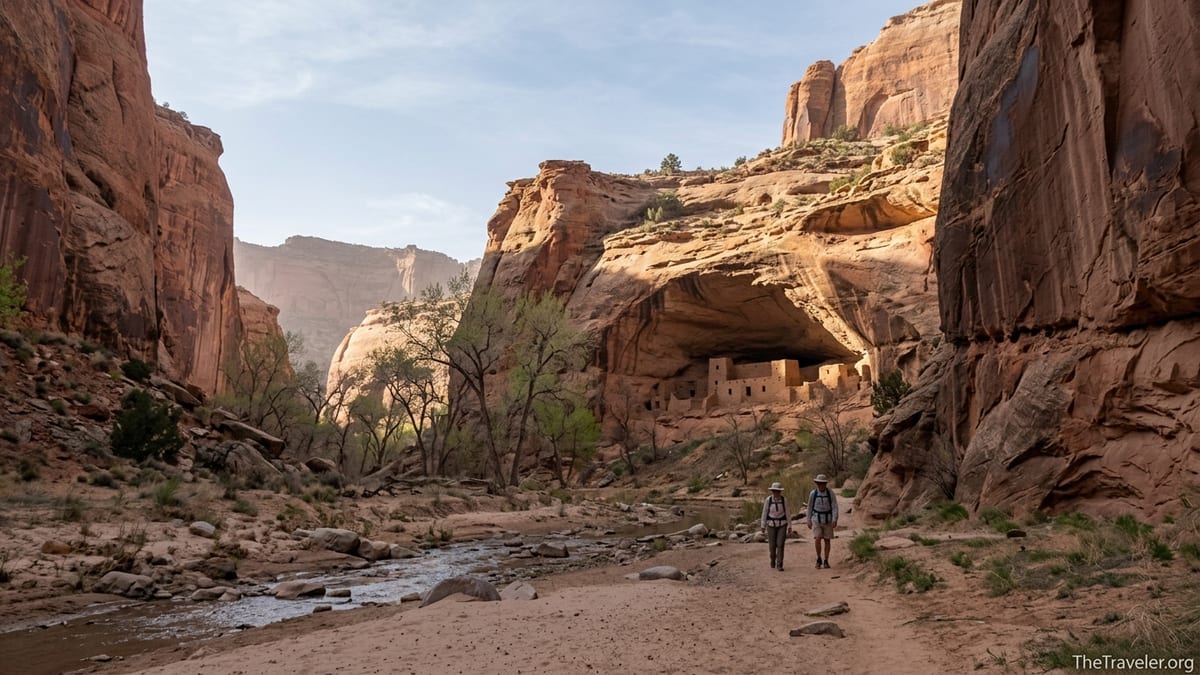
From the Kane Gulch Ranger Station, a well-used trail drops about four miles down Kane Gulch to its confluence with Grand Gulch, where Junction Ruin occupies a massive, shaded alcove on the canyon wall. The site is called “Junction” because it sits almost exactly at this meeting point of canyons. Visitors used to the paved paths and railings of Mesa Verde are often surprised to find an unpaved, sometimes muddy desert route with occasional rock steps and creek crossings. Knowing in advance that you will be descending into a real backcountry canyon, not a developed park loop, helps calibrate expectations.
Travelers also frequently confuse Grand Gulch in Utah with Grand Gulch Mine in Arizona, a historic mining site in Grand Canyon-Parashant National Monument that is reached by long dirt roads rather than a canyon hike. When people search for “Grand Gulch directions” online, information about the Arizona mine often appears alongside details about the Utah canyon system. If you are aiming for Junction Ruin, you are heading for the Utah Grand Gulch on Cedar Mesa, accessed from Utah Highways 95 and 261, not the mine in Arizona.
Because the entire area is part of a living cultural landscape for Navajo, Hopi, Ute and other Indigenous communities, visitors should also come with the mindset that they are entering a place of ongoing significance, not an abandoned theme park. The ruins, rock art and artifacts in Grand Gulch are protected under federal law, and treating the canyon as a museum without walls is one of the most important mental shifts new visitors can make.
Permits, Seasons and Crowd Realities
One of the biggest surprises for many travelers is that Grand Gulch, including the day hike to Junction Ruin, is not a free, show-up-anytime destination. The Cedar Mesa and Bears Ears permit system limits daily visitor numbers to protect fragile archaeological sites and the desert environment. As of recent seasons, day use permits for Kane Gulch and Grand Gulch can be purchased for a modest fee per person, while overnight backpacking requires advance reservations and additional restrictions on designated camps near popular sites such as Junction and Turkey Pen. These systems evolve, so checking the latest Bureau of Land Management guidance before your trip is essential.
Season matters. The most popular times to hike to Junction Ruin are spring and fall, roughly March through May and late September through October, when daytime temperatures are more forgiving and intermittent water can sometimes be found in canyon pools. In summer, temperatures on the exposed rim often climb well above 90 degrees Fahrenheit, and the descent into Kane Gulch offers little shade in the middle of the day. Winter can bring snow and ice to the rim and upper trail, and short daylight hours reduce your margin for error. Many experienced hikers consider late April and October the sweet spots for comfortable temperatures and somewhat thinner crowds.
Because Junction Ruin is the first major site along the popular Kane Gulch route, it is often busier than deeper canyon destinations such as Split Level or Jailhouse Ruin. On peak spring weekends, it is not unusual to share the alcove with several small groups, including guided parties. Travelers expecting total solitude may be disappointed, but the flip side is that a lightly used but well-visited trail tends to be easier to follow, and staff at the Kane Gulch Ranger Station can provide up-to-date information on conditions based on that steady stream of visitors.
One practical implication of the permit and season puzzle is that spontaneous trips are less workable than they once were. A family driving from Moab on a busy April Saturday may find that day-use quotas have already been filled by mid-morning. Many frequent visitors now build their entire Southwest itinerary around confirmed Cedar Mesa permits, then fill in secondary stops such as Natural Bridges National Monument or Valley of the Gods around those fixed dates.
Trail Conditions, Water and Just How Strenuous It Is
The hike from Kane Gulch Ranger Station to Junction Ruin is often described in guidebooks as “moderate,” which can be misleading. The one-way distance of roughly four miles might sound short, but it involves a descent of several hundred feet into a canyon, uneven footing, and seasonal water crossings that can slow your pace. For a fit day hiker carrying a light pack, the round-trip can feel straightforward, but visitors unused to walking several hours on rocky trails often underestimate how tired they will be on the climb back out.
The trail itself is a mix of packed dirt, slickrock steps and occasional sandy stretches along the canyon bottom. In early spring, snowmelt and recent storms can turn sections into shallow streams or muddy patches, and hikers may find themselves crisscrossing the small flow repeatedly. In drier spells, the creek bed can be mostly dry, with just a few stagnant pools. Sturdy hiking shoes with good traction and willingness to get your feet damp make the experience more pleasant than trying to tiptoe through in running shoes you hope to keep dry.
Water is a constant concern and a frequent surprise for first-time visitors. Many assume that because they are hiking in a canyon, there will be reliable flowing water. In reality, the availability of drinkable water varies widely by season and recent weather. Veteran Grand Gulch backpackers often carry at least three liters per person for a spring day hike to Junction Ruin, more during hot spells, and treat any natural sources they decide to use. It is common to encounter small pools that look clear but may be contaminated by livestock, wildlife or algae. Arriving with the expectation that you will carry your own water for the entire outing is safer than planning to rely on the canyon.
Even for a day hike, the remoteness of the area adds a layer of seriousness. Cell coverage is extremely limited to nonexistent once you leave the highway. A simple turned ankle on a rocky step becomes a bigger problem when you are miles from the trailhead with no easy way to call for help. Many travelers now carry a satellite messenger for peace of mind, but at minimum you should leave a detailed itinerary with someone who is not on the trip, including your planned route, start time, and expected return.
What to Expect at the Ruin Itself
Travelers who have visited more developed archaeological parks are often surprised by the raw, unmanicured character of Junction Ruin. The site fills a large alcove in the canyon wall on multiple levels, with dozens of masonry rooms, granaries and kivas tucked under the sandstone overhang. Only the lowest tier is accessible to visitors, and there are no guardrails, boardwalks or docents. Instead, you step directly into the same alcove where Ancestral Pueblo families once lived, stored corn and held ceremonies.
This intimacy is powerful but comes with responsibilities. Regulations prohibit entering or climbing on walls, sitting inside rooms or kivas, disturbing stones, or touching rock art. In practical terms, that means appreciating doorways and interior spaces from a short distance rather than posing inside them, and keeping children close enough that they do not scramble onto fragile masonry. Experienced visitors often carry a small pair of binoculars so they can examine upper-level rooms and faded painted designs high on the wall without approaching them physically.
Expect to see pottery sherds, corncobs and other small artifacts scattered in the dust near the site. It is legal to look at these objects where they lie, but illegal to move or collect them. A common misstep from well-meaning visitors is to “tidy up” the site by gathering sherds into piles or rearranging them along ledges. Archaeologists consider this a form of damage because it erases the spatial clues that help researchers understand how people lived here. The best practice is to admire, photograph and then leave everything exactly as you found it.
The atmosphere in the alcove can change markedly depending on how other visitors behave. When groups speak in hushed voices and avoid music or loud conversations, the ruin can feel almost like a small open-air chapel, echoing with the chirp of canyon wrens and the trickle of water below. When someone plays music from a phone speaker or allows unsupervised children to scramble among the stones, that sense of connection to the past evaporates quickly. Most travelers who have been both ways wish everyone who came to Junction Ruin understood how much individual behavior shapes the experience for others.
Cultural Respect and Legal Responsibilities
For many Indigenous communities, including Hopi, Zuni, Navajo and Ute peoples, the dwellings and rock art of Grand Gulch are not simply historical curiosities but the homes and sacred spaces of ancestors. In recent years, tribal leaders and local organizations have emphasized that visiting these places should be approached more like walking through an active churchyard than touring an abandoned fort. This perspective often shifts how travelers photograph, talk and move around the ruins.
From a legal standpoint, Junction Ruin and the rest of Grand Gulch are protected under several federal laws, including the Archaeological Resources Protection Act and the Antiquities Act. These laws make it a serious offense to excavate, remove artifacts, deface rock art or build new structures such as cairns or “rock chairs” from fallen stones. Visitors have been prosecuted in the broader Bears Ears region for carving names into sandstone or pocketing a single pot sherd as a souvenir. While enforcement personnel are relatively few in such a large area, the expectation is that every visitor acts as a steward rather than waiting to be watched.
Some practical examples of culturally respectful behavior include avoiding drones, which are often prohibited in sensitive cultural areas and can feel intrusive to other visitors. It also means thinking carefully about what you post online. Many frequent visitors now avoid sharing exact coordinates or close-up maps of fragile sites on social media, focusing instead on broader landscapes and messages about etiquette. If you do share photos of specific ruins, consider cropping out detailed approach routes and adding language that encourages Leave No Trace behavior.
Simple choices like where you sit for lunch can also matter. Rather than leaning your back against a masonry wall or resting your pack on a low ruin, move a few meters away to a bare patch of slickrock or sand. Avoid stepping on biological soil crusts, the dark, knobby living layer on open soil that helps prevent erosion and holds moisture. It may not look as dramatic as a stone tower, but damaging it has long-term impacts on the desert ecosystem.
Logistics: Getting There, Nearby Services and Backup Plans
Junction Ruin feels remote because it is. The Kane Gulch Ranger Station lies in a sparsely populated corner of Utah, roughly an hour and a half’s drive from the small service town of Blanding and several hours from larger hubs like Moab. Fuel, groceries and lodging options are limited along the immediate approaches, so most experienced visitors stock up in Blanding, Monticello or Cortez before heading toward Cedar Mesa. Prices for simple motel rooms in these towns often fluctuate with the spring and fall tourist seasons; booking ahead is wise if you plan to visit on a weekend.
The access roads themselves deserve attention. Utah State Route 261 is paved where it passes the ranger station, but to the south it becomes the steep, unpaved Moki Dugway as it drops off the mesa toward the San Juan River. Many rental car agreements discourage or prohibit use of this gravel switchback section, especially in wet or icy conditions. Approaching Kane Gulch from the north on Highway 95 and then south on 261 keeps you on pavement the entire way to the trailhead and is the preferred route for most standard vehicles.
Because Grand Gulch and its tributaries make up only part of the Cedar Mesa and Bears Ears landscape, it is smart to build some flexibility into your itinerary. Permits for Grand Gulch backpacking or for other premium sites such as Moon House can sell out well ahead of prime dates. If you cannot secure the exact permit you want, consider day hiking to other accessible ruins and viewpoints on Cedar Mesa, or visiting nearby Natural Bridges National Monument, which has short, signed trails to spectacular rock spans and viewpoints into White and Armstrong Canyons.
Travelers should also have weather-driven backup plans. Heavy rain can make even paved roads slick and can quickly raise water levels in normally shallow canyon streams. In a strong monsoon pattern, many veterans will choose rim-top hikes or visits to museums and cultural centers in Blanding or Bluff rather than committing to a deep canyon day. Remember that your safety margin shrinks in poor weather and short daylight, and Junction Ruin will still be there when conditions improve.
The Takeaway
Most travelers who make the effort to reach Junction Ruin come away describing it as one of the most memorable experiences of their time in the Four Corners states. Standing in the cool shade of the alcove, dwarfed by intricate masonry and faint painted designs, it is easy to feel both the distance and the continuity between your own life and the families who lived here centuries ago. That sense of connection is exactly why the place deserves thoughtful preparation and careful behavior.
Going in with realistic expectations about permits, trail conditions, water and remoteness turns what could be a stressful scramble into a rewarding day. Understanding the cultural and legal context encourages a quieter, more respectful visit that leaves the ruin unchanged for the next person. If you treat Junction Ruin not as a box to tick on a list of Southwest sights, but as a rare opportunity to share space with a fragile past, your experience will likely align with what long-time visitors cherish most about Grand Gulch and Cedar Mesa.
FAQ
Q1. Do I need a permit to hike to Junction Ruin?
Yes. Day hikers to Junction Ruin in Grand Gulch are required to obtain a Cedar Mesa day-use permit, and overnight backpackers need additional permits and reservations. The details and fees can change, so always check the current Bureau of Land Management guidance before you travel.
Q2. How difficult is the hike from Kane Gulch Ranger Station to Junction Ruin?
The hike is roughly four miles one way, with a descent and climb of several hundred feet on uneven, rocky terrain. Most fit hikers consider it moderate, but those unaccustomed to multi-hour walks on desert trails often find the climb out tiring, especially in hot weather or with a heavy pack.
Q3. When is the best time of year to visit Junction Ruin?
Spring and fall are generally the best seasons, with more comfortable temperatures and somewhat more reliable water in canyon pools. Many experienced visitors favor late April and October for cooler days and long enough daylight, while avoiding the intense heat of midsummer and the ice and short days of midwinter.
Q4. Is there reliable water on the way to Junction Ruin?
No. Water availability in Kane Gulch and Grand Gulch is highly variable and depends on recent storms and snowmelt. Travelers should carry enough water for the entire hike, typically at least three liters per person in cooler seasons and more in hot weather, and treat any natural sources they decide to use.
Q5. Can I bring my dog to Grand Gulch and Junction Ruin?
Pets are not allowed in key portions of Grand Gulch and some tributary canyons in order to protect sensitive cultural and natural resources. Rules can be complex and may change, so review the most recent Cedar Mesa and Bears Ears regulations before assuming that dogs are permitted on any given trail.
Q6. How close can I get to the structures at Junction Ruin?
Visitors can walk into the alcove and view the lower-level rooms from a short distance, but regulations prohibit climbing on walls, entering rooms or kivas, or touching rock art. Staying a few steps back from masonry and using binoculars or a zoom lens offers good views without risking damage.
Q7. Is Junction Ruin suitable for children and less experienced hikers?
Many families successfully hike to Junction Ruin with school-age children, provided they are comfortable walking several hours on uneven terrain and are closely supervised around the archaeological site. For less experienced adults, building in generous time, carrying ample water and starting early in the day can make the trip more manageable.
Q8. What kind of vehicle do I need to reach Kane Gulch Ranger Station?
In dry conditions, a standard passenger car is usually sufficient to reach the ranger station via paved highways 95 and 261. However, the nearby Moki Dugway section of 261 south of the mesa is an unpaved, steep, switchback road that many rental contracts discourage using, especially when wet. Most visitors approach from the north to avoid this segment.
Q9. Are guided trips available, or do I need to go on my own?
Several regional outfitters and guiding services based in towns such as Bluff, Blanding and Moab offer guided day hikes and backpacking trips into Grand Gulch, including visits to Junction Ruin. Independent travel is also common, but first-time canyon hikers or those unfamiliar with desert navigation often appreciate the context and safety margin a guide can provide.
Q10. Can I camp near Junction Ruin?
Overnight camping in Grand Gulch is strictly regulated, with limits on designated campsites near popular locations such as Junction. Backpackers must obtain appropriate permits and follow rules on campsite spacing, group size and length of stay. Day hikers are not allowed to camp at the ruin itself and should plan to exit the canyon the same day.