


Hidden where Kane Gulch meets Grand Gulch in Utah’s Cedar Mesa, Junction Ruin is one of those places that quietly rewires how you think about the ancient Southwest. It is not the largest or most famous cliff dwelling in the Four Corners region, yet its setting, accessibility, and density of visible history make it one of the most fascinating ancient sites a modern traveler can still experience on foot.
Get the latest updates straight to your inbox!
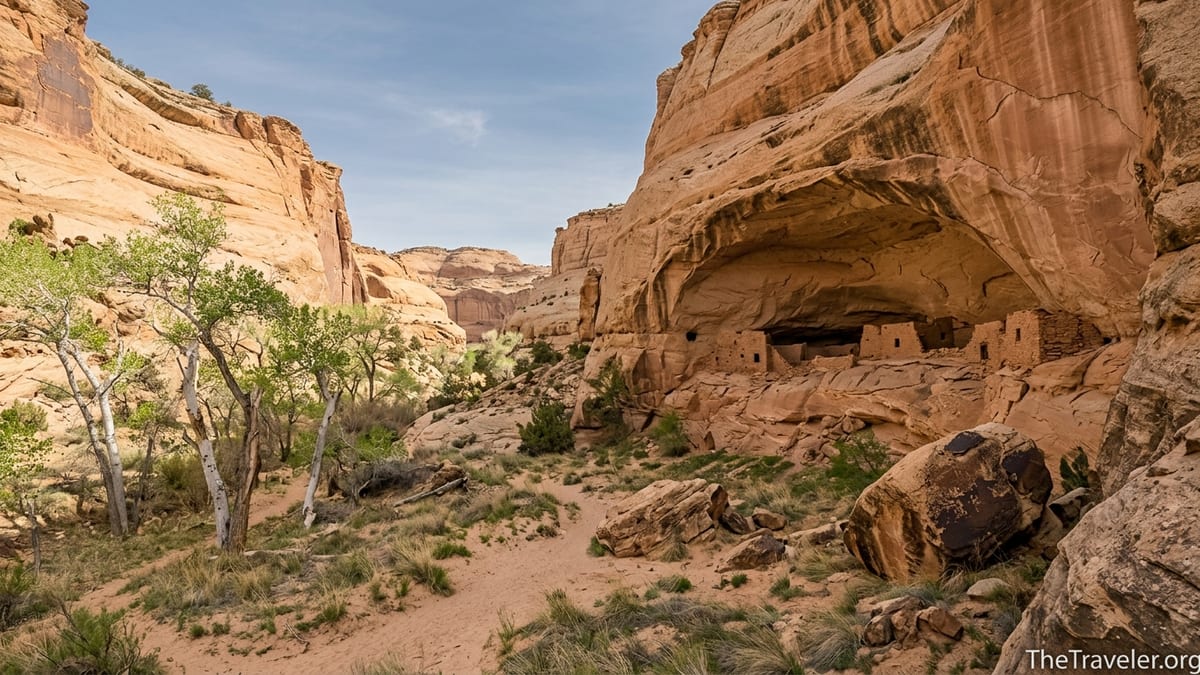
A Cliff Dwelling at the Heart of Grand Gulch
Junction Ruin sits precisely where Kane Gulch empties into Grand Gulch in the Cedar Mesa backcountry of Bears Ears National Monument. From the rim, the mesa looks like a simple pinyon and juniper forest. Drop into the canyon and the landscape transforms into overhanging alcoves, pour-offs, and meandering washes that have sheltered people for thousands of years. Junction Ruin occupies one of the most commanding alcoves at this confluence, a natural crossroads that helped shape its importance.
Travelers reach the site by hiking roughly 3.7 to 4 miles one way from the Kane Gulch Ranger Station trailhead along Utah Highway 261, about a 40-minute drive from the small town of Blanding. The trail loses a modest 500 to 600 feet of elevation as it follows Kane Gulch downstream to Grand Gulch, making Junction Ruin one of the most approachable major sites in this remote canyon system for fit day hikers. The moment the canyon opens at the junction and the ruin comes into view under the cliff is often when visitors realize just how extensive the site is.
Unlike many single-room granaries tucked high on ledges, Junction Ruin sprawls across a broad alcove, with multiple levels of masonry rooms, storage areas, and middens spread along the cliff. Some rooms perch on ledges above the main floor while others hide back in shadowed recesses, giving travelers an immediate sense that generations of families lived and stored their food here over a long span of time. Viewed from the wash, the dwelling is both intimate and monumental, a compact village nested into the rock itself.
The surrounding canyon amplifies the site’s impact. Sheer sandstone walls, desert varnish streaks, and cottonwoods clustered along the wash frame the ruin in a way that is hard to capture in photographs. In spring, when willows leaf out and pools linger in the potholes, the sounds of water and canyon wrens echo off the alcove, hinting at why ancestral inhabitants chose this place as a home.
A Rarely Matched Density of Visible History
Part of what makes Junction Ruin so fascinating is how much you can see and understand from a single vantage point. Many Cedar Mesa sites require long, technical days or multi-day backpacks to fully appreciate. By contrast, Junction Ruin offers a condensed introduction to the human story of Grand Gulch that can reasonably fit into a single day for prepared hikers.
Within a short walking radius of the junction, travelers can spot the remains of masonry structures, possible kiva depressions, middens, and shards of pottery weathering out of the soil. Even though current guidance strongly discourages handling artifacts, the simple fact that ceramic fragments and shaped stone still rest near where they were used centuries ago drives home the continuity of place. Visitors will also notice the difference between darker, soot-blackened alcove ceilings and lighter rock, tangible signs of long-term habitation.
Beyond the main cluster of rooms, the canyon walls around Junction Ruin preserve rock art and smaller ancillary structures tucked into side alcoves. Many hikers pair a visit here with a short continuation deeper into Grand Gulch to see Turkey Pen Ruin, another significant cliff dwelling roughly a mile farther, turning the day into a living gallery of ancestral architecture. For a single permit fee and a day of effort, travelers can encounter more intact, uncommercialized cultural sites than most roadside viewpoints offer anywhere in the Southwest.
Because Junction Ruin lies in a primitive management area, there are no interpretive signs or built overlooks. That absence of infrastructure means each visitor must slow down and interpret the setting for themselves, ideally using printed resources from Kane Gulch Ranger Station or guidebooks picked up in towns like Blanding or Monticello before heading out. The result is an experience that feels more like stumbling upon an outdoor museum in situ than touring a developed historic site.
Understanding the Ancestral Puebloan Story
Junction Ruin is fascinating not only for what remains but for the human story it hints at. Archaeologists consider Grand Gulch and the broader Cedar Mesa region to be a critical area for understanding Ancestral Puebloan life between roughly 700 and 1300 CE. Sites here record shifts from earlier Basketmaker periods, when people lived in pithouses and relied heavily on hunting and gathering, to later Pueblo periods, when communities built more formal masonry villages and intensively farmed maize, beans, and squash.
Standing below Junction Ruin, travelers can see how the architecture reflects these changes. Many rooms are rectangular, with carefully laid sandstone blocks and mud mortar, similar to classic Pueblo III masonry seen at better-known locations like Mesa Verde and Chaco Canyon. Storage rooms tucked higher in the alcove likely protected precious corn and seeds from rodents and moisture. The strategic positioning above the canyon floor provided both defensibility and access to fields that would have been cultivated on benches and along the wash below.
The site’s location at a junction underscores how interconnected these communities were. Canyons like Kane Gulch and Grand Gulch functioned as travel corridors linking small settlements, seasonal camps, and field houses scattered throughout Cedar Mesa. Junction Ruin would have given its residents visual control of traffic moving up and down the main canyon and into tributaries, while still providing relative seclusion under the alcove. For modern hikers, tracing these routes on foot offers a visceral sense of how people moved through and understood this labyrinth of stone.
Junction Ruin also prompts questions rather than simple answers. Like many sites in the region, it appears to have been largely abandoned by the late 1200s, part of the wider depopulation of the northern San Juan region. The reasons remain complex and debated, ranging from prolonged drought and resource stress to social and religious realignments that prompted migration to areas along the Rio Grande, the Hopi Mesas, and other parts of the Southwest. Spending time quietly at the site, hearing only wind and ravens, many travelers report feeling both awe and a poignant sense of departure.
How to Reach Junction Ruin and What the Hike Is Really Like
Reaching Junction Ruin starts at Kane Gulch Ranger Station on Cedar Mesa, just off Utah Highway 261. Most visitors overnight in nearby Blanding or at simple roadside camping areas on Cedar Mesa, then drive 30 to 60 minutes to the ranger station to begin their hike. Parking is straightforward at the small lot, though in peak spring and fall seasons it can fill by mid-morning, so early arrival is sensible.
The out-and-back hike to Junction Ruin typically runs 7.5 to 8 miles round trip. The first mile follows a shallow wash and slickrock ledges before the canyon deepens. Travelers should expect sandy stretches, occasional rock steps, and a few minor ledges but no technical climbing. In spring, small pools or trickles may flow, creating muddy sections. The BLM describes the hike as easy to moderately difficult, but summer heat, a full backpack, or infrequent hikers can experience it as more strenuous than the mileage suggests.
Many visitors treat Junction Ruin as a day hike, starting between 8 and 10 a.m., eating lunch in the shade near the ruin, and hiking out in the afternoon. Fit hikers who begin early and move quickly may continue past Turkey Pen Ruin toward features like Stimper Arch before turning around, creating a roughly 10-mile day. Others choose to incorporate Junction Ruin into a multi-day Grand Gulch backpack, camping downstream at designated sites and exploring side canyons such as Bullet Canyon or Collins Canyon.
Conditions vary by season. In March and April, temperatures are usually cool and daylight generous, but lingering snowmelt or spring storms can make the drive in and out on unpaved side roads messy. By May and into September, daytime highs can be intense, and the exposed stretches of the hike demand early starts, wide-brimmed hats, and ample water. While natural pools may exist in the canyon, travelers should carry at least three liters per person for a day trip and treat any surface water they do use.
Permits, Regulations, and Visiting with Respect
One of the reasons Junction Ruin remains so compelling is that it sits in a landscape managed deliberately to protect cultural resources. Day hiking in Grand Gulch and other Cedar Mesa canyons requires a day hiking pass, which travelers can usually obtain either in advance through the national reservation system or in person at Kane Gulch Ranger Station when it is open. Overnight backpacking permits are more limited, commonly capped at around 20 people per trailhead per day across the different canyons, and carry a per-person fee that helps fund management and trailhead facilities.
At the ranger station, staff often ask visitors to watch a brief “Visit with Respect” video before issuing permits. This orientation goes beyond the usual Leave No Trace principles to address the particular vulnerabilities of archaeological sites. Travelers are reminded to stay on durable surfaces to avoid crushing biological soil crusts, to keep a respectful distance from walls and structures, and to never sit, climb, or lean on ruins, no matter how sturdy they appear.
Artifact etiquette is equally crucial. At Junction Ruin, it is common to see pottery sherds, stone flakes, and other cultural materials on the ground. Regulations require visitors to leave everything where it lies, refraining from handling or gathering items into “display piles.” Even gently picking up a sherd for a closer look can accelerate erosion and disrupt the archaeological record, especially when thousands of visitors arrive over many seasons.
Other rules help preserve the sense of remoteness and cultural integrity. Campfires are often prohibited in Grand Gulch and its tributaries because of scarce downed wood and the risk of permanent fire scars. Dogs are generally not allowed on some of the key archaeological trails in Cedar Mesa. Drones are banned within Bears Ears National Monument without a special permit, a regulation designed in part to protect the privacy and spiritual values associated with sites like Junction Ruin. Understanding and embracing these rules is part of what makes a visit meaningful rather than extractive.
Experiencing Solitude in a Living Cultural Landscape
The appeal of Junction Ruin is not just architectural; it is experiential. Unlike heavily visited parks where tour buses and railings shape every encounter, Grand Gulch still offers a measure of solitude that surprises many first-time visitors. On a midweek day in April, you might pass only a handful of other parties between Kane Gulch Ranger Station and Junction Ruin. Sit quietly in the alcove’s shade and the loudest sounds are likely to be canyon wrens, the flutter of raven wings, or the rustle of cottonwood leaves in a breeze.
This solitude amplifies the site’s emotional charge. Travelers frequently describe an almost time-suspended quality to the hours spent exploring Junction Ruin and the nearby canyon walls. The absence of road noise, cell coverage, and built structures beyond the ancient masonry encourages a more reflective pace. Many visitors choose to keep their group conversations hushed near the ruin out of deference to its cultural significance, treating it more like an outdoor sanctuary than a casual picnic spot.
At the same time, Junction Ruin is part of an actively living cultural landscape for contemporary Native communities, including Navajo, Hopi, Ute, and Pueblo peoples with ongoing ties to Bears Ears. Trip planning resources increasingly encourage travelers to recognize that sites like this are not abandoned relics, but places that remain woven into oral histories, ceremonies, and modern identity. Approaching the ruin with humility and curiosity, rather than as a checklist destination, is a small way to honor that continuity.
For many travelers, this combination of solitude, cultural depth, and wildness sets Junction Ruin apart from more developed archaeological attractions. It is one thing to gaze across a fenced overlook at a world-famous cliff dwelling and quite another to walk miles through a twisting canyon to reach a site that still feels largely held by the landscape.
Practical Tips for a Safe and Meaningful Visit
Because Junction Ruin is reached by a backcountry trail in a desert canyon, realistic preparation matters. Even for a day hike, travelers should carry at least three liters of water per person in spring and fall, more during hotter spells. Lightweight sun protection such as a wide-brimmed hat, long-sleeve shirt, and sunglasses will make the exposed sections of Kane Gulch more comfortable. Sturdy shoes with good traction are essential, as sections of the trail traverse uneven slickrock, sand, and eroded slopes.
Most visitors find trekking poles useful on the descent and ascent, especially when carrying a daypack loaded with water, lunch, and extra layers. Weather can shift quickly on Cedar Mesa. A clear morning can give way to a gusty, cool afternoon, so packing a light wind shell or fleece, even in late spring, is wise. In shoulder seasons, freezing nights and icy patches in shaded alcoves are not unusual, particularly on north-facing slopes or after storms.
Navigationally, the Kane Gulch trail to Junction Ruin is generally straightforward. Well-used tread, occasional cairns, and the natural confines of the canyon keep hikers oriented. Still, printed maps picked up at Kane Gulch Ranger Station or downloaded topographic maps on a GPS app provide useful backup, especially for those considering longer itineraries that combine multiple canyons. Cell coverage is sporadic to nonexistent once you leave the highway, so travelers should plan to be self-sufficient.
Respect for quiet and space is part of good trail etiquette at a site like Junction Ruin. When you arrive at the alcove and find another small group already sitting in the shade, consider lingering at the canyon floor for a few minutes to let them finish, or quietly exploring adjacent features before approaching the main ruin. Keeping group sizes small and voices low helps everyone experience the sense of discovery that makes this place special.
The Takeaway
Junction Ruin is one of the rare places where a reasonably fit hiker can, in a single day, step directly into the deep-time story of the Colorado Plateau. Its cliff dwellings, set at a natural crossroads in Grand Gulch, compress centuries of Ancestral Puebloan life into a single sweeping alcove. The hike from Kane Gulch Ranger Station is demanding enough to feel earned but accessible enough that careful, well-prepared travelers can experience it without specialized gear or guides.
Just as importantly, the way Junction Ruin is managed keeps it from feeling like a museum behind railings. The requirement to secure a simple day pass, sit through a short orientation, and hike several miles to reach the site filters visitation to those willing to engage with the landscape on its own terms. In an era when many destinations are overwhelmed, Junction Ruin remains quiet, contemplative, and profoundly instructive.
For travelers willing to respect both the land and the living cultures connected to it, a day at Junction Ruin can be transformative. It is not simply another ruin to photograph, but a vantage point from which to glimpse how deeply human history is etched into Cedar Mesa’s canyons and how urgently that story deserves careful, humble attention.
FAQ
Q1. Where exactly is Junction Ruin located?
Junction Ruin sits at the confluence of Kane Gulch and Grand Gulch in the Cedar Mesa area of Bears Ears National Monument in southeastern Utah, reached from the Kane Gulch Ranger Station trailhead off Utah Highway 261.
Q2. How difficult is the hike to Junction Ruin?
The hike is generally rated easy to moderate: about 7.5 to 8 miles round trip with roughly 500 to 600 feet of elevation loss and gain, on uneven canyon trail with sand, slickrock, and short ledges.
Q3. Do I need a permit to visit Junction Ruin?
Yes. Day hiking in Grand Gulch requires a day hiking pass, and overnight trips require a backpacking permit. These are typically obtained through the national reservation system or at Kane Gulch Ranger Station when it is staffed.
Q4. Can Junction Ruin be visited as a day trip?
Most travelers visit Junction Ruin as a day hike, starting in the morning from Kane Gulch Ranger Station, spending time at the site and nearby canyon features, and returning to the trailhead by late afternoon.
Q5. Is it safe to touch or enter the rooms at Junction Ruin?
No. Visitors are asked to stay off walls and rooftops, avoid entering rooms or kivas, and keep a respectful distance to prevent damage to fragile structures and cultural materials.
Q6. When is the best time of year to hike to Junction Ruin?
Spring and fall, roughly March through May and late September through October, usually offer the most comfortable temperatures. Summer heat can be intense, and winter conditions may bring ice, snow, or short daylight hours.
Q7. Are there services or water available along the trail?
There are no services and no guaranteed water sources along the route. Hikers should carry all the water they need for the day and treat any canyon pools with caution and proper filtration.
Q8. Can I camp near Junction Ruin?
Overnight camping in Grand Gulch is allowed only with a backpacking permit and within designated zones. Campers must follow specific rules about campsite locations, fires, and waste to protect archaeological resources.
Q9. Are dogs allowed on the hike to Junction Ruin?
Regulations generally restrict pets in key archaeological canyons of Cedar Mesa. Travelers should check current rules with the Bureau of Land Management or Kane Gulch Ranger Station before planning to bring a dog.
Q10. How can I help protect Junction Ruin during my visit?
Stay on durable surfaces, keep off structures, leave all artifacts where they are, pack out all trash and waste, avoid creating new social trails, and maintain a quiet, respectful presence at the site.