


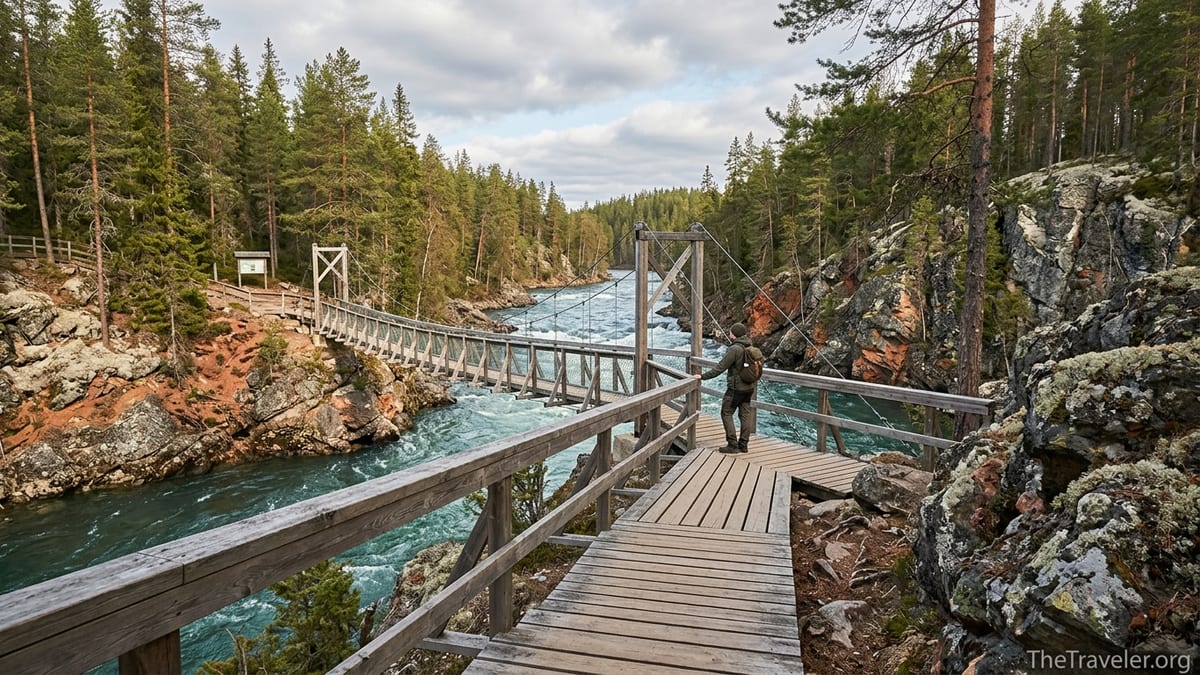
Oulanka National Park in north‑eastern Finland looks straightforward in the photos: wooden suspension bridges, turquoise rapids and the famous Karhunkierros hiking trail. In reality, first-time visitors are often surprised by how remote the park feels, how quickly conditions change and how different the logistics are from a typical European nature getaway. If you are planning your first trip, understanding what people usually miss will save you money, stress and in some cases a potentially dangerous mistake.
Get the latest updates straight to your inbox!
Oulanka Is More Remote Than It Looks on the Map
Many travelers glance at the map, see names like Kuusamo, Ruka and Salla, and assume Oulanka is just a quick side trip from a Lapland city break. In practice, reaching the main trailheads involves several steps and more time than first-timers expect. You will likely fly or take the night train to a gateway town such as Kuusamo or Rovaniemi, then continue by regional bus or rental car to Ruka or directly to one of the park access points like Juuma or the Oulanka Visitor Centre. Even in summer, you can easily spend half a day in transit, especially if your flight into Kuusamo arrives after the main daytime buses.
Public transport exists but is not set up primarily for tourists. From Kuusamo or Ruka you may find only a couple of daily buses heading toward trailheads like Juuma or the Oulanka Visitor Centre, with schedules that change seasonally and often do not align neatly with flights. Some services run mainly on school days or ski season weekends. Travelers arriving in March for winter activities sometimes discover that the afternoon bus they were relying on does not run in shoulder months, forcing them into last-minute taxi rides that can easily cost as much as a budget flight.
Car rental is common among Finns visiting Oulanka, and for good reason. A compact rental car from Kuusamo or Rovaniemi usually gives you the flexibility to reach lesser-known access points such as Ristikallio and Harjulampi and to adjust plans quickly if weather closes a trail or you misjudge distances. Winter drivers need to be comfortable with snow and ice, but cars are equipped with proper winter tires and main roads are generally well maintained. If you do not drive, build slack into your itinerary and confirm bus times for your specific dates rather than relying on examples you find in older blog posts.
Another point first-timers miss is that there is no single “park gate” with an admission booth. Oulanka sprawls across a large area shared by the municipalities of Kuusamo and Salla. You can enter the national park from multiple trailheads, each with its own small parking area and information boards. This is liberating for experienced hikers who plan multi-day routes, but it means you should know exactly which access point you are heading for on arrival day, rather than just telling a taxi driver “Oulanka.”
Seasonality Changes Everything, Not Just the Scenery
Travelers often choose their dates based on one picture: autumn colors on Pieni Karhunkierros, summer midnight sun or frozen Kiutaköngäs in January. What many do not realize is how completely the park’s logistics, trail conditions and even packing list change with the season. Summer from roughly June to early September brings long daylight, open trails and the easiest conditions for first-time hikers. You can complete classic routes like the 12 kilometer Pieni Karhunkierros loop from Juuma in a relaxed day, refilling water from streams when safe and taking time for photos on the suspension bridges.
Spring and autumn shoulder seasons look romantic on camera, especially late September when birch forests turn golden. On the ground, however, these periods can be the most challenging. In May and early June snowmelt and rain turn some sections of Karhunkierros into mud and boardwalks can be slippery. In October you may find snow at higher points, icy wooden steps and short daylight that squeezes even a modest day hike into a narrow window between a late sunrise and early sunset. Visitors who arrived thinking “it is just a 12 kilometer loop” sometimes underestimate how much slower they will move with ice and mud underfoot.
Winter is another world again. While some shorter trails are marked for snowshoeing or skiing, and guided day trips from Ruka and Kuusamo take visitors safely to viewpoints and frozen rapids, independent hikers cannot simply show up in hiking boots and attempt summer routes. The famous 80 kilometer Karhunkierros through-hike is for experienced winter trekkers with appropriate gear and safety knowledge. Temperatures can drop well below freezing, daylight is limited in December and January, and a minor route-finding mistake can have serious consequences. First-timers who mainly want to photograph frozen waterfalls are usually better off booking a local guide for a half-day trip to Kiutaköngäs or Myllykoski rather than venturing deep into the forest alone.
One more seasonal factor first-timers underestimate is insects. In early to mid-summer, especially around late June and July, mosquitoes and midges thrive around Oulanka’s rivers and wetlands. With the right clothing and repellent, they are manageable, but hikers who arrive in shorts and sleeveless tops often find breaks at scenic lean-to shelters less relaxing than expected. Shoulder seasons in late May and September can offer a sweet spot of fewer insects and manageable trail conditions, though exact timing varies from year to year.
Karhunkierros Is Not Just One Trail and It Is Easier to Overcommit Than You Think
Most people hear about Oulanka through the name Karhunkierros, often translated as the Bear’s Trail, and assume it refers to a single hike you can adjust to any fitness level. In reality, Karhunkierros is a network of routes that range from the famous multi-day 80 kilometer through-hike between Hautajärvi and Ruka to shorter day routes that share sections of the main trail. The 12 kilometer Pieni Karhunkierros loop from Juuma is the most popular first-time option, with wooden stairs, suspension bridges and rapids like Myllykoski that appear in most promotional photos.
Where beginners get caught out is in assuming that Finnish distance signs and modest elevation numbers mean an easy stroll. The park’s wooden staircases can be steep and long, especially on Pieni Karhunkierros, and after rain or in early winter they are very slippery. A visitor who comfortably walks 15 kilometers on urban paths may find that 12 kilometers in Oulanka with repeated steep climbs, uneven roots and photo stops at viewpoints ends up taking the better part of a full day. Families with younger children or anyone with knee issues should factor in extra time for steps and consider turning back early if energy is fading.
The long 80 kilometer Karhunkierros through-hike is a classic trek that attracts hikers from across Europe, but first-time visitors sometimes underestimate its remote character. There are wilderness huts and designated camping areas, but there are no cafés every few kilometers and no quick exits to a road in many sections. On some days you may see only a handful of other hikers outside peak season. If you are used to hut-to-hut walks in the Alps where every col has a restaurant and a cable car, adjust your expectations. In Oulanka, self-sufficiency is key. You need to be comfortable carrying food for several days, treating water and making conservative decisions about weather and fatigue.
Another subtle point many people miss is how important it is to match your route to your transport. For example, doing a one-way section of Karhunkierros from Ristikallio to Oulanka Visitor Centre is a wonderful day hike, but only if you have arranged a car shuttle or taxi at one end. Public buses do not wait at trailheads and schedules can leave large gaps. Before setting off on any linear route, confirm not just distances and daylight but also how you will get back to your accommodation. Otherwise, what was meant to be a scenic one-way walk can turn into an exhausting or even risky forced march back along a road at dusk.
Free Wilderness Infrastructure Still Comes With Hidden Costs
One of the biggest surprises in Oulanka, especially for visitors from countries where national parks charge entrance fees, is that access to the park and most facilities is free. There is no ticket booth, and you are allowed to use marked trails, lean-to shelters and campfire sites without paying a daily fee. For budget-conscious travelers this can make Oulanka seem like a remarkably affordable destination. You can wild camp at designated spots, cook over campfire sites using your own food and enjoy long days in pristine nature without ever taking out your wallet.
However, first-timers often overlook the indirect costs that can add up quickly. If you do not have your own camping gear, renting a tent, sleeping bag and stove in Kuusamo or Ruka can be expensive compared with southern European destinations. A basic cabin or guesthouse room in the Kuusamo region can start around moderate prices per night in shoulder seasons and rise significantly during peak holiday weeks and winter ski season. Grocery prices are also higher than many visitors expect, especially for imported goods, and eating every meal at restaurants in Ruka can quickly outstrip your flight cost.
Transport is another hidden cost. A one-way regional taxi ride from Kuusamo to a remote trailhead such as Hautajärvi or Ristikallio can easily cost more than a night’s accommodation in a midrange guesthouse. Even short rides between Ruka and nearby starting points add up if you rely on taxis for every move. If you are on a tight budget, it is worth planning hikes that start and end from the same place or that connect to bus stops in Kuusamo or Ruka, and consolidating taxi use to only the most necessary transfers.
Finally, remember that “free” infrastructure comes with responsibilities. Firewood is provided at many lean-to shelters, but you are expected to use it sparingly and only in designated fire pits, observing any seasonal fire restrictions. Waste bins may not be available at every site, so you need to pack out your rubbish, including food scraps and toilet paper. Travelers used to serviced campgrounds with daily cleaning sometimes leave more impact than they realize. In Oulanka, the expectation is that you leave each shelter, hut and campsite as clean or cleaner than you found it.
Weather, Safety and Navigation Are Easy to Underestimate
Photos of sunny summer days can give the impression that Oulanka is a gentle, forgiving place to hike. While the park is well managed and trails are clearly marked, conditions can change fast and the environment deserves respect. Even in July temperatures can drop sharply with a passing rain front, and on exposed riverbanks wind can make wet hikers feel chilled quickly. Many first-timers set out with only a light sweater, forgetting that even a short stop at a viewpoint or a wait for a bus in the evening can feel long and cold when you are damp.
Navigation is straightforward on main routes like Pieni Karhunkierros and the most trodden sections of Karhunkierros, where orange markers guide you clearly. Problems tend to arise when hikers wander off trail toward unofficial viewpoints, follow faint tracks that lead to private cabins or cut corners across marshy ground. GPS apps and downloaded maps are helpful, but batteries drain faster in cold weather and dense forest can reduce satellite accuracy. Carry a paper map from the Oulanka or Karhunkierros visitor centres and know how to orient it. If visibility drops in snow or fog, conservative decisions and a willingness to turn back are more valuable than any gadget.
Another safety aspect newcomers often overlook is river and bridge etiquette. Suspension bridges are a highlight of Oulanka, but they are narrow and can sway when several people cross at once. In peak season there can be queues at famous bridges, and impatient hikers sometimes push on when the bridge is already loaded. It is safer to cross in small groups and to wait until anyone coming the other way has cleared the span. In spring when water levels are high, currents around rapids like Kiutaköngäs and Jyrävä are powerful, and slipping too close to the edge for a photo is a bad idea. There are fenced viewpoints for a reason.
Emergency services in Finland are reliable, but response times in a remote national park are not instantaneous. Mobile coverage is generally decent on higher ground and near main routes but can be patchy in ravines. If you are undertaking any hike longer than a few hours, make sure someone at your accommodation or at home knows your planned route and expected return time. Many seasoned visitors also carry a simple first-aid kit with blister care, bandages and pain relief; small issues like a twisted ankle or severe blisters can quickly turn into big problems far from a road.
Local Culture, Facilities and Etiquette Around the Park
Oulanka does not exist in a vacuum; it sits in a region where forestry, reindeer herding and rural life shape the landscape. First-time visitors often focus solely on trail maps and forget that they are moving through an area where people live and work. You may see semi-domesticated reindeer along roads or even on trails, and they have right of way. Stopping to take photos is fine as long as you do not chase or feed them. Gates and fences you encounter outside the park boundaries are usually related to reindeer herding and should be left exactly as you found them.
Visitor centres in and around Oulanka are more than just information points. They often host small exhibitions on local nature and culture, offer up-to-date trail conditions and sometimes rent gear or sell simple hot meals and snacks. First-time visitors who bypass them miss out on the most current advice, such as warnings about a washed-out boardwalk or a section of trail temporarily closed for maintenance or nesting birds. Stopping in at the Oulanka Visitor Centre on your first hiking day can prevent unexpected detours later in the trip.
In nearby Kuusamo and Ruka you will find a spectrum of facilities, from large supermarkets and outdoor shops to cafés and ski resort amenities. However, once you leave these hubs and drive toward smaller trailheads or villages, services thin out quickly. Gas stations become occasional rather than frequent, and small roadside cafés may have limited opening hours outside peak seasons. It is wise to fill your fuel tank and stock up on food in Kuusamo or Ruka before heading deeper into park surroundings, rather than assuming you will stumble upon a shop along the way.
Respect for quiet and cleanliness is taken seriously in Finnish nature. Many wilderness huts and lean-to shelters operate on an unwritten code: make space for newcomers, keep noise low at night, and do not monopolize indoor bunks with unnecessary gear if others arrive late. Alcohol is not forbidden but heavy drinking around shared campfires is frowned upon. If you are traveling with a dog, check local rules; in many parts of the year dogs must be kept on a leash to protect wildlife and other visitors’ experience.
The Takeaway
Oulanka National Park rewards preparation. The very things that catch first-time visitors off guard its remoteness, changeable seasons, demanding trails and minimalist infrastructure are also what make it special. This is not a theme-park version of wilderness but a real slice of northern Finnish nature where rivers still carve their way through deep gorges and long-distance trails can feel genuinely wild only a few hours from major transport routes.
If you understand that getting there takes planning, that 12 kilometers on wooden stairs and roots is not the same as 12 kilometers in a city park, and that free wilderness facilities come with personal responsibility, your first trip to Oulanka can be memorable for all the right reasons. Choose your season with open eyes, match your routes to your experience, and give yourself enough time to move at nature’s pace rather than your smartphone calendar’s. Do that, and Oulanka is likely to become one of those rare places you start planning to return to even before you have left.
FAQ
Q1. Do I need a car to visit Oulanka National Park for the first time?
It is possible to reach Oulanka using buses and taxis from Kuusamo or Ruka, but a rental car gives you far more flexibility, especially for less frequented trailheads and in shoulder seasons when public transport is limited. First-time visitors who want to explore more than one main route in a short trip usually find a car highly convenient.
Q2. How many days should a first-time visitor spend in Oulanka?
For a relaxed first visit that includes at least one full day hike such as Pieni Karhunkierros, plus time for shorter walks or a guided activity, plan a minimum of two full days on the ground. If you hope to tackle a longer section of Karhunkierros or want contingency time for bad weather, three to four days is more realistic.
Q3. Is Oulanka suitable for beginners or families with children?
Yes, as long as you choose routes that match your fitness and experience. Shorter nature trails near visitor centres and the Pieni Karhunkierros loop can be good options for active families, but steep stairs and uneven terrain mean you should allow extra time and pack snacks, layers and basic first-aid items.
Q4. When is the best time of year for a first visit?
Late June to early September is usually the easiest period for first-time visitors, with snow-free trails, long daylight and full services in nearby towns. Late September can be wonderful for autumn colors, but cooler temperatures, shorter days and occasional ice require more care and warmer clothing.
Q5. Can I hike Karhunkierros without a guide?
Experienced hikers with good navigation and camping skills regularly complete both the 12 kilometer Pieni Karhunkierros and the full 80 kilometer Karhunkierros independently in summer. First-timers who are unsure about multi-day trekking or who visit in winter often benefit from hiring a local guide for at least their first long outing.
Q6. Are there entrance fees or permits for Oulanka?
There is no general entrance fee to Oulanka National Park, and day hikes on marked trails do not require permits. Costs mainly come from transport, accommodation, food and any rented gear or guided tours. Specific activities like fishing may require separate permits, so check current regulations before you go.
Q7. What kind of clothing and gear do I really need?
Even for day hikes in summer, you should bring sturdy footwear with good grip, a waterproof jacket, warm layers, a hat, gloves, water bottle, snacks and a small first-aid kit. In cooler seasons, add insulating layers, traction devices for icy paths if recommended locally, and a headlamp, as darkness can fall quickly.
Q8. Is it safe to visit Oulanka in winter as a first-timer?
Day visits to well-marked winter trails and viewpoints can be safe and rewarding if you dress properly for the cold, respect weather warnings and ideally join a guided trip for your first outing. Independent long-distance winter trekking in Oulanka is best left to experienced hikers with appropriate equipment and training.
Q9. Can I rely on my phone for maps and emergencies?
Phone-based maps and navigation apps are very useful and work much of the time, but coverage can be patchy and batteries drain fast in cold weather. It is wise to carry a paper map, keep your phone warm and charged, and let someone know your route and expected return time before you set out.
Q10. Are there food and water sources inside the park?
There are no restaurants deep inside the park, only occasional cafés near visitor centres or popular access points. You should carry your own food for the day and plan for safe water sources such as treated stream water or supplies carried from your accommodation. On multi-day hikes, assume full self-sufficiency between towns or roadheads.