


Far in the northeast of Finland, nudging the Russian border, Oulanka National Park quietly offers some of the most dramatic river scenery and rewarding hiking in the country. Yet it sees only a fraction of the visitors that crowd more famous Nordic hotspots. With roaring rapids, suspension bridges, spruce forests and a legendary long-distance trail running right through it, Oulanka has become a favorite among Finnish hikers and in-the-know international travelers looking for wilderness that still feels welcoming and well organized.
Get the latest updates straight to your inbox!
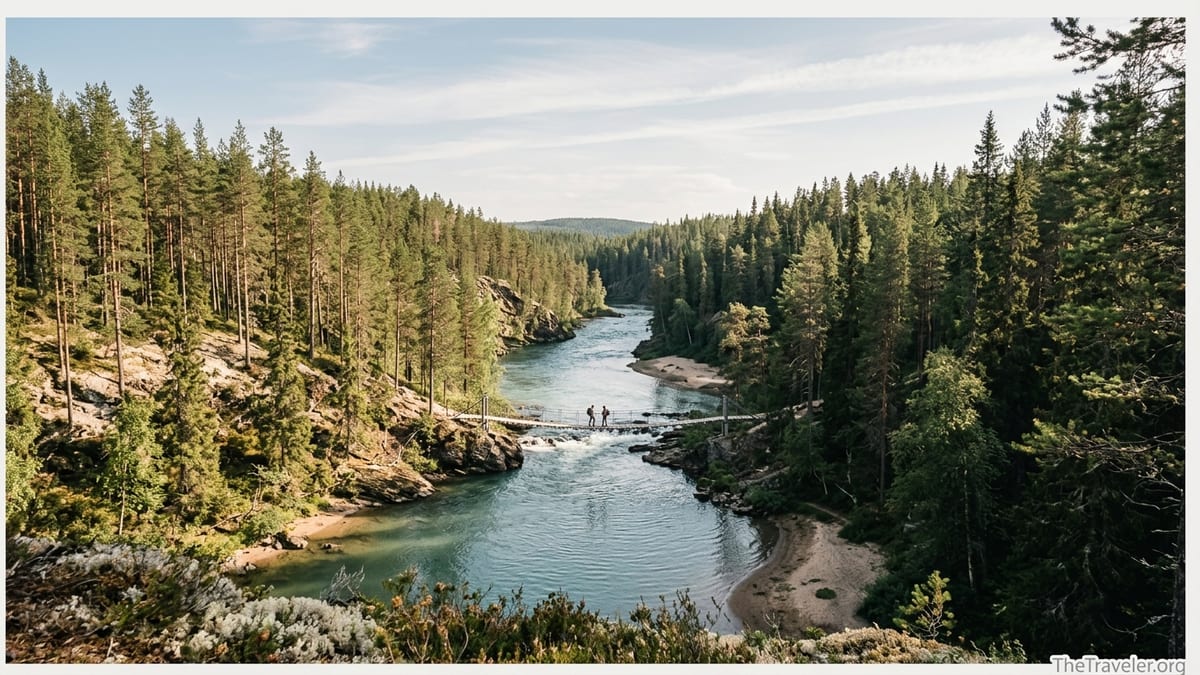
A Wild River Canyon Carved for Adventurous Travelers
At the heart of Oulanka’s appeal are its rivers. The Oulankajoki and Kitkajoki slice through soft sandstone and ancient bedrock, creating narrow canyons, sandy riverbanks and a chain of powerful rapids. One of the most iconic spots, Kiutaköngäs, lies only a short walk from Oulanka Visitor Centre and gives an immediate sense of the park’s power: a churning stairway of red rock and white water that remains dramatic even at low flow. In peak snowmelt, usually late May or early June, the roar of Kiutaköngäs can be heard well before you see it, and spray hangs in the air above the gorge.
Unlike some Finnish national parks that are defined by open fells or large lakes, Oulanka’s scenery feels surprisingly varied and intimate. A day hiker can start among tall Scots pines and spruce forest, cross a narrow suspension bridge above a foaming rapid like Myllykoski, then climb to a sandy, heath-covered ridge with broad views toward Russia. Short waymarked loops such as the Kiutaköngäs nature trail let visitors sample this variety in a couple of hours without needing multi-day hiking experience.
Despite its raw feel, the landscape is accessible. The main visitor hub, Oulanka Visitor Centre, is reachable by road from Kuusamo in under an hour and provides maps, trail updates and basic exhibits on the park’s geology and wildlife. Many international travelers arrive by plane to Kuusamo, pick up a rental car directly at the airport and are standing at the Kiutaköngäs viewpoint the same afternoon, combining real wilderness with straightforward logistics.
For those willing to go beyond the popular viewpoints, quieter corners of the park like the Savinajoki valley or the more remote northern sections of the Oulankajoki river feel truly off the beaten path. Here, trails are less crowded, and it is still common in shoulder seasons to hike for several hours and encounter only a handful of other people, especially on weekdays in May or late September.
Karhunkierros: Finland’s Legendary Bear Trail
Oulanka is most famous for the Karhunkierros, or Bear’s Round, Finland’s best-known long-distance hiking route. Running roughly 80 kilometers between Hautajärvi in the north and Ruka to the south, the trail spends much of its length inside or along the borders of Oulanka National Park. Over four to six days, hikers follow wooden duckboards, forest paths and riverside tracks past cliff walls, hanging bogs and swinging bridges.
While the full Karhunkierros is a serious undertaking that requires good fitness and the ability to carry a multi-day pack, it is also one of the best supported wilderness trails in the Nordic region. There are free open wilderness huts, reservable huts for a modest fee, and designated lean-to shelters with fire pits spaced roughly a day’s walk apart. Many Finnish hikers tackle the route in June or early July, starting from Hautajärvi after catching the dedicated Karhunkierros bus from Kuusamo or Ruka and finishing a few days later right at the ski village of Ruka where supermarkets, hotels and even a spa await.
For visitors who do not have the time or inclination for a full through-hike, Oulanka still offers a taste of the Bear Trail with its most famous section, the Pieni Karhunkierros or Small Bear Trail. This 12-kilometer loop near the village of Juuma combines almost all of Oulanka’s classic elements in a half-day outing: narrow canyons, multiple suspension bridges, waterfalls at Jyrävä, the photogenic old mill at Myllykoski and high viewpoints over the Kitkajoki river. Many travelers base themselves for two nights at a lakeside guesthouse in Juuma or at Basecamp Oulanka and spend one full day exploring the Small Bear Trail with plenty of time for photographs and picnic breaks.
Trail infrastructure is a major reason Oulanka’s routes feel welcoming. Waymarking is generally clear, bridges and duckboards are maintained, and popular routes are patrolled in high season. That said, distances between huts can still be significant, and long-distance hikers must be prepared for sections that feel wild and remote, especially in bad weather. Spring snow patches, autumn frost and slippery roots on steep descents around Juuma remind visitors that the Karhunkierros, despite its popularity, is still a proper backcountry trail.
Four Distinct Seasons in an Accessible Arctic Landscape
Oulanka’s setting in northeastern Finland gives it a pronounced seasonal rhythm that transforms the park several times a year. In late May and June, the combination of snowmelt and long daylight hours creates rushing rivers, cool nights and often surprisingly mild daytime temperatures around 10 to 18 degrees Celsius. This is when rapids like Kiutaköngäs and Myllykoski are at their most impressive, and mosquitoes have not yet reached their peak, making it a favored window for experienced hikers and photographers.
July and early August are peak summer. Daytime temperatures often sit in the high teens, sometimes pushing above 20 degrees, and the forest is at its greenest. This is prime time for families and casual hikers, and it is when the Small Bear Trail can feel busy, especially on sunny weekends. Local operators based in Ruka and Juuma run guided rafting trips on the Kitkajoki, gentle canoe excursions on calmer sections and even evening photography tours that focus on sunsets over Ala-Juumajärvi or the quieter bends of the Oulankajoki river.
By early September, the ruska, or autumn color season, begins. Birches turn bright yellow, blueberries carpet the forest floor with both fruit and red leaves, and the air turns crisp. Many Finns consider mid to late September the best time to hike in Oulanka, especially for sections of the Karhunkierros. Days are shorter, but trails are calmer than in July and bugs are generally minimal. The trade-off is rapidly changing weather: clear sunshine can flip to sleet in a day, so hikers bring layers, waterproofs and warmer sleeping bags if camping.
Winter transforms Oulanka into a very different destination. From December through March, the park is draped in deep snow, and temperatures can regularly fall below minus 15 degrees Celsius. The rivers continue to flow but are framed by thick ice formations and snow-covered banks. Dedicated winter routes like the Rytisuo snowshoe trail or the Oulanka Wilderness Trail between Juuma and Kiutaköngäs give access to this frozen landscape, usually on packed snow tracks suitable for snowshoes or backcountry skis. Many visitors combine a day in Oulanka with a stay in nearby Ruka, taking advantage of ski resort amenities while still experiencing a national park winter.
Real-World Experiences: Rafting, Wildlife and Local Culture
What sets Oulanka apart from other Finnish parks is how easy it is to build a trip that mixes self-guided hiking with organized experiences. For example, a couple staying three nights at a lakeside cabin in Juuma in July might spend their first day walking the Small Bear Trail, their second day on a guided rafting trip with a local outfitter starting at Basecamp Oulanka and finishing with a sauna and swim, and their third day exploring shorter trails near Kiutaköngäs before continuing on to Rovaniemi or the Arctic Ocean.
Rafting and river trips are a particular highlight. Operators based at Basecamp Oulanka and in Ruka offer different grades of trips, from gentle scenic floats suitable for families with children to more intense whitewater runs that tackle the Oulanka and Kitka rapids at higher flows. A typical scenic route might last three to four hours, including transport, gear and a break for snacks around a campfire on a riverbank lean-to. Prices vary by company and season, but visitors can expect to pay a moderate per person fee comparable to other Nordic rafting destinations, with discounts often available for children or groups booking from Ruka hotels or holiday apartments.
Wildlife watching in Oulanka is more about quiet observation than guaranteed sightings. The park supports species such as reindeer, elk, otter and occasional large carnivores in the wider region, but many visitors experience wildlife through signs and sounds: woodpeckers drumming on dead pines, the tracks of a hare in fresh snow or the soft call of a Siberian jay on a misty autumn morning. Birdwatchers sometimes focus on the riverside habitats where rare plants and insects occur, continuing a long tradition of Oulanka as a site of scientific research as well as recreation.
Local culture is never far away. The nearby town of Kuusamo and the Ruka ski resort blend tourism with year-round community life. Many small guesthouses around Juuma and Käylä are family run, serving hearty Finnish dishes such as salmon soup, Karelian pies and reindeer stew to hungry hikers. It is common for guesthouse owners to share practical advice such as where the trail is muddy after heavy rain or which lean-to shelters have the best firewood. For international visitors, these conversations often become some of the most memorable moments of an Oulanka trip.
Getting There and Around: Remote but Not Inconvenient
One reason Oulanka is such an attractive outdoor destination is that it offers a genuine sense of remoteness without being especially hard to reach. For most international travelers, the simplest route is to fly into Helsinki and connect to a domestic flight to Kuusamo, which normally takes a bit over an hour. From Kuusamo airport, rental cars are readily available, and the drive north to Ruka or east toward Oulanka Visitor Centre follows good paved roads across forest and lake country.
Travelers relying on public transport still have options. Regular buses connect Kuusamo to Ruka, and seasonal services such as the Karhunkierros bus and local shuttles typically operate between late May and late September, linking Ruka, Juuma, Oulanka Visitor Centre and trailheads like Hautajärvi or Ristikallio on selected days. Schedules change from year to year, but it is common to find at least one connection per day in peak season that allows hikers to start or finish a section of the Karhunkierros without needing a private car. Because services can be limited outside summer and holiday peaks, visitors planning shoulder-season or winter trips should build in extra time and check timetables carefully in advance.
For those comfortable driving, having a car opens up more flexibility. A typical itinerary might see travelers collecting a rental car in Kuusamo, driving 30 to 40 minutes to Ruka for groceries and last-minute gear, then continuing about another 45 minutes to Juuma or Oulanka Visitor Centre. From there, many trailheads are within a short drive, and it is easy to combine short walks in several areas over a couple of days. Parking is generally free at official trailhead lots, though some private accommodations near popular access points may reserve spaces for their guests.
Winter visitors must factor in snow and ice. Roads in this part of Finland are well maintained, but conditions can still be challenging for those unfamiliar with winter driving. Rental cars in season are equipped with winter tires, and daylight hours in December and January are limited. Many travelers therefore choose to base themselves in Ruka, joining day tours to Oulanka that include transport, snacks and guiding, rather than driving themselves in the dark. By March, longer days and often clearer weather make self-drive visits more comfortable again.
Huts, Campgrounds and Sustainable Comfort in the Wilderness
Oulanka demonstrates how Finland blends wilderness access with a strong ethic of low-impact infrastructure. Along the Karhunkierros and key day trails, you will find lean-to shelters, fire pits, dry toilets and sometimes simple open wilderness huts, all designed to concentrate human impact and keep camping from spreading haphazardly across sensitive areas. Firewood is often provided at lean-tos and huts, with visitors expected to use it sparingly, follow posted rules and leave the area tidy for the next group.
For hikers who prefer a roof over their head, open wilderness huts can be a highlight. These rustic log cabins, typically offering wooden bunks, a stove and basic seating, are free to use on a first-come basis and cannot be reserved. In busy summer weeks or on popular weekends during the autumn color season, huts on the Karhunkierros can fill up early in the evening, so many hikers carry a tent as backup or plan their stages to include reservable huts or commercial lodges where available.
Front-country options are steadily improving. Oulanka Camping, located near the visitor centre on the Karhunkierros route, provides tent pitches, small cabins and services such as hot showers, a cooking shelter and equipment rental in season. Around Juuma, small private campgrounds and lakeside cabin clusters give easy access to the Small Bear Trail and river trips. At the more developed end of the scale, Ruka village functions as a year-round base with full-service hotels, apartments and holiday cottages, as well as outdoor shops where visitors can pick up last-minute gear like gas canisters, warm base layers or sturdier hiking socks.
This mix of facilities makes Oulanka accessible to a range of budgets and comfort levels. A backpacker might spend a week combining free huts and tent camping, buying groceries in Kuusamo and only occasionally paying for a campground shower, while another traveler might opt for a string of lakeside cabins and guided day hikes. What they share is a landscape that encourages walking and a park management system that emphasizes trail maintenance, visitor information and sustainable use over heavy commercialization.
Planning Your Visit: Practical Tips and Safety
As with any serious outdoor destination, the key to enjoying Oulanka lies in realistic planning. Even day hikes like the Small Bear Trail can feel demanding, with steep steps, slippery roots and multiple ascents and descents that surprise visitors expecting flat forest walks. Good footwear with decent grip, weatherproof outer layers and a small daypack with snacks, water and a basic first-aid kit make a big difference, even in summer. In spring and autumn, lightweight gloves, a beanie and an extra warm layer are wise, as temperatures can drop quickly in the evening.
Mosquitoes and other biting insects are part of the reality in early and mid-summer. While their numbers vary from year to year, most June and July visitors find it helpful to carry insect repellent and, for longer hikes or overnight trips, a head net or lightweight long-sleeved clothing. On the upside, berries are plentiful from late July into September, with blueberries and lingonberries carpeting many sections of forest floor. Under Finland’s Everyman’s Rights, visitors are generally allowed to pick berries and mushrooms for personal use, provided they respect park rules and do not damage vegetation.
Safety in Oulanka is largely about judgment and preparation rather than technical hazards. There are no high mountains or glaciers, but riverbanks can be steep, and water is cold even in summer. Swimming is possible in calmer lakes and river sections, but only for confident swimmers and not near rapids. Mobile phone coverage is decent along most main trails but can be patchy in deeper valleys, so hikers should not rely entirely on navigation apps and would be wise to carry a paper map and know the basics of using it.
Before setting out, visitors are encouraged to stop at Oulanka Visitor Centre or check official information channels, where up-to-date details about trail conditions, closures and any fire restrictions are posted. In warm, dry summers, open fires may be temporarily banned even at designated sites, which affects how hikers cook and plan their evenings. During shoulder seasons, bridge repairs or flood damage can occasionally reroute sections of trail, another reason to confirm conditions shortly before arrival rather than relying on older guidebooks or blogs.
The Takeaway
Oulanka National Park stands out among Finland’s outdoor destinations because it manages to be both wild and welcoming. The sculpted river canyons, thundering rapids and deep spruce forests feel far removed from city life, yet the park’s well-marked trails, huts and shelters make it a realistic goal even for travelers who are new to multi-day hiking. With the Karhunkierros trail offering a true long-distance challenge, the Small Bear Trail giving a half-day highlight reel of the park’s best scenery and the changing seasons reshaping the landscape several times a year, Oulanka rewards both quick visits and longer stays.
For anyone planning a trip to Finland that goes beyond the standard circuit of Helsinki, Lapland ski resorts and Santa attractions, Oulanka is a compelling addition. A few days here can be combined with Rovaniemi, the fells of nearby national parks or a road trip across northern Finland, offering a concentrated experience of wilderness, Nordic trail culture and river landscapes unlike anywhere else in the country. Whether you come for a single summer hike to Kiutaköngäs or commit to the full Bear Trail in autumn colors, Oulanka is likely to linger in your memory long after you have left its forests behind.
FAQ
Q1. Where is Oulanka National Park located in Finland?
Oulanka National Park lies in northeastern Finland, mainly in the municipality of Kuusamo, close to the Russian border and a few hours’ drive from Rovaniemi.
Q2. How do I get to Oulanka National Park without a car?
Most visitors without a car fly to Kuusamo, take a bus or shuttle to Ruka or Kuusamo town and then use seasonal buses or arranged transfers to reach Oulanka Visitor Centre, Juuma or Karhunkierros trailheads.
Q3. What is the best time of year to visit Oulanka?
June to early October is ideal for hiking, with roaring rivers in late spring, warm forest trails in high summer and spectacular autumn colors in September. December to March suits those interested in snowshoeing and winter scenery.
Q4. Do I need to be very fit to hike in Oulanka?
Short waymarked trails near the visitor centre and the Small Bear Trail are manageable for reasonably active visitors, though they include stairs and steep sections. The full Karhunkierros long-distance route requires good fitness and multi-day hiking experience.
Q5. Are there guided tours or activities available in the park?
Yes. Local companies around Juuma, Basecamp Oulanka and Ruka offer guided hikes, rafting and river trips, snowshoe excursions and photography outings, often including transport, gear and snacks.
Q6. Can I camp inside Oulanka National Park?
You can camp at designated sites along marked routes, including lean-tos and campfire areas, and at managed campgrounds near the visitor centre and Juuma. Wild camping outside these areas is restricted, so always follow current park guidelines.
Q7. Is Oulanka suitable for families with children?
Yes, especially in summer. Short trails, suspension bridges and safe viewpoints appeal to children, but parents should be prepared for uneven ground, stairs and supervise kids carefully near rapids and steep drops.
Q8. What kind of wildlife might I see in Oulanka?
Common sightings include birds such as woodpeckers, forest songbirds and occasionally grouse, as well as signs of mammals like reindeer, elk and hares. Large predators live in the wider region but are rarely seen by casual visitors.
Q9. Do I need special permits to hike the Karhunkierros trail?
No permits are required for individual hikers on the Karhunkierros, but you should check current rules, book any reservable huts well in advance if you plan to use them and register route details with your accommodation or contacts for safety.
Q10. How many days should I plan for Oulanka National Park?
Two to three days allow you to see highlights such as Kiutaköngäs and the Small Bear Trail. Hikers tackling the full Karhunkierros typically spend four to six days on the trail, often adding a night before and after in Ruka or Kuusamo.