


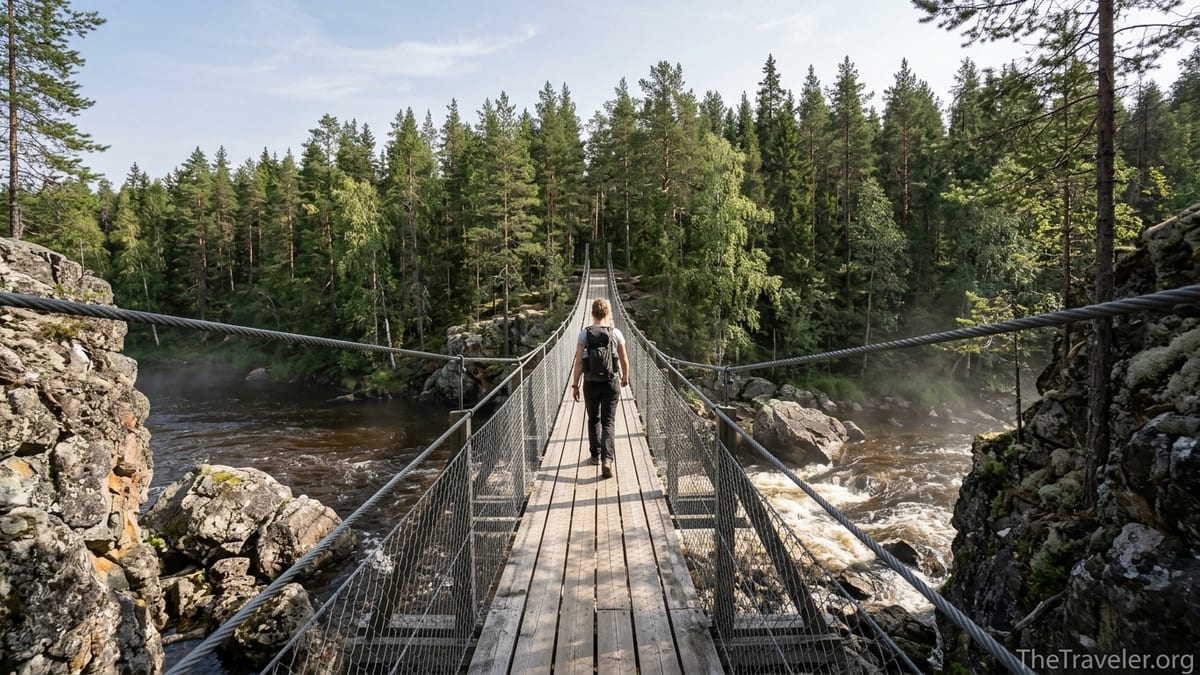
The first time I stepped onto a suspension bridge in Oulanka National Park, the Kitkajoki River was roaring so loudly below that it seemed to rise up through the wooden planks under my boots. The bridge swayed just enough to remind me that there was nothing but a mesh of steel cables and a strip of timber between me and the chocolate-brown water, foaming over hidden rocks. It was the moment my trip to Finland’s northeast stopped being an abstract plan penciled into a notebook and became something physical, visceral and unforgettable.
Get the latest updates straight to your inbox!
Finding Oulanka at the Edge of Finland’s Wild North
Oulanka National Park sits in Finland’s northeast, straddling the border of the Northern Ostrobothnia and Lapland regions and spreading out along the Oulankajoki and Kitkajoki river valleys. The nearest gateway town is Kuusamo, a small hub with an airport, supermarkets and gear shops, and the Ruka ski resort village about 25 kilometers to the north. From Ruka, the drive to Oulanka’s main visitor center takes roughly 30 to 40 minutes along good paved roads, which in summer are lined with birch and pine and, if you are lucky, a few wandering reindeer.
Most travelers arrive by flying into Kuusamo Airport, then taking a rental car or seasonal bus toward Ruka and on to the park. In summer there is usually a Karhunkierros trail bus and a Karhunkierros Express shuttle serving key trailheads and accommodations such as Basecamp Oulanka and Juuma village, making it possible to visit without renting a car if you time your days around the timetables. I used a combination of a rental car and the trail bus, which allowed me to hike linear sections without worrying about the return leg.
Oulanka is famous among hikers for the Karhunkierros, or Bear’s Trail, an 80 plus kilometer route that threads through river canyons, old-growth forest and high ridges. But you do not have to commit to a multiday trek to experience its signature features. The park’s nine suspension bridges are spread across several short and medium-length hikes, and with a bit of planning it is possible to cross three or four of them in a single long summer day without ever shouldering a heavy backpack.
Because this is a popular hiking area by Finnish standards, the infrastructure is excellent. Trails are clearly signposted, bridges feel solid underfoot, and there are maintained campfire sites, lean-to shelters and pit toilets at regular intervals. At the same time, once you step off the parking area and onto the path, it quickly feels wild. Phone reception is patchy, and the background soundtrack is more likely to be the rush of water or the call of a willow warbler than traffic.
First Steps onto the Little Bear Trail’s Famous Bridge
The most accessible introduction to Oulanka’s suspension bridges is the Pieni Karhunkierros, or Little Bear’s Trail, a 12 kilometer loop that begins and ends near Juuma village. I started my day at the small gravel parking area by the Kitkajoki River, where a hand-painted sign pointed to the trailhead and a simple map showed the tangle of rapids, bends and bridges ahead. Within minutes of leaving the car, the forest closed around me and the roar of water grew louder.
The first suspension bridge on this loop appears quickly, spanning the Kitkajoki at a point where the river pours through a narrow notch in the rocks. The structure is classic Oulanka: wooden planks underfoot, metal mesh sides up to waist-height, and steel cables anchored into the bedrock on either side. Only a few hikers are allowed on at once, and the customary etiquette is to wait for people to cross rather than setting it swaying with opposing traffic. When I stepped onto it, I felt an immediate, subtle bounce, like walking on a boat moored in a calm harbor.
From the midpoint of the bridge, I stopped and looked down. The Kitkajoki was a deep, tea-colored torrent, stained brown by tannins from the bogs upstream. Rafts from local operators in Juuma occasionally shot through the rapids far below, bright helmets bobbing against the dark water. The contrast between the quiet concentration on the hikers around me and the shouts from the rafts made the scene feel like two adventures layered on top of each other.
Once across, the trail climbed steeply on wooden stairs, a reminder that Oulanka’s bridges are only half the story. The other half is the succession of viewpoints, boardwalks and riverbank sections that link them together. On the Little Bear’s Trail, the path loops past Myllykoski, an old wooden mill perched by a rapid, and Jyrävä, one of the park’s most photographed waterfalls. Each time the river cut deep into a new gorge, another suspension bridge appeared, and with it that familiar flutter in the stomach.
Walking Above Rapids on the Main Karhunkierros Route
For a deeper immersion, I spent several days on sections of the full Karhunkierros trail, which can be tackled either as an 80 plus kilometer through-hike from Hautajärvi or Ristikallio down to Ruka, or in shorter pieces accessed from side roads. Many Finnish hikers split it into three or four days, staying in the free open wilderness huts or tent platforms along the way, though you can also book private cabins around Basecamp Oulanka or Ruka if you prefer more comfort.
One of the most memorable bridge crossings came on a stretch along the Oulankajoki River. The trail ran close to the water for several kilometers, with sandy banks and quiet pools broken up by sudden sections of fast-flowing rapids. At a bend where the river narrowed into a gorge, a long suspension bridge arched from one forested bank to the other. This one felt higher than those on the Little Bear’s Trail, and as I stepped out I could see chunks of white foam swirling far below like drifting ice.
Unlike some high-altitude bridges in mountain regions, Oulanka’s are low enough that you can still see the individual currents and rocks, but high enough to make you very aware of the drop. On a windy day, the bridge moved with a slow, side-to-side roll, more pronounced when another hiker stepped onto it. I found that walking steadily in the middle of the planks, focusing on the far bank instead of the handrails, made it easier to keep my balance. A Finnish family with small children crossed just after me, the kids chattering happily and barely noticing the movement, which put my own nerves nicely into perspective.
Further along the Karhunkierros, bridges appear in quieter settings as well. One afternoon I crossed a shorter span over a tributary stream that felt almost peaceful, with only a low murmur of water and a kingfisher flashing along the bank. It was reassuring to see that even these smaller crossings were built to the same robust standard as the bigger ones, with sturdy cables and well-maintained decking despite the heavy use the trail receives every summer.
Planning Your Own Bridge-Focused Itinerary
If your goal, like mine, is to make Oulanka’s suspension bridges a centerpiece of your trip, it helps to think in terms of specific loops and sections rather than trying to “collect” all nine in one rushed visit. A realistic plan for a first-timer could be two or three days based in Ruka or Juuma, with one full day on the Little Bear’s Trail, another half-day at Kiutaköngäs and the Oulanka Visitor Centre, and an optional third day on a segment of the Karhunkierros reached by bus or car.
The Little Bear’s Trail alone includes several bridges of different lengths and exposure levels, plus classic viewpoints like the Myllykoski mill and Jyrävä waterfall. This makes it an ideal first day, especially if you are adjusting to the local light. In June and early July, the sun barely sets, and I had enough daylight to pause often on each bridge for photos without worrying about running out of time.
On another day, I drove to the Oulanka Visitor Centre, which sits near the Kiutaköngäs rapids. While there is no major suspension bridge directly over this rapid, the short walking path and nearby trail sections offer smaller bridges and river viewpoints that add variety to the experience. The visitor center itself is useful for checking current trail conditions, asking about the Karhunkierros bus schedule, and picking up the official hiking map, which shows all bridge locations clearly.
For a taste of the longer route, many travelers use the Karhunkierros bus or a destination taxi to start at a mid-trail access point such as Savilampi or Oulanka Camping and hike back toward their accommodation, crossing a bridge or two along the way. Prices for the seasonal buses and taxis are subject to change, but in recent summers single rides have typically been in the ballpark of a modest restaurant meal in Kuusamo. I booked my seat a day in advance through my guesthouse, which is common practice in the area.
Seasonal Conditions and Safety on the Bridges
Oulanka is a year-round destination, but the experience of crossing its bridges varies dramatically by season. I visited in late August, when the days were still long, daytime temperatures hovered around 10 to 18 degrees Celsius and the first tinges of autumn color were creeping into the birch trees. In these conditions, the bridges felt dry and secure, with only the occasional damp patch from overnight rain.
In early summer, melting snow can make the approaches to the bridges muddy, and wooden steps may be slippery. Locals often recommend simple trekking poles and boots with a decent tread, rather than running shoes, both for the bridges and for the steep staircases that link them. In spring shoulder season, some sections can still hold snow and ice, and crampon-style traction devices for your boots can make crossings much more comfortable.
Winter is a different story. The same suspension bridges that feel playful in summer can become serious in sub-zero temperatures, with snow packed onto the planks and handrails crusted with ice. Many visitors then experience Oulanka on guided snowshoe tours or cross-country ski routes that approach some, but not all, of the summer bridges. Guides from operators based in Ruka and Basecamp Oulanka typically know which crossings are safe and maintained that week, a detail that can change quickly with heavy snowfall or thaw.
Whenever you visit, basic common sense applies. Do not run or jump on the bridges, give way to larger groups, and avoid clustering in the middle for long periods if others are waiting. Parents typically hold kids by the hand, and most dog owners clip their pets to short leashes before stepping onto the planks. Official signage at key trailheads reminds hikers that camping is only allowed at designated sites and that weather in the north can change quickly, which matters just as much on a bridge as on an open fell.
What It Feels Like: The Emotional Side of Crossing
Part of the appeal of Oulanka’s suspension bridges is emotional. They create small, concentrated pockets of exposure that punctuate otherwise meditative forest walking. Even if you are not especially afraid of heights, there is something primal about stepping into space above rushing water, suspended by a few centimeters of wood and metal. Each crossing feels like a tiny commitment, a choice to trust the engineering and your own balance.
My own feelings shifted over the course of my visit. On the first bridge of the Little Bear’s Trail, I was hyper-aware of every sensation: the vibration from other hikers’ footsteps, the slight scraping sound of my boots on the timber, the tug of the handrails when the wind gusted. By the third or fourth crossing later that day, those sensations had faded into the background. I was able to look up, frame photographs of the canyon walls, and notice small details such as moss patterns on the rocks and the way the light caught spray drifting up from the rapids below.
For travelers who are nervous about heights, Oulanka can be a surprisingly supportive environment. Bridges are not excessively long or high compared with some in alpine regions, and the trail network allows for gradual exposure. I met one solo hiker from Germany who told me she had almost skipped the park because of her fear of bridges, but after tackling the shortest span near Myllykoski and realizing how solid it felt, she went on to complete the entire Little Bear’s Trail. Her strategy was to pause before each bridge, watch others cross, and then walk steadily without stopping in the middle.
One of my favorite memories came late in the evening, when the crowds had thinned out and a soft, cool light settled over the forest. I had returned to a short bridge near Juuma to photograph it from the riverbank. A couple crossed slowly, hand in hand, pausing in the middle to lean over the rail and watch a raft pass below. There was nothing dramatic about the scene, yet it captured perfectly what these structures represent in Oulanka: small, human-scale touchpoints in a landscape that otherwise feels vast and old.
The Takeaway
Looking back, crossing Oulanka National Park’s suspension bridges was not just a novelty or a box to tick off a hiking list. It was a thread that tied my entire visit together, linking the thrum of Juuma’s rafting launches, the quiet of Kiutaköngäs at dusk, and the long, contemplative hours spent walking through silver birch and Scots pine. Each bridge marked a transition: from one bank to another, from apprehension to ease, from planning a trip on a screen to inhabiting it with all the senses.
For travelers planning their own journey to Finland’s northeast, these crossings offer a concrete focal point around which to organize time in Oulanka. Base yourself in Ruka or Juuma, allow at least a full day for the Little Bear’s Trail and, if possible, add a second day for a segment of the main Karhunkierros. Check seasonal bus schedules and trail updates through local visitor centers or accommodations, and be prepared for both rain and shine, even in midsummer.
Most of all, leave space in your schedule for repetition. Some of the most rewarding moments of my trip came not from discovering a new bridge, but from returning to the same one in different conditions: misty morning, bright afternoon, and the long twilight that passes for night in a Finnish June. The bridges of Oulanka are famous for a reason, but they only fully reveal their character when you linger on them, feel them move beneath your feet, and look down at the wild rivers that carved this landscape in the first place.
FAQ
Q1. Where is Oulanka National Park and how do I get there?
Oulanka National Park is in northeast Finland near Kuusamo and Ruka. Most visitors fly to Kuusamo Airport, then continue by rental car, seasonal Karhunkierros trail bus or shuttle to the park and nearby villages such as Juuma.
Q2. Which trail should I choose if I mainly want to cross suspension bridges?
The 12 kilometer Pieni Karhunkierros (Little Bear’s Trail) near Juuma is the best choice for first-time visitors, as it features several of Oulanka’s most famous suspension bridges along with rapids, waterfalls and viewpoints in a manageable day hike.
Q3. Do I need special equipment to cross the bridges?
No technical gear is required, but sturdy hiking shoes with good grip are recommended, especially in wet or early-season conditions. Trekking poles can help on the stairs leading to and from the bridges, particularly if you are carrying a backpack.
Q4. Are the suspension bridges safe for children and people afraid of heights?
The bridges are well maintained, have solid handrails and limit the number of people on them at one time. Many families cross them with children, but anyone afraid of heights should start with the shorter, lower bridges and cross at their own pace.
Q5. When is the best time of year to visit for bridge hiking?
Late May to late September is generally the most comfortable window, with snow-free trails and long daylight. July and early August are the busiest weeks, while June and early September often offer fewer crowds and cooler temperatures.
Q6. Can I hike the full Karhunkierros trail without camping?
It is possible but requires careful planning. Many hikers use a mix of open wilderness huts, tent platforms and privately run cabins or guesthouses near the route, sometimes combining hiking sections with local transport back to fixed accommodation in Ruka or Basecamp Oulanka.
Q7. How long does it take to hike the Little Bear’s Trail?
Most reasonably fit hikers complete the 12 kilometer loop in 4 to 6 hours, depending on how often they stop at bridges, rapids and viewpoints. Allow a full day if you plan to take many photos or travel with children.
Q8. Is there public transport to the main suspension bridge areas?
In the main hiking season, a Karhunkierros trail bus and other local services usually connect Kuusamo, Ruka, the Oulanka Visitor Centre and Juuma. Schedules change from year to year, so check current timetables locally before relying on them.
Q9. Are there entrance fees or permits required for Oulanka?
There is no general entrance fee for Oulanka National Park, and day hiking on the marked trails, including the suspension bridges, is free. Fees may apply for parking at certain lots, guided tours, rafting trips or overnight stays in private accommodations.
Q10. What should I pack for a day of bridge-focused hiking in Oulanka?
Bring layered clothing suitable for changeable weather, waterproofs, sturdy footwear, snacks and water, a paper map or offline map app, and a small first aid kit. In summer, insect repellent and a sun hat are useful, while in shoulder seasons extra warm layers and light traction for icy patches can make the bridges and trails more comfortable.