


Utsjoki, at the very top of Finnish Lapland on the Norwegian border, looks like a dream of Arctic wilderness and northern lights. For many first-time visitors, though, the reality feels far stranger and more intense than the photos suggested. Distances are longer, nights can be weeks long, the silence feels physical, and everyday logistics work differently from the rest of Europe. Understanding those surprises before you go can turn potential stress into exactly the kind of once-in-a-lifetime experience you came for.
Get the latest updates straight to your inbox!
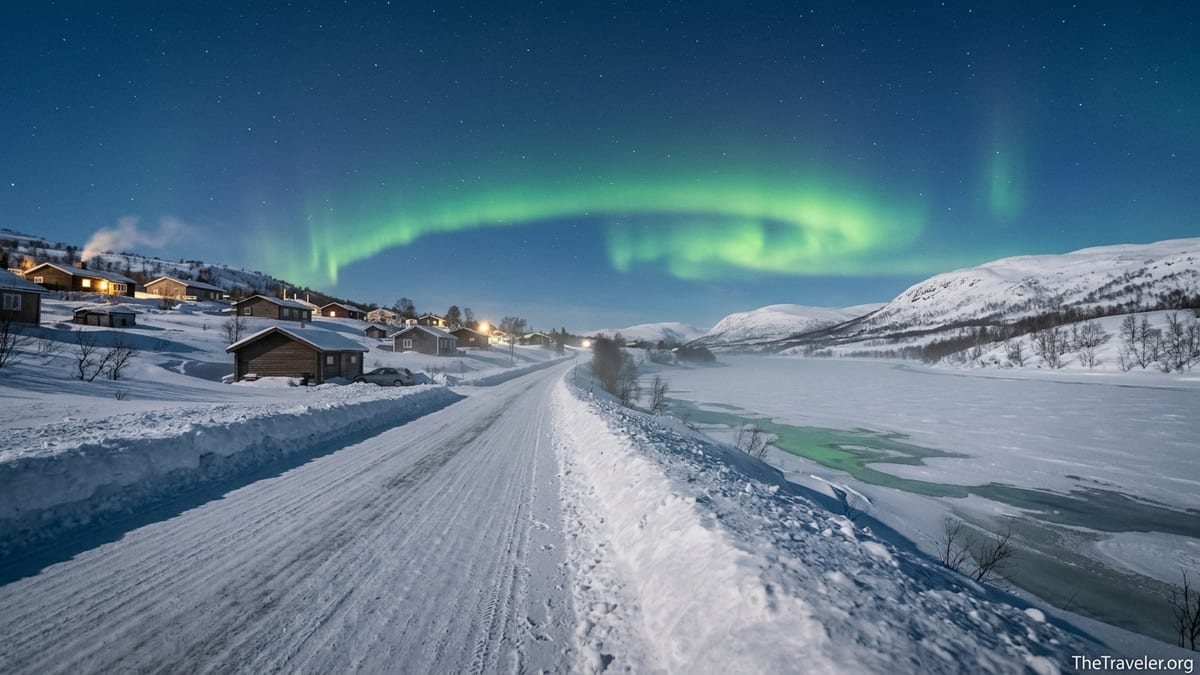
The Scale of Remoteness Catches People Off Guard
On the map, Utsjoki looks like “just another stop in Lapland.” In reality it is Finland’s and the European Union’s northernmost municipality, with around 1,100 to 1,200 residents scattered across a vast tundra landscape. Villages such as Utsjoki church village, Nuorgam and Karigasniemi are small pockets of life separated by long stretches of empty road along the Teno River valley. First-time travelers often picture something like a compact ski town; what they find instead is a handful of services surrounded by wilderness as far as the eye can see.
The journey alone can be a shock. A common route is to fly to Ivalo and then continue three to four hours by bus or rental car north to Utsjoki, often in winter darkness. People used to zipping between European cities by train are surprised when the last leg of their day feels more like an expedition, with no roadside cafés, few other cars and mobile reception that comes and goes. Comments from recent visitors describe leaving Ivalo with a full tank and a trunk full of groceries, then not seeing a supermarket again until they reached their accommodation hours later.
That remoteness shapes small, everyday choices. Supermarkets are limited to places like the S-Market in Utsjoki village or the shops in Nuorgam, and opening hours can be shorter than in Helsinki or Rovaniemi, especially on Sundays and public holidays. If you realize late in the evening that you forgot to buy snacks, you may not be able to walk five minutes to a 24-hour shop. Booking accommodation with at least a kitchenette, stopping at a large grocery store in Ivalo, and treating refueling stops as non-negotiable becomes part of the rhythm of travel here rather than an optional extra.
The payoff for that distance is the sense of space. You quickly notice how quiet it is even in the heart of the village, how streetlights fade after a few houses, and how easy it is to reach untouched nature. For visitors coming from busy Arctic hubs such as Rovaniemi or Tromsø, Utsjoki often feels like stepping several layers deeper into the north, both physically and emotionally.
Light, Dark and Weather Are More Extreme Than Expected
Many travelers have heard about the polar night and the midnight sun, but most underestimate how radically these phenomena shape a day in Utsjoki. From late November to mid-January, the sun does not rise at all. Instead there is a few hours of blue twilight around midday, fading to full darkness again by early afternoon. The opposite happens in summer, when from roughly late May to late July the sun circles above the horizon without setting, leaving the village in broad daylight at midnight. This can be magical or disorienting depending on how prepared you are.
In winter, visitors arriving around Christmas often expect dark evenings but not a full lack of sunrise. They are surprised when the sky never brightens beyond deep blue, and when activities like snowshoeing or a short walk to the river happen in headlamp light. Photographers used to chasing golden hour instead learn to work with subtle gradations of twilight, snow glow and aurora. Getting proper rest during the midnight sun can be just as difficult. Many cabins and guesthouses such as Holiday Village Valle or smaller riverside apartments have decent blackout curtains, but not all do. Bringing a quality sleep mask is a simple item that makes a significant difference if you are sensitive to light.
Temperatures are another surprise. Utsjoki winters routinely drop to minus 20 degrees Celsius and, during cold snaps, closer to minus 30. Visitors who tested their gear in Rovaniemi or Southern Finland sometimes find that what felt warm enough there is marginal this far north, especially when standing still on an aurora tour or reindeer sleigh ride. Local operators that run excursions, from snowmobile safaris to aurora hunts, typically lend thermal overalls, boots, balaclavas and mittens for exactly this reason. Those borrowed layers are not a cosmetic extra but the difference between delight and real discomfort out on the tundra.
Even in shoulder seasons the weather can shift fast. You may land in Ivalo in late September to mild autumn air, then wake in Utsjoki to fresh snow. In May the road verges might still hold patches of ice while the birches start to bud. Lightweight traction spikes for your shoes, a headlamp in winter and a thin beanie even in early summer are practical additions people seldom regret packing.
Indigenous Sámi Culture Is Living, Not A Costume
One of the most important things first-time visitors do not expect is that Utsjoki is not just another Lapland village with a bit of Sámi decoration. It is the only municipality in Finland where the majority of residents are Sámi, and Northern Sámi is widely used alongside Finnish in everyday life. Road signs carry both languages, the local school teaches Sámi, and traditional livelihoods such as reindeer herding are not staged performances but cornerstones of the local economy and identity.
This has practical implications. Many visitors arrive with an image shaped by commercial Christmas villages further south: quick reindeer rides between gift shops, Sámi patterns on tourist souvenirs and short photo opportunities with no real context. In Utsjoki, when you join a small-group visit to a reindeer farm or a storytelling evening run by a local family business, you are stepping into someone’s home territory. Guides may explain how reindeer herding cooperatives work, how corrals are shared among families or why snowmobile routes cross seemingly empty tundra in strict patterns.
Expect experiences to be slower and deeper than in busy resort towns. A winter day with a company like Aurora Reindeer or Utsjoki Tours might begin with feeding the animals and a slow sleigh ride through the forest, followed by coffee and flatbread around a fire in a turf hut while your host speaks about seasonal migrations, language and legislation affecting Sámi land rights. There may be no glossy entertainment program or elaborate costumes beyond everyday gákti clothing worn with pride. What you get instead is a chance to listen and ask genuine questions, provided you approach with respect.
Respect also means understanding that Sámi culture is not merely a backdrop for holiday photos. Locals sometimes speak of discomfort when visitors wear cheap imitation Sámi outfits bought online or demand “authentic shaman rituals” on short notice. If you want to support local crafts, ask your host or accommodation about duodji, genuine Sámi handicrafts. Buying a hand-woven belt, silver brooch or knife directly from a Sámi artisan at a small shop or market both supports the community and gives you something with a traceable story rather than a generic souvenir.
Northern Lights Are Not Guaranteed, Even Here
Many people travel to Utsjoki for one main reason: to see the aurora borealis. The latitude and generally dark skies make it one of the best places in Finland for northern lights, but first-time visitors are often taken aback by how unpredictable the experience still is. Even in peak season from roughly September to March you can have several nights in a row with thick cloud or low solar activity where nothing appears. Travelers who arrive expecting a nightly neon show like the photos on hotel websites risk feeling disappointed if they do not build that uncertainty into their plans.
Local guides are clear that no tour can manufacture the lights. What they can do is increase your odds on any given night by driving away from clouds, finding open views and helping you interpret real-time forecasts. On a typical aurora chase, perhaps with a small company based in the village, you may head out around 8 or 9 p.m., drive 30 to 60 minutes along the Teno valley or upward toward the fells, and then wait in cold darkness with hot berry juice and a small fire. On some nights you might see only a faint gray arch that suddenly brightens for a few minutes around midnight. On others the entire sky can erupt in green and pink curtains that leave everyone speechless. That variability is part of why locals never promise more than “a chance.”
Photography brings its own surprises. What looks barely visible to the naked eye often appears strikingly green in long-exposure images, which is why social media photos can be misleading. Guides sometimes remind guests that a night of soft, subtle aurora still counts as a success, even if it does not match the most dramatic pictures online. Bringing a tripod, knowing the basics of manual camera settings and protecting your batteries from the cold will help, but the key is mental flexibility. Give yourself at least three to four nights in Utsjoki if the northern lights are your main goal, treat the lights as a gift rather than an entitlement, and enjoy the deep silence of the tundra even when the sky stays dark.
One more unexpected aspect: the best aurora moments sometimes happen off-tour. Guests at riverside cabins or glass-roofed igloo-style rooms occasionally report waking at 2 a.m. to a soft green glow shivering through their window and stepping outside in slippers and a jacket to watch a display over the Teno River. Booking accommodation with an open view of the northern sky and minimal light pollution can be just as important as booking the right excursion.
Infrastructure Is Basic, Safe and Quietly Efficient
First-time visitors used to resort-style Lapland or Alps ski villages often expect Utsjoki to feel rough or improvised. In practice, the infrastructure is modest but generally reliable and safe. Main roads are well maintained even in deep winter, with snowplows passing regularly, and long-distance buses from companies such as JBus connect Utsjoki with Ivalo and Rovaniemi on set schedules. That said, timetables may not line up neatly with flight arrivals. It is common to spend a night in Ivalo or rent a car if you want more flexibility. Recently, travelers planning trips for winter 2026 and 2027 have commented on how quickly seats on key bus legs can sell out on busy holiday weekends, so booking ahead is wise.
Once you are in the municipality, do not expect a dense web of public transport. Local movements are typically by car, taxi or arranged transfer with your accommodation. Many guesthouses and hotels offer airport pickup for a fee that can seem high compared with urban taxis but is reasonable given the distances involved. For example, a one-way transfer for a small group from Ivalo airport to Utsjoki is often priced more like a mini private tour, with stops at viewpoints or supermarkets en route, than like a quick city ride.
Healthcare and safety services are present but limited. There is local primary healthcare and a small pharmacy, but anything serious would mean a trip to Ivalo or beyond. The upside is that crime rates are very low. Locals describe leaving cars unlocked while running into the shop and children walking to school in winter twilight without concern beyond the usual caution around snowplows and icy roads. Visitors coming from large cities often remark on how quickly they stop worrying about personal security and start watching the sky and road conditions instead.
Wifi and mobile data work in villages and at most accommodations, but can falter once you head onto hiking trails or remote fells. Travelers sometimes only realize at the trailhead that their navigation app will be unreliable. Downloading offline maps, telling your host where you are going and when you plan to return, and carrying a physical map on longer routes such as parts of the Kevo canyon trail are all simple steps that match the realities of connectivity in this part of the world.
The Wilderness Is Bigger and More Demanding Than It Looks Online
Photos of Utsjoki’s landscapes are stunning: the deep Kevo canyon, the rolling fells above the tree line, the wide Teno River marking the border with Norway. What those images rarely convey is how physically demanding even a “short” excursion can feel in Arctic conditions. The Kevo Strict Nature Reserve, for example, protects a dramatic 40 kilometer canyon system with hanging bridges and steep paths that are only open in the snow-free season. Hikers who arrive expecting an easy afternoon stroll often discover that even partial routes involve significant elevation changes, rocky paths and very few facilities along the way.
Closer to the village, lower-key trails such as Báktevárri or routes along the old museum road offer more accessible ways to taste the tundra without committing to a multi-day trek. Still, the combination of variable weather, limited daylight in autumn and minimal signage compared with heavily touristed national parks further south catches some first-timers off guard. It is not unusual for local rescue services to help otherwise fit hikers who underestimated how quickly fog can roll in on the fells or how disorienting the landscape becomes when fresh snow covers summer paths.
Anglers are often surprised by how regulated and seasonal fishing on the Teno River has become. Long known as one of Europe’s most important salmon rivers, Teno now has strict quotas and permit systems designed to protect stocks. Visitors who remember stories of easy salmon catches decades ago discover that their stay might coincide with closed stretches or highly limited day permits. Planning any fishing in Utsjoki now requires checking current rules, disinfecting any gear brought from outside and being prepared for “catch and release” or no fishing days at all, depending on the state of the river.
For most travelers, the key is learning to match ambition with conditions. Booking guided day hikes, snowshoe walks or summer canoe trips with local operators not only supports the community but also gives you knowledge of reindeer routes, private lands and weather patterns that is hard to gain from a map alone. If you are planning independent adventures, treat Utsjoki’s wilderness like a remote mountain region rather than a theme park: tell someone your plans, pack extra layers and food, and be ready to turn back when conditions change.
Everyday Life Is Quiet, Slow and Surprisingly Addictive
Perhaps the biggest unexpected element of Utsjoki is how much everyday life differs from more commercial Lapland destinations. There are no big après-ski bars, no long restaurant strips, no designer shopping streets. Instead you find a small handful of cafés, one or two restaurants attached to hotels or holiday villages, a petrol station, a supermarket and not much else. On a winter weeknight, the village streets may be almost empty by 9 p.m., with only a soft glow from house windows and the occasional car heading toward the Norwegian border crossing.
For visitors who crave nightlife, this can feel like a disappointment. For others it becomes the highlight of their stay. You might spend evenings in a wooden cabin, cooking food you bought in Ivalo or at the local S-Market, stepping outside periodically to check the sky. Social life gravitates toward saunas, shared fires and small events rather than big venues. In summer, locals head to the disc golf course, riverbank picnic spots or nearby lakes for swimming when the weather allows. Travelers often remark that, after a couple of days, their sense of time changes: they eat when they are hungry, walk when the light is beautiful, nap when the weather turns, and suddenly realize they have not checked social media for hours.
Prices, while not cheap, can also surprise people who expect hyper-inflated “tourist town” rates. Accommodation with aurora-friendly features, such as glass-roof cabins or riverside lodges, commands a premium, especially in peak season. However, you will also find simple, family-run guesthouses and self-catering apartments where cooking your own meals and planning one or two paid excursions instead of daily activities keeps overall costs closer to a normal Lapland trip. The main financial shock tends to be transport: long transfers from southern Finland, internal flights to Ivalo and private shuttles to Utsjoki add up quickly, so budgeting realistically for the journey often matters more than shaving a few euros from restaurant bills.
Many first-time travelers leave convinced that Utsjoki is a “once in a lifetime” destination and then find themselves planning a return, often in the opposite season. Winter guests want to see the midnight sun on the same fells they snowshoed across in January. Summer visitors who camped by the Teno in July remember the golden twilight and wonder what the same valley looks like under aurora. The quiet, which can seem intimidating at first, turns into a powerful draw.
The Takeaway
Visiting Utsjoki is more than a typical Lapland holiday. It means traveling to a sparsely populated corner of Europe where indigenous Sámi culture shapes everyday life, the sun behaves in unusual ways, and nature begins just beyond the last streetlight. What most first-time travelers do not expect is how strongly those factors affect simple things like sleep, transport, clothing and time itself.
By arriving with realistic expectations about the remoteness, the limits of infrastructure, the unpredictability of northern lights and the depth of Sámi presence, you give yourself room to appreciate what Utsjoki offers at its best: clean air, powerful landscapes, meaningful encounters and long stretches of genuine quiet. In return, the village and its surroundings reward patience and respect with moments you are unlikely to find anywhere further south.
FAQ
Q1: When is the best time of year to visit Utsjoki for northern lights?
The most reliable months for aurora are generally from late September to late March, with long nights and frequent clear skies. Many visitors aim for October, February or early March to balance darkness with manageable temperatures.
Q2: How many days should I spend in Utsjoki on my first trip?
For a first visit focused on northern lights and basic winter activities, three to four nights is a good minimum. If you want to combine guided excursions, some downtime and a buffer for bad weather, five to six nights will feel more relaxed.
Q3: Do I need a rental car, or can I rely on public transport?
You can reach Utsjoki by long-distance bus from Ivalo or Rovaniemi, but local buses are limited. A rental car or pre-arranged transfers make it much easier to move between villages, trailheads and activity providers, especially in winter.
Q4: How cold does it really get, and what should I pack?
Midwinter temperatures often fall below minus 20 degrees Celsius and can be colder during cold spells. Pack thermal base layers, a high-quality insulating jacket, windproof outerwear, insulated boots, thick mittens, a balaclava or face mask and a warm hat. Many local tour companies provide extra thermal overalls and boots.
Q5: Is Utsjoki suitable for families with children?
Yes, provided you plan around the conditions. Families with school-age children often enjoy short reindeer or husky experiences, easy walks and cabin life. It is important to keep activities short in very low temperatures and to choose accommodation with indoor space for play and rest.
Q6: Can I visit both Utsjoki and the Norwegian coast on the same trip?
Many travelers combine Utsjoki with a drive to the Norwegian coast, as the border is close and roads follow the Teno River toward the Arctic Ocean. Weather and road conditions in winter can be demanding, so leave enough time and check forecasts carefully.
Q7: How easy is it to learn about Sámi culture respectfully?
The easiest way is to book small-scale experiences operated by local Sámi families or businesses, such as farm visits, storytelling evenings or guided nature tours. Approach with curiosity and respect, avoid imitation outfits and support genuine Sámi handicrafts when shopping.
Q8: Are there vegetarian or vegan options in Utsjoki restaurants?
Restaurant options are limited but many places can offer at least a basic vegetarian dish, especially if you inform them in advance. Vegans may find choices more restricted, so booking self-catering accommodation and bringing specific ingredients can make meals easier.
Q9: Is it safe to drive in winter if I am not used to snow and ice?
Cars in northern Finland are equipped with proper winter tyres, and main roads are regularly cleared. However, driving in snow, darkness and potential reindeer crossings can be stressful if you are inexperienced. If in doubt, consider using bus connections and local transfers or visiting in autumn and spring instead of the coldest months.
Q10: Can I visit Utsjoki without speaking Finnish or Sámi?
Yes. Many people working in tourism speak English, and signage at accommodations and key services is often available in English. Learning a few basic Finnish or Northern Sámi greetings is appreciated but not essential for a smooth visit.