


I arrived in Utsjoki expecting Lapland to look like a Christmas card. Instead, standing on the banks of the Teno River, watching the slow Arctic light slide along the water between Finland and Norway, I felt the familiar images of glass igloos, reindeer safaris and Santa villages fall away. Lapland suddenly became something quieter, older and far more complex than the winter-marketed fantasy I thought I knew.
Get the latest updates straight to your inbox!
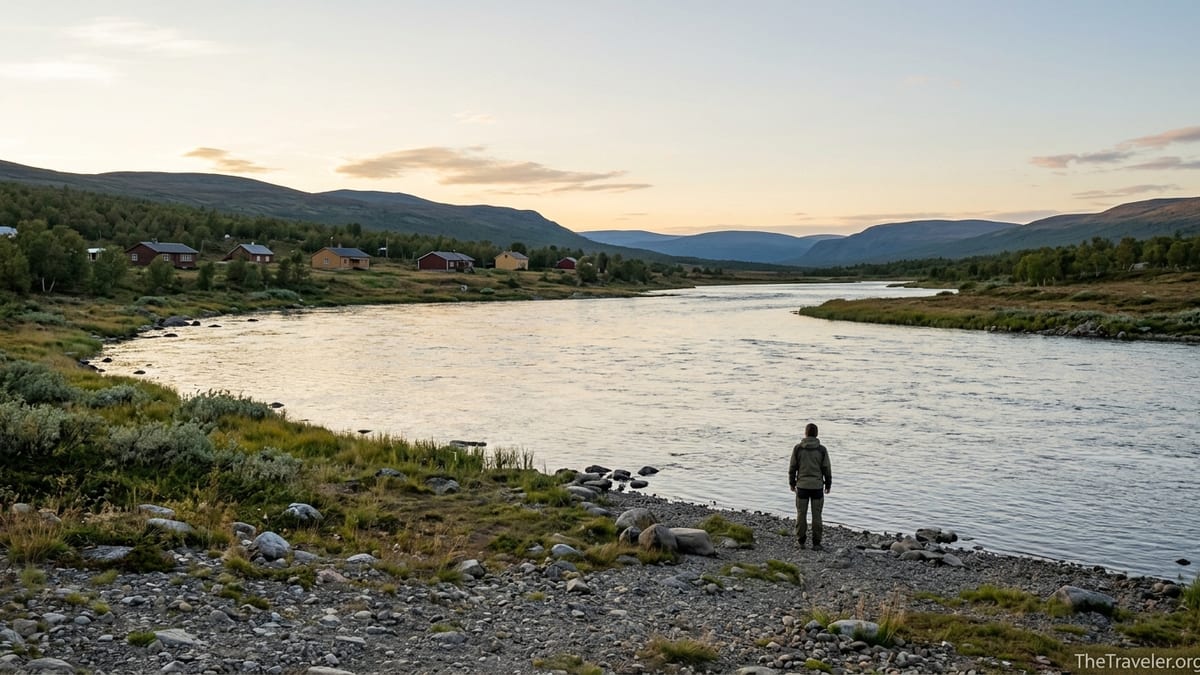
Meeting the Real Lapland on the Teno’s Edge
The first surprise on the Teno came before I even stepped out of the car. Utsjoki is not a ski resort town with neon-lit après bars; it is a small riverside community where most people live close to the valley carved by the Teno and Utsjoki rivers. Rather than a row of chalets, I found a cluster of wooden houses, a petrol station, the modest Hotel Utsjoki on the hill above the water and, beyond it all, a wide river flowing like a strip of pewter between low fells.
The Teno, also known as the Tana and Deatnu in Northern Sámi, forms the border between Finland and Norway for more than 250 kilometers, with Utsjoki village sitting at a bend where the Utsjoki tributary joins it. Here the river can be broad and slow, edged by gravel bars and birch scrub, or narrow into fast, shallow channels. In the stillness of late spring or early autumn, the surface acts as a long mirror, doubling the sky and the soft silhouettes of the surrounding hills.
Standing on the Finnish bank late one August evening, I could see the yellow light of Norwegian houses on the opposite shore and hear almost nothing but water dragging against stones. It is this quiet border landscape, more than any curated excursion, that begins to rewrite what visitors think Lapland is supposed to be.
The river also carries a reputation. For decades, the Teno was known as one of Europe’s most important wild Atlantic salmon rivers, drawing anglers from across the continent. Strict conservation measures in recent years mean that salmon fishing is now heavily regulated and, in many stretches, temporarily halted or limited. Yet the fishing culture remains part of the valley’s identity, and today the conversation along the banks is as much about protecting the river as it is about landing a trophy catch.
Discovering a Sámi Majority Community
Utsjoki is the only municipality in Finland where Sámi speakers form a majority of the population. That single fact reshaped my sense of Lapland more than any view. Instead of Sámi culture being presented as an add-on show for tourists, it is the everyday context here. Street signs appear in Finnish and Northern Sámi, local radio carries Sámi-language broadcasts, and many reindeer herding families work as guides, entrepreneurs and cultural mediators.
Checking into a small riverside cabin, the owner casually mentioned switching between Finnish and Sámi with his children. Later, on a short evening walk, I passed the old church cabins near Utsjoki’s historic stone church, simple wooden huts that once housed Sámi families who had to travel long distances for church services and markets. Today they stand as a visible reminder of how recently a nomadic and semi-nomadic way of life shaped this valley.
Modern Sámi life in Utsjoki is not frozen in time. It is reindeer trailers on the E75 highway, teenagers scrolling on their phones in oversized hoodies, and local businesses that blend traditional knowledge with modern tourism. Companies like Travel Utsjoki, run by a Finnish-Sámi reindeer herding family, offer activities from reindeer experiences to guided hikes on local fells. Spending a day with such guides is less about staged performances and more about hearing how grazing areas are changing, how climate affects winter ice, and why certain valleys matter culturally as well as ecologically.
This living, everyday Sámi presence challenges the tidy, costume-based image often marketed further south in Lapland. In Utsjoki, Sámi culture is not a show arranged for an evening; it is the language you hear over coffee at the petrol station and the perspective shaping how people talk about land, water and seasons.
Light, Silence and the Shock of Arctic Scale
Standing on the banks of the Teno, I also realized how poorly postcards capture Arctic light. In summer, the famous midnight sun hovers above the horizon, washing the valley in a pale, horizontal glow. Around midsummer, the Teno’s surface reflects this low sun so precisely that the water seems to emit its own light. Locals talk about heading down to the river at midnight simply to watch the colors slide from gold to pink to a cool, almost metallic blue.
In winter the mood reverses. Between December and January, Utsjoki experiences polar night, when the sun does not rise above the horizon. Yet a kind of blue twilight seeps down the valley around midday, and when the aurora appears, the riverbank becomes a natural viewing platform. Instead of joining crowded northern lights tours in larger towns, travelers here often simply step outside a cabin or walk a few minutes to an open stretch of river to watch the sky flare green or purple across the Norwegian hills.
The scale is another revelation. From the riverside, the fells look almost gentle, softened by dwarf birch and heath. But once you start hiking into nearby areas like the Paistunturi or Kaldoaivi wilderness regions, you understand how empty this corner of Europe can be. Marked trails quickly dissolve into reindeer paths, and it is entirely possible to walk for hours without seeing another person. The river provides a kind of anchor, a visible line of movement and sound that contrasts with the stillness of the surrounding plateau.
For visitors used to the bustle of Rovaniemi or Levi, this silence can be unsettling at first. There are no shopping streets, few restaurants and limited nightlife. Instead, experience is measured in small, precise moments: the rasp of sand under your boots on a gravel bar, the sudden rush of wind from the fjell, the distant clink of bells on a reindeer herd crossing higher ground.
From Tourist Spectacle to Everyday Life
On my first morning in Utsjoki, I drove up from the village to one of the low viewpoints above the valley, near the Ailigas fell that overlooks the river. From there, the Teno looks like a silver thread winding between two countries, with the E75 highway ending in a tidy curve at the Sámi Bridge that crosses into Norway. What struck me was not a grand panorama of wilderness, but the ordinary choreography of daily life: Finnish cars heading across the border for cheaper fuel or groceries, Norwegian vans coming the other way, a local school bus making its way along the valley.
This everyday cross-border rhythm reshaped the way I thought about Lapland’s geography. The Teno is a dividing line on a map, but in practice it functions as a corridor. People travel regularly between the Norwegian side and Utsjoki for work, services and family visits. For travelers, this means it is entirely realistic to spend a morning on the Finnish riverbank, then drive across the bridge to the small Norwegian town of Tana Bru for a coffee and a different perspective on the same valley.
The river also reframed my idea of Lapland’s economy. I had imagined tourism as the dominant force, powered by winter package holidays and northern lights safaris. In Utsjoki, tourism is present but still intertwined with traditional livelihoods. Reindeer herding coexists with small guesthouses, and guiding work often aligns with the seasonal rhythms of herding, berry picking and fishing. At the petrol station café, a laminated flyer advertising aurora tours sat next to notices about community meetings and reindeer roundups.
Instead of viewing Lapland as a stage set for visitors, the Teno valley shows it as a place where tourism is just one layer. When I asked a local guide about the best time to visit, she did not respond with a marketing slogan. Instead, she listed the pros and cons of different seasons in practical terms: icy roads and limited daylight in December, but steady aurora chances; long hikes possible in July but also more insects and a busier river; wonderful autumn colors in September, yet cooler nights and the first risk of snow.
Practical Lessons from a Riverbank
Time beside the Teno also changed how I think about planning travel in Lapland. Reaching Utsjoki takes more effort than flying into Rovaniemi and booking a transfer to a resort. Most travelers arrive via Ivalo Airport, about 170 kilometers to the south, then drive for around two and a half hours along the E75 highway. Alternatively, some come through Norway, combining Utsjoki with coastal destinations such as Kirkenes or Varangerfjord. Distances between services are long, and you quickly learn that in this part of Lapland, a full tank of fuel, a thermos and a bag of groceries are more essential than an exhaustive list of attractions.
Accommodation in Utsjoki tends toward small-scale and personal. Hotel Utsjoki offers straightforward rooms on the hillside, many with views toward the river, and acts as a practical base for road-trippers. Along the valley, simple log cabins and riverside cottages are available, often with self-catering kitchens and access to private sauna buildings. Prices vary with season, but travelers can expect to pay noticeably less for a small cabin here than for a glass igloo further south in more famous resorts, especially outside the Christmas and New Year peak.
Choosing activities requires a different mindset too. Instead of packaged snowmobile safaris and crowded husky kennels, the main draws here are hiking, snowshoeing, cross-country skiing and quietly observing nature. Local operators organize small-group outings to the nearby Kevo Nature Reserve, known for its deep canyon and suspension bridges, or to the fells behind the village for northern lights watching. A typical half-day guided hike might involve slow walking, coffee brewed over a small fire and conversations about how the land is changing, rather than ticking off Instagram shots.
Even food on the Teno’s banks subtly changes expectations. In Utsjoki’s limited but welcoming cafés and dining rooms, menus might feature salmon soup when stock permits, sautéed reindeer, mashed potatoes and lingonberries, or simple open-faced sandwiches with local cheese. There are no themed Christmas dinners or elaborate buffets. Instead, the food reflects what can realistically be sourced, stored and prepared in a small Arctic community supplied by long-distance trucks.
Rethinking Responsibility in a Fragile Valley
Time along the Teno made it impossible to ignore how vulnerable this river system is. Conversations with local guides and guesthouse owners often circled back to changes in salmon stocks, shifting ice patterns and the impact of warming winters. In recent years, international news outlets have reported on tighter fishing regulations introduced jointly by Finland and Norway to protect wild salmon runs. Visitors who once came primarily to fish now need to check the latest rules carefully, and many turn instead to catch-and-release grayling fisheries in tributaries or to non-fishing activities.
For travelers, this shift is not simply an inconvenience; it is an invitation to rethink what it means to "use" a place like Lapland. On guided walks, I heard about how late-forming river ice complicates winter travel and reindeer migration routes, and how heavy summer rains can rapidly raise water levels, reshaping gravel bars and spawning grounds. Guides increasingly frame activities around observation and learning rather than extraction, encouraging guests to see the valley as a living system rather than a backdrop.
Even small choices feel magnified in a sparse environment. Recycling possibilities are limited, supply chains are long and fragile tundra soils recover slowly from damage. One guide explained why they discourage off-trail driving with snowmobiles on thin snow cover, noting that scars left by careless visitors can remain visible in summer long after the machines have left. Staying on marked tracks, packing out all waste and keeping group sizes small are simple but significant ways to reduce impact.
Perhaps the most profound lesson from the Teno’s banks is that "remote" does not mean "empty." The valley is home to people whose relationship with this river stretches across generations. Respecting seasonal rhythms, from the hectic autumn reindeer roundups to the quiet weeks of polar night, means accepting that not every experience can be scheduled exactly as visitors wish. It also means understanding that sometimes the most responsible choice is to sit on the riverbank and simply watch light move across the water.
The Takeaway
Standing on the banks of the Teno River in Utsjoki, I realized how narrow my idea of Lapland had been. The region is not just a winter playground built around Santa, husky teams and glass igloos. Here, at Finland’s northern border, Lapland reveals itself as a layered place where a powerful river shapes borders, Sámi language and culture provide the dominant voice, and daily life continues at a pace largely indifferent to visitor expectations.
The Teno valley asks travelers to slow down, to trade spectacle for attention, and to see Lapland not as a fantasy destination but as a lived landscape under pressure from climate change and shifting economies. A trip here will not deliver a checklist of must-see attractions or a string of themed activities. What it offers instead is something quieter and far more enduring: the memory of a particular light on water, the sound of a border river flowing between two countries, and the sense of having encountered the North on its own terms.
FAQ
Q1. Where exactly is Utsjoki and the Teno River?
Utsjoki is Finland’s northernmost municipality, in Lapland, on the border with Norway. The Teno River flows along this border, with Utsjoki village located where the Utsjoki tributary meets the main river.
Q2. How do I get to Utsjoki as an international visitor?
Most travelers fly to Helsinki, then onward to Ivalo Airport in northern Finland. From Ivalo, it is roughly a two and a half hour drive along the E75 highway to Utsjoki. Some visitors arrive via Norway, combining Utsjoki with coastal towns before crossing the border.
Q3. When is the best time of year to visit the Teno River in Utsjoki?
It depends on what you want to experience. For midnight sun and hiking, June to August works best. For northern lights and snowy landscapes, late September to March is ideal. Early autumn offers colorful forests and more stable weather than deep winter.
Q4. Can I still fish on the Teno River as a visitor?
Fishing regulations on the Teno are strict and can change as Finland and Norway adjust rules to protect wild salmon. Some stretches and species may be off limits or limited to certain permits. Always check current regulations and consider guided trips or alternative fisheries in nearby rivers or lakes.
Q5. What kind of accommodation is available in Utsjoki?
You will find a small hotel in the village, simple guesthouses and riverside cabins, many with self-catering kitchens and saunas. Options are fewer than in larger Lapland resorts, so it is wise to book ahead, especially during peak summer and holiday periods.
Q6. Is Utsjoki a good place to see the northern lights?
Yes. Utsjoki lies well within the auroral zone, and the relative lack of light pollution along the Teno valley makes it an excellent place for northern lights watching, especially from September to March when skies are dark and clear.
Q7. Do I need a car to explore the Teno valley and Utsjoki?
Having a car gives you the most flexibility, as public transport is limited and distances between services can be long. With a rental car you can reach viewpoints, trailheads and cross into Norway for day trips along the valley.
Q8. What should I pack for a trip to Utsjoki?
Pack layered clothing suitable for rapidly changing weather, a windproof and waterproof outer layer, sturdy footwear, a warm hat and gloves even in summer evenings, and in winter proper insulated boots and thermal layers. In all seasons, bring any medications and personal items you may need, as shopping options are limited.
Q9. Is Utsjoki suitable for families and less experienced travelers?
Yes, provided you plan carefully. Families appreciate the quiet environment, simple activities and riverside cabins. Less experienced travelers should book guided excursions for hiking or winter activities and pay close attention to road and weather conditions.
Q10. How can I be a respectful and responsible visitor in Utsjoki?
Support local businesses and Sámi-owned companies, follow marked trails, respect fishing and land-use rules, minimize waste, and keep noise low along the river and in small settlements. Take time to learn about Sámi culture and listen to local perspectives on how tourism and climate are affecting the valley.