


In an era when most “remote” destinations are a short hop from an international airport or a cruise pier, Utsjoki in far northern Finnish Lapland still feels like the end of the road. This Sámi-majority municipality sits on the Norwegian border at the very top of mainland Finland and the European Union, where reindeer outnumber people, wilderness areas swallow the map and travel logistics demand forethought. For travelers seeking one of Europe’s last truly remote destinations that is still accessible without an expedition budget, Utsjoki offers a rare combination of raw Arctic nature, living indigenous culture and real, road’s-end isolation.
Get the latest updates straight to your inbox!
Where the Road Really Ends
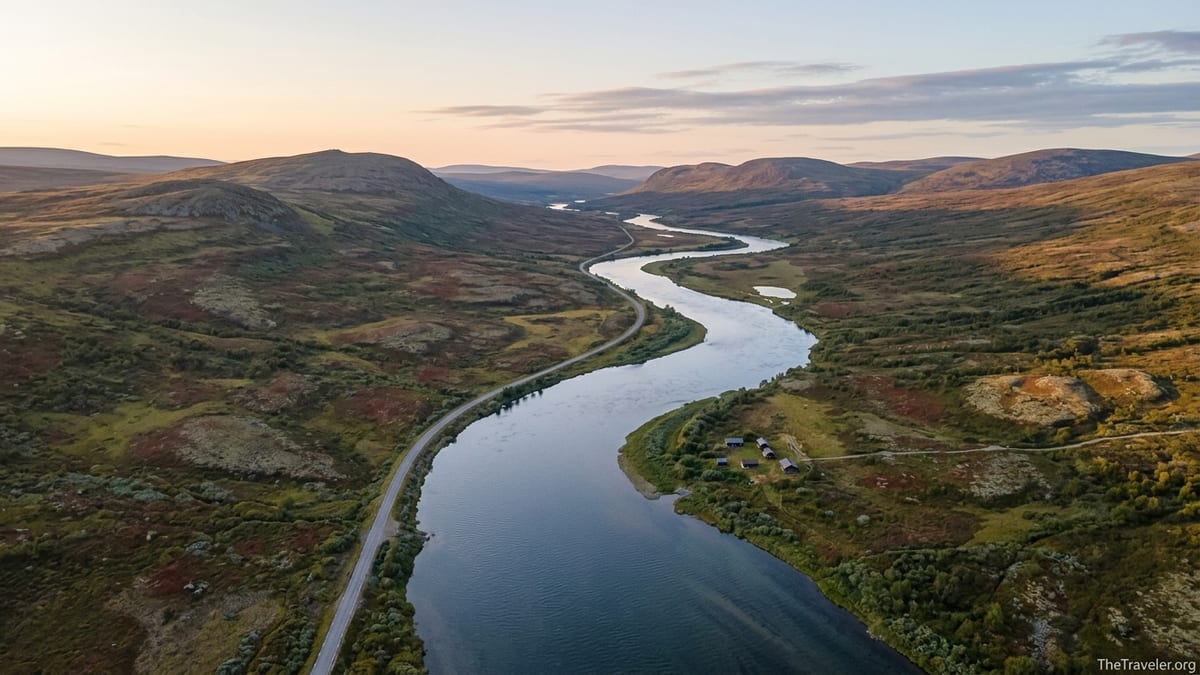
Look at a map of Finland and let your eye run north along Highway 4, the country’s longest road. It simply stops at Utsjoki. This small village, together with hamlets like Nuorgam and Karigasniemi, anchors a municipality of roughly 1,200 people spread across an area where protected wilderness covers the majority of the land. Here, the Tenojoki river marks the border with Norway, and narrow ribbons of asphalt cling to its valley before dissolving into gravel tracks and hiking paths.
Reaching Utsjoki from southern Finland still feels like a journey rather than a weekend trip. Most travelers take an overnight train from Helsinki to Rovaniemi or Kolari, then continue by long-distance bus for another 6 to 8 hours to reach Inari and, eventually, Utsjoki. Even from Ivalo Airport, one of Lapland’s key air gateways, the road distance to Utsjoki is about 170 to 190 kilometers, often driven on dark, snow-covered roads in winter. Scheduled buses typically run once per day in season, so missing a connection can mean an unplanned night in a roadside guesthouse.
Once you arrive, that feeling of being at the end of Europe intensifies. Nuorgam, a village within Utsjoki municipality, is the northernmost settlement in the European Union. From here, the next major services are across the border in Norway or hundreds of kilometers back south. You can drive the famed river road, regional road 970, for nearly 150 kilometers along the Tenojoki without encountering more than a handful of houses, a scattering of fishers’ huts and the occasional cluster of cabins.
This physical isolation has direct consequences for travelers. Fuel stations are spaced far apart, especially in winter when some small operators close early. Mobile coverage is generally good along the main roads, but step a few kilometers into the fells and it can drop to patchy or nonexistent. You are still in the European Union, paying with euros and using your standard roaming plan, yet the silence on the line and the long gaps between villages remind you that you are on one of the continent’s last real frontiers.
Wilderness on a Continental Scale
Many European destinations talk about wilderness, but Utsjoki delivers it on a scale that surprises even seasoned hikers. The municipality includes or borders three major protected areas: the Kevo Strict Nature Reserve, the Kaldoaivi Wilderness Area and the Paistunturi Wilderness Area. Together they form a near-continuous expanse of fell uplands, canyons and treeless tundra that reaches all the way to the Norwegian plateau.
Kevo Strict Nature Reserve alone covers over 700 square kilometers, making it the largest strict nature reserve in Finland. Access is tightly controlled. You cannot simply wander wherever you please; hiking is only permitted on two demanding marked routes, such as the Kevo Trail, a roughly 60 kilometer route that descends into the Kevo canyon, where the gorge can be around 80 meters deep. Hikers must be prepared for multiple river crossings, simple suspension bridges, long days between basic wilderness huts and complete self-sufficiency in changeable Arctic weather.
To the east lies Kaldoaivi, Finland’s largest wilderness area, shared between Utsjoki and Inari. Here, marked routes are fewer, snowmobile tracks in winter double as unofficial paths, and you can walk for days without meeting anyone outside peak seasons. Many visitors do not attempt a full traverse but instead sample shorter routes, for example overnight trips from Nuorgam into the rolling fells, staying in a simple open wilderness hut with a wood stove and no electricity.
Even easier options still feel remote by European standards. The Utsjoki Trail, about 30 to 35 kilometers, forms a loop from the village into the Paistunturi Wilderness Area, offering overnight stays in basic huts like Koahpelasjärvi. Here, you fetch water from a nearby lake, cut your own firewood from the shed and fall asleep under a sky that in summer never darkens and in winter never really brightens. Remote does not always mean technically difficult, but it almost always means you must be willing to look after yourself.
Life in a Sámi-Majority Municipality
Another aspect that sets Utsjoki apart is its living indigenous culture. More than half of the residents are Sámi, and Utsjoki is Finland’s only municipality with a Sámi-speaking majority. Road signs are bilingual, in Finnish and Northern Sámi, and local place names like Ohcejohka (Utsjoki) or Deatnu (Tenojoki) are part of daily language, not just cultural branding.
For travelers, this means that “local life” is not a generic Lapland experience but specifically a Sámi one. Reindeer herding remains a central livelihood, and it is not unusual to see reindeer traffic signs followed by actual animals grazing beside the road. In winter, herders move their animals between grazing grounds using snowmobiles and traditional knowledge of weather and snow conditions that has been passed down for generations. Choosing Sámi-owned accommodation providers or guided experiences, such as family-run reindeer visits or storytelling evenings, helps support this continuity.
You can get a sense of how remote Sámi communities adapted to state structures by visiting the Utsjoki church village on the Tenojoki. A short drive from the modern village center, it consists of a stone church from the 19th century and a cluster of small log cabins called kirkkotuvat, or church huts. Historically, Sámi families who lived scattered across the fells would travel to this church settlement several times a year for services, trade and social gatherings, staying in these simple huts because a permanent village did not yet exist in the modern sense.
Modern Utsjoki balances tradition and pragmatism. There is a small supermarket, a school, a health center and even an Arctic resort that offers glass-roofed cabins for aurora viewing. Yet many residents still depend on fishing, reindeer and seasonal work in tourism. Conversations with locals often return to the same tension: how to welcome visitors and diversify income without overwhelming a fragile culture and ecosystem. For travelers seeking authenticity, that ongoing negotiation is part of what makes Utsjoki feel different from busier Lapland destinations built primarily around large-scale winter tourism.
Seasons of Extremes: From Polar Night to Midnight Sun
Part of Utsjoki’s remoteness is temporal as well as geographic. The rhythm of life is dictated by polar extremes that many visitors from more temperate latitudes find hard to grasp until they experience them. Around late November, the sun sinks below the horizon and does not rise again for roughly seven weeks. This is kaamos, the polar night. It is not complete darkness, but a lingering blue twilight at midday, soft pink glows on clear days and long hours of darkness when the sky is clear enough for the aurora to blaze overhead.
Traveling during kaamos can feel more remote than the map suggests. Temperatures routinely drop well below freezing, sometimes to minus 20 or minus 30 degrees Celsius. Locals plug their cars into electrical outlets to keep engines from freezing, and simple tasks like walking between buildings or carrying groceries require serious winter clothing. For visitors, a guided aurora stay at a lodge or glass igloo-style cabin can be the safest way to experience this season, with insulated overalls, boots and emergency procedures handled by professionals who understand the risks.
By contrast, from around late May to late July, the sun never sets. The midnight sun transforms the landscape: rivers sparkle at 2 a.m., birds sing throughout the “night,” and many locals shift to a looser daily rhythm shaped by fishing conditions and weather rather than the clock. Hiking during this time is a uniquely Arctic experience. You can start a long day hike after dinner, follow the Kevo or Utsjoki trails through the bright “night,” and return for breakfast without ever using a headlamp.
Shoulder seasons are short but revealing. In early autumn, the fells turn red and gold as the birch forests light up in ruska, the Finnish term for the fall foliage peak. Around this time, nights are dark enough again for the aurora, yet snow has not yet closed the highest trails. Spring, on the other hand, is a time of crust snow and bright sun: by April, locals glide on skis over frozen lakes in T-shirts while the thermometer still reads below zero. These extremes remind you that, despite modern climate control and smartphones, life in Utsjoki still follows the uncompromising cycles of the Arctic.
Getting There, Getting Around and the Price of Isolation
Although Utsjoki is remote, it is not unreachable, and that paradox contributes to its appeal. Most international visitors fly to Helsinki, then onward to Ivalo or, less commonly, to Kirkenes over the border in Norway. From Ivalo, a long-distance bus or pre-booked transfer covers the final stretch north. As of mid-2026, a one-way bus ticket from Ivalo to Utsjoki typically costs the equivalent of several dozen euros, reflecting the long distance and sparse passenger numbers.
Accommodation choices range from small family-run guesthouses and cabins to higher-end Arctic resorts with glass-roofed suites aimed at aurora hunters. In peak winter and autumn foliage seasons, nightly rates can climb into the upper hundreds of euros for premium cabins with private saunas and panoramic views. More modest cabins with shared facilities or basic rooms in simple inns are more affordable, but still generally more expensive than similar lodging in southern Finland. The cost reflects the realities of operating in a place where nearly everything, from building materials to fresh produce, must be transported hundreds of kilometers.
Public services operate on Arctic terms. The local grocery store will usually have a decent selection of fresh food, but supply interruptions during storms are not unknown. Fuel deliveries may be delayed, and small roadside cafes sometimes adjust opening hours according to season and staffing. For travelers, that means always checking up-to-date bus timetables, planning fuel stops ahead of time and carrying at least basic snacks and warm clothing, even on short drives between villages.
Notably, a car is almost essential if you hope to explore beyond the immediate village area. While hitchhiking occasionally occurs, locals often advise against relying on it because traffic volumes are low and winter conditions can be dangerous if you end up waiting in the cold for too long. Some visitors choose to base themselves in one spot, such as a resort near Utsjoki village or a cabin near Nuorgam, and join guided excursions for fishing, snowshoeing or northern lights photography. This can be a practical way to experience the region’s remoteness without needing to manage Arctic driving yourself.
Remote, Yet Not Empty: Human Stories in the Arctic Landscape
Behind the statistics about population and protected areas are real human stories that underline how unusual Utsjoki is within Europe. Many families here maintain multiple homes or huts, moving seasonally between winter and summer places based on reindeer pastures or fishing spots. Children might travel long distances by school transport, and healthcare workers sometimes drive for hours along snowy roads to make home visits.
Tourism businesses also reveal the area’s balancing act. A single family may operate guest cabins, fishing guiding on the Tenojoki, and winter snowshoe tours into nearby fells, pivoting from midnight sun anglers in July to aurora photographers in February. Some entrepreneurs offer airport transfers between Ivalo and Utsjoki, recognizing that there may be only one practical bus option per day but that flights arrive at various times. These hybrid roles reflect both the sparse population and the need to make a living across seasons in a place with limited traditional employment.
For visitors, engaging with these human dimensions can transform Utsjoki from a remote landscape into a place with context. Booking a guided hike into Kevo or a cultural evening with a Sámi host, asking about how climate change is affecting reindeer migrations, or simply chatting in the local shop about road conditions will give a sense of how people sustain life at the edge of Europe. The remoteness is not just about kilometers from the nearest city; it is about the level of self-reliance and flexibility required of everyone who calls this region home.
At the same time, modern connectivity blurs some of the harshest edges. Children stream entertainment on tablets; entrepreneurs manage online bookings from their living rooms; and a video call to Helsinki is technically as simple here as anywhere. Yet, when a winter storm knocks out power or a cold snap drives temperatures below minus 30, daily life instantly reverts to basics: wood stoves, headlamps and careful planning. That tension between 21st-century connectivity and elemental Arctic conditions is part of what makes Utsjoki feel so distinct in Europe.
The Takeaway
Utsjoki’s sense of remoteness is not a marketing slogan; it is a lived reality shaped by distance, climate, culture and land use. You reach it only after long journeys by train, bus or car. Once there, you find yourself at the northern end of the EU road network, surrounded by some of Finland’s largest wilderness areas and immersed in a Sámi-majority community that still relies on reindeer and river fish as well as broadband connections and booking platforms.
For travelers willing to embrace long distances, unpredictable weather and a slower, more self-reliant rhythm, Utsjoki offers an experience that is increasingly rare in Europe: true physical and psychological distance from crowds and cities, without the need for mountaineering skills or expedition-scale logistics. You can spend days on the trail seeing more reindeer than people, step outside your cabin into real darkness pierced by aurora, or feel the strangeness of a midnight sun that never sets over the fells.
Yet Utsjoki is not a museum piece. It is a living community grappling with how to welcome visitors responsibly. Approached with respect, realistic expectations about services and a willingness to slow down, it rewards travelers with something that many popular Arctic destinations have lost: the humbling, invigorating sensation of being very far away, at the edge of a continent, in a place that still deserves to be called remote.
FAQ
Q1: How do I get to Utsjoki from Helsinki?
Most travelers take an overnight train from Helsinki to Rovaniemi or Kolari, then continue north by long-distance bus or rental car via Ivalo and Inari to Utsjoki.
Q2: Do I need a car to explore Utsjoki?
You can reach Utsjoki by bus, but a car or pre-arranged transfers are highly recommended if you want to visit hiking trailheads, small villages and remote viewpoints independently.
Q3: When is the best time to visit Utsjoki?
Winter and early spring are ideal for northern lights and snow activities, late summer for hiking and fishing under long days, and early autumn for colorful foliage and auroras.
Q4: Is Utsjoki a good place to see the northern lights?
Yes, Utsjoki lies well within the auroral zone, far from major light pollution, so clear winter nights often bring excellent chances to see the northern lights.
Q5: How remote is Utsjoki compared with other places in Lapland?
Utsjoki is Finland’s northernmost municipality, with long distances between villages, limited public transport and large wilderness areas that make it feel more isolated than resort towns.
Q6: Are there marked hiking trails suitable for beginners?
Yes, while routes like the Kevo Trail are demanding, shorter marked paths near Utsjoki village and Nuorgam allow less experienced hikers to sample the fells.
Q7: What kind of accommodation is available in Utsjoki?
Options range from basic cabins and guesthouses to higher-end Arctic resorts with glass-roofed suites and private saunas, often run by local families or small companies.
Q8: How expensive is it to visit Utsjoki?
Travel, accommodation and food are generally more expensive than in southern Finland, reflecting long supply chains and small-scale operations, so budgeting carefully is important.
Q9: What should I pack for a winter trip to Utsjoki?
Bring layered thermal clothing, insulated boots, a windproof outer shell, warm gloves and headwear; many activity providers can supply overalls and extra gear if needed.
Q10: Is it possible to visit Utsjoki without guided tours?
Independent travel is possible if you are comfortable with Arctic driving, navigation and self-sufficiency, but guided tours are a safer choice for many first-time visitors.