


Bjørvika has gone from industrial docks to one of Oslo’s most distinctive neighborhoods, a compact slice of the city where cutting edge architecture, big name museums and relaxed waterfront life all sit within a ten minute walk of Oslo Central Station. For travelers short on time, it is one of the easiest places to experience how modern Oslo lives, works and spends its free hours by the water.
Get the latest updates straight to your inbox!
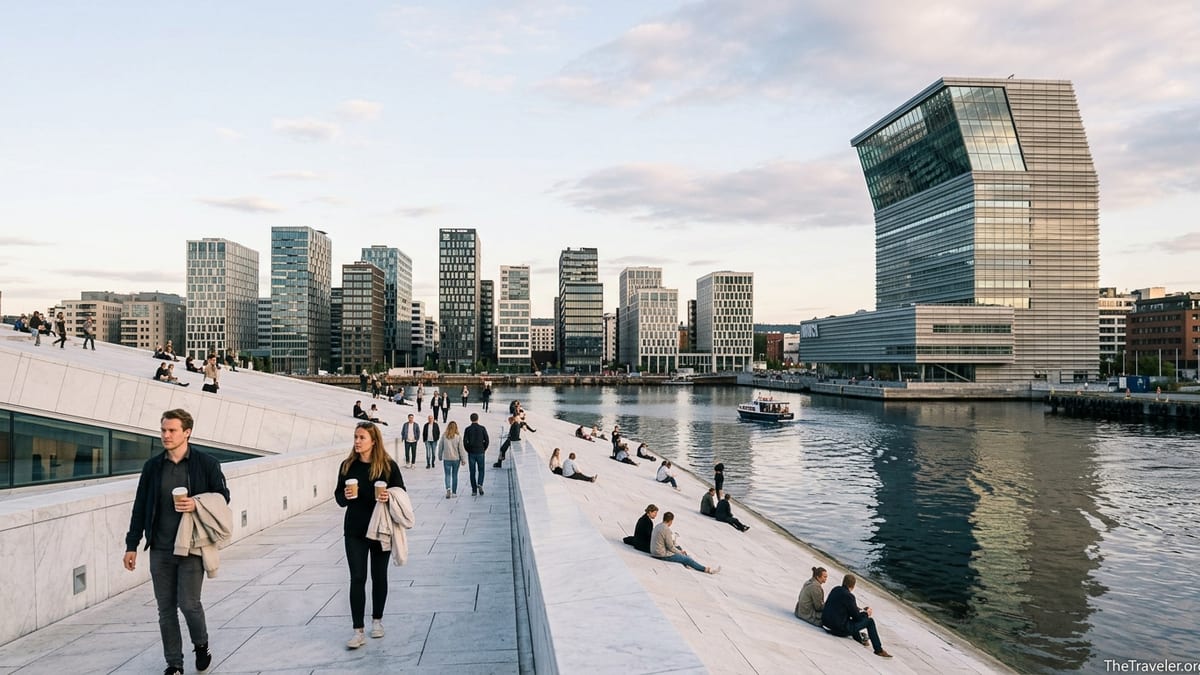
Getting Oriented in Bjørvika
Bjørvika sits directly south of Oslo Central Station at the head of the Oslofjord, which makes it unusually easy to reach compared with many waterfront redevelopments. The moment you step out of the station’s south exit you can see the white sloping roof of the Oslo Opera House ahead, the Barcode row of tall towers to your left, and the glassy bulk of the MUNCH museum just beyond the harbor. Most visitors simply walk the three to five minutes from the station, but tram lines that stop at Bjørvika and local buses also criss cross the area, so it integrates smoothly into any Oslo itinerary built around public transport.
The neighborhood itself is compact enough to cover on foot in a few hours. Think of it as a T shape: the vertical of the T is Dronning Eufemias gate, the main boulevard that parallels the railway and the Barcode buildings; the horizontal top is the harbor promenade running from the Opera House east to Sørenga. This layout matters in practice because you can plan an easy loop: start at the Opera House roof, dip into Deichman Bjørvika library, continue on to MUNCH, and then stroll the fjord promenade to the Sørenga seawater pool for a coffee or a swim if the weather cooperates.
What makes Bjørvika stand out compared with more traditional parts of Oslo is the feeling of a deliberately designed showcase district. The city concentrated several of its flagship cultural institutions here, so in a single afternoon you can move from opera to avant garde architecture to one of Europe’s largest single artist museums without ever needing a taxi. For travelers who only have a short stop in Oslo, this density of attractions is a gift, making Bjørvika an obvious first or last stop in the city.
Although it is very much a new neighborhood, Bjørvika also gives subtle glimpses of older Oslo. Information boards along the harbor explain how the redevelopment uncovered medieval shipwrecks and harbor structures, and if you look back from the Opera roof you see Akershus Fortress and the older low rise city providing a visual counterpoint to the glass and steel. It is an urban planning story as much as a sightseeing stop, and architecture fans in particular will find plenty to unpack.
Oslo Opera House: Rooftop Views and Waterfront Life
The Oslo Opera House is Bjørvika’s original anchor attraction and still its most striking sight. Opened in 2008 and designed by Norwegian firm Snøhetta, the building is clad in pale granite and marble and seems to rise out of the fjord like an angular slab of ice. Visitors are encouraged to walk on that “ice” all the way to the top. The sloping roof is completely free to access, with no ticket barriers or bag checks; you can simply stroll up from the quay and within minutes be looking down over the fjord, the Barcode towers and the steady flow of commuter trains sliding into Oslo Central Station.
This is one of the best value experiences in Oslo, a famously expensive city. You can visit at any time of year, but you feel the character of the place change with the seasons. On a bright summer evening the marble warms in the sun and locals come with takeaway coffee, children run along the edges of the roof, and photographers line up to catch the orange light on the distant forested hills. In winter the rooftop can be icy and sometimes closed in particularly slippery conditions, but even then the contrast of snow, dark water and glowing interior lights is dramatic and worth the short walk from the station.
You do not need an opera ticket to see the inside of the building either. The main foyer and atrium are open to the public during the day, and popping in for a look at the sweeping oak clad interior feels like an attraction in its own right. There is a café where a simple sandwich and coffee will cost roughly what you might expect in central Oslo, and large glass walls frame views back over the water. If your timing is right, consider a guided backstage tour, usually priced in the range of a modest museum ticket and offered in English on selected days, which takes you through rehearsal spaces and behind the stage machinery most visitors never see.
The plaza in front of the Opera House flows directly down into the harbor, where kids dangle their feet over the edge in summer and kayakers occasionally glide past within earshot. It is one of the few spots in central Oslo where the city and the fjord feel completely connected. Even if you only have an hour in town between trains, it is easy to step outside, walk up the roof, grab a quick photo of the skyline and still be back on your platform in time.
MUNCH: A Waterfront Home for Edvard Munch
A short walk along the harbor from the Opera House brings you face to face with MUNCH, the 13 storey waterfront museum that now houses the world’s largest collection of works by Norwegian artist Edvard Munch. Opened in the early 2020s, the building has a distinctive profile with a leaning upper section that appears to bow slightly toward the fjord. Locals sometimes debate the aesthetics, but for visitors there is no doubt about the significance of the collection inside. Multiple versions of “The Scream,” “Madonna” and other iconic paintings are rotated through the galleries alongside lesser known works, sketches and photographs that give a fuller picture of Munch’s long career.
For planning purposes, it helps to know that MUNCH operates with timed entry on busy days and that adult tickets are priced similarly to other major European art museums. It is wise to check current opening hours and consider buying tickets in advance if you will be in Oslo during peak summer or around major holidays. Once inside, you can choose between traditional chronological exhibitions and more experimental themed shows; signage is generally available in Norwegian and English, and free or low cost audio guides are often on offer.
The museum is also notable for its views. Higher floors have large windows framing the Opera House, the Bjørvika skyline and the ferries moving in and out of the harbor. On a clear day it is worth heading up even if you are not a committed art lover, if only to take a quiet break in the café with a coffee and watch the light change over the water. Prices here are what you would expect for a museum café in a Nordic capital, but there is no pressure to rush, and staff are used to visitors lingering with sketchbooks or laptops.
Accessibility is generally strong, with step free entrances, elevators serving all floors and staff trained to assist visitors who need extra help. Several travelers have noted that wheelchairs can be borrowed on site and that personal assistants or companions for disabled visitors often receive free or reduced admission. This makes MUNCH a realistic and rewarding stop for a wide range of travelers, including multigenerational families and visitors with mobility limitations.
Deichman Bjørvika: Oslo’s Living Room by the Tracks
Across the square from the Opera House sits Deichman Bjørvika, Oslo’s main public library and one of the most approachable cultural spaces in the city. Opened in 2020, the building looks almost like a glassy stack of books, with big cut outs and terraces carved into its volume. From the outside it can seem like a place only locals would use, but visitors are not just welcome, they are encouraged to treat it as a public living room. You can walk in without a library card, find a seat with fjord views, use the free Wi Fi and simply soak up the atmosphere without spending a krone.
Inside, Deichman is an ideal stop if you are traveling with children or need a quiet hour between more intense sightseeing. There are dedicated family and children’s sections with play corners and picture books in multiple languages, cozy reading nooks, and plenty of workspaces with charging points. It is common to see international students revising for exams next to locals leafing through newspapers and travelers resting their feet while planning the next leg of their trip. This mix of uses gives the building a more relaxed feel than a traditional tourist attraction.
Practical facilities are another plus. Clean public restrooms, drinking water taps and lockers make Deichman a useful base if you have checked out of your hotel but still have hours before an evening train or flight. There is also a café which serves coffee, simple pastries and light lunches at prices comparable to other central Oslo spots. If you are in the city on a rainy day, building a long library break into your Bjørvika route can make the difference between enduring bad weather and actually enjoying your time indoors.
The building’s top floors offer some of the best free indoor views of Bjørvika. Large picture windows look toward the fjord and across to the Barcode towers, and some evenings host low key cultural events, from small concerts to author talks. Schedules shift with the season, so it is worth checking the day’s program when you arrive at the information desk. You may find that what was meant to be a brief bathroom stop turns into an unexpectedly memorable slice of local life.
The Barcode and Bjørvika’s New Skyline
Walk north from the Opera House toward the railway and you will find yourself under the shadow of the Barcode, the row of narrow high rise buildings that has become a symbol of modern Oslo. Built in stages over the 2000s and 2010s along Dronning Eufemias gate, the towers are arranged with deliberate gaps between them, giving the impression of the vertical bars of a barcode when viewed from across the fjord. Architects from several firms contributed to the design, and opinions among locals remain divided, but as a traveler it is hard not to be intrigued by the geometry and the way the buildings interact with light and weather.
At street level, however, the Barcode is less about grand statements and more about everyday urban life. Ground floors are lined with cafés, casual restaurants and small shops, serving office workers during the day and a mix of residents and visitors in the evenings. It is a convenient place to refuel between museum visits: you might, for example, grab a quick espresso or a bowl of soup here rather than paying premium prices at a fjordside venue. Prices still reflect central Oslo standards, but you often have a wider range of choices than around more overtly touristy areas.
Architecture enthusiasts may enjoy tracing the changes in height, material and window pattern from one building to the next. Some facades are a patchwork of glass panels in different shades, others are more solid, with deep balconies cut into the mass. If you climb back onto the Opera House roof and look inland, you see how the Barcode frames the railway tracks and forms the modern edge of downtown. Several guided architecture tours of Oslo now include this section of Bjørvika, and even if you opt to explore independently, slowing down to notice the details can make the area feel less like a generic office cluster and more like an open air design gallery.
Another small but practical point is that the streets intersecting the Barcode often provide sheltered corridors on windy or rainy days. Because Bjørvika is so open to the fjord, the weather can change quickly, and ducking briefly behind a row of towers before reemerging at the waterfront can make walking more pleasant in shoulder season. The mix of residential apartments and hotels in the upper floors also means this is one of the more lived in parts of the new district rather than a purely daytime office quarter.
Waterfront Promenades, Sørenga and Fjord Swimming
Bjørvika really comes into its own along the water’s edge. From the Opera House you can follow a continuous pedestrian promenade east toward Sørenga, a sequence of wooden decks, small seating terraces and low steps where locals dangle their feet just above the water. The route passes new apartment blocks with ground floor eateries and a scattering of public art, but the real draw is the feeling of moving along the line where city and fjord meet. On a warm summer evening it is not unusual to see people in business clothes walking home alongside families pushing strollers and teenagers with ice creams, all using the same car free path.
At the far end of this promenade lies the Sørenga peninsula, one of Oslo’s most popular urban swimming areas. Here, a seawater pool, floating jetties and ladders give secure access to the fjord, and in the height of summer the place fills with swimmers, sunbathers and people meeting for early evening drinks. There is a small sandy patch suitable for children to splash in, and lifebuoys mounted along the edge underline that this is treated as a real piece of the sea, not an ornamental basin. Travelers staying nearby sometimes use Sørenga as their morning workout spot, slipping in for a quick cold water dip before breakfast.
Practicalities are straightforward but worth noting. The seawater pool and surrounding decks are free to access, though there are no reserved loungers or resort style services. Temperatures can be brisk even in July, so bringing a towel, warm layers and sandals to protect your feet from hot or rough surfaces is sensible. Changing areas are basic, and many locals simply use large towels as ad hoc screens. If you visit outside the high summer months, you may find only a few hardy bathers in wetsuits or people using the benches as a quiet place to read in fresh air.
Sørenga also functions as a casual dining hub, especially from late spring through early autumn. Restaurants and cafés line the inner streets, with terraces facing both the water and the sheltered courtyards between apartment blocks. Prices vary, but you can usually find everything from simple takeaway options, like slices of pizza or Asian street food, up to full sit down dinners with fjord views. Because this area is popular with locals as well as visitors, it is wise to book if you are planning a weekend evening meal at one of the most prominent waterside spots.
Hidden Corners, Cultural Boats and Local Moments
Beyond the headline architecture and big museums, Bjørvika has smaller experiences that reward travelers who slow down. One of the more distinctive is the cultural boat MS Bjørvika, often moored near the Opera House and MUNCH. This vessel hosts concerts, events and private functions, and even if you do not attend a performance, seeing a dedicated culture boat tied up between glass towers reinforces how maritime Oslo still is. Keep an eye on local event listings if you are in the city over a weekend; you may find an intimate jazz concert or storytelling night scheduled on board.
Another subtle highlight is simply watching how Oslo residents use the open spaces. On sunny weekdays, workers from nearby offices bring their lunches to the steps by the water or the low walls outside Deichman Bjørvika. In the shoulder seasons of spring and autumn, you might notice small groups huddled around takeaway coffee cups, determined to catch the brief slant of sunlight that reaches into the plaza at midday. In winter, the same spaces feel quieter, but dog walkers, joggers and parents with strollers still trace the same routes, underlining that this is a real neighborhood, not just a stage set for visitors.
Even small design choices can become part of the experience. Benches with integrated wooden recliners invite people to lie back and watch clouds move over the fjord. Strategic lighting along the promenade keeps paths usable long after dark, which matters during the short days around December and January. For solo travelers, these thoughtful public spaces often feel safer and more welcoming than more hidden corners of older cities, because there is almost always someone else in sight and clear lines of movement toward major landmarks like the Opera House or the station.
If you are interested in photography, consider visiting Bjørvika twice at different times of day. Early morning can bring calm water and soft reflections of the Barcode in the fjord, while late evening may deliver dramatic sky colors behind the jagged skyline. The glass facade of Deichman shifts character with changing light, sometimes reading as almost opaque, other times as a glowing lantern. None of this requires tickets or fixed timings, so it is easy to adapt around museum entry slots or meal reservations.
The Takeaway
Bjørvika is one of those rare urban districts that works as both a postcard and a place to live. For travelers it offers a concentration of big ticket attractions, including the Oslo Opera House, MUNCH and Deichman Bjørvika, all within a small, walkable area directly beside the city’s main transport hub. Add in the Barcode skyline and the seawater pools and promenades of Sørenga, and you have an itinerary that mixes high culture, everyday local life and simple enjoyment of the fjord.
In practical terms, this means Bjørvika can anchor a half day or full day in Oslo, whether you are on a short city break, a cruise stop or a longer journey through Norway. You could arrive mid morning, explore the Opera House and library, spend several hours inside MUNCH, then end your day with a walk along the water and a casual meal in Sørenga before heading back to your hotel. Alternatively, you might dip in for just an hour to walk the Opera roof and people watch between trains.
What sets the neighborhood apart is not just its individual sights but the way they connect. There are no long transit hops, no need to navigate confusing backstreets, and plenty of free or low cost spaces that soften the financial impact of visiting an expensive capital. Whether you come for the art, the architecture or the simple pleasure of sitting by the water with a coffee, Bjørvika offers a clear, contemporary snapshot of Oslo as it is today.
FAQ
Q1. How do I get to Bjørvika from Oslo Central Station?
From Oslo Central Station, use the south exit and walk three to five minutes toward the white sloping roof of the Opera House. Bjørvika begins right outside the station, so you do not need additional transport unless you have heavy luggage or mobility issues, in which case short tram or bus rides also serve the area.
Q2. Is it free to walk on the roof of the Oslo Opera House?
Yes, access to the Opera House roof is completely free and open during regular outdoor hours. You do not need a ticket, and you can simply walk up from the harbor plaza, though the surface may be closed or partially restricted in very icy winter conditions for safety.
Q3. How much time should I plan for visiting MUNCH?
Most visitors spend between two and three hours inside MUNCH, which allows time for the main Edvard Munch galleries, at least one temporary exhibition and a break in the café. Art enthusiasts may want longer, especially if they enjoy reading wall texts or using the audio guide in detail.
Q4. Can I use Deichman Bjørvika library even if I am not a local resident?
Yes, the library is fully open to visitors. You can enter freely, use seating areas, Wi Fi and many facilities without a membership card. Borrowing physical books usually requires local registration, but simply spending time in the building is encouraged for both residents and travelers.
Q5. Is it safe and allowed to swim at Sørenga in Bjørvika?
Swimming is not only allowed but actively facilitated at Sørenga’s seawater pool and surrounding jetties, with ladders, floating platforms and safety equipment in place. As with any open water swimming, use common sense, be aware of cold temperatures even in summer, and keep an eye on children near the edges.
Q6. Are there good food options in Bjørvika for different budgets?
Yes, Bjørvika offers everything from takeaway pizza slices and casual cafés along the Barcode to sit down restaurants in Sørenga with fjord views. Prices reflect central Oslo standards, but it is possible to manage costs by choosing simpler venues or grabbing coffee and snacks from bakeries and supermarkets near the station.
Q7. Is Bjørvika suitable to visit in winter, or is it only a summer area?
Bjørvika is worth visiting year round. In winter you may not want to swim at Sørenga, but the Opera House interior, MUNCH and Deichman library are all indoor attractions, and the stark winter light over the fjord can be very atmospheric. Just dress warmly, as the waterfront is often windier than inland streets.
Q8. Are the main attractions in Bjørvika accessible for visitors with limited mobility?
Most major sites in Bjørvika offer step free access, elevators and accessible restrooms. Both the Opera House interior and MUNCH are designed with wheelchair users in mind, and the library has wide corridors and lifts. The sloping Opera roof can be challenging in bad weather, but staff can advise on the safest routes and alternatives.
Q9. Can I see the main sights in Bjørvika on a short layover in Oslo?
Yes, if your layover is at least three to four hours, you can usually step out of Oslo Central Station, walk the Opera roof, explore the public areas of Deichman Bjørvika and stroll part of the waterfront. A full museum visit to MUNCH might be tight on a very short stop, but the neighborhood itself is ideal for quick impressions.
Q10. What is the best time of day to visit Bjørvika for photography?
Early morning and late evening often offer the best light, with softer shadows and reflections of the Barcode in the fjord. In summer, the long golden hour can give the Opera House and MUNCH warm tones, while in winter the low sun can produce dramatic contrasts between bright surfaces and deep blue water, even in mid afternoon.