


Bjørvika used to be the part of Oslo most travelers passed on their way from the central station to somewhere else. Today it is one of the first places many visitors head for: a waterfront district of striking architecture, major museums, fjord swimming spots and busy café terraces. If you are wondering whether Bjørvika is worth fitting into a short Oslo itinerary, the answer for most travelers is yes, provided you know what to expect and how to use the area as a base for exploring the rest of the city.
Get the latest updates straight to your inbox!
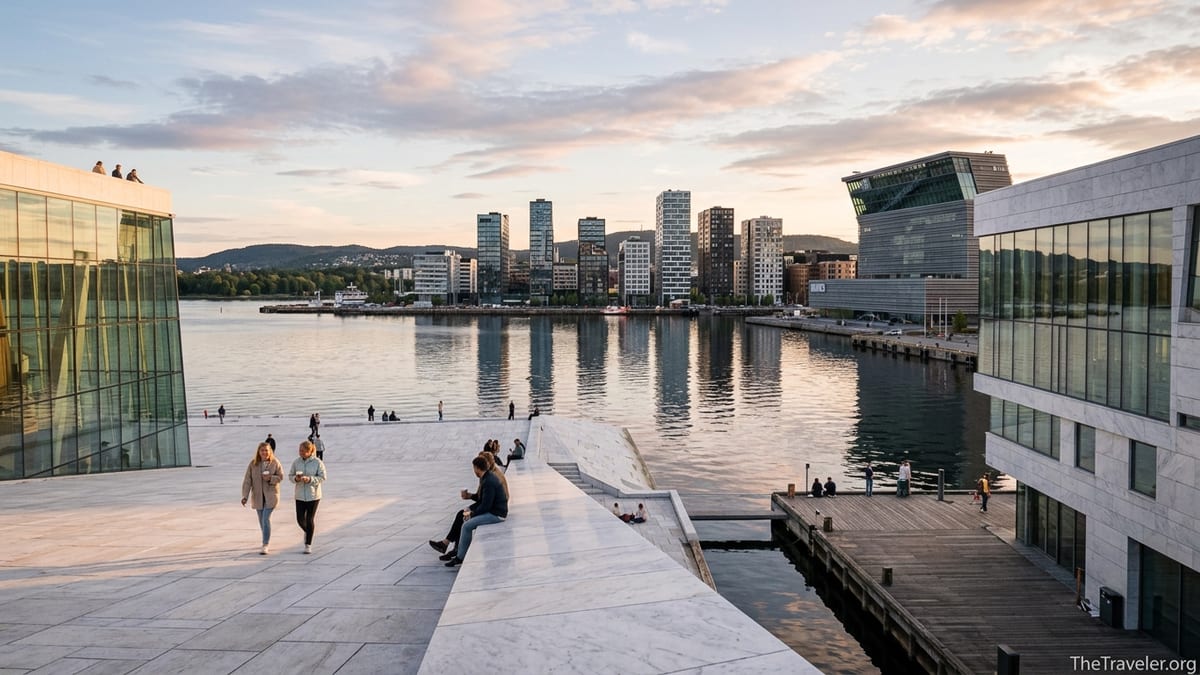
From Working Port to Oslo’s Showpiece Waterfront
Bjørvika sits directly east of Oslo Central Station, at the innermost end of the Oslofjord. Historically this was a gritty dock and highway interchange, cut off from the rest of the city. Over the past two decades it has been almost completely rebuilt as part of Oslo’s long-term Fjord City project, which is turning former port and industrial land into public waterfront neighborhoods with housing, culture and promenades. The shift is dramatic: where there were once container yards, you now find boardwalks, museums and people sunbathing on wooden piers.
The neighborhood’s modern identity really began with the opening of the Oslo Opera House in 2008. Its sloping white marble roof, designed so that anyone can walk all the way up to the top, set the tone for Bjørvika as a place where high culture and everyday city life mix. Since then, major public investments have followed, including an ambitious public library, new bridges and a sea bath at Sørenga that makes it possible to swim in the fjord just a few minutes’ walk from the train platforms.
This transformation has made Bjørvika one of the most talked-about urban renewal projects in Scandinavia. For travelers, that means you are stepping into a kind of open-air architecture and planning laboratory. It will feel different from traditional European “old towns,” and opinions about the skyline can be divided, but there is nowhere better to see what Oslo is becoming.
That background also explains why the neighborhood can feel unusually polished and new. Much of Bjørvika has been built in the last 10 to 15 years, so you will not find many historic facades. If you come expecting cobblestone lanes and medieval churches you may be disappointed, but if you are curious about contemporary Nordic urban design, it is an ideal place to start.
Iconic Architecture: Opera House, MUNCH and the Barcode
The single most compelling reason to visit Bjørvika is its concentration of landmark buildings. The Norwegian National Opera and Ballet dominates the waterfront with its low, angular profile, iceberg-white marble cladding and glass curtain walls. Visitors are encouraged to treat the roof like a public plaza: you can walk up ramp-like slopes without a ticket, sit on the edge to watch boats move across the fjord, or photograph the Barcode skyline and the hills surrounding Oslo. On a clear summer evening the late sun turns the stone golden and the views are among the best in the city.
A short walk east along the water brings you to MUNCH, the dedicated museum for Edvard Munch’s work. The building itself is deliberately sculptural, with a top section that leans slightly toward the fjord. Inside, floor after floor is devoted to Munch’s paintings and prints, including several versions of The Scream, as well as rotating exhibitions and a top-floor bar and terrace. Timed tickets can sell out in peak season, especially during summer and on Norwegian public holidays, so it is wise to buy in advance if you know when you will visit.
Just behind the Opera House runs the Barcode, a row of slender high-rise buildings that look like the vertical bars of a supermarket barcode when seen from across the tracks. The ensemble houses offices, apartments, restaurants and shops. Some locals find the design too sharp and corporate, but it has become one of the most recognizable images of modern Oslo. Travelers often enjoy the contrast: you can take a photo of the white, sloping Opera House roof in the foreground with the dark, serrated Barcode towers behind it, a visual summary of the city’s waterfront ambitions.
Other notable structures in the area include Deichman Bjørvika, Oslo’s main public library, which sits between the Opera House and the central station. Its multi-level interior, with bookcases lined along dramatic staircases and views of the fjord from reading nooks, makes it worth a short visit even if you only come in to warm up on a winter day. Many travelers comment that it feels more like a cultural center than a quiet library, with cafés, study spaces and occasional free events.
Why Travelers Love Spending Time Here
Bjørvika’s popularity with visitors comes from how much you can experience in a compact, walkable area. Within a 10-minute radius on foot you can take in the Opera House, MUNCH, the Barcode, the main library and the Sørenga waterfront. For someone arriving in Oslo on a Friday afternoon and leaving Sunday, this makes planning easy: you can check into a nearby hotel or apartment, leave your bags and immediately start exploring without needing public transport.
The neighborhood also offers a lot of atmosphere in good weather. In late spring and summer, the boardwalks fill with families eating ice cream, couples sharing pizza at outdoor tables and office workers lingering over a drink after work. Wooden steps and piers along the water become informal seating areas. On warm July evenings you may see people in swimwear walking barefoot from their apartment buildings straight into the fjord at Sørenga, then back to a café for a coffee or beer.
For many travelers, this easy access to the water is a revelation. Oslo is a capital city, but in Bjørvika you can treat it almost like a seaside resort for a few hours. You might walk up to the Opera House roof in the morning, visit MUNCH over lunch, then head to the Sørenga sea bath area for an afternoon swim and a casual dinner at one of the waterfront restaurants. The distances are short enough that you rarely need to look at a map, and there are clear pedestrian paths and bridges connecting each part of the district.
The area works well in colder seasons too, though in a different way. In autumn and winter, the outdoor restaurants largely retract their terraces, but the museums, library and indoor cafés become warm refuges. It can be atmospheric to walk along the nearly empty boardwalk on a snowy evening, see the Opera House glowing in the dark and then step inside for a performance or simply watch the lights of ferries crossing the fjord.
Dining, Nightlife and Everyday Practicalities
Because Bjørvika has been purpose-built as a mixed-use district, it contains a dense selection of cafés, restaurants and bars at street level. Many of them line the canals and waterfront in the Oslobukta shopping and dining area, which stretches between the Opera House and Sørenga. You will find everything from bakeries serving cardamom buns and strong coffee to higher-end seafood places that highlight local fish and shellfish from the Oslofjord and nearby coastal waters.
Prices reflect Oslo’s reputation as an expensive city. A simple cappuccino at a specialty café in Bjørvika can cost around the equivalent of 4 to 5 US dollars, and a main course at a sit-down restaurant might be closer to 25 to 40 dollars depending on the place and the current exchange rate. That said, there are ways to manage costs. Many spots offer more affordable lunch menus or “dagens rett,” a daily special that is cheaper than the full dinner menu. Supermarkets and takeaway counters in the ground floors of apartment buildings can be handy if you prefer to picnic on the piers or eat in your room.
Nightlife in Bjørvika tends to be relaxed rather than wild. You will find bars with fjord views where locals meet for after-work drinks, as well as wine bars and cocktail places tucked under the towers of the Barcode. On weekend evenings in summer, the waterfront promenade can feel lively with a steady buzz of conversation, but most venues close at reasonable hours compared to larger European capitals. If you are looking for clubs or late-night music, you may end up heading to other neighborhoods such as Grünerløkka or the city center around Youngstorget.
In day-to-day terms, Bjørvika is extremely convenient. Oslo Central Station sits at its edge, with trains to the airport, Bergen, Trondheim and other parts of Norway. There are also bus, tram and metro stops that make it simple to use Bjørvika as a base while exploring the rest of the city. Travelers staying in apartments here often note that they can roll their suitcase from the airport express train to their accommodation in under 10 minutes, yet still be drinking coffee by the fjord half an hour after landing.
Outdoor Life: Swimming, Strolling and Fjord Views
One of the biggest surprises in Bjørvika is how much of the shoreline has been given over to public space. Wooden boardwalks and piers ring much of the water, and a series of bridges link the MUNCH and Opera House area to the residential peninsula of Sørenga. For visitors, this translates into an easy and scenic walking route, especially when combined with the longer Oslo Harbour Promenade that continues west toward Akershus Fortress and Aker Brygge.
The Sørenga sea bath is the standout outdoor attraction. Here, designers have created a sheltered swimming area with floating pontoons, diving platforms, ladders into the fjord and an enclosed lap pool section. In summer, locals of all ages come to swim, sunbathe on the wooden decks and use the outdoor showers. For travelers, it is an unusually urban way to experience Norwegian outdoor culture: you can be in the water looking back at the Opera House, Barcode and the hills behind Oslo, then dry off and sit down at a nearby café for a meal.
Even if you do not plan to swim, the sea bath area is a good place to feel the rhythm of the city. Families push strollers along the promenade, teenagers gather with portable speakers and older residents take slow walks along the edge, stopping to talk with neighbors. Because the neighborhood is still relatively new, you will also see construction and landscaping continuing in some pockets, a reminder that Bjørvika is still evolving.
Walking remains the best way to take in the architecture and views. A popular route for first-time visitors starts at the central station, crosses the footbridge to the Opera House, continues along the edge of the building toward MUNCH, then follows the wooden promenade and bridges to Sørenga and the sea bath. From there you can loop back through the inner streets of Oslobukta and the Barcode, taking in pocket parks, small plazas and the way the buildings frame the fjord.
Is Bjørvika a Good Place to Stay?
For many visitors, the answer is yes, particularly if it is your first time in Oslo or you have limited days. The area’s location next to Oslo Central Station and its compact walkability mean you can minimize time spent figuring out transport. Hotels and serviced apartments in and around Bjørvika often market themselves on this convenience: step off the airport express, walk for a few minutes and drop your bags in a modern room before heading outside.
Staying here also gives you front-row access to some of Oslo’s most sought-after attractions. You can visit the Opera House roof early in the morning before day-trippers arrive, explore MUNCH right when it opens, or take advantage of off-peak times at popular waterfront cafés. In practical terms, that can make your experience feel calmer and more spacious, even in the middle of summer when the city is busy.
However, there are trade-offs. Because Bjørvika is so new and purpose-built, it can lack some of the cozy, organic charm you will find in older neighborhoods like Grünerløkka, Frogner or St. Hanshaugen. After dark, some parts of the district may feel quiet or even a bit sterile once office workers and daytime visitors have gone home. If your idea of a perfect Oslo stay revolves around small independent shops, vintage stores and traditional wooden houses, you may prefer to stay elsewhere and simply visit Bjørvika for a day or evening.
Price is another consideration. Accommodation directly on the waterfront or with fjord views often commands a premium. If your budget is tight, you might find better value a few tram stops away, while still planning several visits to Bjørvika for sightseeing and dining. On the other hand, if you value time and convenience over square footage, being able to walk to both major sights and long-distance trains from your front door is a significant benefit.
Who Will Enjoy Bjørvika Most?
Bjørvika is particularly attractive if you are interested in architecture, urban planning or contemporary art and design. Travelers who like to photograph cityscapes will find endless angles: reflections of the Barcode in glass facades, silhouettes of people walking on the Opera House roof, and the geometric patterns of wooden piers and staircases against the water. If your Instagram feed tends to feature buildings and skylines rather than historic churches, you will likely spend a lot of time here.
Culture-focused visitors are also well served. Between the Opera House’s schedule of opera, ballet and contemporary dance, the extensive exhibitions at MUNCH and a program of events and installations at the public library, you could easily fill a full day or more in Bjørvika without running out of things to see indoors. For families, the library’s children’s areas and the simple novelty of walking up and down the Opera House roof are easy, low-cost activities.
The neighborhood is also a good fit if you appreciate being close to the water and enjoy casual, everyday pleasures: swimming, sitting on a pier with takeaway food, watching commuter ferries come and go, or simply walking along the edge of the fjord at sunset. Because Bjørvika is relatively flat and well-signed, it is accessible for many mobility levels, though some of the most scenic spots on the Opera House roof require navigating sloped surfaces that can be slippery in rain or snow.
On the other hand, travelers looking primarily for nightlife, alternative culture or historic streets might find more of what they are after elsewhere in Oslo. In that case, Bjørvika is still worth visiting for half a day to see how the city is reinventing its waterfront, but it may not need to be the center of your stay.
The Takeaway
Bjørvika is not a traditional neighborhood with centuries of layered history, but that is precisely what makes it so interesting. It offers a concentrated snapshot of twenty-first-century Oslo: bold cultural institutions, ambitious architecture, a strong emphasis on public space and everyday access to the fjord. For most visitors, it is well worth at least half a day, and often more, especially if you plan to visit the Opera House, MUNCH and the Sørenga sea bath.
Whether you choose to stay in Bjørvika or simply visit, the area is easy to fit into almost any Oslo itinerary. Its direct connection to the central station and its walkable layout mean that even a few hours can be rewarding. If you arrive with realistic expectations, prepared for a modern, occasionally polished environment rather than a storybook old town, you are likely to come away impressed by how quickly a former industrial port has become one of the city’s most popular places to live, work and play.
In the end, what makes Bjørvika so popular is the way it condenses many of the things travelers appreciate about Oslo into one compact district: culture on an international scale, daily contact with the fjord, and public spaces that invite you to linger. You can step off a long-distance train, walk onto the roof of an opera house, swim in the sea and have dinner on a pier without ever leaving the neighborhood. Few waterfronts in Europe can offer that combination so close to the heart of a capital city.
FAQ
Q1. Is Bjørvika worth visiting on a short trip to Oslo?
Yes, Bjørvika is easy to reach from Oslo Central Station and packs major sights like the Opera House, MUNCH and Sørenga sea bath into a compact, walkable area.
Q2. How much time should I plan for Bjørvika?
If you only want to walk the waterfront and go up on the Opera House roof, a couple of hours can be enough, but visiting MUNCH or swimming at Sørenga can turn it into a half or full day.
Q3. Is it free to walk on the Oslo Opera House roof?
Yes, the roof is a public space and free to access during opening hours, so you can walk up for fjord views without buying a performance ticket.
Q4. Can you swim in the fjord at Bjørvika?
Yes, the Sørenga sea bath area has designated swimming zones, ladders and diving platforms, and in summer it becomes a popular spot for locals and visitors.
Q5. Is Bjørvika a good area to stay in for first-time visitors?
It is an excellent base if you value convenience, modern accommodation and walking access to major attractions, though it feels more new and polished than older neighborhoods.
Q6. How expensive are food and drinks in Bjørvika?
Prices are typically high by international standards, with coffee often several dollars and restaurant main courses much higher, but lunch specials and supermarket options help manage costs.
Q7. Is Bjørvika lively at night?
The waterfront has busy bars and restaurants in the evening, especially in summer, but the area is more relaxed than party-oriented and can feel quiet later at night.
Q8. Is Bjørvika suitable for families with children?
Yes, families appreciate the car-light promenades, the fun of walking on the Opera House roof, the library’s children’s areas and in warm weather the swimming options at Sørenga.
Q9. How do I get to Bjørvika from Oslo Airport?
Take the airport train or regular regional train to Oslo Central Station; from there it is only a few minutes’ walk across pedestrian bridges and plazas into the heart of Bjørvika.
Q10. What is the best season to visit Bjørvika?
Summer offers outdoor swimming and busy terraces, while autumn and winter are quieter but still rewarding for museum visits, fjord views and indoor café culture.