


Oslo’s waterfront has been rebuilt into two very different playgrounds: Bjørvika, the bold newcomer of glass, culture and clean lines, and Aker Brygge, the classic promenade of restaurants, bars and ferries. Both sit within a 15-minute walk of each other along the Oslofjord, yet they feel like two separate cities. Choosing where to stay, eat and wander can shape your entire Oslo experience. Here is how the two districts really compare, and which one fits your travel style better.
Get the latest updates straight to your inbox!
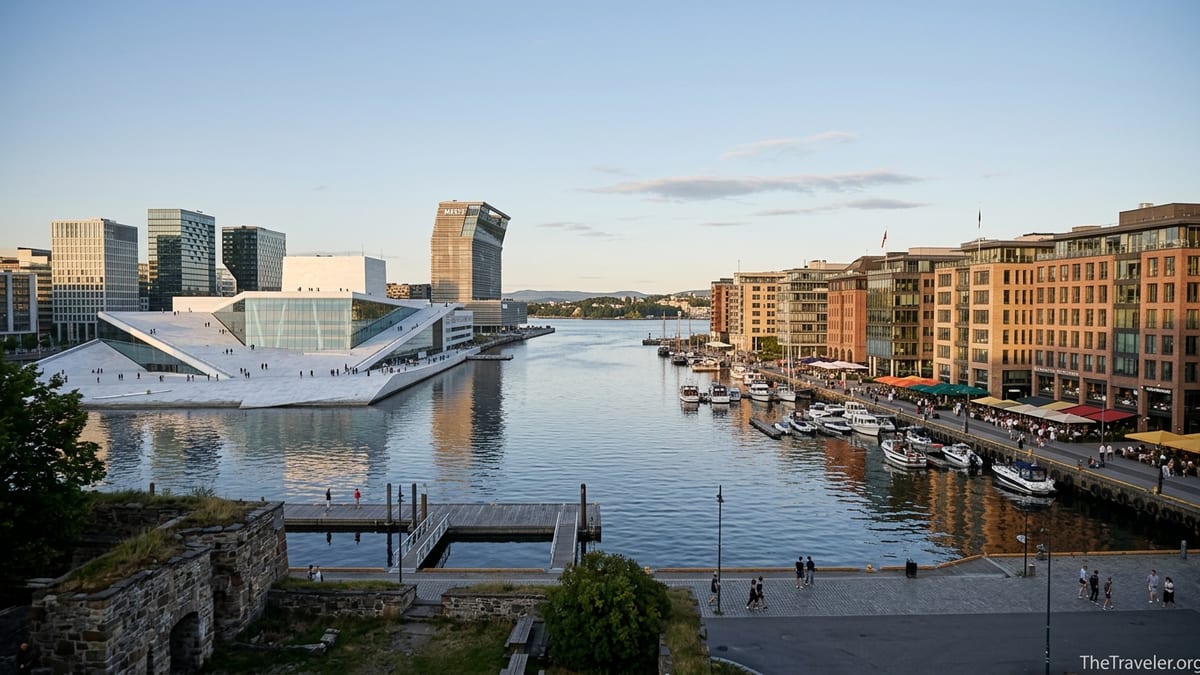
First Impressions: Two Very Different Fjord Fronts
Bjørvika is Oslo’s poster child for twenty‑first‑century urban renewal. Once a container port, it is now all sharp angles and glass, anchored by the white marble Oslo Opera House, the new MUNCH museum tower and the Barcode skyline. Walking out of Oslo Central Station and straight onto the Opera House roof feels more like arriving in a European architecture biennale than a traditional harbor. The mood is open, spacious and slightly futuristic, with wide promenades, floating saunas and clean-design cafes replacing old cranes and warehouses.
Aker Brygge, just west of Oslo City Hall, has a longer track record as the city’s social waterfront. Converted from a shipyard in the late 1980s and 1990s, it is now a lively strip of restaurants, bars and shops lining a 400‑meter promenade of piers and bobbing boats. In good weather, every terrace is full of people in sunglasses nursing Aperol spritz or local craft beer. While Bjørvika feels like a culture campus, Aker Brygge feels like a Mediterranean-style boardwalk transplanted to Norway.
For a first-time visitor, it is easy to tell them apart by sound alone. In Bjørvika, you are more likely to hear the quiet echo of footsteps on the Opera House roof or the soft hum of cyclists. In Aker Brygge, the soundtrack is clinking cutlery, buskers on the quay and announcements from ferries heading to the islands of the Oslofjord. Neither is “better,” but they are distinctly different stages for your time in Oslo.
Most travelers will see both areas on a short visit. The real decision is where you base yourself, where you spend your evenings, and which waterfront matches your priorities: culture and calm, or people-watching and dining.
Architecture, Atmosphere and Scenery
If striking architecture and contemporary cityscapes appeal to you, Bjørvika is hard to beat. The Oslo Opera House, designed so its sloping roof can be walked like a public plaza, is free to access and offers some of the best panoramic views in the city. On a clear evening in July, you can stand on the rooftop and watch the light linger over the fjord until nearly midnight, with Akershus Fortress on one side and the Barcode high-rises on the other. Nearby, the angular glass facade of Deichman Bjørvika library glows warm at night, while the vertical, leaning form of MUNCH punctuates the skyline.
At street level, Bjørvika feels wide and uncluttered. Boardwalks stretch past floating saunas, pocket parks, and new residential wharves toward the Sørenga area, where locals swim in a seawater pool and lay out on wooden decks in summer. Even on busy days in July or during an autumn festival, it is usually easy to find a bench or a quiet stretch of railing to watch the water. The aesthetic is modern Scandinavian minimalism applied at neighborhood scale.
Aker Brygge, by contrast, leans into warmth and bustle. The architecture is a mix of refurbished brick shipyard buildings and newer glass-and-steel blocks filled with offices and apartments. The narrow lanes behind the main pier hide small design shops and galleries, but the real focus is the waterfront promenade itself. Restaurants often place tables right along the edge of the quay; you can eat a plate of steamed mussels or a reindeer burger while watching sailboats reverse out of their berths.
Photographically, both areas shine in different ways. Bjørvika suits wide-angle shots of cutting-edge buildings reflected in still water, especially early morning or late evening when the marble of the Opera House takes on pastel colors. Aker Brygge is better for candid street-style images: couples leaning against railings, waiters weaving between tables, sunset glowing behind the masts of moored boats and the peninsulas of Tjuvholmen and Bygdøy in the distance.
Cultural Heavyweights vs Laid-back Leisure
Bjørvika is Oslo’s cultural engine room. Within a 10-minute walk you have the Oslo Opera House, home to opera, ballet and concerts; MUNCH, the dedicated museum for Edvard Munch’s work, in a 13‑storey tower opened in 2021; and Deichman Bjørvika, Norway’s flagship public library. A visitor could easily spend an entire day here without once leaving the district. A typical cultural day might begin with a free wander through the library, continue with two or three hours at MUNCH exploring various Munch collections and temporary exhibitions, and finish with a backstage tour or evening performance at the Opera House.
Ticket prices in Bjørvika are comparable to other Nordic capitals. A standard adult entry to MUNCH is typically in the region of 200 Norwegian kroner, while Opera House backstage tours sit roughly in the 130 to 160 kroner bracket, depending on season and time. Many exhibits inside Deichman are free, and spending a rainy afternoon in its reading rooms, with fjord views and design furniture, costs nothing more than a coffee from the ground-floor cafe. For cost-conscious travelers who still want rich cultural experiences, Bjørvika offers a good balance of free and paid options in a compact area.
Aker Brygge is less about formal culture and more about soft leisure. Here, your “museum ticket” is the price of a drink at a sun-drenched terrace. The main activities are wandering the boardwalk, stopping for an ice cream or cold beer, dipping your feet into the water at the steps near the small city beach at neighboring Tjuvholmen, or browsing galleries and design boutiques. The nearby Astrup Fearnley Museum of Modern Art on Tjuvholmen adds a serious cultural note, and the National Museum sits only a short walk away, but most people come to Aker Brygge to relax rather than tick off art-historical must-sees.
If your perfect Oslo afternoon involves a long, slow lunch outdoors, punctuated only by deciding whether to order another coffee, Aker Brygge delivers that better than Bjørvika. If instead you want to come home feeling like you really engaged with Norwegian art and architecture, Bjørvika is the better anchor.
Food, Drink and Nightlife: What You Will Actually Spend
Eating out in Oslo is not cheap in general, but there are real differences between these two waterfronts. Aker Brygge is one of the most restaurant-dense areas in the city, with everything from polished seafood houses to casual burger joints and chain pizza outlets. A typical main course at a mid-range waterfront restaurant here often lands between 260 and 380 kroner, with a glass of wine or beer adding another 110 to 150 kroner. Sitting right on the quay usually carries a small price premium, but you are paying for fjord views and people-watching that last for hours.
Examples at Aker Brygge include upscale fish restaurants serving Arctic char, cod and mussels, trendy spots that pair Norwegian ingredients with international flavors, and newer openings such as an Indian kitchen adding more diversity to the scene. On warm summer evenings, every outdoor table can be full by 6 pm, and locals happily linger over a single drink while the sun moves slowly down the fjord. Nightlife here is more about relaxed bars and late dinners than clubs, but if you want to stroll between several bars without thinking too hard, this is the easiest waterfront base.
In Bjørvika, the food and drink scene is still growing but already varied. You will find contemporary Nordic cafes offering open sandwiches, bakeries selling cinnamon buns and cardamom buns, and a handful of restaurants along the water in Sørenga and around the Opera House. Prices for coffee and light meals are slightly more forgiving here: a cappuccino might run around 45 to 55 kroner, a pastry 35 to 55 kroner, and a simple lunch dish between 180 and 260 kroner, depending on location. For a budget-friendly waterfront evening, picking up takeaway sushi or supermarket picnic supplies near Oslo Central Station and eating them on the Opera House roof is a popular local trick.
After dark, Bjørvika is generally calmer than Aker Brygge. People come for performances or an exhibition opening, then disperse. You will find a few bars and cocktail spots, but the overall tone is lower-key. If you are sensitive to noise and do not want late-night shouting under your hotel window in peak summer, Bjørvika or neighboring streets just behind it may suit you better than directly on the Aker Brygge quay.
Where to Stay and Who Each Area Suits
For accommodation, Bjørvika offers a cluster of modern hotels and serviced apartments close to Oslo Central Station, including several business-style properties that appeal to city-break travelers looking for convenience. Rooms often feature floor-to-ceiling windows overlooking rail lines, the fjord or the Barcode district. Because this part of town doubles as an office hub, you can sometimes find better weekend deals here compared with midweek business peaks. The ability to walk from your train or airport express directly to your hotel in five to seven minutes, then out to the Opera House in two more, is a practical advantage if you are carrying luggage or traveling with young children.
Aker Brygge has fewer hotels directly on the quay, but neighboring Tjuvholmen is home to one of Oslo’s better-known design hotels, popular with travelers who want a boutique experience and immediate access to the waterfront. From there, you can be at a restaurant table in under a minute and at the Astrup Fearnley Museum in just a few more. Some higher-end apartments and serviced residences in the area cater to visitors who want to stay several nights and live like locals, with balconies facing the marina.
In terms of traveler type, Bjørvika suits culture-focused visitors, architecture fans, and anyone who values quick transport connections. It is also a good fit if you only have one or two nights in the city and want to minimize time lost in transit while maximizing time on your feet. Solo travelers often appreciate that the area feels well lit and open in the evening, with plenty of other people heading to and from performances.
Aker Brygge, by contrast, is ideal for social travelers, couples on city breaks and small groups of friends who see Oslo as a place to eat, drink and talk late into the evening by the water. If you want to be able to step outside, stroll a lively promenade and choose from dozens of menus without thinking about tram schedules, this waterfront is your natural base. Just keep in mind that the same vibrancy can mean higher noise levels on summer nights and on weekends.
Getting Around, Day Trips and Practicalities
Both Bjørvika and Aker Brygge are centrally located and well connected. Bjørvika effectively begins at the doors of Oslo Central Station; from there, local trains, metro lines, trams and buses spread across the city, and the airport express train arrives from Oslo Airport in around 20 minutes. This makes Bjørvika a strategic starting point for day trips to places like the Bygdøy museum peninsula by bus, the Holmenkollen ski jump via metro, or the forest trails of Nordmarka. You also have easy access to the inner-city bus network for reaching other neighborhoods like Grünerløkka or Majorstuen.
Aker Brygge, meanwhile, is Oslo’s main ferry hub. Regular public ferries run from piers near the promenade to several islands in the Oslofjord, such as Hovedøya and Gressholmen, and onward to suburban communities like Nesodden. In summer, travelers often combine a morning island hike or swim with an afternoon drink back at Aker Brygge without ever stepping into a car. Separate seasonal boats connect Aker Brygge with Bygdøy, home to the Fram polar ship, the Kon-Tiki collection and the Norwegian Folk Museum, although many visitors opt for the all-year city bus line instead.
Reaching Aker Brygge from elsewhere in the city is straightforward. Trams on the Vika Line serve a dedicated stop a short walk from the water, and Oslo City Hall stands just behind the promenade, making it easy to combine the waterfront with a visit to the National Museum or a stroll up Karl Johans gate. On foot, Bjørvika and Aker Brygge are about 20 to 25 minutes apart along a pleasant harbor-side route that passes Akershus Fortress and the developing waterfront in between.
On practical matters like services and facilities, Aker Brygge has the edge in sheer variety, with shopping centers, a cinema and plenty of public toilets integrated into the complex. Bjørvika counters with generous public space, wide benches and several cultural buildings whose ground floors function almost like indoor plazas on cold or rainy days. In winter, the exposed nature of both waterfronts can make them feel chilly; packing a windproof layer and warm hat is sensible, even for a restaurant dinner only 200 meters from your hotel.
Which Waterfront Fits Your Travel Style?
Choosing between Bjørvika and Aker Brygge is less about finding the “best” part of Oslo and more about matching the neighborhood to the way you like to travel. If your ideal city break revolves around galleries, modern architecture, good coffee and time to sit with a book while watching the light change over the water, Bjørvika is a strong fit. You can fill a day with the Opera House, MUNCH, and Deichman, then walk home along quiet quays, perhaps stopping at a floating sauna or a low-key wine bar.
If, on the other hand, your trips are defined by long conversations over dinner, hopping between bars and making last-minute decisions to catch a sunset fjord cruise, Aker Brygge will feel more natural. The density of restaurants and the availability of ferries right outside your door make it especially appealing for short stays where you do not want to decode an unfamiliar transport network after dark.
Families may find a hybrid approach works best. Staying near Bjørvika gives you quick airport access and ample space for children to run on the Opera House roof or play near Sørenga’s swimming areas, while making Aker Brygge a dedicated afternoon or evening excursion focused on ice cream, ferries and perhaps a quick swim at Tjuvholmen’s small beach. Budget-conscious backpackers might favor Bjørvika for its free cultural experiences and cheaper takeaway options, saving their splurge meal for one memorable evening at a waterfront restaurant in Aker Brygge.
Ultimately, the two districts complement rather than compete with each other. On a three-day Oslo trip, spending one full afternoon and evening in each, with a connecting harbor walk in between, offers a neat way to understand how the city has turned its industrial waterfront into one of its greatest assets.
The Takeaway
Seen side by side, Bjørvika and Aker Brygge represent two faces of modern Oslo. Bjørvika is the contemplative side: light-filled institutions, confident architecture and a sense of space that invites slow exploration. Aker Brygge is the extrovert: terraces, ferries, clinking glasses and the constant movement of people and boats along the quay.
For culture lovers, architecture fans and travelers catching early or late trains, Bjørvika is the logical base that will keep most of your must-sees within a short walk. For social travelers and those who picture Oslo as a place to toast the long Nordic evenings by the water, Aker Brygge will deliver exactly that postcard image you have in mind.
The best news is that you do not really have to choose. Oslo’s compact center and pedestrian-friendly harborfront make it entirely realistic to sleep in one district, spend your days in the other and see both under different lights. Start on the Opera House roof, end with a lingering dessert at Aker Brygge, and you will have experienced the full arc of Oslo’s waterfront story.
FAQ
Q1. Is Bjørvika or Aker Brygge better for a first-time visitor to Oslo?
For a first-time visitor with just a couple of days, Bjørvika often makes the better base thanks to its direct connection with Oslo Central Station and concentration of major sights like the Opera House and MUNCH. You can easily walk to Aker Brygge from there for an afternoon or evening on the promenade.
Q2. Which area is more budget friendly, Bjørvika or Aker Brygge?
Neither area is cheap by global standards, but Bjørvika is generally kinder to a tight budget. Many of its highlights, such as the Opera House roof and Deichman library, are free, and you can picnic by the water. Aker Brygge centers more around restaurant terraces, where food and drink can add up quickly.
Q3. Where should I stay if I have an early flight or train?
If you have an early departure, staying in or near Bjørvika is more convenient. Hotels there are only a short walk from Oslo Central Station, where both local trains and the airport express depart frequently, so you minimize morning travel stress.
Q4. Which waterfront is better for nightlife?
Aker Brygge has the livelier evening scene, with a dense cluster of bars and restaurants that stay busy on weekends and summer nights. Bjørvika tends to quieten after performances finish, making it more suitable for travelers who prefer calm streets and early nights.
Q5. Is it easy to walk between Bjørvika and Aker Brygge?
Yes. Allow around 20 to 25 minutes on foot for the harbor walk between the two. The route is mostly flat and scenic, passing Akershus Fortress and several piers, so it works well as a pre-dinner stroll or a way to link cultural sightseeing with a meal by the water.
Q6. Which area is better for families with children?
Both can work, but Bjørvika has more open space for running around and features like the Opera House roof and Sørenga’s swimming area, which children usually enjoy. Aker Brygge is great for ice cream stops and short ferry rides, but it can feel more crowded and restaurant-focused.
Q7. Where can I catch ferries to the Oslofjord islands?
The main ferry piers for the inner Oslofjord islands are near Aker Brygge and the adjacent City Hall quay. From there, public ferries run to islands like Hovedøya and Gressholmen. If you are staying in Bjørvika, it is an easy tram ride or a pleasant walk over to these piers.
Q8. Which waterfront is better in winter?
In winter, Bjørvika’s proximity to indoor cultural venues like the Opera House, MUNCH and Deichman library makes it a more comfortable base. You can move quickly between heated spaces and still enjoy fjord views. Aker Brygge is atmospheric in cold weather but its appeal relies more on outdoor terraces, which are less attractive in storms or heavy snow.
Q9. Are there good swimming spots near Bjørvika and Aker Brygge?
Yes. Near Bjørvika, the Sørenga seawater pool and surrounding wooden decks are popular with locals for summer swimming. Near Aker Brygge, the small beach at Tjuvholmen offers steps directly into the fjord, and on warm days it fills up quickly with both residents and visitors.
Q10. If I only have one evening in Oslo, where should I go?
If you have just one evening, a balanced option is to watch the light on the Opera House roof in Bjørvika, then walk or tram over to Aker Brygge for dinner on the waterfront. That way you experience both Oslo’s cultural showpiece and its most sociable promenade in a single outing.