


Bjørvika is where Oslo turns to face the fjord. Once a container port and highway junction, it is now the city’s boldest showcase of contemporary architecture, creative dining and car-free harbor life. With the Opera House, the Munch museum and the Deichman Bjørvika library all clustered around the water, you can spend an entire day here without ever losing sight of the Oslofjord. This guide walks you through how to explore Bjørvika for its architecture, food and harbor views, with concrete suggestions that fit into a real-world itinerary.
Get the latest updates straight to your inbox!
Getting Oriented in Bjørvika
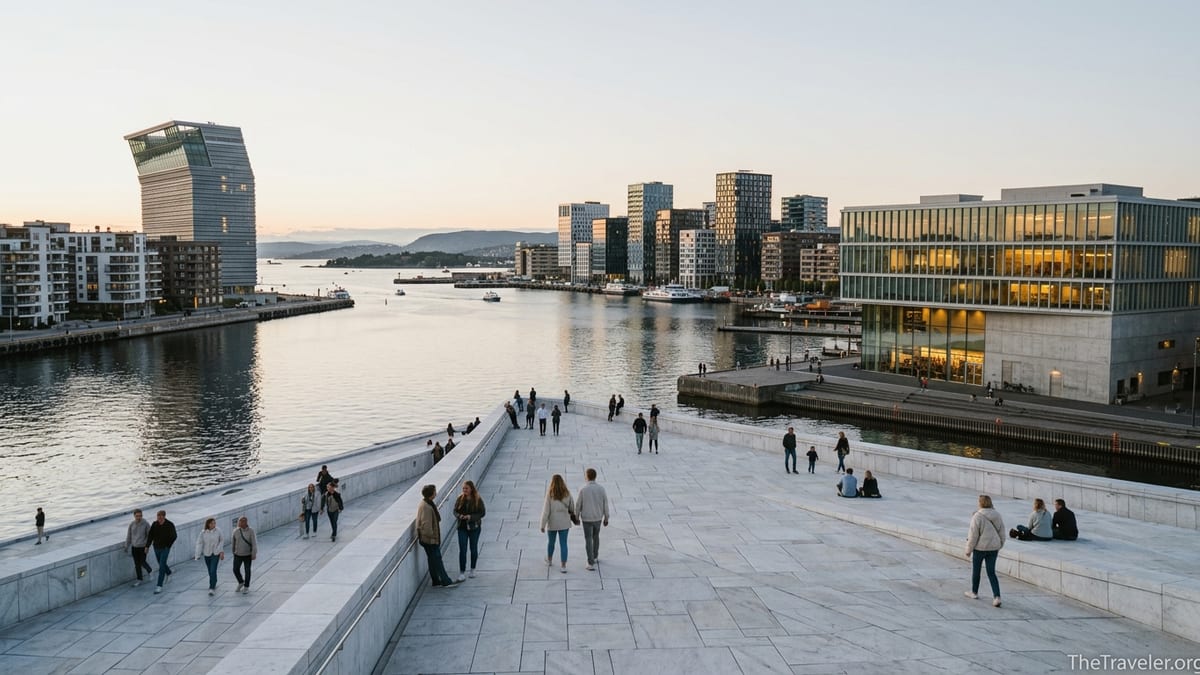
Bjørvika sits just south of Oslo Central Station, between the central railway tracks and the inner Oslofjord. Step out of the station on the waterfront side and within five minutes you are at the foot of the Oslo Opera House, standing on white marble that seems to slide into the water. From here the key landmarks fall into place: the slanted glass volume of Deichman Bjørvika to your right, the tall, leaning Munch building to your left, and the Barcode row of high-rise offices directly behind you.
The area is compact enough to explore entirely on foot, but public transport connections make it easy to combine with other Oslo neighborhoods. Bjørvika has its own tram stop on the lines that run east–west through the city, and most regional and airport trains stop at Oslo Central Station, a short walk away. For many visitors, the simplest approach is to start at the station, walk down to the Opera House, and then follow the harbor promenade east towards Sørenga, allowing time for detours into the backstreets and courtyards.
Bjørvika is part of Oslo’s wider Fjord City redevelopment, designed to open the waterfront to pedestrians and culture instead of cars and cargo. In practice that means wide boardwalks, public staircases down to the water, and a mix of residential towers, offices and cultural venues. You will be walking alongside office workers on their lunch break, local families with strollers and visitors heading to a performance or exhibition, especially on weekday afternoons.
Season and time of day change the feel dramatically. On a bright summer evening in July the sun lingers over the Oslofjord until late, and the marble roof of the Opera House becomes a social terrace. In winter, shorter days and colder air mean fewer people outside, but indoor views from cafés, museums and restaurants become even more attractive, and snow on the surrounding hills can provide a dramatic backdrop.
Architectural Highlights You Should Not Miss
The white, angular Oslo Opera House is the obvious starting point. Designed by Snøhetta and completed in 2008, it is deliberately accessible: the sloping marble and granite roof is open to the public, and walking up is free at any time of day. Take the gentle ramp to the top for some of the best open views of Bjørvika’s architecture, including the Barcode skyline, the Munch museum and the islands of the inner fjord. Early morning around 8 or 9 is quiet and ideal for photos with soft light and few people.
Just across the basin stands Deichman Bjørvika, Oslo’s main public library and one of the city’s most striking recent buildings. From the outside it looks like a glass and concrete box with a cantilevered upper floor; step inside and you find a series of dramatic atriums, floating staircases and reading terraces looking towards the Opera House and the water. Entry is free and you do not need a library card to wander, read or sit in most areas, which makes it a perfect architectural stop even if you are not there to borrow books.
Continue east toward the tall, slightly leaning tower of the Munch museum, which opened in Bjørvika in 2021 as the new home for Edvard Munch’s work. The building is controversial among Oslo residents for its sheer scale and industrial facade, but from a visitor’s perspective it serves as a vertical viewing platform over the harbor. Even if you are not a dedicated art fan, consider paying for museum admission to ride the elevators up to the higher exhibition floors and the upper terraces, where floor-to-ceiling windows frame the fjord, the Opera House and the islands.
Behind these cultural landmarks stretches the Barcode project, a line of slim high-rise office and residential towers separated by narrow gaps that are meant to resemble a barcode when viewed from a distance. The architecture here is more corporate than cultural, yet walking the pedestrian route between the buildings is a way to feel the scale of Oslo’s business district and discover small cafés, bakeries and lunch spots that serve the thousands of people who work here daily.
Walking the Harbor Promenade for the Best Views
Bjørvika is one of the best sections of Oslo’s continuous harbor promenade, a waterfront walking route that curves around much of the inner city shoreline. To experience it at its best, start on the seaward side of the Opera House, where the marble meets the water, and wander along the floating walkways and wooden piers that lead towards the Munch museum. As you walk, glance back for classic postcard views of the Opera’s sloping roof set against the backdrop of the Barcode towers.
Near the foot of Munch, wooden boardwalks and small plazas bring you almost level with the water. On still days you can see the reflections of the museum and nearby residential blocks in the fjord’s surface, especially in late afternoon when the sun sinks behind the city and lights begin to appear in the windows. Small public seating areas with simple benches or low steps make it easy to stop for fifteen minutes with a takeaway coffee and simply watch the ferries and small boats moving in and out of the harbor.
Continue along the edge of the water and you eventually reach Sørenga, a residential peninsula with a popular seawater pool and swimming platforms. In summer this is one of Oslo’s liveliest outdoor spots, with locals sunbathing on the wooden decks, children wading in the shallow pool and brave swimmers jumping directly into the fjord. Even if you do not plan to swim, walking out to the end of Sørenga gives you a wide-angle perspective back towards Bjørvika and the rest of central Oslo, which can be particularly photogenic around sunset on clear evenings.
If you prefer a more structured overview, consider one of the hop-on hop-off buses or harbor cruises that include Bjørvika on their route. Many of these circuits point out the main buildings and explain the Fjord City project as you pass, which can be helpful context early in your visit. However, the most intimate and flexible way to enjoy the harbor views is still on foot, moving at your own pace and pausing whenever a particular angle or reflection catches your eye.
Where to Eat and Drink in Bjørvika
For a quick coffee break between architectural stops, it is hard to beat the cafés inside Deichman Bjørvika. Near the main entrance you will find places such as Kaffoteket, which serves specialty coffee roasted in Oslo along with simple pastries and light snacks. Expect to pay roughly the equivalent of 4 to 5 euros for a cappuccino, similar to prices in other Nordic capitals. The advantage here is the setting: choose a seat by the window or find a spot on an upper-level terrace with a view of the Opera House.
If you want a proper meal without straying far from the water, the Bjørvika waterfront hosts several restaurants that cater to both locals and visitors. Around the Munch museum, Munch Brygge has become a small dining cluster with everything from Neapolitan-style pizza at places like Villa Paradiso to bistro-style dishes and seafood at brasserie-style venues. Here you can expect main courses to start around the equivalent of 20 to 25 euros, rising to more for fish, steaks or tasting menus in higher-end restaurants.
Inside Deichman Bjørvika, Centropa offers a European-inspired menu for lunch and dinner, paired with views across the water and towards the Opera House. It is a convenient choice if you are already visiting the library and want to break up your day without leaving the building. For a more casual, social atmosphere, Barcode Street Food near Dronning Eufemias gate brings together multiple food stalls under one roof, serving everything from burgers and bao to tacos and ice cream. It is particularly lively on evenings when sports events are shown on big screens and is a good bet for mixed groups where everyone wants something different.
For drinks and a more elevated harbor view, look for restaurants and bars on the upper floors of the Munch building. Dining rooms on the higher levels open onto wide fjord views, making them a popular choice for special-occasion dinners or a glass of wine at sunset. Advance reservations are a good idea for these spots, especially on Friday and Saturday nights, as local demand can be high and many Oslo residents now see Bjørvika as a go-to place for a night out as well as daytime sightseeing.
Designing a One-Day Bjørvika Itinerary
A realistic way to explore Bjørvika in one day is to structure your visit around three themes: morning architecture walks, a leisurely lunch and museum time in the afternoon, followed by an early evening harbor stroll and dinner. Start around 9 or 10 in the morning at Oslo Central Station, then walk directly to the Opera House and spend an hour exploring the interior foyer and climbing the rooftop. Mid-morning, continue to Deichman Bjørvika to wander through the building, ride the escalators to higher floors and enjoy a coffee while taking in the views from a reading terrace.
By lunchtime, you will likely be near either the library or the Munch museum. This makes it easy to choose a nearby restaurant depending on your mood and budget. If you prefer something informal, a bowl of ramen, a burger or a plate of sushi at one of the mid-range eateries along the waterfront will leave you comfortably full without taking too much time. If you want a slower meal, consider booking a table at a brasserie-style restaurant near Munch Brygge and allowing ninety minutes to eat and relax.
After lunch, dedicate two or three hours to the Munch museum. Beyond the famous versions of The Scream, the galleries reveal how prolific Munch was in painting landscapes and scenes from Oslo life. Many visitors find that a focused visit to a selection of floors, rather than trying to see everything, leaves more energy to enjoy the building itself and its vantage points. When you are ready for a break, head to the higher levels or the museum’s café areas for a coffee or drink with a fjord view.
Towards late afternoon, return to ground level and set off along the harbor promenade towards Sørenga, timing your walk so that you are looking back at Bjørvika in the softer light of early evening. You might choose to stop at a waterside bar for an aperitif or simply sit on the steps at the edge of the boardwalk with a takeaway drink from a kiosk. Finish the day with dinner in one of the waterfront restaurants, where floor-to-ceiling windows let you watch the lights come on in the Barcode towers and the last commuter ferries depart across the fjord.
Practical Tips, Costs and Seasonal Considerations
While Bjørvika can be enjoyed on almost any budget, it helps to know typical costs so you can plan. A coffee from a specialty café will generally cost the equivalent of 4 to 5 euros, while soft drinks run slightly less. Simple lunch dishes in mid-range cafés and casual restaurants, such as salads, burgers or pasta, typically start around 15 to 20 euros, and more elaborate main courses in sit-down restaurants near the harbor often range from 25 to 35 euros. Tickets for major cultural venues such as the Munch museum are comparable to other European art museums and can usually be purchased on the day, though buying in advance may save time on busy weekends.
Weather is a key factor in how you experience Bjørvika. From late May through early September, daytime temperatures are often mild enough to sit outside comfortably, and long evenings make late harbor walks inviting. Light layers, sunglasses and a light jacket are usually enough in summer, but even then a breeze off the fjord can feel cool, especially if you stay out on the Opera roof after sunset. From late autumn through early spring, bring a warm coat, hat and gloves if you plan to walk along the water, and consider alternating indoor and outdoor stops so you can warm up regularly.
Most places in Bjørvika accept contactless payment and major credit cards, and it is entirely normal in Oslo to pay even small amounts by card or mobile app rather than cash. Tap water is safe to drink and routinely served free in restaurants when you order food or other drinks, which can help keep costs down. Public toilets are available inside the Opera House, the library and the museums for ticket holders or visitors, and there are some pay toilets in the wider area if you are simply walking the promenade.
Transport-wise, many visitors simply walk from their hotel in central Oslo to Bjørvika. If you are coming from farther away, trams and buses stop at Bjørvika or nearby stops along Dronning Eufemias gate, and local trains and metro lines converge at Oslo Central Station. If you are arriving by cruise ship or long-distance ferry, check whether your vessel docks close enough to walk; if not, city buses and taxis both serve the pier areas. Cycling is another option in warmer months, with dedicated lanes leading into the district and bike racks dotted around the main squares.
The Takeaway
Bjørvika is more than a backdrop for a few famous buildings. It is a concentrated snapshot of how Oslo sees its future: oriented towards the water, built around culture, and designed for people on foot. In a small area you can climb a world-renowned opera house, get lost among the shelves of a cutting-edge public library, stare out at the fjord from the upper floors of a contemporary art museum and eat well at restaurants that draw locals as much as visitors.
For travelers, the advantage is simplicity. You do not need a car, a complex plan or a long list of reservations to enjoy Bjørvika. A pair of comfortable shoes, a willingness to walk and a rough sense of how you want to divide your time between architecture, food and views are enough to build a rewarding day here. Whether you visit on a bright summer evening when the sun barely dips below the horizon or on a crisp winter afternoon with lights reflecting on the fjord, Bjørvika will give you a strong sense of modern Oslo in a single, manageable slice of the city.
FAQ
Q1. How much time do I need to explore Bjørvika properly?
Most visitors can experience the main highlights in a full day, with a few hours each for the Opera House, Deichman library, Munch museum and a harbor walk.
Q2. Is it free to walk on the Oslo Opera House roof?
Yes. Access to the outdoor roof and terraces of the Opera House is free at all hours, and you do not need a performance ticket to go up.
Q3. Do I need tickets in advance for the Munch museum?
Advance tickets are recommended on weekends and during peak summer, but on many weekdays you can buy tickets on arrival without long waits.
Q4. Is Bjørvika suitable for families with children?
Yes. Wide car-free promenades, open plazas, the Sørenga seawater pool in summer and relaxed cafés make it easy for families to move around with strollers and kids.
Q5. Can I visit Deichman Bjørvika library without a library card?
Yes. The public can freely enter, explore and use most seating areas without a card, although borrowing books and some services require registration.
Q6. What is the best season to enjoy the harbor views?
Late spring to early autumn offers the longest days and most comfortable temperatures, but clear winter days can also provide crisp air and dramatic light.
Q7. Are there affordable food options in Bjørvika?
Yes. In addition to higher-end restaurants, there are casual cafés, bakeries and food hall concepts where you can find filling meals at mid-range prices.
Q8. Is Bjørvika walkable for people with limited mobility?
The area is generally flat with ramps, elevators and smooth surfaces, though the sloping Opera roof and some boardwalk sections may require extra care.
Q9. Can I swim in the harbor near Bjørvika?
Yes. The Sørenga seawater pool and surrounding fjord swimming platforms are popular in summer, with changing facilities and easy access to the water.
Q10. Is it safe to walk around Bjørvika at night?
Bjørvika is usually calm and feels safe in the evening, especially around the Opera, library and major restaurants, though normal city awareness is still advisable.