


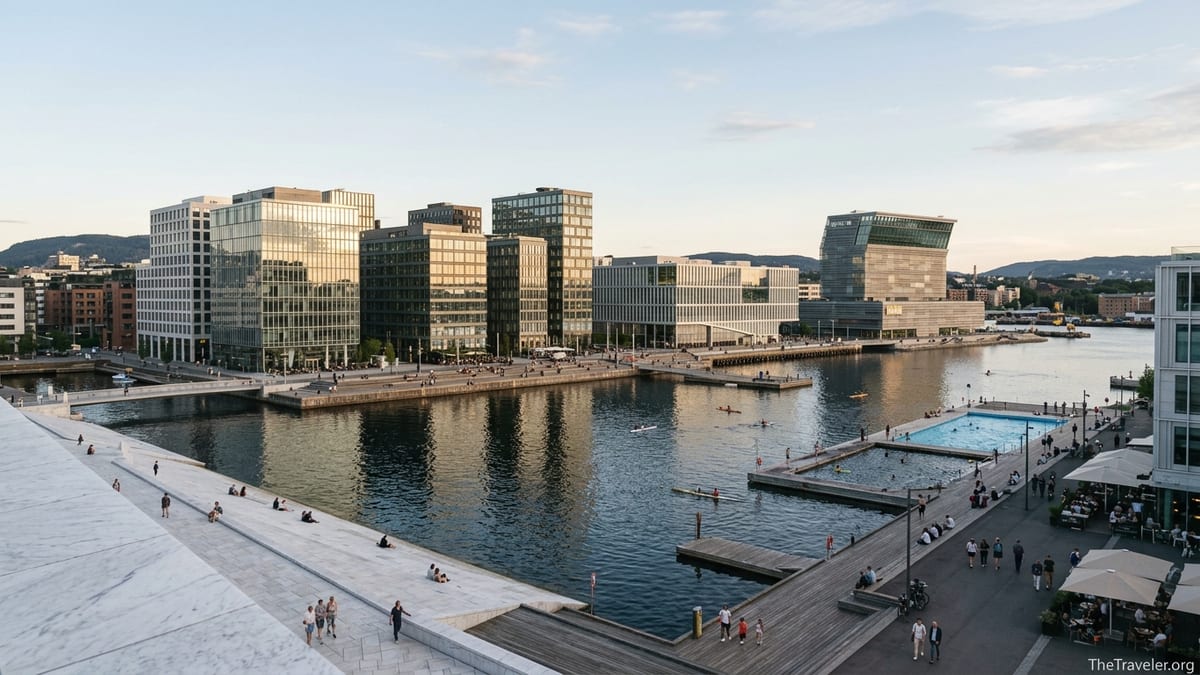
Walk out of Oslo Central Station today and it takes only a few steps to understand why Bjørvika has become one of the city’s most talked‑about neighborhoods. Glass towers line the skyline, the white marble roof of the Opera House slopes into the fjord, swimmers cut through seawater pools in summer, and locals linger on wooden piers outside cafés that simply did not exist twenty years ago. Where there were once container docks and a noisy highway, Bjørvika is now the sharpest expression of Oslo’s ambition to reinvent itself as a modern fjord city.
Get the latest updates straight to your inbox!
From Working Port to Fjord City Vision
For most of the twentieth century, Bjørvika was a place most visitors never saw and locals rarely lingered in. The inner Oslo Fjord waterfront was dominated by port facilities, storage sheds and truck traffic, and a tangle of highway ramps severed the historic center from the water. When container shipping and automation changed global port logistics in the late twentieth century, large stretches of central harbor land in Oslo became redundant. What had been a practical but unwelcoming industrial zone suddenly offered the city a rare opportunity: several square kilometers of waterfront real estate directly beside Oslo Central Station.
In the early 2000s, the municipality launched the long term Fjord City initiative, a strategy to reclaim the waterfront from heavy infrastructure and give it back to people in the form of housing, culture and public spaces. Bjørvika sat at the heart of this vision. The relocation of the E18 coastal highway into the Bjørvika Tunnel might sound like a technical detail, but it was decisive on the ground. Once the traffic disappeared underground, it became possible to plan streets, plazas and parks that connected the existing center and the eastern district of Grønland directly to the water’s edge.
The zoning plans for Bjørvika set out not just to build apartments and offices but to create a new cultural quarter for Oslo. City planners deliberately clustered major national institutions along the harbor, starting with the new Oslo Opera House, then the relocated main branch of Oslo’s public library Deichman Bjørvika and a new home for the Munch Museum. This concentration of heavy hitting cultural anchors was intended to ensure Bjørvika would become a destination for Norwegians and international visitors rather than simply a commuter district of glass towers.
Equally important was the balance between private development and public space. Official figures from Bjørvika’s developers indicate that a substantial share of the land is reserved for parks, waterfront promenades and what Norwegians call allmenninger, linear public squares that run between the buildings to pull the city down toward the water. For travelers, that policy shows up very tangibly: it is hard to walk more than a few minutes in Bjørvika without stumbling onto a pier, a small playground, a pocket park or a broad set of steps inviting you to sit and watch the ferries glide across the fjord.
Iconic Architecture that Put Bjørvika on the Map
Much of Bjørvika’s appeal comes from how visibly different it looks from older parts of Oslo. The conversation usually starts with the Oslo Opera House, completed in 2008. Its crisp white marble and glass volumes appear to rise directly out of the fjord, and its gently sloping roof is open to the public. On a summer afternoon, it feels less like a reserved cultural institution and more like a public hillside park made of stone, as people spread out with takeaway coffee, children slide down the marble rails and tourists line up to photograph the panoramic view over the city and islands.
Just behind the Opera stands the Barcode, a row of narrow high‑rise office and residential blocks with gaps in between that are meant to preserve visual corridors toward the fjord. Love it or hate it, the Barcode has become one of Oslo’s most recognizable skylines, home to banks, design firms and tech companies. Travelers notice real world details: commuters queue for espresso at ground floor cafés early in the morning, bicycles stack up outside glass lobbies, and digital agencies leave their logos glowing after dark. The architecture’s vertical drama gives Bjørvika a big city feel that distinguishes it from the low stone buildings of nearby Karl Johans gate.
On the other side of the Opera, the new Munch Museum, often referred to simply as MUNCH, has transformed the skyline again. The museum is a tall, slightly leaning tower clad in metal panels, its upper floors angled as if bowing toward the city. Inside, visitors find extensive collections of Edvard Munch’s work, including multiple versions of “The Scream,” but even those who do not go in experience the museum as a beacon on the waterfront. At night, the illuminated top floors act as a landmark that helps you orient yourself among the new streets and quays.
Completing this trio of cultural buildings is Deichman Bjørvika, Oslo’s main public library, which opened in 2020. The library’s glass and concrete volumes jut out toward the fjord, creating dramatic overhangs and inviting terraces. Travelers who step inside discover a civic living room filled with reading rooms, a cinema, sound studios and a family floor where local parents park strollers while children explore picture books and play areas. It is free to enter, and you do not need a library card to find a desk with a view of the fjord, making it a practical stop if you need Wi‑Fi, a quiet place to catch up on work, or simply a moment of calm between sightseeing stops.
Life Between the Buildings: Promenades, Parks and Swimming Spots
What really convinces many visitors that Bjørvika has become one of Oslo’s most exciting districts is not only the flagship architecture but the way people use the spaces between buildings. The waterfront promenade now runs continuously from the historic Akershus Fortress area past the Opera House, around Bjørvika and out toward Sørenga, forming a long, car‑free route for walking and cycling. On a clear summer evening you might see office workers in sneakers power‑walking past tourists with cameras, local teenagers fishing off the pier and couples in kayaks sliding along the edges of the harbor.
Sørenga, at the eastern end of Bjørvika, has become a particularly vivid example of how the redeveloped waterfront invites everyday life. Built on former container docks, Sørenga’s seawater pool and floating diving platforms are packed on warm days. Locals lay towels on the wooden decks, children jump from low piers into the sheltered harbor basin, and the smell of grilled seafood drifts from nearby restaurants. Even in early autumn, when the water is brisk, you will see Norwegians in wool hats plunging in for a brief swim before wrapping themselves in towels and sitting in the low sun.
Between the cultural institutions and the residential buildings, a series of allmenninger cut from the old town down to the water. One of the most striking is Stasjonsallmenningen, a broad pedestrian route that begins just outside Oslo Central Station and leads directly toward the fjord. Here, travelers arriving by train can roll their suitcase along level paving stones, pass small public art installations and street trees, and reach the Opera House roof in under ten minutes. It is a simple experience, but it captures how thoroughly the area has been reoriented around people instead of cars.
Public spaces in Bjørvika were also designed to function through the long Nordic winter. Low seating walls with built‑in lighting create safe, well lit paths even in December afternoons, when the sun barely rises above the horizon. Wind breaks, careful orientation of benches and the use of warm materials like timber on decks and piers make it possible, if not exactly tropical, to drink a coffee outdoors when the weather allows. For families, the small playgrounds scattered through the neighborhood mean a visit to the library or museums can be punctuated with an easy stop where children can climb or swing with a view of ferries crossing the fjord.
Food, Nightlife and Everyday Neighborhood Energy
Beyond architecture and public space, Bjørvika has gained momentum because it now offers the kinds of everyday experiences that make a place feel livable, not just visitable. Ground floors that might once have been parking garages or anonymous lobbies are instead occupied by cafés, bakeries, grocery stores and small restaurants that keep lights on late into the evening. For travelers staying in central Oslo, this means you can walk to Bjørvika not only for a matinee at the Opera but also for a casual dinner, a drink by the water or a simple supermarket run with a view.
Around the foot of the Barcode you will find espresso bars that fuel the district’s office workers in the morning and turn into informal after‑work meeting spots later in the day. Typical prices give a sense of Oslo’s cost level: a cappuccino might cost the equivalent of 4 to 6 US dollars, while a glass of draft beer on a fjordside terrace often runs between 10 and 12 dollars depending on the location and brand. It is not cheap, but the price of admission includes front row seats to the changing light on the water and, in summer, long golden evenings when the sun barely dips behind the hills.
On the waterfront between the Opera and MUNCH, newer venues have started to tap into the neighborhood’s growing residential base. You might find a sushi restaurant with floor‑to‑ceiling windows looking directly onto the harbor, a casual pizza place that does brisk takeaway business with nearby apartments, and small wine bars serving natural wines to a mix of architects, tech workers and visiting culture lovers. During big cultural events such as performance premieres or exhibition openings, terraces fill up and the streets feel more like a southern European port city than the once isolated docks of northern Oslo.
The everyday services also signal Bjørvika’s shift from project to neighborhood. Small supermarkets, pharmacies and fitness centers tucked into the ground floors of residential blocks make it possible to live a few hundred meters from the fjord without having to trek back into the older city center for basics. For visitors renting an apartment in Bjørvika or staying in a nearby hotel, this creates an easy base where you can stock up on groceries, grab morning pastries or find a late‑night snack within a five minute stroll of your front door.
Connecting East and West: Social Ambitions and Critiques
Bjørvika’s transformation is also about more than architecture and lifestyle. Historically, the main railway lines and industrial harbor separated central Oslo from the working class districts to the east. By burying traffic and building pedestrian routes across the tracks and down to the water, the redevelopment aimed to stitch together east and west, offering new gathering places that feel equally accessible whether you arrive from the business hotels of the city center or the immigrant‑rich streets of Grønland.
In practice, that connection now takes several forms. The Akrobaten pedestrian bridge, a striking white lattice structure, strides over the train tracks linking the Barcode area with the older neighborhood of Grønland. On weekday mornings it has the feel of a moving carpet of commuters: office workers in suits, students with backpacks, parents pushing strollers, all streaming toward the towers or the center. Later in the day, tourists cross slowly, stopping to photograph the trains and the cityscape of glass and brick. The bridge has become a symbolic and literal route between different social worlds within Oslo.
Bjørvika’s planners also commissioned extensive public art and programming, with the aim of making its spaces feel like shared urban living rooms rather than privatized corporate plazas. Artworks are embedded into building facades, woven into paving and mounted along the promenade. In warmer months, outdoor film screenings, temporary installations and food festivals pop up on squares and piers. A visitor arriving in July might stumble onto a free concert outside the library one weekend and a local street food event in Sørenga the next, illustrating how culture spills out of formal institutions into the open air.
At the same time, the district has attracted criticism for high prices and a sleek aesthetic that some locals see as disconnected from Oslo’s history. Apartments along the water sell for premium prices, and rents in the newest blocks around Bispevika and Sørenga are beyond the reach of many students and lower income residents. Some Norwegians argue that the glass and steel facades feel cold in the long winter and that the architecture could do more to reflect traditional materials. These debates are part of what makes Bjørvika interesting: it has become a focal point for national conversations about who the new Oslo is being built for and how waterfront redevelopment can balance exclusivity and openness.
Why Travelers Gravitate Toward Bjørvika
For visitors, the practical reasons to spend time in Bjørvika are straightforward. The neighborhood lies directly beside Oslo Central Station, making it one of the first areas many travelers encounter. Within a radius of about a kilometer you can attend an opera or ballet performance, explore a major modern art collection, visit a world class library, swim in a seawater pool, dine by the fjord and still be back at your hotel in time for an early train. That density of experiences, all located along car‑free promenades, is relatively rare even among Nordic capitals.
Bjørvika also offers useful options across seasons. In winter, you can arrive by train from Oslo Airport, drop your bags at a nearby hotel, and walk five minutes to Deichman Bjørvika to warm up with a hot drink and a book while watching snow swirl over the fjord. In shoulder seasons, when outdoor swimming is only for the very brave, a stroll along the promenade to Sørenga and back still gives you a sense of Oslo’s relationship with its waterfront, with plenty of glass‑fronted cafés where you can duck inside if the wind picks up.
Even if you have limited time in the city, Bjørvika can easily anchor a half‑day or full‑day itinerary. A traveler might start with a morning climb up the Opera roof, continue with a visit to MUNCH or a guided tour inside the Opera House, break for lunch on one of the terraces facing the water and then spend the afternoon either exploring the library’s upper floors or walking out to Sørenga for a swim and a coffee. The key is that distances are short and the route is intuitive: follow the water, and you will rarely be more than a short stroll from your next stop.
Crucially, Bjørvika also feels safe and well maintained, even late in the evening. Good lighting, clear sightlines and a steady flow of people leaving performances or bars create a sense of security that solo travelers often appreciate. While it is always wise to take normal city precautions, the atmosphere is more relaxed promenade than rough dockyard, a transformation that would have been hard to imagine before the redevelopment began.
The Takeaway
Bjørvika’s rise from overlooked harbor fringe to one of Oslo’s most exciting waterfront districts did not happen by accident. It was the result of long term planning to bury highways, repurpose derelict port land and cluster major cultural institutions along a once neglected stretch of the inner fjord. The district’s success today can be read in the ordinary scenes that unfold there: schoolchildren spilling out of the library, office workers streaming over pedestrian bridges, swimmers lining up at the Sørenga diving platform, and visitors lingering on the Opera roof long after sunset.
For travelers, Bjørvika offers a concentrated snapshot of contemporary Oslo. Its bold architecture, walkable promenades, fjordside swimming spots and network of cafés and restaurants encapsulate how the city wants to present itself to the world: open to the water, confident about design and deeply invested in public space. Whether you treat it as a base for your stay or a half‑day excursion from another part of town, walking through Bjørvika is one of the most direct ways to understand how the Norwegian capital has turned its face back to the fjord.
FAQ
Q1: Where exactly is Bjørvika in Oslo?
Bjørvika is the waterfront district directly south of Oslo Central Station, stretching from the Opera House area in the west to Sørenga in the east along the inner Oslo Fjord.
Q2: How do I get to Bjørvika from Oslo Airport?
Take the airport train or regional train to Oslo Central Station. From the main concourse, follow signs to the Opera House, and you will reach Bjørvika on foot in under ten minutes.
Q3: Is it worth visiting Bjørvika if I only have one day in Oslo?
Yes. In a compact area you can see the Opera House, MUNCH, Deichman Bjørvika library, the Barcode skyline and the Sørenga waterfront, making it ideal for a short visit.
Q4: Can you swim in the water at Bjørvika?
Yes, there are designated swimming areas, particularly at Sørenga, where you will find a seawater pool, diving platforms and wooden decks popular in summer.
Q5: Are there good places to eat and drink in Bjørvika?
Yes, the district has many cafés, bakeries and restaurants, including sushi bars and casual bistros with outdoor seating and views of the fjord and skyline.
Q6: Is Bjørvika expensive to visit?
Oslo in general is relatively expensive, and restaurant prices in Bjørvika are similar to other central neighborhoods, but walking the promenade and visiting the library are free.
Q7: What is the best time of year to experience Bjørvika?
Summer offers long evenings, outdoor swimming and lively terraces, while winter brings a quieter waterfront atmosphere and cozy indoor time in the museums and library.
Q8: Is Bjørvika suitable for families with children?
Yes. The gently sloping Opera roof, small playgrounds, family areas in Deichman Bjørvika and the sheltered swimming spots at Sørenga all make it welcoming for families.
Q9: Can I visit the Oslo Opera House roof without a ticket?
Yes. The roof is open to the public free of charge at most hours, and you can walk up for views over Bjørvika, the fjord and central Oslo without attending a performance.
Q10: Is Bjørvika safe to walk around at night?
Generally yes. The area is well lit, has regular foot traffic after performances and dinners, and feels comfortable for most visitors, though normal city awareness is still recommended.