


Bjørvika, once a tangle of highways and container docks, has become Oslo’s most striking waterfront district. Between the white marble roof of the Opera House, the tilted tower of the MUNCH museum and the glassy Barcode skyline, this compact neighborhood packs in some of Norway’s biggest cultural sights along with fjord promenades, swimming spots and relaxed cafes. With so much clustered into a small area, a bit of planning goes a long way. Here is how to make the most of your time in Bjørvika, what to see and do, and the key things to know before you go.
Get the latest updates straight to your inbox!
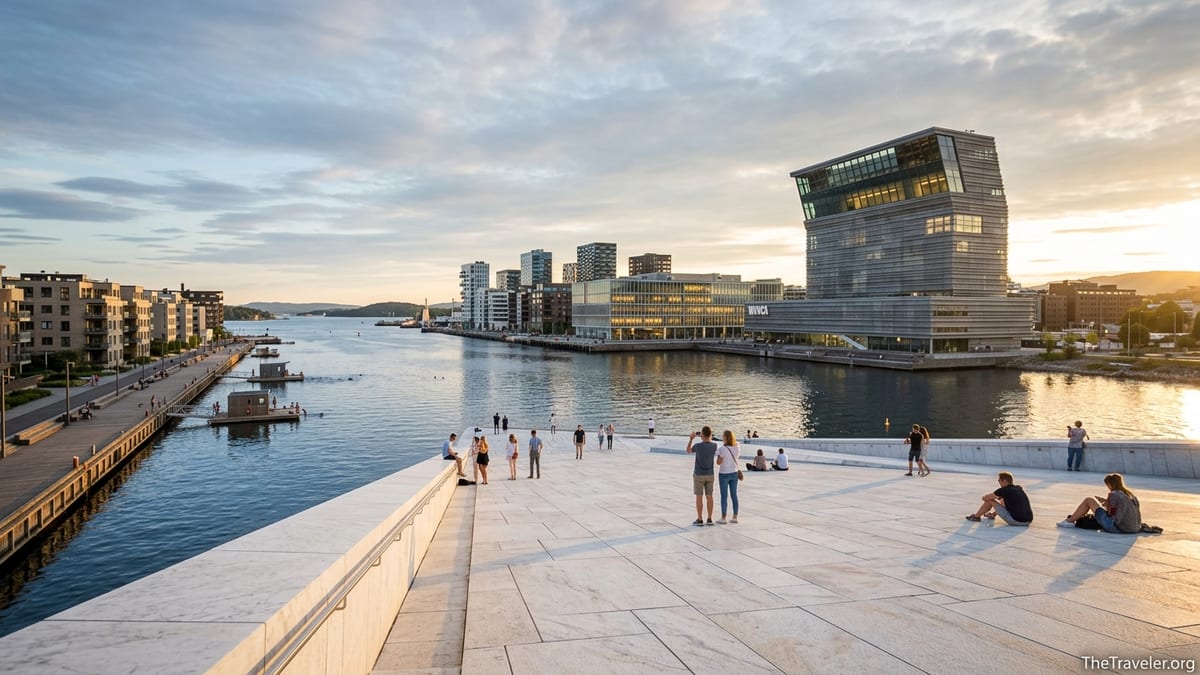
Getting Oriented: Understanding Bjørvika Today
Bjørvika sits at the head of the Oslofjord, just southeast of Oslo Central Station. Until the early 2000s it was dominated by a motorway interchange and port facilities. Urban redevelopment has turned it into a dense cultural and residential quarter where most major sights are within a 10–15 minute walk of each other. The Oslo Opera House anchors the waterfront, with the Deichman Bjørvika main library just behind it, the MUNCH museum a short stroll along the quay, and the Barcode office and residential towers rising to the north.
For a first-time visitor, it helps to think of Bjørvika as a triangle. One corner is the Opera House, another is MUNCH, and the third is the Barcode and adjacent plaza around Oslo Central Station. Walking the triangle at a relaxed pace, with photo stops and a coffee, easily fills a couple of hours. Add time inside the museum and library or a swim at Sørenga and you have the makings of a full day.
Although Bjørvika is very walkable, the atmosphere changes by time of day and season. On a bright July afternoon the fjordside boardwalk is busy with swimmers, families and office workers out for ice cream. In January, early darkness and icy wind off the water make the indoor attractions more appealing. Planning when you want to be indoors versus outdoors will shape how you use your time.
Because the neighborhood is new, maps on older guidebooks sometimes lag behind reality. On the ground, wayfinding is straightforward. From Oslo Central Station you simply follow signs for the Opera or walk downhill toward the water. Once you reach the marble roof of the Opera House, you can visually locate most of the other landmarks just by looking around.
How Much Time Do You Need in Bjørvika?
How long to allocate to Bjørvika depends on how deeply you want to explore. As a rule of thumb, plan at least half a day if you want to go inside at least one major attraction, and a full day if you are combining museum visits with swimming, long coffees or a waterfront dinner.
A quick sampler is possible in 2–3 hours. You might arrive mid-morning, walk onto the Opera House roof, continue to Deichman for a look inside the atrium and rooftop terrace, then cross to MUNCH for a coffee in the lobby café without visiting the exhibitions. This gives you a feel for the architecture and the fjord setting, with minimal time commitment and cost.
A more typical visit runs to 5–7 hours. Many travelers book timed tickets for MUNCH late morning, spend two to three hours exploring the collection, then break for lunch at the museum café or one of the casual restaurants in the Oslobukta waterfront precinct. In the afternoon they might browse Deichman’s upper floors, then end the day on the Opera roof for golden-hour views of the fjord and the Barcode skyline.
If you are an art or architecture enthusiast, you can easily fill an entire day or even two. One day could center on MUNCH and its rooftop bar, plus a guided tour or performance at the Opera House. Another could combine a slow morning writing or reading inside Deichman, lunch in Bjørvika, and an afternoon walk out to Sørenga for a swim and sauna session. Because everything is walkable, you can improvise as you go, provided you pre-book any performances or special exhibitions that matter most to you.
Oslo Opera House: Roof Walks and Performances
The Oslo Opera House is Bjørvika’s most iconic structure, a sloping white building that seems to rise straight out of the fjord. One of its most appealing features is that the roof is open to the public at all hours when conditions are safe. You simply walk up the ramped marble surfaces from the waterfront and wander over the gently sloping roof, with views back to the city, out to the islands and along the Bjørvika waterfront.
Visiting the roof is free, which makes it a useful anchor for budget-conscious travelers. Many people stop here on their first evening in Oslo, using the sweeping views to get their bearings. In summer, sunset can be late in the evening, and you will often see locals sitting on the warm stone with takeaway pizzas from nearby bakeries or grocery-store picnics. In winter, the roof can be snowy or icy; access may be restricted to cleared paths, and you will want grippy footwear.
Inside, the Opera House hosts the Norwegian National Opera and Ballet. If you plan far enough ahead, you can book tickets for a full evening performance, which usually runs several hours including intermission. For those who do not want to commit to a show, the venue periodically offers guided tours that take you backstage and into the main auditorium. These tours tend to sell out on busy weekends, so checking schedules and booking before you arrive in Oslo is wise if this experience is important to you.
Even without a tour or performance, it is worth stepping into the lobby to see the towering timber-clad walls and glass façade. There is a café inside where you can pause over a coffee while watching people filter in and out of the building. Combining a roof walk with a short look indoors typically takes 45–60 minutes, more if you stay for a drink or snack.
MUNCH: Planning Your Museum Visit
MUNCH, the dedicated Edvard Munch museum, moved to its Bjørvika location in 2021 and is now housed in a 13-story tower that tilts slightly toward the fjord. The building contains the world’s largest collection of Munch’s works, including multiple versions of The Scream, alongside rotating exhibitions, live events and top-floor dining with panoramic views. It is one of Oslo’s flagship attractions, so planning ahead pays off.
Timed-entry tickets are standard, particularly in summer and on weekends. Recent visitor guides that cross-check the official website suggest that adult tickets usually fall in a range similar to other major European art museums, with discounts for students, children and seniors. Because prices and opening hours can change, especially around Norwegian public holidays, it is smart to verify current details shortly before your trip and consider booking your preferred time slot a week or two in advance if you are visiting in July or August.
Once inside, you should allow at least two hours if you want to see the core Munch galleries, including the rooms dedicated to his most famous motifs, and still have time to pause and absorb the works. Many visitors spend closer to three hours, especially if they add one of the temporary exhibitions or take breaks in the seating areas that overlook the city and fjord. To avoid fatigue, consider starting your visit from one of the higher exhibition floors and working your way down toward the lobby, saving the rooftop bar or café for the end.
The upper floors of MUNCH include a restaurant and bar with floor-to-ceiling windows and a rooftop terrace space. Even if you do not dine, it is worth riding the glass elevator up for the views across Bjørvika and toward the islands. Reservations are useful if you want a sit-down dinner at sunset, particularly on weekends. For a more casual option, the lobby café serves coffee, light meals and pastries at prices comparable to mid-range Oslo cafés, where a cappuccino and slice of cake might cost in the region of 120–150 Norwegian kroner depending on your choices.
Deichman Bjørvika and Everyday Life in the District
Behind the Opera House stands Deichman Bjørvika, Oslo’s main public library. Opened in 2020, it has quickly become a favorite both with locals and visitors. Entry is free, and you do not need a library card to walk around, read, or use many of the study spaces. The building is as much a piece of public architecture as a traditional library, with irregular angles, terraces and a central atrium that lets daylight filter down through several floors.
Travelers often use Deichman as a quiet refuge between more intense sightseeing. On a winter afternoon you might grab a window seat overlooking the fjord, plug in your laptop and catch up on emails, or simply read with a coffee from the ground-floor café. The upper levels host children’s areas, comic collections and media labs, while the rooftop terrace offers one of the better free views back toward the Opera House and Barcode. Plan around 45 minutes for a quick look or up to a couple of hours if you intend to settle in and work.
At street level, Bjørvika’s daily life is increasingly shaped by Oslobukta, the umbrella name for the shopping and dining district that sprawls along the quays between MUNCH, the Opera and Sørenga. Here you will find small fashion boutiques, independent design stores, ice cream kiosks and a mix of Norwegian and international restaurants. Prices lean toward the mid to upper range for Oslo; a casual sit-down main course of pizza or a burger may start around 220–260 kroner, while a more elaborate set dinner in a waterfront restaurant can easily run higher.
Because many of the buildings in Bjørvika have shops and restaurants tucked into their ground floors, it is worth exploring the small side streets and courtyards rather than sticking just to the main promenade. Some cafes cater to office workers and may be busiest at weekday lunch, while others are oriented toward evening drinks with outdoor seating and heaters. If your time is limited, it can help to decide whether you prefer a relaxed coffee stop near Deichman or a longer waterfront meal closer to MUNCH and Sørenga and plan your walking route accordingly.
Waterfront Walks, Swimming and Seasonal Experiences
One of the pleasures of Bjørvika is how close the city has come to the water. A continuous promenade connects the Opera House, MUNCH and the residential peninsula of Sørenga, where wooden decks, ladders and floating pontoons turn the fjord into an urban swimming area in summer. This area, known as Sørenga Sjøbad, is free to use and typically opens for the main swimming season from late spring through early autumn, depending on water temperatures and weather.
In July and August, it is common to see locals of all ages swimming here after work, often followed by a session in one of the nearby floating saunas. These saunas, run by private operators, usually require advance booking and charge per time slot, which might be 60–90 minutes. Exact prices vary, but for planning purposes you can expect them to be in the same general range as other Nordic urban sauna experiences, with discounted off-peak times and higher rates at sunset or on weekends. Many saunas allow you to alternate between the hot room and direct dips into the fjord via a ladder or platform.
Even if you do not swim, walking the waterfront from the Opera to Sørenga is rewarding. The route takes you past moored boats, public art and outdoor seating areas where people linger over ice cream or cold drinks in warm weather. In winter, snow and ice can accumulate on the boardwalk, so sturdy footwear and attention to underfoot conditions are important. The views back to the Opera and the slanted MUNCH tower are particularly photogenic on clear days when low sunlight reflects off the water.
Seasonal light plays a big role in how Bjørvika feels. In June, long days mean that the waterfront stays active late into the evening, and you might time your walk to coincide with the soft light of the late “blue hour.” In December, it is more about the glow of interior lights from the library, museum and apartments, with people moving briskly between warm interiors. If your trip spans different seasons, you may find it worthwhile to visit Bjørvika more than once to experience the contrast.
Architecture, Photography and the Barcode Skyline
Bjørvika is also an open-air gallery of contemporary architecture. The Barcode Project, a row of slender high-rises with gaps between them, lines the northern edge of the district. Each building has a distinct design, with alternating dark and light facades that, from a distance, resemble a barcode. The effect is particularly striking when viewed from the Opera House roof or from across the tracks near Oslo Central Station.
For photographers, some of the best vantage points are free and easily accessible. Early morning often provides calm water for reflections of the skyline, especially on windless days. Late afternoon gives warm side light on the Barcode towers and the surfaces of the Opera and Deichman. Tripods are generally allowed in outdoor public areas, but inside museums and performance venues there may be restrictions, so checking on-site signage or asking staff before setting up more serious equipment is sensible.
The buildings themselves invite close-up exploration. Walking beneath the Barcode towers, you will find small plazas, passageways and artworks that are easy to overlook if you only see the area from a distance. Some of the towers house offices, banks and corporate headquarters, while others include apartments, gyms and restaurants. This mix gives the area life at different times of day, with office workers dominating during weekday mornings and residents and visitors filling cafes and bars later on.
Beyond the high-rises, Bjørvika features a variety of architectural styles, from the angular glass of Deichman to the more subdued brick and timber of residential blocks closer to Sørenga. Architecture enthusiasts may enjoy taking a self-guided walking tour, using the neighborhood’s major landmarks as waypoints and paying attention to details like public art installations, staircases leading directly to the water and small pocket parks that soften the dense urban fabric.
Practical Tips: Getting There, Costs and When to Go
Reaching Bjørvika is straightforward from almost anywhere in central Oslo. From Oslo Central Station it is a short walk down to the Opera House and the rest of the district. Several tram and bus lines stop near the station and adjacent streets, while metro passengers can exit at Jernbanetorget and simply follow signs for the Opera. If you are arriving by cruise ship or long-distance ferry, you can either walk or take public transport, depending on your exact terminal.
For budgeting, it helps to remember that Norway is generally more expensive than many other European destinations. Admission to MUNCH and guided tours at the Opera House will form a significant part of your costs in Bjørvika, alongside food and drink. However, some of the area’s best experiences are free: walking the Opera roof, exploring Deichman, enjoying the waterfront promenades and taking photographs of the architecture. Travelers watching their spending can combine one paid attraction with several free ones and still have a full day of activities.
Opening hours in Bjørvika vary by venue and season. MUNCH typically opens in the morning and stays open into the evening on selected days, while Deichman keeps generous library hours that are slightly shorter on weekends. The Opera House roof is accessible whenever the area is not cordoned off for safety or special events, but indoor facilities follow the performance and box office schedules. Around Norwegian public holidays, especially in late December and in May, some museums and attractions may close or operate on reduced hours, so checking specific dates is important if your visit falls then.
In terms of weather, late spring through early autumn offers the most flexibility. May and June can bring pleasant temperatures and long daylight without the peak summer crowds, while July and August are livelier but also busier at popular attractions. Winter visits reward travelers who enjoy crisp air, early dusk and the interplay of snow and electric light on the modern buildings, but require warmer clothing, good footwear and perhaps a willingness to adjust plans if icy conditions limit roof or promenade access.
The Takeaway
Bjørvika concentrates a remarkable amount of culture, architecture and fjordfront public space into a walkable slice of Oslo. With the Oslo Opera House, MUNCH, Deichman library and the Barcode skyline all within a few hundred meters, you can design anything from a short architectural stroll to a full day of museum visits, waterfront walks and sauna sessions without ever straying far from the central station.
The key to a rewarding visit is matching your plans to your interests and the season. Pre-book the performances or museum slots that matter most to you, build in time for unhurried walks and casual coffee stops, and stay flexible enough to respond to weather and energy levels. Whether you are standing on the marble roof of the Opera at sunset, reading by a window in Deichman on a snowy afternoon or watching swimmers plunge into the fjord at Sørenga, Bjørvika offers a vivid snapshot of contemporary Oslo and how the city has turned its face back toward the water.
FAQ
Q1. How much time should I plan for Bjørvika if I only have one day in Oslo?
Most visitors can get a good feel for Bjørvika in half a day, but if you want to go inside MUNCH and the Opera House or Deichman, plan a full day. A typical schedule might include a morning at MUNCH, lunch by the waterfront, an afternoon library or waterfront walk and a sunset visit to the Opera roof.
Q2. Do I need to buy tickets in advance for MUNCH?
Advance booking is strongly recommended, especially in summer, on weekends and during school holidays. Timed-entry slots help manage crowds, and popular time windows can sell out. Checking availability a week or two before your visit and booking the time that fits your wider Oslo plans will make your day smoother.
Q3. Is it free to walk on the Oslo Opera House roof?
Yes. Walking on the roof is free and open to the public when conditions are safe. You can go up for a quick look or stay longer to enjoy the view. In icy or stormy weather, some areas may close temporarily for safety, so obey any barriers or instructions from staff.
Q4. Can I visit Deichman Bjørvika without a library card?
Yes. Deichman is a public building, and you do not need a library card to enter, browse, find a seat or enjoy the views. A card is only necessary if you want to borrow materials. Many travelers use the library as a quiet place to read, work or simply relax between other sights.
Q5. Is it safe to swim at Sørenga Sjøbad?
Sørenga Sjøbad is a popular designated urban swimming area with ladders and platforms. Locals swim there regularly in the warmer months, and water quality is monitored by city authorities. As with any open-water swimming, you should assess your own ability, pay attention to posted signs and avoid swimming alone late at night or in poor conditions.
Q6. What is the best time of day to photograph Bjørvika?
Early morning and late afternoon usually offer the best light. Morning can bring calm water and clear reflections of the Barcode skyline, while late afternoon and early evening provide warm side light on the Opera House, MUNCH and Deichman. In winter, the blue tint of twilight and the glow from interior lights can also produce striking images.
Q7. Are there affordable food options in Bjørvika?
Bjørvika leans toward mid-range and higher-end dining, but you can still eat reasonably. Cafés inside MUNCH and Deichman offer light meals, and there are pizzerias, bakeries and takeout spots scattered at street level. Many travelers pick up sandwiches or groceries from central Oslo and enjoy a picnic on the waterfront steps when the weather allows.
Q8. How accessible is Bjørvika for travelers with limited mobility?
The main promenades, museum entrances and Deichman are designed with step-free access, elevators and ramps. The Opera House roof has sloping surfaces that can be challenging for some wheelchairs or mobility aids, especially in wet or icy weather, but indoor areas and the waterfront walkway are generally good for visitors with limited mobility.
Q9. Can I combine a visit to Bjørvika with other Oslo attractions in one day?
Yes. Because Bjørvika sits right by Oslo Central Station, it is easy to pair it with other nearby sights. Many travelers spend a morning in Bjørvika, then take a tram or walk to the National Museum or the city hall area in the afternoon, or vice versa. Just factor in museum opening hours and travel time when planning.
Q10. What should I wear for a day in Bjørvika?
Comfortable walking shoes are essential, as you will likely cover several kilometers on foot, including sloping surfaces on the Opera roof. Dress in layers suited to the season; even in summer, breezes off the fjord can be cool, and in winter, hats, gloves and insulated footwear make a big difference. If you plan to swim or use a sauna at Sørenga, bring swimwear, a towel and sandals that can handle wet surfaces.