


Mexico has become a leading destination for internationally mobile families seeking a mix of proximity to North America, relatively moderate costs, and expanding international education options. However, conditions vary sharply by city, particularly regarding safety, schooling, and family infrastructure. This briefing highlights some of the best-positioned cities in Mexico for foreign families, using current data on security, quality of life, and child-focused amenities to support relocation decisions.
Methodology: How Family Suitability Was Evaluated
Family suitability in Mexican cities depends less on traditional tourism appeal and more on quantifiable factors that influence daily life with children. This analysis prioritizes cities where safety indicators are comparatively favorable by Mexican standards, where family-oriented services are mature, and where international or bilingual education is realistically accessible to foreign families.
Key evaluation dimensions include: (1) relative security and public order, drawing on recent national crime and peace index trends, (2) presence and diversity of international and high-quality bilingual schools, (3) robustness of urban infrastructure and services used heavily by families such as parks, public transport, and organized activities for children, and (4) scale and maturity of the foreign-resident community, which often correlates with the availability of English-speaking services, support networks, and schools familiar with international curricula.
Because city-level crime and quality-of-life data are uneven, this overview uses cautious language and emphasizes cities that consistently appear in comparative safety and competitiveness analyses, as well as in professional site-selection and peace index studies. The focus is on medium and large urban areas, as they are more likely to sustain international-standard schooling and services over time.
The result is not an exhaustive ranking, but a curated set of cities that currently stand out as strong candidates for families relocating from abroad: Mérida, Querétaro, Mexico City (selected districts), San Miguel de Allende, and selected cities in Baja California Sur such as La Paz and Los Cabos.
Mérida: High Perceived Safety and Quality of Life
Mérida, capital of Yucatán state, is widely cited as one of Mexico’s safest large cities. It has been recognized in international community safety frameworks and has ranked at or near the top of several national quality-of-life and urban prosperity assessments in recent years. One UN-affiliated city prosperity index identified Mérida as having the highest quality of life in Mexico, reflecting its combination of public safety, services, and governance performance.
For families, the most relevant attribute of Mérida is its comparatively low violent crime rate relative to national averages, combined with a strong local narrative around security. While precise current city-level crime figures fluctuate and should be checked at the time of move, Mérida consistently appears near the top of national rankings for perceived safety. This does not mean risk is absent, but the overall environment is generally more predictable and less volatile than many other Mexican urban areas.
The metro area, with a population close to one million, is large enough to support a growing range of private and bilingual schools, shopping centers, and structured children’s activities, yet compact enough to maintain reasonable commute times within core residential zones. International-style schools offer bilingual Spanish-English education and some follow North American or International Baccalaureate-style curricula, though the selection is narrower than in Mexico City.
Key family considerations in Mérida include extreme heat for much of the year, which affects outdoor routines and housing choices, and rapid in-migration that can strain infrastructure in some districts. Nevertheless, for families who prioritize security, predictable daily routines, and a mid-sized city structure, Mérida remains one of Mexico’s strongest overall candidates.
Querétaro: Balanced Growth, Infrastructure, and Family Services
Santiago de Querétaro, commonly referred to as Querétaro, is a fast-growing city in the central Bajío region with a metropolitan population approaching one million. It frequently ranks among Mexico’s top cities for competitiveness and quality of life, supported by diversified manufacturing, aerospace, and services sectors, which draw both domestic and foreign professionals.
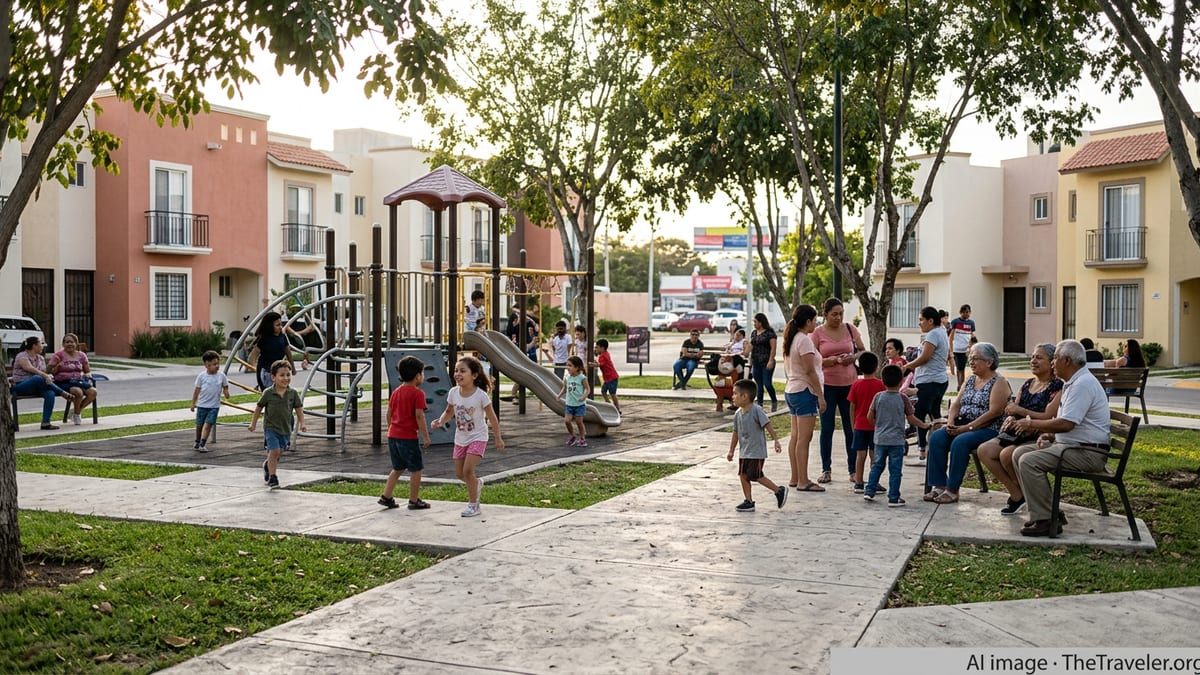
From a family perspective, Querétaro offers a combination of relatively favorable security conditions and modern planned communities that cater explicitly to middle- and upper-middle-class families. Gated residential developments in areas such as Juriquilla, El Refugio, and other northern and eastern suburbs typically provide controlled access, shared green spaces, sports facilities, and organized children’s activities, which can be important for parents concerned about safety and socialization.
The city has a growing ecosystem of private and bilingual schools, including institutions that follow American-style, Canadian-style, or international curricula. While the number of full international schools remains limited compared with Mexico City, Querétaro has enough diversity in the private-education sector for most foreign families to find a workable option, particularly at primary and lower secondary levels. Commute patterns and traffic should be modeled carefully, as residential and school locations can significantly impact daily schedules.
Querétaro’s foreign-resident community is smaller and more dispersed than in resort destinations, which often results in a more integrated, less tourism-driven environment. Families who value living in predominantly Mexican middle-class neighborhoods with access to modern infrastructure, rather than in highly tourist-oriented enclaves, often consider Querétaro a particularly attractive choice.
Mexico City: Highly Selective District Choices for Families
Mexico City, a megacity of over 20 million in the wider metro area, presents both significant advantages and substantial challenges for families. Overall crime levels in the city have historically been high by international standards, although certain central and western districts have seen improvements in security and are widely considered safer for day-to-day family life.
For foreign families, the realistic conversation is not about “Mexico City” in general, but about specific boroughs and neighborhoods. Districts such as Miguel Hidalgo (including parts of Polanco and Lomas), Cuauhtémoc (Condesa and Roma Norte), Benito Juárez, and Coyoacán contain residential areas where reported crime levels are lower than the metropolitan average, where streets are better lit and policed, and where family-centric amenities are concentrated. Recent family-focused travel and relocation guidance routinely highlights these areas as the most suitable for households with children, acknowledging that conditions can differ sharply even between adjacent neighborhoods.
Mexico City offers the country’s broadest range of international schools, including institutions running American, British, French, German, Japanese, and other national curricula, as well as International Baccalaureate programs. For families whose relocation is primarily driven by work assignments in multinational companies, embassies, or international organizations, access to this dense network of international education options is often the decisive factor. Many schools have waiting lists, especially at primary levels, so early engagement and admissions planning are essential.
Urban infrastructure also favors families in selected areas, with extensive park systems, museums oriented toward children, and a variety of organized sports and extracurricular programs. At the same time, parents must weigh chronic issues such as high air pollution on certain days, traffic congestion, and the need for robust security routines. For globally mobile families used to major metropolitan environments, the trade-off between risk exposure and educational and cultural advantages may still be acceptable when constrained to the best-performing districts.
San Miguel de Allende: Smaller-Scale City with Established Expat Networks
San Miguel de Allende, in Guanajuato state, is a mid-sized city that has attracted foreign residents for decades. While it is often promoted for cultural and aesthetic reasons, its relevance for families lies in its established support ecosystem for foreigners and its smaller urban scale. The foreign population is estimated to represent a notable share of municipal residents, creating sustained demand for English-speaking services and community organizations.
For families, the main advantages are a walkable historic core, relatively short travel times across the city, and a sense of community that can be easier to tap into than in larger metropolitan areas. The city hosts bilingual and international-style schools, some of which follow American curriculum structures and cater explicitly to children of foreign professionals and binational families. Class sizes in these schools tend to be smaller than in large-city institutions, which can be positive for some students but also limits peer group diversity.
Security conditions in San Miguel de Allende have historically been more stable than in many other cities in central Mexico, although the broader state of Guanajuato has at times experienced elevated levels of violent crime. Families considering this city should therefore conduct highly localized research at neighborhood level and monitor recent trends rather than relying on the city’s historical reputation alone.
San Miguel de Allende is particularly suitable for families seeking a smaller community with an existing expat network, where English is more frequently spoken in daily interactions and where integration into local schools and activities can be facilitated by long-standing binational initiatives. However, older teenagers may experience limitations in terms of specialized schooling tracks, advanced extracurricular programs, or large-scale youth networks compared with major cities.
Baja California Sur: La Paz and Los Cabos for Coastal Family Lifestyles
The state of Baja California Sur, including La Paz and the Los Cabos corridor (Cabo San Lucas and San José del Cabo), is often cited among Mexico’s safer regions by national victimization and perception surveys. Recent analyses place the state among the top tier for safety perception, and its homicide rate has been reported as significantly below the national average and lower than that of many large US cities. This relatively favorable security picture, combined with strong North American connectivity, gives coastal cities in Baja California Sur particular relevance for foreign families.
Los Cabos has a long-established foreign-resident and commuter community, originally driven by tourism but now incorporating remote workers and longer-term families. This has supported the development of international schools and bilingual private institutions following North American curricula. Organized sports, water-based activities, and after-school programs are widely available, though concentrated in fee-based settings aligned with the region’s higher cost profile.
La Paz, while smaller and less tourism-driven than Los Cabos, has also developed a reputation for being orderly and comparatively safe, with a growing but still more modest foreign community. For families, this can mean more exposure to everyday Mexican life while still having access to key services and some bilingual schooling options. As in all mid-sized coastal cities, the range of specialized educational and therapeutic services is narrower than in a major metropolitan area.
Both La Paz and Los Cabos are suitable for families who specifically prioritize coastal environments but want to reduce exposure to the higher-risk patterns seen in some other Mexican coastal states. As always, conditions can vary by neighborhood, and families should investigate local schooling capacity, commute patterns, and seasonal safety dynamics such as road conditions and severe weather risks.
Cross-City Comparison: Key Family Considerations
Choosing among these cities involves weighing different configurations of safety, education, and daily-life convenience. No single location is optimal for all families, but the cities highlighted above cover distinct profiles that can be matched to particular priorities and risk tolerances.
A simplified qualitative comparison is provided below, based on information available as of early 2026 and using conservative descriptors rather than exact scores:
City-level family profile (indicative only):
| City | Relative safety (national context) | International / bilingual school depth | Scale of foreign family community |
|---|---|---|---|
| Mérida | High | Moderate | Significant and growing |
| Querétaro | Moderately high | Moderate | Growing, dispersed |
| Mexico City (selected districts) | Varies by area, from moderate to relatively secure | Extensive | Large, especially in specific neighborhoods |
| San Miguel de Allende | Moderately high at city level | Limited but focused | High relative share of residents |
| La Paz / Los Cabos | High at state level | Moderate | Significant in coastal zones |
Families should treat this table as a starting framework rather than a definitive ranking. Within each city, micro-level variations across neighborhoods, school catchment areas, and commuting corridors can be more important than the aggregate picture. In practice, the decision process should include detailed neighborhood profiling, school admissions timelines, and scenario planning for security routines and transportation.
The Takeaway
Mexico offers several cities that, as of early 2026, can credibly support the needs of foreign families, particularly those prioritizing relative safety, access to international or bilingual schooling, and a stable environment for children. Mérida and Querétaro stand out for combining comparatively favorable security conditions with growing education options and modern family-oriented housing developments. Select districts in Mexico City provide unmatched international-school density and cultural resources but require more complex risk management and routine planning.
Smaller and mid-sized destinations such as San Miguel de Allende and coastal cities in Baja California Sur add alternative profiles for families who prefer a slower pace or coastal lifestyle. In each case, the decisive factors will be neighborhood-level safety, realistic commuting times, and confirmed school placements rather than macro-level city branding.
Any relocation decision should be preceded by up-to-date verification of crime trends, consultation with local experts or corporate security providers where relevant, and on-the-ground visits focused on daily-life simulations with children. With adequate preparation and a data-driven approach, the cities highlighted in this briefing can offer viable and often attractive environments for families moving abroad to Mexico.
FAQ
Q1. Which city in Mexico is generally regarded as safest for families?
Mérida is frequently cited as one of Mexico’s safest large cities, with comparatively low violent crime rates and strong local perceptions of safety, making it a leading option for families.
Q2. Does Mexico City make sense for families with children?
Mexico City can be suitable for families who select safer districts such as Polanco, Condesa, Roma, parts of Benito Juárez, and Coyoacán, and who prioritize access to the city’s extensive international-school network.
Q3. How important are international schools when choosing a Mexican city?
For families relocating from abroad, international or strong bilingual schools are critical, as they ease curriculum transitions and language barriers; Mexico City has the widest choice, while Mérida, Querétaro, San Miguel de Allende, and Los Cabos offer more limited but viable options.
Q4. Are resort areas in Mexico automatically safer for families?
Not necessarily; some resort zones in Mexico face significant security challenges. However, certain areas in Baja California Sur, including La Paz and Los Cabos, currently combine relatively favorable safety indicators with established foreign communities.
Q5. How large is the foreign family community in Mérida and Querétaro?
Both cities host growing foreign-resident populations; Mérida’s community is relatively large and visible, while Querétaro’s is more dispersed across middle- and upper-middle-class neighborhoods.
Q6. Is San Miguel de Allende suitable for teenagers as well as younger children?
San Miguel de Allende can work for all ages, but older teenagers may find fewer advanced schooling tracks, sports leagues, and large peer groups compared with major cities such as Mexico City.
Q7. How do traffic and commuting affect family life in Mexican cities?
In large cities, particularly Mexico City and Querétaro, traffic can significantly affect daily routines, so families should model door-to-door travel times between home, school, and workplaces before committing to specific neighborhoods.
Q8. Are safety conditions uniform within each recommended city?
No; safety conditions vary widely by neighborhood, even in relatively secure cities. Families should focus on micro-locations, consult recent local data, and avoid generalizing from city-wide labels.
Q9. How frequently do safety conditions change in Mexican cities?
Security conditions can shift over months or years due to local dynamics, so any decision should be based on the most recent data available and periodically reviewed after relocation.
Q10. What first steps should families take when shortlisting Mexican cities?
Families should clarify schooling needs, map potential employment or remote-work constraints, research neighborhood-level safety patterns, and schedule exploratory trips focused on daily routines rather than tourism.