


Thailand has emerged as a leading regional destination for relocating families, supported by a dense network of international schools and relatively safe urban environments. Choosing the right city, however, is critical to long-term family wellbeing. This briefing evaluates Thailand’s principal cities from a family perspective, focusing on education availability, safety, environmental conditions and child-oriented infrastructure rather than short-term tourism appeal.
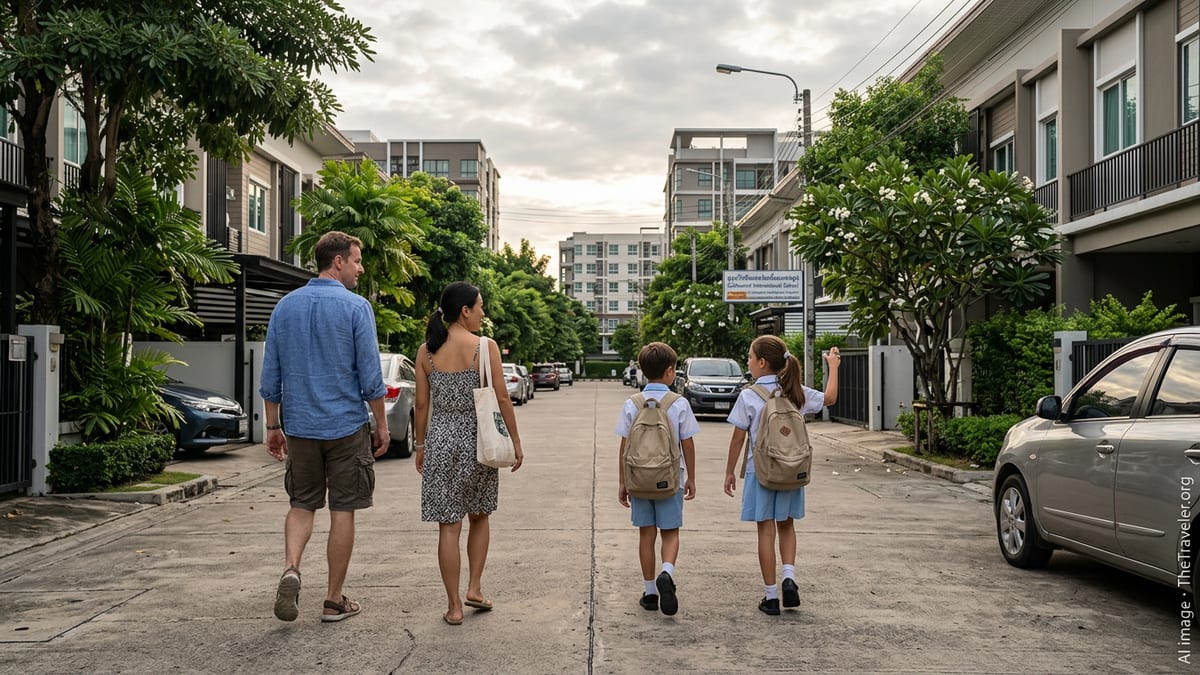
How to Assess Thai Cities for Family Relocation
Families moving to Thailand typically prioritize four structural factors when comparing cities: schooling options in an international language, everyday safety and security, environmental conditions such as air quality, and the availability of child-focused services and infrastructure. Cost of living, visas and employment are important but are considered secondary for the purpose of this analysis.
International education is a central driver of location choice. Recent industry data indicates that Thailand hosts roughly 240 to 250 international schools nationwide, with close to half concentrated in the capital region and a second cluster in Chiang Mai and the main resort provinces. These schools follow a range of curricula including British, American, International Baccalaureate and Singaporean, and are the default option for most foreign families planning multi-year stays.
Safety in Thailand’s main urban centers is generally favorable compared with many Western cities, with national homicide rates reported at less than half those of the United States and major provincial cities such as Chiang Mai and Phuket recording relatively low violent crime levels. Petty theft and fraud risks exist, particularly in high-tourism zones, so micro-location within a city can be as important as the city choice itself.
Environmental quality and urban form vary widely across Thailand. Bangkok and some industrial coastal areas experience seasonal air pollution and traffic congestion, while secondary cities and certain coastal locations provide cleaner air and a less dense built environment. Families must decide their tolerance for large-city complexity versus the simplicity and constraints of smaller centers with fewer schooling choices.
Bangkok Metropolitan Area: Maximum Choice and Urban Complexity
Bangkok and its surrounding provinces remain the primary destination for corporate transferees and international professionals with school-age children. Recent counts suggest more than 100 international schools across the Bangkok metropolitan area and neighboring Nonthaburi and Samut Prakan provinces, representing over 40 percent of all such schools in Thailand. This concentration delivers the widest range of curricula, fee levels and campus types, from early years to pre-university programs.
Within the capital region, established institutions such as long-running American, British and Singaporean-curriculum schools anchor multiple family-friendly neighborhoods. Sukhumvit, Bang Na, Nonthaburi and areas near the eastern ring road have become de facto education corridors, where residential compounds and condominium developments are planned around school catchments and commute patterns. For families with children at different stages of schooling, Bangkok offers the most practical possibility of keeping all children within high-standard institutions without major compromises.
From a safety perspective, Bangkok scores respectably in global expatriate rankings on everyday convenience and healthcare access but less strongly on perceived personal security and traffic safety. Families typically mitigate risks by selecting gated communities or managed condominiums, using organized transport for children and favoring neighborhoods where school runs do not require complex cross-city travel. The city’s scale and traffic congestion mean that proximity to school is often more important than proximity to downtown business districts.
The main trade-offs in Bangkok are environmental and lifestyle related. Air quality deteriorates in the cool season, especially from roughly December to March, and outdoor play may need to be restricted on high-pollution days. Noise and density are part of daily life in central areas. For families who require the broadest school choice, specialist healthcare, extracurricular activities and a large international peer group, these drawbacks are often accepted as manageable in exchange for metropolitan advantages.
Chiang Mai: Smaller City with Strong Education Cluster
Chiang Mai is widely considered Thailand’s leading secondary city for foreign families, combining a sizable international community with a more compact urban footprint. The city hosts more than 20 international schools, making it the second-largest international education hub in the country after Bangkok. Long-established institutions dating back to the mid-20th century anchor the market, and newer schools offer American, British and hybrid curricula.
The education ecosystem in Chiang Mai extends beyond international schools to include reputable universities and language centers, supporting older teens and accompanying spouses who wish to study. Several K–12 schools are accredited by overseas bodies and deliver programs that align with North American or European higher education expectations, which is important for families planning eventual repatriation.
Safety indicators and anecdotal evidence consistently portray Chiang Mai as one of Thailand’s calmer and more community-oriented cities. Local neighborhoods on the western and northern edges of the urban area are popular with families seeking detached houses in gated compounds, with relatively short commutes to schools and commercial centers. Violent crime is rare in family districts, though routine precautions remain necessary around nightlife zones and tourist clusters.
The main environmental drawback is seasonal air pollution linked to regional burning, typically affecting the city from roughly February to April. During these months particulate levels can rise significantly, prompting many schools and families to implement air-filtration measures and limit outdoor activities. Families with children who have respiratory vulnerabilities should factor this seasonal pattern into their decision, balancing the city’s otherwise favorable scale, community feel and breadth of schooling options.
Phuket: Resort Province with Established Schooling and Services
Phuket functions as both a tourism destination and a long-term residence hub for international families, particularly those prioritizing a coastal environment. The province hosts a compact but significant group of international schools, with recent surveys listing around seven institutions offering international programs in the main district alone. These schools predominantly follow British or mixed international curricula and serve a combination of expatriate and Thai students.
From a family perspective, Phuket’s education offer is narrower than Bangkok’s but sufficient for many use cases. Several schools provide complete pathways from early years through secondary levels and market themselves to globally mobile families. The student body tends to be diverse, and facilities such as sports fields and outdoor play areas benefit from the provincial setting where land is more available.
Safety conditions in Phuket are generally favorable away from specific entertainment districts. Provincial crime data and independent analyses suggest overall crime rates that are moderate to low for a tourist-intensive location, with family residential areas outside core nightlife zones experiencing relatively few incidents of serious crime. Road safety and water safety are more salient concerns than street crime, leading many families to prioritize locations with good internal roads and managed communal facilities.
Environmental quality in Phuket is mixed. Coastal areas often enjoy better air quality than inland industrial regions, and outdoor recreation opportunities are extensive. However, rapid development and high visitor volumes can put pressure on infrastructure in some parts of the island, leading to congestion during peak seasons. For families who value a marine environment and are comfortable with a somewhat smaller menu of school choices, Phuket represents a viable alternative to Bangkok’s density.
Chonburi and Rayong: Industrial Eastern Seaboard with Family Enclaves
Chonburi and neighboring Rayong provinces form Thailand’s primary industrial and logistics corridor along the Eastern Seaboard. They are home to major manufacturing zones and port facilities, which in turn support a concentration of foreign professionals and technicians. This has driven the development of multiple international and bilingual schools designed to serve both expatriate and upwardly mobile Thai families.
International schools in this corridor are fewer in number than in Bangkok but are strategically located near industrial estates and residential compounds. Children of employees in large multinational firms often attend these schools, where English is widely used and graduates may progress to universities in Thailand and overseas. Reports from international educators note particularly strong English proficiency among students from this region, reflecting both school quality and the international orientation of local employers.
In terms of safety, many expatriate families reside in planned communities with controlled access, shared recreational facilities and on-site management. These enclaves mitigate concerns about proximity to heavy industry and major transport routes. Road traffic and industrial hazards are the primary risks, so neighborhood selection and commuting patterns warrant careful review.
Environmental conditions are the central trade-off. Air quality can be influenced by industrial emissions and traffic, and some coastal areas have experienced visible environmental stress. However, several districts maintain relatively low-rise, suburban environments with access to beaches and open spaces. For families tied to Eastern Seaboard employment, Chonburi and Rayong offer practical, if less picturesque, family living with acceptable schooling options and reasonably structured residential zones.
Secondary Coastal Cities: Hua Hin and Koh Samui
Beyond the main hubs, a small number of secondary coastal cities have emerged as niche options for relocating families seeking a quieter environment. Hua Hin, a mid-sized seaside city on the Gulf of Thailand, attracts both retirees and families who prefer a more manageable scale while remaining within weekend travel distance of Bangkok. The city hosts several international or bilingual schools and a growing network of private medical facilities.
Hua Hin’s school market is limited compared with Bangkok or Chiang Mai, but sufficient for families with younger children or those willing to accept a narrower choice of secondary programs. Class sizes may be smaller and facilities less extensive than in large metropolitan schools, but the more compact city layout can translate into shorter commutes and greater day-to-day autonomy for older children.
Koh Samui represents another emerging family hub, with at least one established international school and a handful of smaller education providers catering to foreign residents. Private hospitals with English-speaking staff operate on the island, which is important for families prioritizing medical access in a relatively isolated location. Education and healthcare infrastructure are still less dense than on the mainland, so this option suits families comfortable with a small-island environment and limited redundancy in school choices.
Safety and community cohesion are generally strong in these secondary coastal cities, with lower crime levels than major urban centers and a high degree of social familiarity. The main constraints are limited higher-grade schooling options, reliance on domestic flights for connectivity and reduced access to specialized services. These cities are best viewed as targeted choices for families whose work or lifestyle priorities align with smaller-scale coastal living.
Emerging Options in the Thai Heartland
Beyond the best-known expatriate centers, a few inland provincial capitals such as Khon Kaen and Udon Thani are gradually improving their appeal for foreign families, largely through the expansion of international or English-program schools linked to local universities and Christian education networks. For example, some Bangkok-based international school operators have opened campuses in the northeast to meet demand from both Thai and expatriate households.
These cities offer significantly lower density and a more traditional Thai urban structure, where daily life is less oriented around tourism and more around local commerce and education. Safety conditions are generally stable, with lower levels of petty crime than in major tourist hubs. The social environment tends to be more Thai-language dominant, which can be an advantage for families who want deeper integration but may create adaptation challenges for children with limited exposure to Thai.
The key limitation for heartland cities is the small number of international schools and the absence of multiple parallel pathways at the secondary and pre-university levels. Families may find suitable options for early and middle years but need to plan for a possible move to a larger city for the final stages of schooling. For highly cost-sensitive or long-term residents with strong local ties, these emerging cities can nevertheless provide a stable, low-pressure environment for raising children.
When considering these locations, families should conduct detailed due diligence on specific schools, including accreditation status, language of instruction, graduation outcomes and teacher turnover. Given the smaller market size, individual institutional quality matters more than in regions where multiple alternatives are available within a short radius.
The Takeaway
Thailand offers a diversified portfolio of cities for relocating families, each with distinct profiles in terms of education infrastructure, safety, environment and urban scale. Bangkok remains the first-choice destination for families requiring maximum flexibility in curriculum, school brand and extracurricular options, accepting trade-offs in air quality and traffic in exchange for comprehensive services.
Chiang Mai provides a strong alternative for those who value a smaller-city environment without giving up a robust cluster of international schools, but families must weigh this against the seasonal impact of regional burning on air quality. Phuket, Chonburi and Rayong serve more specialized needs, whether for coastal living or proximity to industrial employment, and are best suited to families whose work locations or lifestyle priorities align with these geographies.
Secondary coastal cities like Hua Hin and Koh Samui, along with emerging heartland centers, are promising but more niche. They can deliver high perceived quality of life in quieter settings, at the cost of narrower school choices and fewer specialist services. For decision-grade planning, families should move beyond general city reputations and map specific school locations, commute times, air-quality seasonality and neighborhood safety conditions before committing to a long-term relocation.
FAQ
Q1. Which city in Thailand offers the widest choice of international schools for families?
Bangkok and its surrounding metropolitan area offer by far the widest range, with more than 100 international schools spanning multiple curricula and fee levels.
Q2. Is Chiang Mai a good choice for families concerned about safety?
Chiang Mai is generally regarded as one of Thailand’s safer cities, especially in family-oriented residential districts, though standard urban precautions remain advisable.
Q3. How does air quality compare between Bangkok and Chiang Mai for children?
Bangkok experiences recurring urban pollution, while Chiang Mai faces a pronounced burning season typically from February to April. Families should assess which pattern better aligns with their children’s health needs.
Q4. Are there enough schooling options in Phuket for long-term family relocation?
Phuket has a modest but established group of international schools, sufficient for many families, though choice is more limited than in Bangkok or Chiang Mai, especially at higher grade levels.
Q5. What makes Chonburi and Rayong relevant for expatriate families?
These provinces host major industrial estates employing foreign professionals and provide a network of international and bilingual schools plus planned residential communities designed with families in mind.
Q6. Is Hua Hin suitable for families with teenagers?
Hua Hin can work for teenagers, but the range of upper-secondary and pre-university programs is limited compared with major cities, so some families later relocate for final schooling years.
Q7. How important is living close to school in large Thai cities?
In cities like Bangkok, proximity to school is critical due to congestion; living within a short commute often improves children’s daily routines more than living close to downtown offices.
Q8. Are smaller heartland cities like Khon Kaen viable for non-Thai-speaking children?
They can be viable where an international or strong bilingual school is present, but daily life outside school is more Thai-language dominant, requiring greater adaptation efforts.
Q9. Do Thai international schools generally support university entry abroad?
Many established international schools are accredited and follow curricula recognized by overseas universities, but families should confirm specific graduation pathways and historical placement outcomes.
Q10. How should families prioritize factors when choosing a Thai city?
Most families prioritize school quality and commute time first, then assess safety, air quality patterns, healthcare access and the match between city scale and their preferred pace of family life.