


November in Europe sits in a sweet spot for city-break travelers who care more about galleries than beaches. Airfares and hotels have usually dipped from October peaks, crowds thin out in big-name museums, and Christmas markets begin to light up darker evenings. The trade-offs are real: shorter daylight, colder or wetter weather, and the risk that certain attractions cut hours or close on Mondays or public holidays. In November 2027, choosing the right city matters more than simply grabbing the cheapest flight, especially if you want strong museums, atmospheric but walkable historic districts and realistic weekend costs.
Get the latest updates straight to your inbox!
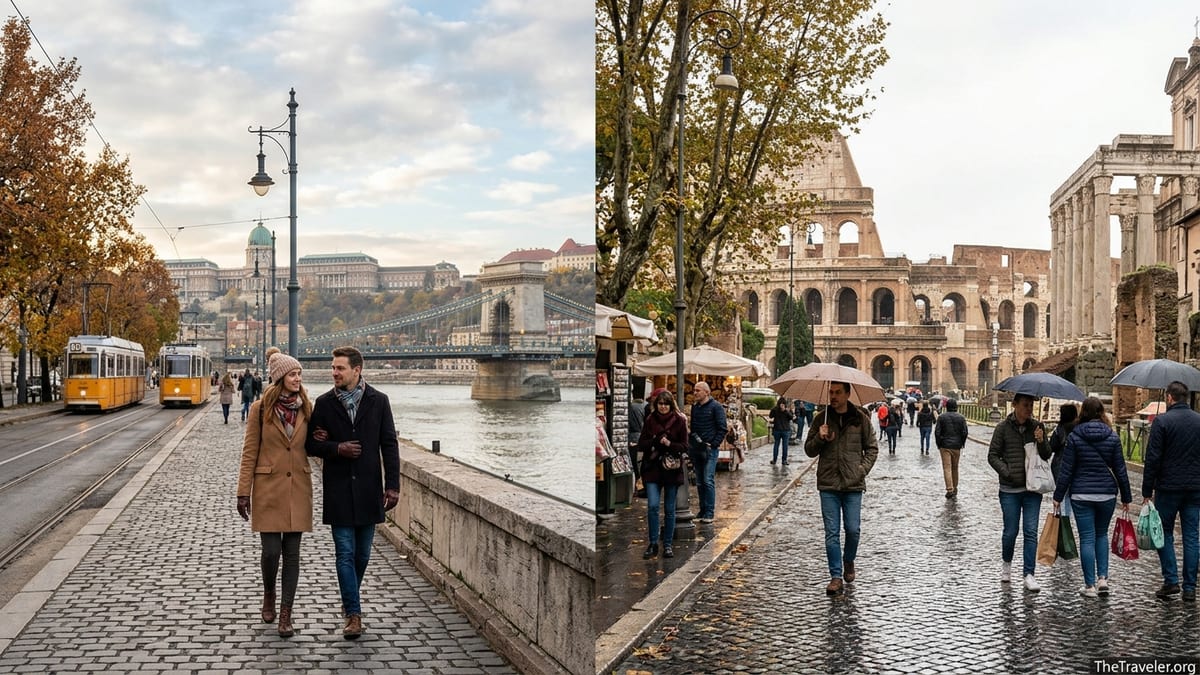
Why November 2027 Can Work for Culture Lovers
Across central Europe, long-term climate data shows November daytime highs typically around 6 to 10 degrees Celsius in cities such as Vienna, Budapest, Prague, Kraków and Berlin, with nights close to freezing and around 8 to 9 hours of daylight by mid-month. In practice this means hat-and-scarf weather for morning walks, plus an early dusk that encourages museum time before a late-afternoon coffee or mulled wine. Further south in Rome, Florence, Bologna, Madrid or Valencia, averages are milder, often in the mid-teens Celsius, but November is also among the wetter months, so showers are more likely even when temperatures stay comfortable for outdoor sightseeing.
Shorter days affect how you structure a city break. In Berlin in November you can expect fully dark streets by late afternoon, which is ideal if you want to combine the Pergamon Museum or the Neues Museum with evening restaurant reservations, less so if you dreamed of long golden hours on Museum Island. In Kraków or Prague, foggy mornings and early sunsets mean it is wise to schedule outdoor walking tours in the middle of the day and hold the big indoor museums in reserve for grey or rainy windows.
Public holidays are another factor in early November. November 1, All Saints’ Day, is a public holiday in Austria, Belgium, Hungary, Italy, Poland, Portugal and Spain, among others. Some city museums, particularly in Italy and Spain, may operate on a Sunday or holiday schedule, occasionally with reduced opening, while many shops and smaller private museums simply close. Planning a long weekend from Friday 29 October to Monday 1 November 2027, for example, will feel quite different in Florence, where smaller churches and boutiques may shut on the holiday, than in Berlin, where November 1 is a normal working day.
The upside is that cultural travelers get space and value. In cities where summer queues stretch for hours, November lines are often measured in minutes if you book a timed ticket. Room rates also tend to be lower outside trade-fair dates or major events, so a design hotel near Vienna’s Ringstrasse or a boutique guesthouse in Porto’s Ribeira can fall into midrange budgets, particularly from Sunday to Thursday nights.
Weather, Crowds and Costs by Region
Central European capitals such as Vienna, Budapest, Prague and Kraków share similar November conditions: cool, sometimes damp, but rarely locked in deep winter. Using typical 1991 to 2020 climate normals, average highs around Vienna and Budapest sit in the high single digits Celsius with lows a few degrees above or below freezing and moderate rainfall spread across roughly a week of the month. Berlin is similar, with mean daily maximum temperatures of about 7 degrees Celsius, around 40 to 50 millimetres of rain and limited sunshine, which is why local tourist information openly calls November the ideal time for museums and shopping rather than outdoor lounging.
Further north and west, Ghent and Brussels are slightly milder but wetter, with many cloudy days and daylight fading by late afternoon. What these Belgian cities lack in blue skies, they compensate for with compact medieval cores and good cafés, which suit travelers happy to mix one major museum with plenty of time in warm interiors. Prices are shaped heavily by the EU institutional calendar in Brussels, where midweek rates can spike when large conferences or summits land, while Ghent often remains better value at weekends.
Southern Europe offers a different November trade-off. In Rome and Florence, daytime temperatures commonly range from the low to high teens Celsius, cool enough for comfortable church and museum visits without the oppressive heat of summer. Rain is more frequent, especially in Rome, which treats November as one of its wetter months. Bologna, with its famous porticoed streets, can actually be ideal in mixed weather because much of the historic center is sheltered. Madrid and Valencia stay relatively dry and bright; their plateau and coastal climates often provide clear, crisp days, especially in the first half of the month, though chilly evenings can surprise visitors who assumed southern Spain would feel like late summer.
Price-wise, November 2027 should remain shoulder season in most of these cities, with two big caveats. First, weekends at the start of Christmas market season, especially from mid to late November in Vienna, Budapest, Prague, Kraków, Berlin and Brussels, already show higher hotel tariffs on metasearch engines than early-November dates. Second, big trade fairs and academic conferences in Bologna, Florence or Berlin can quietly drive rates up on specific weeks, so it is important to cross-check your intended dates against local convention calendars before locking in flights.
Museums, Opening Hours and All Saints’ Day
For a November 2027 city break built around art and history, opening hours and regular closure days matter at least as much as weather. Many major European museums maintain broadly stable timetables year-round, but several still close on Mondays or Tuesdays, and some shift to shorter winter hours. In Florence, the Uffizi Gallery’s official information shows standard daytime openings with last admission around mid to late afternoon, and low-season ticket pricing in parts of November and December designed to nudge visitors into traditionally quieter weeks. In Vienna, the Kunsthistorisches Museum and other imperial collections keep core daytime hours but now rely mostly on prebooked time slots even outside summer, which can help you plan around the early sunset.
In Budapest, the Hungarian National Gallery and Hungarian National Museum both advertise consistent opening through much of the year, and recent holiday schedules indicate that they remain open on 1 November when it falls on a weekend, with normal hours unless a special event or safety concern intervenes. Prague’s National Gallery sites and Kraków’s Wawel Royal Castle typically follow a mixed pattern of opening on All Saints’ Day but occasionally closing on other church holidays; by the time you book for 2027, each museum’s late-2026 or 2027 calendar should confirm whether 1 November is open, shortened or fully closed.
Italy and Spain warrant special care around All Saints’ Day. Official EU and national calendars list 1 November as a public holiday in both countries, and traveler reports confirm that many Italian cities see widespread closures of shops and smaller museums on that date. Large state museums such as Rome’s Capitoline Museums or Florence’s Uffizi often open but may operate with Sunday-style schedules and timed-entry limits. In Madrid, headline attractions such as the Prado Museum publish year-round hours with slightly earlier closing on Sundays and holidays; November 1 is treated like other public holidays, with the museum open but shops, banks and some private galleries closed.
Mondays remain the most common closure day across the region. In Brussels, key art collections like the Magritte Museum and the Royal Museums of Fine Arts generally close on Monday. Many city museums in Ghent, Kraków and Prague also take Monday off, though some, such as Ghent’s STAM city museum or Prague’s Jewish Museum synagogues, use different weekly patterns. For a Friday to Monday city break it is therefore wise to prioritize must-see museums on Friday, Saturday and Sunday and save open-air wandering or churches for Monday morning if your flight allows.
Christmas Markets and Late-November Atmosphere
By mid-November 2027, Christmas markets will transform the feel of several central European cities. Verified 2026 schedules from municipal and tourism sources already show a pattern: Vienna’s main Christkindlmarkt on Rathausplatz runs from mid-November to 26 December, with Schloss Schönbrunn and other smaller markets often starting in the second week of the month. Budapest’s flagship market on Vörösmarty Square is also confirmed for mid-November starts in 2026, stretching into early January, and similar timing is expected for 2027 unless city authorities publish changes. Prague, Kraków and Brussels show later starts, closer to the final week of November.
For a November city break this split matters. Choose Vienna, Budapest or Berlin for a trip on the weekend of 15 to 18 November 2027 and you are likely to enjoy a full Christmas market experience, with stalls, lights and mulled wine already in place. Opt for Madrid, Valencia or Rome on the same weekend and you may find only low-key festive decorations and early department-store displays, with no major Christmas market focus. Brussels tends to sit in the middle: its Winter Wonders event usually opens in the second half of November and runs through New Year, combining an illuminated Grand-Place with Ferris wheel, food stalls and ice rink.
Christmas markets influence both crowds and costs. Central squares in Vienna, Prague, Budapest and Kraków are significantly busier on Friday and Saturday evenings once markets open, which may not suit travelers chasing quiet streets. At the same time, hotel prices for those weekends often climb above early-November levels. For instance, recent booking data for November 2026 showed some Vienna city-center three and four star properties charging noticeably more on the first Christkindlmarkt weekend than the previous Friday, while rates slid back down for midweek nights between markets and Advent weekends. If you want both value and atmosphere, consider a Sunday to Wednesday stay around 22 to 25 November 2027, which can catch the lights but miss the peak weekend surge.
Cities without huge destination markets offer a different vibe. Porto, Valencia, Bologna and even Florence see more modest Christmas setups, which leaves their historic centers less crowded with seasonal day-trippers. For some travelers this is ideal: you still get occasional festive lights and winter treats but without dense crowds under nightly light shows. If your priority is contemplative museum visits and unrushed café time, these “lighter Christmas” cities can outshine the more famous market capitals in late November.
Weekend and Midweek Prices in Practice
Comparing November 2026 and advance 2027 hotel quotes across major booking platforms reveals broad patterns that should hold next year, even if exact figures change. In central Europe, Budapest and Kraków often emerge as the most budget-friendly for both solo travelers and couples. A midrange, centrally located double room in Budapest around a non-holiday November weekend can be significantly cheaper than equivalent lodging in Vienna or Prague, while Kraków’s well-developed guesthouse market keeps both double and single-occupancy prices attractive, especially Sunday through Thursday. Berlin generally sits in the middle, with excellent public transport reducing the need to pay for the most central postcodes.
In western and southern Europe, Porto and Valencia commonly offer good value relative to their national capitals. Checking sample dates in November 2026, Porto showed comfortable guesthouses and boutique hotels near the historic Ribeira district at noticeably lower nightly rates than comparable properties in Lisbon. Valencia similarly undercut Madrid’s art triangle district, especially on weekdays between fairs. Rome and Florence commanded higher averages, but a closer look showed clear dips whenever there was a lull between major events and around midweek, when business travel eases.
Trade fairs and conferences are the wildcard. Bologna’s Fiera district can double or triple room rates citywide when large medical or industrial events are in town, including in November. Berlin sees surges around major trade shows at Messe Berlin or political events, which can push even outer-district midrange hotels into premium territory for a few nights. Brussels is heavily tied to the EU and NATO meeting schedule; when large summits coincide with your planned city break, it may be cheaper to stay in Ghent and take the half-hour train for a day trip.
Food and local transport are relatively predictable across these cities. In 2026, a seated main course in a non-touristy bistro in Budapest or Kraków often runs at a fraction of the cost of a similar dish in Vienna, Florence or Brussels, while coffee and bakery breakfasts in Porto or Valencia remain reasonable compared with northern capitals. Urban public transport passes, such as Vienna’s 72-hour ticket, Berlin’s ABC zone tickets or Madrid’s Tourist Travel Pass, can flatten costs further by making airport transfers and daily travel predictable. For short weekends, many travelers find that a central but modest hotel plus a transport pass offers better overall value than a cheaper peripheral hotel combined with ad hoc single-ride tickets.
Three Sample Three-Day Itineraries for November 2027
For a budget-friendly central European city break in November 2027, Budapest makes an appealing base for three days. After landing at Budapest Ferenc Liszt International Airport, you can reach the center on the bus and metro combination rather than a private transfer, bringing a solo traveler into town at a small fraction of taxi costs. A Friday arrival could feature an afternoon orientation walk around the Danube riverfront and a quick visit to the Hungarian National Museum, an institution whose climate-controlled halls are ideal for a chilly or rainy day. Dinner in an inner-city neighborhood away from the riverfront, perhaps in the Jewish Quarter, keeps meal prices moderate while still allowing a taste of local cuisine.
Saturday in Budapest can anchor on Buda Castle. A morning ride on public transport up to the castle district offers panoramic views if the weather is clear, followed by a substantial visit to the Hungarian National Gallery inside the former royal palace. With public transport inexpensive and frequent, you can return across the river in the afternoon for a soak at one of the city baths, which becomes especially attractive in cold weather. A solo traveler or couple who choose a midrange hotel, use a multi-day transit ticket and focus spending on museum tickets and one or two special meals can keep total three-day costs markedly below what the same pattern would cost in Vienna or Florence.
For a mild-weather southern option, consider Porto. Its hilly old town and Douro riverfront stay atmospheric under grey skies, and November temperatures are cool but rarely harsh. Fly into Francisco Sá Carneiro Airport and take the metro into the center, an easy and budget-conscious transfer for one or two people. Day one can focus on the Ribeira district and a cross-river stroll to Vila Nova de Gaia for cellar visits, many of which include guided tours of port wine lodges that take place largely indoors. On day two, explore cultural sites such as the Serralves Museum of Contemporary Art and the Casa da Música, linked by buses or tram, then retreat to tiled cafés when showers roll in.
A museum-focused trip with minimal outdoor dependence might be best built around Madrid or Berlin. In Madrid, a three-day itinerary can orbit the Prado Museum, the Reina Sofía and the Thyssen-Bornemisza, all within walking distance of each other and connected by reliable metro lines. After landing at Adolfo Suárez Madrid–Barajas Airport, you can choose between an express bus and metro into the center, both manageable even for solo travelers at reasonable cost. Day one might feature the Prado’s classic collections, day two the Reina Sofía’s modern art and Guernica, and day three the Thyssen plus smaller venues like the Sorolla Museum if the weather holds. With these museums operating year-round schedules including November public holidays, your exposure to rain or cold is limited mainly to short walks between them and nearby cafés.
In Berlin, a similar three-day plan can concentrate on Museum Island for the Pergamon’s neighbors, the Neues Museum and the Altes Museum, supplemented by the Jewish Museum or contemporary art spaces that are easy to reach via the rapid S-Bahn and U-Bahn network. Berlin Brandenburg Airport’s rail link into the city lets both solo travelers and couples avoid high taxi fares. Given Berlin’s relatively low November daylight and a reputation for grey skies, a museum-heavy program with prebooked timed tickets and evening meals in lively neighborhoods like Kreuzberg or Prenzlauer Berg can make early darkness feel like an asset rather than a drawback.
Practicalities: Clothing, Early Darkness and Rainy-Day Backups
Packing for a November 2027 city break across this mix of destinations means planning for layers. In Vienna, Budapest, Prague, Kraków, Berlin, Ghent and Brussels you should expect near-winter conditions, even if snow is not guaranteed. A warm, water-resistant jacket, scarf, gloves and a hat are important, as is footwear with good grip for wet cobbles. Further south, Rome, Florence, Bologna, Madrid, Valencia and Porto often feel like a cool, damp autumn: a lighter but still water-resistant coat, a compact umbrella and one warm layer for chilly evenings are usually enough, but it is wise not to rely on summer sneakers alone.
Early darkness changes the feel of historic districts. Streets in Prague’s Old Town, Kraków’s Rynek Główny, Vienna’s Innere Stadt and Ghent’s Graslei can look their most atmospheric under streetlights by late afternoon. At the same time, dusk can feel abrupt if you expected more outdoor time. A good rule of thumb is to plan outdoor walking tours, views and park visits between roughly 10:00 and 15:00, then shift indoors for museums, cafés, wine bars or thermal baths afterward. This structure also creates natural rainy-day backups: if a forecast looks especially poor, swap an outdoor half-day for museum time and hold a flexible slot on another day for wandering.
Public holidays and Monday closures call for backup plans. On All Saints’ Day in Italy, Spain, Austria, Belgium, Poland and Hungary, assume supermarkets and many shops will be closed or on reduced hours, and that smaller private museums or churches could shut even if big state museums open. Booking timed tickets ahead of time for star attractions such as the Uffizi, the Prado, Vienna’s Kunsthistorisches Museum or Berlin’s major museums is sensible for November as well as summer, particularly on long weekends that include a public holiday or Christmas market opening.
Rainy-day alternatives abound across these cities. In Kraków, smaller museums such as the Rynek Underground or Schindler’s Factory provide absorbing hours under cover. In Ghent and Brussels, café culture and serious chocolate or beer tasting can fill whole afternoons once you have seen the main exhibits. In Rome or Florence, churches themselves are works of art and often quieter in November, providing both shelter and cultural depth, though it is still important to check specific opening times and occasional closure days in advance.
Who November 2027 Suits Best: Art, History, Couples and Budgets
For art lovers, Florence, Vienna, Madrid and Berlin stand out in November. Florence offers the Uffizi, the Accademia and a dense cluster of smaller Renaissance museums within easy walking distance of each other, with low-season ticket policies making November particularly attractive. Vienna’s Kunsthistorisches Museum, Belvedere and numerous specialized collections, combined with the city’s early-opening Christmas markets and café culture, create a rich indoor-focused break that barely depends on weather. Madrid’s Prado and Reina Sofía, and Berlin’s Museum Island and contemporary galleries, similarly provide enough art to fill several short trips, all well connected by public transport.
History enthusiasts may prefer Kraków, Budapest, Prague and Rome. Kraków combines medieval streets, royal Wawel Castle and powerful twentieth-century sites reachable on short excursions. Budapest layers Roman remains, Ottoman baths and Austro-Hungarian architecture, much of it visible from trams and riverbanks even under grey skies. Prague’s castle complex and historic quarters reward slow wandering between indoor stops. Rome, with its forum, Colosseum, basilicas and museums, offers almost limitless depth; in November, key sites are still busy but far less overwhelming than in peak season, particularly if you book early morning or late afternoon tickets.
Couples looking for atmosphere and walkability might gravitate toward Porto, Ghent, Florence or Vienna. Porto’s riverfront and tiled streets feel intimate in cooler weather, with wine lodges and viewpoints an easy stroll apart. Ghent’s medieval core is compact and romantic under evening lights, and canal views shine even in drizzle. Florence’s stone alleys, riverside walks and winter art events balance crowds and intimacy when tour groups thin out. Vienna combines grand boulevards with coffeehouse culture and Christmas lights by mid to late November, ideal for travelers happy to embrace scarves and evening strolls.
Budget travelers will often find the strongest value in Budapest, Kraków, Porto and Valencia. These cities typically combine lower accommodation costs with modest prices for meals, coffee and public transport, while still offering serious museums and historic districts. A solo traveler staying in a simple guesthouse or well-rated budget hotel, using public transport from the airport and focusing spending on a handful of key attractions can craft an engaging long weekend for substantially less than in Rome, Florence, Vienna or Brussels. Couples who share a room gain further savings on per-person accommodation and transit passes.
Across all traveler types, the cities that offer the best combination of cultural depth, lower crowds and value in November 2027 are likely to be Vienna, Budapest, Kraków, Porto and Ghent, with Florence, Madrid and Berlin strong contenders for those prioritizing top-tier museums. The key to making any of them work is not perfect weather, which November cannot guarantee, but realistic planning: understanding average climate, checking museum and holiday schedules carefully, booking key tickets and rooms early, and embracing Europe’s indoor cultural riches when the sun sets before dinner.