


Hong Kong International Airport is no longer just a place to pass through on your way somewhere else. With a dense lineup of cha chaan tengs, dim sum specialists, Asian comfort food counters and smart gastropubs, it has become a destination in its own right for pre-flight dining. Whether you have a tight 45 minutes before boarding or a leisurely three-hour layover, knowing where to eat can turn dead time into one last taste of Hong Kong.
Get the latest updates straight to your inbox!
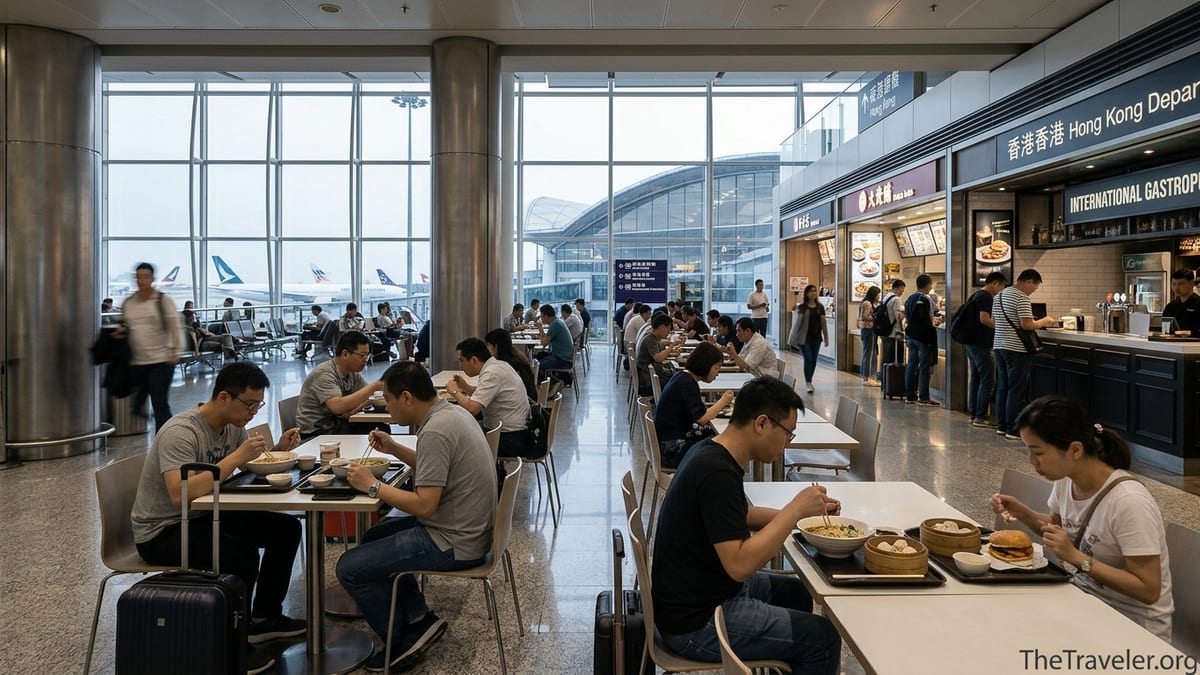
How Dining at Hong Kong International Airport Is Laid Out
Hong Kong International Airport is dominated by its vast Terminal 1, with dining clustered in three main zones: landside before security, the main departures concourse after security, and satellite and midfield concourses further out by the gates. Most travelers will spend their time in the central part of Terminal 1, where escalators connect the main check-in level with multiple dining floors and a busy food court.
If you are checking in at the far ends of the terminal, it is worth knowing that many of the best restaurants are concentrated around the central security area and the major food courts. It can take around 8 to 10 minutes to walk from gates in the 60s to the heart of the dining cluster, so factor that into your plans if boarding time is close. Flight information screens are widely available, so you can keep an eye on boarding while you eat.
Landside options work well if you are meeting friends or family who are not flying, or if you have arrived early before check-in opens. Once you clear security into the restricted area, the choice expands, especially around the departures food courts and near the airline lounges. Recent renovations and the gradual reopening of Terminal 2 have added even more variety, including new food-court concepts and branded quick-service outlets aimed at travelers on tight connections.
Because opening hours and tenant mix can shift, expect some seasonal changes, but core local favorites such as cha chaan tengs, congee and noodle shops, and dumpling counters have remained a constant presence. Prices at most casual places are higher than downtown but still manageable: a bowl of wonton noodles or a plate of fried rice often sits in the range of 70 to 110 Hong Kong dollars, while a basic set meal with drink might run 90 to 130 dollars.
Last Taste of Hong Kong: Cha Chaan Tengs and Local Favorites
For many travelers, the ideal pre-flight meal at Hong Kong International Airport is one last visit to a cha chaan teng, the hybrid Hong Kong diner that serves everything from milk tea to curry beef brisket. One of the most recognisable names is Tsui Wah, which operates in the departures hall of Terminal 1, positioned to catch both departing and arriving passengers. You will typically find classics like crispy bun with condensed milk, fish ball and fish cake noodle soup, and Hong Kong-style milk tea served in thick porcelain cups.
A typical order at a place like Tsui Wah might be a set that includes a main, side and drink: for example, baked pork chop rice with tomato sauce, a side of sautéed vegetables and iced lemon tea. Expect to pay somewhere around 100 to 150 Hong Kong dollars for a filling meal. Despite the airport markup, the portion sizes are generous enough to keep you full even on a long-haul flight, and the menu is designed to move quickly, which helps if you are watching the clock.
Another strong option for a last hit of local flavor is a congee and noodle specialist such as Tasty Congee & Noodle Wantun Shop, which has had an outpost airside in Terminal 1. Here, the focus is on wonton noodles crowned with springy shrimp dumplings, alongside silky rice porridge with ingredients like pork and preserved egg or sliced fish. A standard bowl of noodles usually falls in the 70 to 100 dollar range, and you can add simple greens with oyster sauce or a plate of soy sauce fried noodles to share.
These restaurants can get busy at peak departure times, especially in the mornings when travelers queue for macaroni in soup with ham and scrambled eggs, or in the evenings when families sit down for plates of stir-fried beef ho fun. If your connection is tight, look for counter seating, which often turns over faster than tables. Service is geared toward speed rather than lingering, and staff are used to guests who know their gate numbers by heart.
Quick Bites When You Are Short on Time
Sometimes you land at Hong Kong International Airport, glance at the clock, and realise you have barely 30 minutes before boarding begins. In those moments, the airport’s growing cluster of fast casual options and grab-and-go counters becomes invaluable. One of the concepts created specifically for the airport is One Minute Gourmet, which operates in the Terminal 1 departures food courts near gates in the 40s and 60s. As the name suggests, it specialises in freshly made sandwiches, light hot dishes, snacks and drinks that can be ordered and collected in minutes.
Prices at fast casual counters like One Minute Gourmet are comparable to international coffee chains. A pre-packed salad or sushi set might run 60 to 90 Hong Kong dollars, while a hot rice or noodle box can reach 80 to 110 dollars. The big advantage is predictability: food is displayed in warmers or chilled cabinets, and payment is handled at a central counter, so you can be back on your way quickly. For even faster service, many outlets accept contactless and mobile payment, reducing waiting time at the till.
In the main food courts, you will also find international quick-service names and regional Asian brands. Gordon Ramsay Plane Food To Go, for example, offers sandwiches, wraps and ready-to-carry picnic boxes designed to be taken onto the plane. A typical box containing a sandwich, side salad and dessert might be priced around 120 to 160 Hong Kong dollars. The draw here is the chef’s brand recognition and the convenience of having a fully packaged meal you can eat at your seat after take-off.
For travelers who prefer something warm but streamlined, look for simplified menus at noodle bars and rice-bowl counters. Moon Thai Express in Terminal 1 focuses on Thai comfort dishes such as green curry chicken with rice or pad kra pao minced pork with basil. Portions are substantial enough for a main meal, but the ordering process is similar to a food court: choose your dish, pay at the counter, and pick up when your number is called. In peak times, waiting for a freshly cooked curry may take 10 to 15 minutes, so keep boarding time in mind.
Dim Sum, Noodles and Asian Comfort Food
Hong Kong International Airport also caters to travelers looking for more of a sit-down experience without committing to a full service restaurant. Several dim sum and Cantonese outlets, along with other Asian eateries, line the concourses. Duddell’s, a branch of a well-known Hong Kong restaurant brand, has been a popular choice for those seeking an upscale yet approachable dim sum lunch before flying. While table turnover is brisk, the environment is more polished than a basic food court, with attentive servers and a full menu of steamed, baked and fried dishes.
Ordering dim sum at the airport usually means selecting from a menu rather than traditional trolleys. Dishes like siu mai, har gow and char siu bao are typically priced individually in the 40 to 70 dollar range per basket or plate, and a small selection of three or four types plus a noodle or rice dish can bring a bill for two people into the 300 to 450 dollar range before drinks. The quality is generally higher than what you would find at basic mall chains, and the setting is designed to feel like a miniature version of the city’s more serious Cantonese dining rooms.
Beyond Cantonese cuisine, you will find a cross-section of Asian comfort food aimed at the airport’s diverse passenger base. Putien-style Fujian restaurants offer dishes such as oyster omelette and braised pork rice, appealing to travelers from mainland China and Southeast Asia. Japanese counters like Sushi Taka have offered quick nigiri sets, maki rolls and donburi bowls; a modest sushi set might cost 100 to 160 dollars depending on the fish selection, while a salmon donburi could sit around 120 to 150 dollars.
These outlets are a good fit for travelers who prefer rice-based meals or warm soups before flying. Many passengers choose something relatively light, such as a bowl of udon with tempura or a seafood congee, to avoid feeling weighed down on long flights. Because turnover is steady, ingredients tend to move quickly, and turnover helps keep quality consistent even during off-peak hours.
Western Favorites, Burgers and Bar-style Dining
For those craving western comfort food, Terminal 1 offers a series of casual eateries serving burgers, pizzas and all-day breakfast plates. Tap + Brew, a gastropub located in the departures area, has gained a following among travelers who enjoy a pre-flight drink with something substantial on the side. Its menu usually includes burgers, fish and chips, chicken wings and bar snacks, complemented by a lineup of local and international beers on tap.
At a place like Tap + Brew, a burger with fries is likely to sit in the 130 to 180 dollar range, while a pint of beer may be in the 70 to 100 dollar bracket depending on label. The environment is noticeably livelier than at a standard coffee bar, with large windows overlooking the tarmac where you can watch aircraft taxi while you eat. Many travelers time their visit to coincide with boarding announcements, finishing their drink and heading straight to the gate once their flight status flips to boarding.
Elsewhere in the terminal, you will find familiar global coffee chains and bakery cafes offering sandwiches, pastries and salads. These work best if you prefer a lighter bite or want something portable to carry on board. A simple ham and cheese croissant or a wrap can be around 40 to 70 dollars, while a set that adds a coffee might reach 80 to 110 dollars. Because these outlets have long queues during morning and evening banks of departures, it can be worth walking an extra few minutes to a less obvious branch one level up or down from the main flow.
Some travelers choose to eat at an international chain for the predictability: if you already know what a particular latte or sandwich tastes like in your home city, you will get much the same here. Others deliberately seek out more local flavors. Either way, the western-style restaurants at Hong Kong International Airport are structured for quick service and clear pricing, so you can budget your Hong Kong dollars before you take off.
Eating in Style: Airline and Independent Lounges
If you have access to an airline or pay-per-use lounge, Hong Kong International Airport steps up another level. Cathay Pacific’s lounges, particularly the recently refurbished Wing First and its accompanying business-class spaces, are central to this experience. The Wing First, which reopened after a major renovation in April 2026, now features an upgraded Dining Room that offers full table service with a menu designed in collaboration with acclaimed Hong Kong restaurant Mott 32.
In these premium spaces, you might start with a small plate of barbecued pork, follow with a bowl of spicy noodles or seasonal seafood stew, and finish with a plated dessert, all made to order. The atmosphere is closer to a boutique hotel restaurant than an airport food court: white tablecloths, polished service and a wine and cocktail list included in the access fee. While access is usually limited to first-class or high-status passengers on oneworld carriers, some travelers secure it by booking premium cabins or through elite status match promotions.
Business-class and frequent-flyer lounges operated by other airlines and independent providers are also well-regarded. Plaza Premium’s lounges in the East and West halls of Terminal 1 are popular with economy passengers willing to pay a fee for a calmer environment. Food typically includes a buffet of hot Asian dishes such as curry, stir-fried vegetables and rice, alongside western staples like pasta, salad and pastries. Self-serve coffee machines and soft drinks are standard, and some lounges add a manned noodle bar where freshly cooked bowls of wonton or laksa are prepared to order.
Priority Pass and similar membership programs often provide access to at least one or two lounges at the airport, which can be cost-effective if you have a layover of several hours and plan to eat and drink inside. Before deciding, compare the walk time from your departure gate; a lounge near gate 23 may not be ideal if your onward flight leaves from the far end of the midfield concourse and boarding starts sooner than you expect.
Landside Options and Nearby Alternatives Before Security
Arriving at the airport several hours early, or finishing a meeting in Tung Chung before an evening flight, gives you time to explore landside dining before you even check in. On the departures level of Terminal 1, you will find a sprinkling of cafes, bakeries and local chains where you can sit down with companions who are not traveling. These venues typically serve the same style of menus as their in-town branches, including baked rice dishes, Cantonese roast meats over rice, soups and a wide selection of drinks.
Prices landside are often marginally lower than in the restricted area, and there is less pressure to finish quickly. If you have luggage trolleys or a lot of hand baggage, eating landside can also be more comfortable, as seating is usually more spacious and less crowded between major departure waves. Keep in mind, however, that security and immigration queues can lengthen in the evenings and early mornings, so it is unwise to linger too close to departure time.
An often overlooked alternative is Citygate Outlets in Tung Chung, which sits around 10 minutes from the airport by bus or a short taxi ride. If your layover is long enough and you are already checked in, you can leave the terminal, have a meal in one of the mall’s many restaurants or its multi-vendor food court, and then head back to the airport. Dining here ranges from fast-food chains to full-service Asian restaurants, and pricing is closer to what you would find in downtown Hong Kong.
This option works best for travelers with at least four to five hours between flights and the correct entry permissions for Hong Kong. You will need to clear immigration, travel to the mall, dine, and then return through security. For everyone else, the landside spaces within Terminal 1 are usually sufficient, especially if you simply want a farewell bowl of noodles or one last cup of Hong Kong-style milk tea before you pass through to the restricted area.
Practical Tips for Eating at Hong Kong International Airport
To make the most of your pre-flight meal, start by checking your departure gate as early as possible. At Hong Kong International Airport, long walks to certain piers can catch out travelers who assumed their gate would be nearby. If your gate is in a satellite or midfield concourse, consider eating closer to the transit train or shuttle point so you can move quickly once you are finished. Aim to be heading toward your gate at least 30 to 40 minutes before boarding time, earlier if you are traveling with children or mobility is an issue.
Payment is straightforward throughout the airport. Hong Kong dollars in cash are widely accepted, but most restaurants and cafes also take major credit cards, contactless payments and popular mobile wallets. If you are trying to use up your remaining local currency, look for small add-ons like bottled water, snacks or pastries to reach an approximate amount that leaves only coins. Gratuities are not typically expected at casual airport venues; service charges, where applied, are generally included in the price.
Vegetarian and halal options are available, though they may require a bit of searching. In food courts, you will often find at least one stall marking vegetarian dishes clearly, and One Minute Gourmet and similar counters usually keep a few meat-free salads, sandwiches or pastas on hand. For strictly halal meals, check airport information displays or ask at customer service counters, as designated outlets can shift as tenants change.
Finally, be mindful of how the food you choose will feel in the air. Many travelers prefer to eat a proper meal at the airport and then snack lightly on board, particularly on overnight flights where sleep is a priority. Dishes that are flavorful but not overly rich, such as noodle soups, rice bowls with lean meat and vegetables, or simple dim sum, are often easier on the stomach than heavy fried platters and sugary desserts. Treat the airport as your last chance to calibrate your comfort level before you step into the enclosed environment of the aircraft cabin.
The Takeaway
Eating at Hong Kong International Airport can be far more than a rushed sandwich grabbed on the way to the gate. The terminal brings together much of what makes the city’s dining scene special, from fast, satisfying cha chaan teng plates and expert wonton noodles to polished dim sum rooms and lounges that feel like hotel restaurants. Whether you have half an hour or half a day, you can match your time and appetite to the right venue without straying far from your boarding point.
The key is to have a rough plan. Decide whether you want one last taste of Hong Kong comfort dishes, a leisurely dim sum spread, a reliable burger and beer, or a quiet meal in a lounge if you have access. Check your gate, allow walking time, and remember that the most popular options can draw queues at peak hours. With a bit of foresight, your final meal in Hong Kong can be as memorable as anything you ate in the city itself, setting the tone for the journey ahead.
FAQ
Q1. Can I get a proper sit-down meal at Hong Kong International Airport before my flight?
Yes. Terminal 1 offers several full-service restaurants and dim sum spots where staff take your order at the table, along with premium lounge dining for eligible passengers.
Q2. How early should I arrive at the airport if I want to eat before boarding?
For international flights, arriving at least three hours before departure gives you enough time for check-in, security and a relaxed meal, even if queues are long.
Q3. Are there good options for local Hong Kong food inside the terminal?
Yes. You will find cha chaan teng style restaurants, congee and noodle shops, and dim sum outlets serving wonton noodles, milk tea, baked rice dishes and classic steamed dumplings.
Q4. Is airport food at Hong Kong very expensive compared with the city?
Prices are higher than in most neighbourhood restaurants, but many casual meals still fall in the range of about 70 to 150 Hong Kong dollars per person before drinks.
Q5. Can I find vegetarian or vegan meals before my flight?
Most food courts and several restaurants offer vegetarian dishes such as vegetable stir-fries, tofu curries, salads and meat-free noodle bowls, though fully vegan choices may be more limited.
Q6. Do I need local cash to pay at airport restaurants?
No. While Hong Kong dollars are accepted, most outlets also take major credit cards and contactless or mobile payments, so you can comfortably pay without cash.
Q7. Are there child-friendly places to eat at Hong Kong International Airport?
Yes. Many casual restaurants have high chairs and simple dishes like fried rice, noodles, sandwiches and pastries that work well for children, and food courts offer flexible seating.
Q8. Is it worth paying for lounge access just for the food?
If you have a long layover, lounge access can be worthwhile because the cost often includes unlimited food, drinks, Wi-Fi and a quieter environment compared with the main terminal.
Q9. Can I take food from the airport onto the plane?
Generally yes. Pre-packaged meals, sandwiches and snacks bought airside can be carried onto most flights, though you should avoid strong-smelling items out of consideration for other passengers.
Q10. What should I eat if I am about to board a very long flight?
Many travelers prefer a balanced meal such as noodle soup, rice with lean meat and vegetables or moderate portions of dim sum, avoiding very heavy or greasy foods that may feel uncomfortable in the air.