


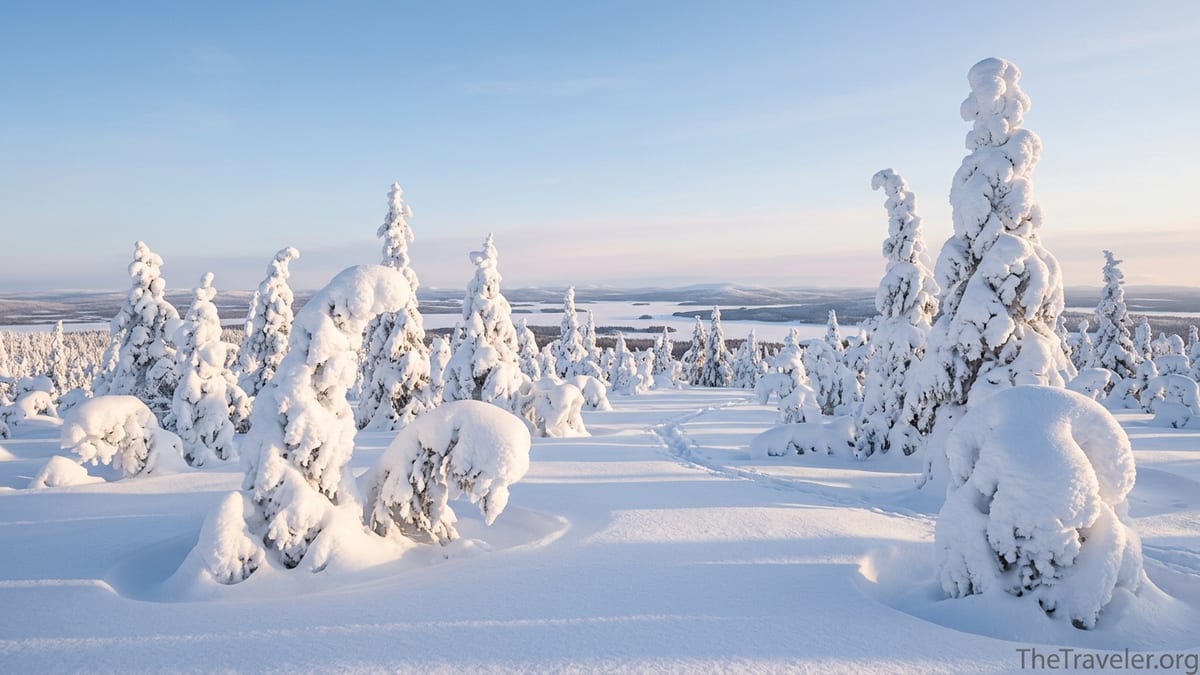
Riisitunturi National Park in Finnish Lapland has become a dream destination for hikers and photographers who want to see the famous snow-laden “snow monster” trees and wide views over the lakes of Posio. Whether you come for a short winter snowshoe loop, a summer sunset hike or a multi-day photography workshop, choosing the right tour and trail can make the difference between a rushed visit and a genuinely unforgettable Arctic experience.
Get the latest updates straight to your inbox!
Why Riisitunturi Belongs on Your Lapland Itinerary
Riisitunturi National Park sits in the municipality of Posio, roughly 40 to 50 kilometres from Kuusamo and about a two hour drive from Rovaniemi, which makes it an achievable day trip on most Lapland itineraries. The park is relatively compact compared with better known Lapland reserves, but concentrates much of what visitors come to the Arctic for: fell-top views, old spruce forest and in winter some of the most photogenic snow-covered trees in Finland.
The park is especially famous in winter when heavy rime forms on the spruces and turns them into sculptural white figures. This phenomenon draws both hobby photographers and international photo workshops, some of which base entire itineraries around sunrise and sunset shoots on the main fell of Riisitunturi. In summer and autumn the same hills offer long views over the Yli-Kitka lake region and colourful mires, with far fewer crowds than in more marketed resorts.
Access has improved in recent years, with a well maintained road from the main Posio–Tolva route leading to a large parking area and marked trails that start directly from the main entrance. Facilities at the trailhead are simple but practical: dry toilets, a café that opens in the main seasons and clear information boards about the routes and safety. For most visitors this infrastructure makes a self-guided hike perfectly feasible, while others appreciate the extra comfort of a guided tour with transport from towns like Rovaniemi, Kuusamo or Ruka.
Because winter weather in Lapland can be harsh and daylight limited, it is worth planning your routing in detail before you arrive. Many travellers combine Riisitunturi with ice climbing or canyon hikes in nearby Korouoma, or with skiing at Ruka, basing themselves for several days in Kuusamo or Posio to avoid too much time on the road.
How to Get to Riisitunturi and Choose a Base
The most common access points for Riisitunturi are Rovaniemi, Kuusamo, Ruka ski resort and the village of Posio. If you are flying in, Kuusamo Airport is the closest, roughly an hour’s drive from the park, while Rovaniemi Airport is around two hours away by car along main roads that are generally kept open throughout winter. Many travellers rent a car at the airport and drive themselves, as public transport into the park is limited and infrequent.
From Rovaniemi, one realistic pattern is to use the main road toward Kuusamo, then turn toward Posio and follow local signage for Riisitunturi National Park. Several local taxi companies in Kuusamo and Posio also run fixed price transfers; travellers report one way taxi fares from Kuusamo in roughly the 120 to 150 euro range for a private car, which can be cost effective for small groups splitting the cost. For those who do not want to drive on snow and ice at all, a guided tour that includes hotel pickup and return is usually the most straightforward option.
Your choice of base will influence the type of experience you have. Staying in Rovaniemi gives access to Santa-themed attractions and a city atmosphere but involves long driving days to reach Riisitunturi and back, especially in December and January when there are only a few hours of usable daylight. Basing in Kuusamo or Ruka means shorter transfers and the chance to combine your hike with downhill skiing or other winter sports. Posio itself is quieter but suits those who want a more rural feel and easier access to both Riisitunturi and Korouoma canyon.
If you are travelling in mid-winter and have no previous snow driving experience, consider booking at least one organized excursion. Several operators based in Rovaniemi and Kuusamo run Riisitunturi day trips that include all transport, guiding, snowshoes or spikes and a campfire lunch, allowing you to focus on the landscape rather than road conditions or navigation.
Signature Hiking and Snowshoe Routes Inside the Park
Most visitors experience Riisitunturi on one of the marked circular trails that start from the main parking area. The most popular is the Riisin Rääpäsy loop, a roughly 4 to 4.5 kilometre circuit that climbs steadily to the main fell before looping back through snow-buried spruce forest. Typical hiking time in dry summer conditions is around two to three hours, with greater variation in winter depending on snow depth and the number of photography stops you take.
For those with a little more time and fitness, a longer loop extends the basic route to around 10 kilometres, visiting additional viewpoints and mires. In summer and autumn, fit hikers sometimes link trails to create full day excursions of 12 to 15 kilometres, carrying picnic supplies and using the open wilderness hut or lean-to shelters for breaks. The elevation gain on most routes is in the order of a couple of hundred metres, which can feel more demanding in soft snow or high winds on the fells.
In winter, many visitors use snowshoes on the main loops. Local authorities maintain packed winter trails, but after fresh snowfall you may still be breaking a track if you arrive early in the day. Some commercial tours specifically market snowshoe excursions on the Riisin Rääpäsy route, typically describing it as suitable for people of average fitness who are comfortable walking slowly uphill. In contrast to some more alpine destinations, there are no technical passages, but cold, wind and slippery surfaces should not be underestimated.
There is also a longer cross-country skiing route through the wider Riisitunturi area, starting from near the village of Tolva and reaching the fell area after over twenty kilometres on skis. This is more of a local adventure than a typical visitor route and is best left to experienced skiers with proper equipment. For most first time visitors, the combination of a short or mid-length circular hike and time to photograph on the summit plateau is the ideal introduction to the park.
Best Guided Tours and Experiences to Book
If you prefer not to hike alone or do not plan to rent a car, taking a guided tour to Riisitunturi is often the simplest choice. Operators based in Rovaniemi, Ruka and Kuusamo advertise day trips that include return transport, guiding on the trail and usually hot drinks or a light lunch. Many of these tours run in small groups, with group sizes around eight people, and prices commonly fall in the 140 to 190 euro range per adult depending on group size, inclusions and departure point.
A typical example from Rovaniemi is a full day excursion that departs around 8 in the morning, drives approximately two hours to the park, then spends three to four hours on the Riisin Rääpäsy loop with photography stops, snowshoeing and a campfire lunch. The remainder of the day is taken by the return transfer, with guests usually back in the city by early evening. From Ruka or Kuusamo, similar tours may be shorter and cheaper simply because the driving distances are less.
Travelers who want a more personalized experience can book private trips with local wilderness guides. One operator based near Kuusamo offers a private snowshoe adventure in Riisitunturi where the pace and length of the route are tailored to the group. These tours appeal to families with children or visitors who are unsure about their fitness, as the guide can shorten the loop, skip viewpoints in poor weather or spend more time helping with photography. Prices for private tours vary widely, but for a small group of four the cost per person can compare reasonably with a regular group tour.
In addition to daytime hikes, some companies organize late afternoon and evening visits in mid-winter aimed at aurora hunters who want to photograph the Northern Lights above the sculptural trees. Because clear skies and auroras are never guaranteed, these experiences work best if you are in the area for several nights and can be flexible about your dates. Always check what is included: in the Arctic winter you will want high quality winter clothing, boots, hand warmers and tripod friendly time on location if serious photography is your priority.
Photography Highlights: Snow Monsters, Auroras and Seasons
Riisitunturi has become something of a pilgrimage site for winter landscape photographers, both Finnish and international. The heavy rime formations on the trees are the main draw, especially in January and February when the snow sculptures are usually at their most dramatic. During this period, several multi day workshops based in Lapland include Riisitunturi as a core location, with sunrise and sunset shoots on the fell combined with night sessions at nearby rapids or lakes.
For independent photographers, the key is timing. In deep winter the sun barely rises above the horizon, which creates long periods of soft pastel light rather than a single brief golden hour. Many photographers aim to be at or near the highest viewpoints of Riisin Rääpäsy at local midday, then work their way back down as the colours shift toward pink and blue. A wide angle lens in the 14 to 24 millimetre range is ideal for capturing the full shapes of the snow laden spruces, while a mid range zoom around 24 to 70 millimetres helps isolate individual “snow monsters” against the sky.
Beyond the famous winter look, Riisitunturi is quietly rewarding for photography in other seasons. In late September and early October the mires and forests glow with autumn colours while the first dustings of snow appear on the higher ground, creating subtle contrasts that appeal to landscape photographers who prefer quieter scenes. In summer, long evenings and the possibility of midnight sun style light make it easier to plan extended hikes that end with sunset views over the lakes without having to walk back down in full darkness.
Several specialist photography outfitters run Lapland itineraries that combine Riisitunturi with nearby national parks such as Oulanka. These workshops typically cater to enthusiasts who already understand the basics of manual mode and composition but want help finding the best locations and reacting to Arctic light. Prices for week long workshops in Finnish Lapland, including accommodation and guiding, often fall in the range of a few thousand euros, though flight costs are usually separate.
Practical Tips for Weather, Safety and Gear
Conditions in Riisitunturi can be challenging, particularly in winter. Even if the road to the park is clear and well ploughed, wind on the exposed fell tops can be severe and temperatures can drop well below freezing. Always check the forecast for Posio or Kuusamo before you set out and be prepared for windchill significantly lower than the air temperature. In December and January you may only have three to five hours of usable daylight, so plan your start and finish times conservatively.
Clothing should follow the classic layering concept: thermal base layers, warm mid layers such as fleece or wool and a windproof, waterproof shell. In mid winter, insulated trousers and jackets are strongly recommended, as are warm mittens with thin liner gloves underneath so you can handle camera controls without exposing bare skin for long. Footwear should have good insulation and space for thick wool socks. On the trails, lightweight spikes or snowshoes help significantly on icy or deep snow sections; many guided tours supply these as standard.
For self guided visits, bring a small daypack with water, high energy snacks, a thermos of hot drink and a basic emergency kit. Mobile coverage in the park is generally reasonable on the main fell but can be unreliable in low areas, so do not depend entirely on your phone. In winter it is helpful to carry a printed map or at least a downloaded offline map, as well as a headlamp in case your descent takes longer than planned. The marked routes are well signposted, but fresh snow can sometimes partly obscure trail markers.
Respecting the environment is important in Riisitunturi, particularly on the delicate mire and fell sections. Stick to marked trails even when snow coverage makes shortcuts tempting and use only designated campfire sites and lean-to shelters for hot meals. Firewood is often supplied at these sites but bring your own matches or lighter. In summer, insect repellent becomes essential in forest and mire areas, while in shoulder seasons you should be prepared for wet and muddy sections as snow melts or autumn rains arrive.
The Takeaway
Riisitunturi National Park offers one of the most accessible yet atmospheric introductions to Arctic landscapes in Finland. Its compact network of trails, clear signage and straightforward access from Kuusamo, Ruka and Posio make it suitable for first time visitors, while the sculptural winter trees and open vistas keep experienced hikers and photographers returning. Whether you join a fully guided day trip from Rovaniemi or Kuusamo, base yourself in a local cabin and hike independently or sign up for a week long photography workshop, you can shape the experience to your comfort and skill level.
If you are planning a Lapland trip focused on winter scenery, Riisitunturi deserves a place on your short list next to more famous locations. Allow enough time for weather changes, book at least one organized excursion if you are unsure about driving or snow travel and bring clothing and gear that match the season. With those basics covered, the park’s quiet trails, vast views and otherworldly snow sculptures will do the rest.
FAQ
Q1. How long does the main Riisitunturi hike take in winter?
The popular Riisin Rääpäsy loop is roughly 4 to 4.5 kilometres. In winter conditions most visitors spend around three hours walking and stopping for photos.
Q2. Do I need a guide to hike in Riisitunturi National Park?
No guide is strictly required as the main trails are well marked, but many visitors book a guided tour in winter for safety, transport and local knowledge.
Q3. What is the best month to see the famous snow covered trees?
The most reliable period for the dramatic “snow monster” formations is usually from early January to late February, though conditions vary by year.
Q4. Can I visit Riisitunturi on a day trip from Rovaniemi?
Yes, it is possible as a long day trip by rental car or organized tour, with about two hours driving each way, but you should plan carefully around limited daylight in mid winter.
Q5. Is snowshoeing necessary, or can I walk in normal winter boots?
On well packed trails you can often manage with sturdy boots and traction spikes, but after heavy snowfall snowshoes make walking much easier and are commonly used on guided tours.
Q6. Are there any facilities at the Riisitunturi trailhead?
At the main entrance you will find a parking area, information boards, dry toilets and in main seasons a simple café, plus nearby lean to shelters and campfire sites on the trails.
Q7. Is Riisitunturi suitable for children and less experienced hikers?
The shorter loop is manageable for families with school age children and adults of average fitness, especially in summer. In winter, cold, wind and snow depth can make it more demanding.
Q8. Can I camp overnight inside Riisitunturi National Park?
Finnish outdoor rules generally allow temporary camping, but most visitors use day hikes and open wilderness huts or lean to shelters rather than pitching tents on the fell in winter.
Q9. Will I see the Northern Lights from Riisitunturi?
You might, as the park is in a good aurora zone with dark skies, but clear weather and solar activity are never guaranteed, so plan several potential nights if auroras are a priority.
Q10. Do I need special permits or tickets to enter Riisitunturi?
No entry permit is required and access to the park and trails is free. You only pay for optional services such as guided tours, transport or equipment rental.