


I thought I understood what a standard Hol Chan and Shark Ray Alley snorkeling tour from Ambergris Caye involved. I had seen the photos of nurse sharks, read the breathless reviews and compared a few prices. Only once I was standing barefoot on the dock in San Pedro, watching our small boat pull in and the guide collecting marine-reserve fees in cash, did I realize how many practical details I had almost missed when booking. This is what my tour was really like, and what I wish I had known in advance.
Get the latest updates straight to your inbox!
Choosing an Operator and Understanding the Real Price
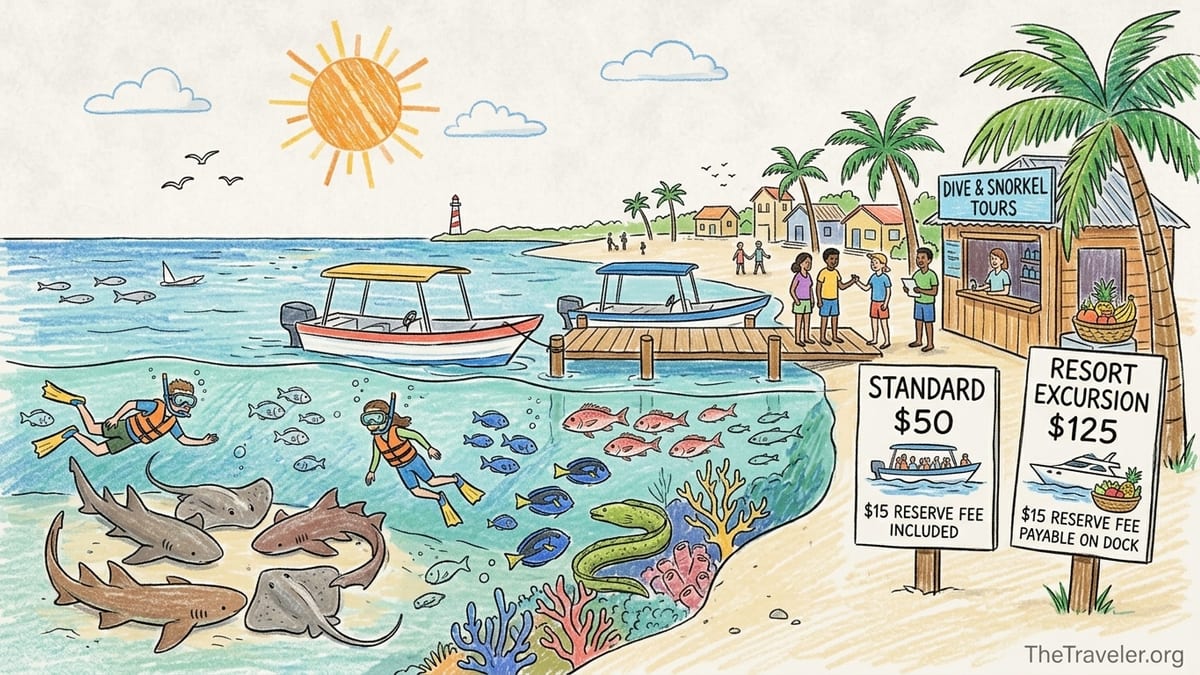
I based myself in San Pedro on Ambergris Caye, where almost every dive and snorkel shop sells some version of a Hol Chan and Shark Ray Alley trip. On paper, many of them look identical. In reality, the differences in price, what is included and how crowded you feel in the water are significant. A September 2026 market check found standard half-day Hol Chan and Shark Ray Alley snorkel trips advertised around 45 to 50 US dollars per person before the separate park fee, with some resort-based boats charging 80 to 125 US dollars plus the same fee. That wide spread matters if you are a couple or a family of four.
Before booking, I compared a classic town-based operator listing a 50 US dollar Hol Chan and Shark Ray Alley snorkel plus a 15 US dollar marine-reserve fee, against a resort tour at 125 US dollars per person plus the same 15 US dollars. Both visited the same two core sites and used similar 25 to 30 foot open skiffs. What finally pushed me toward a mid-range local operator was not just the base price but the way they spelled out the extras. Their page clearly stated that the 15 US dollar Hol Chan Marine Reserve fee was not included in the tour rate and had to be paid in cash on the dock, while another operator quietly added it in small print on a later screen.
Once I added everything up, the tour I chose came to 65 US dollars per person: 50 for the boat, guide and gear, 15 for the marine-reserve day pass. Other shops advertised 45 US dollars, but then charged the 15 US dollars fee and extra for fins or GoPro rental, which brought the total very close. The lesson: you cannot compare headline prices alone. Ask two precise questions before you commit: is the Hol Chan reserve fee included in this price, and is basic snorkel gear fully included or not.
I booked one day ahead in low season, directly at the operator’s small storefront just off the main beach road in San Pedro. In busier months, especially December through April, the staff told me they often fill a boat a few days in advance, so booking online or at least emailing a week out is smart if you are tied to specific dates.
Departure Dock, Boat Type and Group Size
My tour left from a central dock in San Pedro town, about a five-minute walk from the water taxi terminal. That location sounds trivial, but if you are staying north of the bridge, a trip to a town dock means budgeting 15 to 25 minutes in a golf cart each way or arranging resort pickup. Some resorts run their own boats from piers well north or south of town, which is convenient if you are staying with them, but you may pay more for the privilege.
The boat itself was a classic Belizean snorkel skiff around 28 feet long, with a sun canopy covering the center and open bow and stern. There were padded bench seats around the sides, a center rack for fins and life jackets and a small ladder on the stern. Importantly, our operator capped the group at ten snorkelers plus one guide and one boat captain. That felt manageable. I have seen other operators load 16 or more people onto similar-sized boats, which translates into more fins in your face once you are all following one guide in the Hol Chan channel.
At check-in on the dock, the staff weighed whether to send one or two boats by watching who actually showed up. In low season they told me they sometimes wait for at least six confirmed guests before running the tour, otherwise they may cancel or offer to move you to another operator’s boat. That is worth asking about when you book, especially if you are traveling during the quietest months of September and early October.
From the dock in town to Hol Chan Marine Reserve, the ride took roughly 15 minutes across mostly calm, shallow water inside the reef. The reserve lies about four miles south of San Pedro, so you are never very far from land, which matters if you are a nervous boater. Our captain slowed as we approached the ranger mooring, where all boats line up on fixed buoys so that no one is anchoring directly on the coral.
Gear Quality, Safety Briefing and Sea Conditions
One of my concerns before booking was whether I should bring my own mask and snorkel. Nearly every Ambergris Caye operator includes mask, snorkel and fins in the tour rate, and mine was no exception. On board, the gear was rinsed, labeled and sorted by size, but it was clearly shared equipment that had seen a lot of use. I was glad I had packed my own mask for a better seal, but I used their fins without issues. If you have unusual shoe sizes or are picky about fit, it is worth confirming fin sizes ahead of time or bringing your own set.
Before we even left the dock, our guide gave a safety and rules briefing. The key points: life jackets could be worn conventionally or strapped around the waist for extra flotation, we had to follow him in single file inside the Hol Chan channel, and we were not allowed to touch coral, stand on the bottom or harass any animals. At Shark Ray Alley specifically, he reminded us that nurse sharks and rays are wild but used to boats and bait in the water. He explained that feeding is regulated and only guides are allowed to handle the chum from the boat, not guests in the water, and that we were not to reach out to grab or ride anything.
Conditions on the day of my tour were what local operators described as “good but not perfect.” There was a modest easterly breeze, so a gentle surface chop, with visibility somewhere around 15 to 20 meters. Because Hol Chan is a natural cut in the reef, there is almost always some current running in or out with the tide. Our guide chose a route that drifted gently with the current rather than fighting it, which made the 40 to 45 minutes in the water feel surprisingly relaxed.
If you are prone to seasickness, the key detail is that most of the ride is inside the protective barrier reef, so you are not taking long, open-ocean swells. Still, I was glad I had eaten a light breakfast and taken basic motion-sickness tablets; a couple of people on board had skipped both and were clearly less comfortable once the boat turned side-on to the small waves near the reef cut.
Time in the Water at Hol Chan Marine Reserve
Once we tied up to the Hol Chan mooring, the guide split our boat into two water groups of five people each, one following him and one following the captain. That immediately reduced the feeling of crowding. It also lined up with the reserve’s rule of limiting the number of snorkelers per guide. Even so, we were sharing the overall site with at least five other boats at the same time, each with their own groups. You will not have Hol Chan to yourself on a normal morning or afternoon departure.
We spent about 45 minutes actually snorkeling inside the Hol Chan channel. The depth under us ranged from around six to ten meters, depending on where we were along the cut. The guides led us over coral ridges, along sand channels and out toward the drop where the outside of the barrier reef falls away. Because this is a strictly protected zone, the fish density was high: schools of blue tangs, sergeant majors, grunts and snappers were constantly in view. We saw a couple of hefty groupers hovering under ledges and a green moray eel sliding between coral heads.
The highlights for me were a slow-moving hawksbill turtle grazing on sponges and a pair of eagle rays gliding across the sand. The guide was careful to keep us at a respectful distance, but he did free dive down a couple of times to point out specific coral species and a camouflaged nurse shark resting under a ledge. Visually, it felt like snorkeling in an aquarium, just with real current and the occasional wave slop over my snorkel.
In terms of comfort, I never felt out of my depth at Hol Chan. I am a confident swimmer, but in our group of ten there were two people who clung to life jackets and took their time climbing down the ladder. The guide stayed very close to them, kept the group moving slowly and checked in verbally every few minutes. If you are nervous in the ocean, this is exactly the sort of guided, shallow site where you can push your comfort zone while still having a clear exit back to the boat ladder at any time.
Shark Ray Alley: Marine Life and How It Really Feels
Shark Ray Alley lies only a few minutes by boat from the Hol Chan channel, still inside the marine reserve. As we approached, I could already see two other boats idling on their moorings and, more dramatically, several dark shapes circling under the surface. The crew explained that nurse sharks and rays often gather around the sound of boat engines because they associate them with scraps from local fishermen and the regulated feeding that licensed guides are allowed to carry out from the boat.
Our guide tossed a small mesh bag of fish bits over the side to keep the animals’ attention near the stern while we prepared to get in. Within moments, a swirl of brown nurse sharks and southern stingrays were milling in the chum slick. Seeing ten or more nurse sharks, each up to around two and a half meters long, crowding each other within arm’s reach of the ladder was the one moment in the whole tour when my stomach tightened a little. It looked dramatic, much more intense than it felt once I actually slid into the water.
In the water, I realized that nurse sharks truly are the Labradors of the shark world: bulky, indifferent and focused on the fish scraps, not on the humans hovering respectfully to the side. The guide positioned us in a loose semicircle away from the heaviest feeding, which also gave the rays more room to glide between us. Their wings brushed past my legs a couple of times, which was startling but not aggressive. I never felt like anything was trying to bump or test me.
We spent about 30 minutes in the water at Shark Ray Alley. During that time, the initial frenzy at the surface died back into a calmer pattern of sharks cruising slowly along the sandy bottom and rays fanning over the seagrass. A few horse-eye jacks and snappers darted in to grab stray chunks of fish. Throughout, the guide repeated the same message: keep your hands to yourself, give the animals space and focus on observing, not posing for close-contact photos. I finished the stop exhilarated rather than scared. If you have a deep phobia of sharks, you might be happiest staying on the boat and watching from above, but for most people with healthy respect and a willingness to listen to instructions, it feels surprisingly safe.
What Was Included, What Was Not and Hidden Friction Points
The tour I booked included boat transport, guide, mask, snorkel, fins, purified water and a cooler with basic soft drinks. What it did not include was the 15 US dollar Hol Chan Marine Reserve fee, nor any snacks, beer or photography. Some higher-priced resort boats in the area do bundle the park fee into the advertised rate and add complimentary rum punch, fruit or even towels on board. Others keep the base rate low and then charge a menu of small extras: wet suit rental, GoPro use, or a separate hotel pickup if you are staying far from town.
The least obvious friction point was the marine-reserve fee itself. Current information in late 2026 shows the day-pass rate at 15 US dollars per non-resident adult for access to Hol Chan and Shark Ray Alley. Operators collect this on behalf of the reserve and then turn it over, so you do not pay anything separately at a ranger shack. Because this fee is standardized, it is the one fixed line item you can compare across all tours. Some operators wrap it into their published per-person price and call the package “all included,” while others put it as a separate line payable in cash on the day. When you price out options, you should always work with the total sum: tour rate plus the 15 US dollars reserve fee, not just the flashy headline.
Another detail that was not clear until I asked was the minimum and maximum numbers. My operator required a minimum of four paying guests to run a boat at the base price. If only two people showed up, they could either cancel or offer to take them out at a higher per-person cost. On the flip side, they capped each guide at around eight snorkelers in the water, in line with the reserve’s limits. That small-group policy is something worth paying extra for if you are sensitive to crowds, especially during peak season when some boats work right up to their maximum capacity.
Finally, while my tour’s timing and duration were as advertised, the precise order of stops and the amount of time in each spot were adjusted on the fly based on crowding and current. For example, on busier days some captains reverse the order and visit Shark Ray Alley first if Hol Chan looks packed with boats. That sort of on-the-day judgment is helpful for your experience, but it does mean you should treat the advertised timetable as a guide rather than a rigid schedule.
Booking Tips That Actually Matter Once You Are On Board
Having now done the tour, there are a few concrete booking choices I would make again. The first is choosing a morning departure. Our 9 am check-in meant we were tying up at Hol Chan while some of the later boats were still loading in town. By the time we were climbing back aboard after our 45 minutes in the channel, a fresh wave of skiffs was arriving, and you could see the water getting visibly busier. Many operators also offer an afternoon departure around 2 pm, which can be windier and choppier depending on the day.
Second, I would still favor an operator that publishes their group size cap and reserve-fee policy clearly, even if the base rate is a few dollars more. For example, I saw one resort excursion board advertising Hol Chan and Shark Ray Alley at 125 US dollars plus the 15 US dollars fee but promising no more than 10 people per boat, compared with a town shop that hinted at “large comfortable boats” with unspecified numbers. For a site where you are shoulder to shoulder with other snorkelers around a reef cut, fewer fins in the water makes a tangible difference.
Third, I would always confirm hotel pickup or meeting point details the day before. On Ambergris Caye, distances are short, but it still makes a difference whether you are walking five minutes from a central guesthouse or budgeting a 20-minute golf cart ride over the bridge from a quieter northern resort. In my case, I liked seeing the shop the day before, trying on a mask and double-checking payment options. Some operators accept cards for the tour rate but request the 15 US dollars park fee in cash, so bringing a bit of US currency or Belize dollars is wise.
Lastly, consider how snorkeling fits into the rest of your stay. Hol Chan and Shark Ray Alley are the signature spots close to Ambergris Caye, but they are not the only ones. If this is your very first time putting on a mask, you might want to do this tour early in your trip while you still have the option to book another half-day to Mexico Rocks or Coral Gardens later if you catch the bug.
The Takeaway
My Hol Chan and Shark Ray Alley snorkeling tour from Ambergris Caye delivered exactly what the glossy photos promise: clear water, dense coral, turtles, rays and a crowd of surprisingly mellow nurse sharks. What I had not appreciated beforehand were the small decisions that shaped how relaxed the day felt: choosing a boat that limited group size, understanding how the 15 US dollars marine-reserve fee was handled and confirming what gear and drinks were actually included.
If you are planning your own trip, assume a realistic all-in cost of around 60 to 70 US dollars per person for a standard half-day Hol Chan and Shark Ray Alley snorkel from San Pedro in late 2026: roughly 45 to 50 US dollars for the tour itself plus the mandatory 15 US dollars park fee. You can pay more for resort comforts or private charters and less if you find a straightforward local outfit, but everyone works within that same structure.
Most importantly, know that you do not need to be a fearless shark lover or a triathlete to enjoy this experience. With a competent guide, a life jacket and a willingness to follow instructions, Hol Chan offers an accessible entry into Belize’s reef world and Shark Ray Alley delivers the kind of “I cannot believe I just swam with sharks” memory that sticks long after your mask is dry and your feet are back on the dock in San Pedro.
FAQ
Q1. How much does a Hol Chan and Shark Ray Alley snorkeling tour cost from Ambergris Caye in 2026?
The most commonly advertised half-day boat tours from San Pedro were around 45 to 50 US dollars per person for the operator’s service, plus a separate 15 US dollars Hol Chan Marine Reserve fee. Some resort-based and premium tours charged 80 to 125 US dollars plus the same 15 US dollars fee, often with extras like drinks or towels.
Q2. Is the Hol Chan Marine Reserve fee included in the tour price?
It depends on the operator. Some clearly state that the 15 US dollars marine-reserve fee is not included and must be paid in cash on the day, while others bundle it into a higher advertised rate and call the trip “all included.” You should always ask whether the 15 US dollars fee is already in the price or will be added separately.
Q3. What kind of boat and group size should I expect?
Most tours from San Pedro use open skiffs of roughly 25 to 30 feet, with bench seating and a sun canopy. On my tour there were ten guests plus a guide and captain, split into two water groups of five, which felt comfortable. Other operators may put 12 to 16 people on a similar boat, so checking maximum group size is worthwhile.
Q4. How long do you actually spend snorkeling at Hol Chan and Shark Ray Alley?
On my half-day trip we spent about 45 minutes in the water at Hol Chan Marine Reserve and roughly 30 minutes at Shark Ray Alley, plus the short boat rides between town, Hol Chan and the alley. Some operators add an extra stop at a shallow reef or seagrass bed, which can add another 30 minutes of snorkeling.
Q5. What marine life did you personally see on the tour?
At Hol Chan I saw schools of reef fish, a hawksbill turtle, a couple of eagle rays, one resting nurse shark and a green moray eel among the coral. At Shark Ray Alley we were in the water with a dozen or more nurse sharks, several southern stingrays and a cloud of jacks and snappers feeding on scraps near the boat.
Q6. How safe does it feel to be in the water with nurse sharks and rays?
I felt surprisingly comfortable once I was in the water. The nurse sharks were focused on the fish scraps, not on us, and the rays glided past without showing any aggression. Our guide kept us slightly away from the main feeding area, reminded us not to touch anything and watched the group closely, which made the experience feel controlled rather than risky.
Q7. Do I need to bring my own snorkel gear?
Most Ambergris Caye operators include mask, snorkel and fins in the tour price, and my boat did too. I still brought my own mask for a better fit and used their fins. If you have a sensitive fit, unusual shoe size or simply prefer your own gear, bringing at least your mask and snorkel is a good idea.
Q8. Are drinks and snacks provided on the boat?
On my tour, drinking water and basic soft drinks were included, but no snacks or alcohol. Some higher-priced resort tours offer fruit, snacks and rum punch, while budget tours may only provide water. If food matters to you, ask exactly what is included or bring a small snack of your own.
Q9. How crowded are Hol Chan and Shark Ray Alley in practice?
Even in shoulder season, there were several boats tied to the Hol Chan moorings at the same time, and Shark Ray Alley had at least two other boats while we were there. It did not feel unmanageable, but you are definitely sharing the space. Choosing a morning departure and an operator that limits group size helps reduce the sense of crowding.
Q10. When is the best time of day to snorkel Hol Chan and Shark Ray Alley?
I chose a morning departure around 9 am and would do so again. The sea was calmer, the sun high enough for good visibility and we reached Hol Chan before some of the later boats. Afternoon trips are also popular but can be windier and sometimes busier, depending on the season and day of the week.