


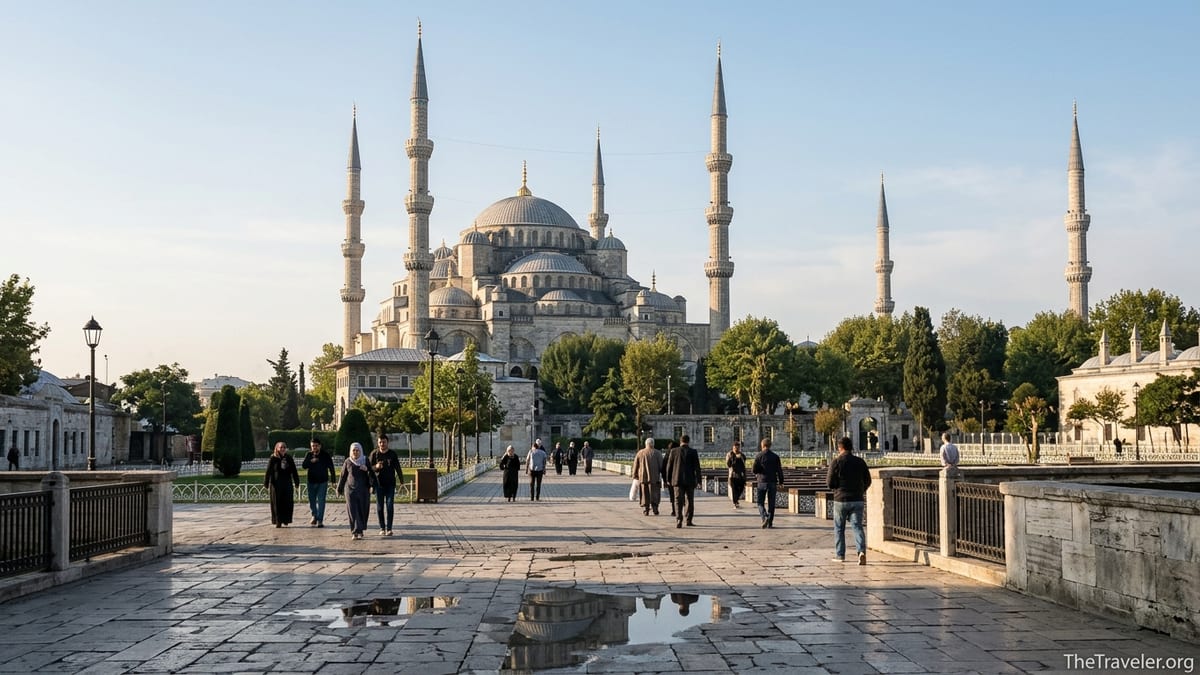
Visiting the Blue Mosque in Istanbul can be one of the most moving moments of a trip to Türkiye, but timing your visit matters. As an active place of worship, Sultanahmet Camii closes to tourists several times a day for prayers and can see heavy tour‑group traffic in between. With a little planning around daily prayer times, weekday patterns and seasons, you can step inside this landmark with minimal waiting and a quieter, more respectful atmosphere.
Get the latest updates straight to your inbox!
Understanding How the Blue Mosque’s Hours Really Work
The Blue Mosque operates first and foremost as a working mosque. Official visitor hours, as listed on recent local guides and the mosque’s own information boards, generally run from about 08:30 in the morning until late afternoon or early evening for non‑worshippers. On a typical Monday to Thursday this often means roughly 08:30 to 17:30, on weekends until about 18:00, and on Fridays opening to visitors only after the main congregational prayer, usually around 13:30 or slightly later. These windows are then interrupted several times a day for prayers, when tourist access to the main prayer hall stops.
Crucially, visitor access is usually paused before and during each of the five daily prayers. In practice this means that around the times of noon (Dhuhr), mid‑afternoon (Asr), sunset (Maghrib) and night (Isha) prayers, entrance for tourists is halted for roughly 30 minutes, sometimes a little more if the mosque is crowded. Early‑morning Fajr, often just before or after sunrise, falls outside regular visitor hours, so it rarely affects tourists. What you experience on the ground is that security staff and mosque attendants will simply stop the queue and redirect tourists away from the main entrance as worshippers begin to arrive.
These closures are not fixed to the clock in the way museum hours are, because prayer times shift slightly every day based on the position of the sun. For example, on a typical June day in Istanbul, noon prayer may be around 13:15, while in January it might be closer to 13:00. Sunset prayer in high summer can be closer to 21:00, well after the mosque has closed to visitors, but in winter it falls in late afternoon. The practical lesson for visitors is that the exact closure minutes change with the season; you need to check the day’s prayer times for Istanbul shortly before your visit and allow a buffer.
It is also worth remembering that restoration works that disrupted visits for years finished in 2023, so as of 2026 visitors usually see the interior free of large scaffolding. That has brought visitor numbers back up. On a peak summer afternoon, it is normal to see a queue snaking across Sultanahmet Square, while on a cold February weekday you might simply walk up to the security check with no line at all.
Daily Prayer Times and What They Mean for Your Schedule
To avoid being turned away at the gate, you need a basic sense of the daily rhythm of Muslim prayer times in Istanbul. There are five obligatory prayers: Fajr (dawn), Dhuhr (midday), Asr (afternoon), Maghrib (just after sunset) and Isha (night). Official prayer schedules for Istanbul, which many mosques follow, are published by national religious authorities and updated daily. You can see the same times mirrored on local news sites and prayer‑time apps. The Blue Mosque follows these timings closely.
For a visitor, the two most disruptive closures are typically Dhuhr and Asr, because they fall squarely in sightseeing hours. On a spring day, Dhuhr might be just after 13:00 and Asr around 16:30. The mosque will usually start restricting tourist entry a short while before the call to prayer, allowing worshippers to enter and settle. If you reach the entrance at 12:55 aiming for a quick look around before a 13:00 Dhuhr, you will almost certainly be held outside and asked to come back later. Similarly, if you arrive at 16:20 on a busy day, you may find guards waving the queue away.
Maghrib and Isha matter mainly in the shorter winter days. In December, sunset in Istanbul is around 17:00, and Maghrib may fall just when many visitors are still out. Since official visiting hours usually end in the late afternoon or early evening, the staff may bring forward last entry so they can clear the prayer hall for worshippers. If you are only in Istanbul for a day or two in winter, a common mistake is to plan the Blue Mosque “just before dusk” without checking when sunset and Maghrib fall. You can easily find yourself walking up as the last non‑worshippers are being ushered out.
In practical terms, use any reliable Istanbul prayer‑times listing or app the day before your visit. Look at the times for Dhuhr and Asr especially, then build a simple plan: aim to enter the mosque at least 45 to 60 minutes before Dhuhr if you prefer a late‑morning slot, or at least one hour after Dhuhr has finished if you are coming in early afternoon. This gives you a comfortable margin for queues and security checks even on a busy day.
The Quietest Windows: Best Hours on a Typical Day
Across multiple recent local guides and first‑hand trip reports, one pattern repeats: the calmest visiting window is on a weekday morning, shortly after the mosque opens to visitors. Arriving between about 08:30 and 10:00 on a Tuesday, Wednesday or Thursday almost always means smaller crowds, shorter queues and a more contemplative atmosphere. Many large tour groups leave their hotels later and tend to converge on Sultanahmet Square from mid‑morning onwards, often between 10:30 and 11:30, then again in early afternoon.
For example, a visitor staying in Karaköy who takes the T1 tram at 08:15 on a Wednesday in May can be walking across Sultanahmet Square by 08:30 and inside the courtyard by 08:40. At that hour the security line is usually just a few dozen people. Inside the mosque, you may find school groups and a handful of early tour groups, but it is often quiet enough to stand in the center, look up to the main dome and actually hear the soft murmur of individual visitors rather than a constant roar of voices.
A second relatively calm slot is the later afternoon lull between Asr and the practical end of visiting hours. In summer, when the mosque stays open later, arriving around 16:30 to 17:00 on a non‑Friday can work well, provided you are not clashing with Asr itself. For instance, in July Asr in Istanbul is often after 17:00, so the late‑afternoon strategy becomes less useful. In shoulder seasons like April or October, though, many tour buses have already moved on to the Grand Bazaar or to evening Bosphorus cruises by 16:30. You may find the interior still busy but less frenetic compared to right after lunch.
By contrast, the most crowded moments tend to be mid‑morning between 10:30 and 12:30 and early afternoon between about 13:30 and 15:30. These are the hours when multi‑stop guided tours of Sultanahmet usually tackle both the Blue Mosque and Hagia Sophia in quick succession. If you stand at the edge of the Hippodrome late on a June morning you will often see a long line curling from the mosque gates, with guides holding umbrellas or colored signs and groups queuing shoulder to shoulder. If your priority is a calmer visit rather than simply “ticking off” the site, those are the time bands to avoid.
Fridays, Ramadan and Other Special Days
Friday is the main congregational prayer day in Islam, and that changes how the Blue Mosque operates. On Fridays the mosque typically remains closed to tourists through the morning and only opens to non‑worshippers after the main midday prayer is complete and the congregational crowd has thinned. In practical terms, this often means no tourist access until early or mid‑afternoon, around 13:30 or later. Some visitors in recent years have reported first tourist entry a little after 14:00, depending on the season and crowd size.
If you are in Istanbul for several days, it is usually simpler to schedule your Blue Mosque visit on a non‑Friday. That lets you use the prime early‑morning window and avoid any uncertainty about when the building will reopen after prayers. If your dates are fixed and you can only go on a Friday, plan to spend your morning at other nearby sights that are open, such as the Basilica Cistern, the Archaeology Museums or the Grand Bazaar, and then walk to the Blue Mosque in the mid‑afternoon after checking the posted reopening time that day.
Ramadan brings its own rhythm. The mosque remains open to tourists during Ramadan, but visiting hours can be adjusted and crowds behave differently. Late afternoons can become busier with local families and groups arriving early for evening prayers and for iftar, the fast‑breaking meal. You might find that mid‑morning remains the most comfortable time for a quiet visit, while late afternoon and the hour leading up to sunset feel more intense, with more worshippers moving in and out and more community events taking place around Sultanahmet Square.
Public holidays in Türkiye, including national religious holidays like Eid, can also affect visitor density. On some days, Istanbul residents from other districts come into the historic center with relatives, meaning that a random Tuesday during a holiday week can feel more crowded than a normal Saturday. If your trip overlaps with major holidays, combine the standard timing advice with local observation: if you wake up and see large family groups already filling Sultanahmet Square in the morning, treat that day as if it were a summer weekend and lean even more heavily on the earliest possible entry time.
Seasonal Patterns: When in the Year to Go
The best time of day to avoid prayer closures does not change with the month, but the overall crowd levels do. Istanbul’s peak tourist season runs roughly from June to August, with a second busy wave around late April to early May and again in late September when European school holidays and pleasant weather coincide. During these periods, even the early‑morning window can see moderate lines. If you plan to visit the Blue Mosque in July, for instance, you should treat 08:30 as “on time” rather than “early” and arrive a few minutes before the official visitor opening if possible.
By contrast, winter months from November through February can feel transformed. Cold, rainy days and shorter daylight mean fewer large tour groups, and independent travelers can often stroll up with minimal waiting outside of prayer times. A traveler visiting in late January who walks over from a hotel in Sirkeci at 10:00 on a Tuesday may encounter only a handful of people ahead at security and may be able to linger longer under the main dome without feeling jostled. The trade‑off is that interior light is dimmer, and exterior photos of the courtyard may look moodier under low clouds.
Shoulder seasons such as March, April and October strike a balance that many visitors appreciate. Daytime temperatures are comfortable for the modest dress code, and the number of buses in Sultanahmet Square is usually lower than in high summer. In these months, combining an 08:30 Blue Mosque visit with a late‑morning stop at Hagia Sophia or the Basilica Cistern can make for a full but not overwhelming day. You still want to respect midday Dhuhr closures, but you have more flexibility to move between sites without the sense of constant crowd pressure.
Another subtle seasonal factor is how changing daylight shifts prayer times. In June, with long evenings, sunset and night prayers fall later, so late afternoon remains part of the visitor window. In December, when dusk comes early, visiting late in the day risks bumping into Maghrib preparations. As you plan, check not only the date of your visit but also sunrise and sunset for that week in Istanbul to understand how much of the late‑day period will realistically be open to tourists.
Designing a One‑Day Itinerary Around the Blue Mosque
One of the easiest ways to avoid both prayer closures and thick crowds is to anchor your old‑city day around the Blue Mosque and then build the rest of the itinerary around it. A common strategy is to start your morning there and work outward. For example, if you are staying near Taksim, you might leave at 07:45, take the funicular and tram to Sultanahmet and aim to reach the mosque by 08:20. After a quick security check at opening, you spend 40 minutes inside the prayer hall, step back out into the courtyard by 09:15 and are crossing the square to Hagia Sophia before most tours have assembled.
From there, you could plan the Basilica Cistern or the nearby Hippodrome obelisks for late morning, then an early lunch on a side street away from the main tourist strip around Divanyolu Caddesi. By timing the Blue Mosque first, you not only experience it in relative calm but also insulate yourself from the risk that a long line or prayer‑time closure will derail your entire day. If you instead leave it for mid‑afternoon, you may arrive after 15:00, find an unexpected queue and lose an hour of precious sightseeing time just when your energy is lowest.
Another practical tactic is to pair your Blue Mosque visit with a flexible activity for the next slot. For instance, you could plan to visit the mosque around 14:00 on a quiet Wednesday in March, after Dhuhr has ended, and then keep the rest of the afternoon open for strolling through Gülhane Park or exploring the Grand Bazaar. If you reach the mosque and discover that, on that particular day, tourist entry will be paused again soon for a special prayer or event, you can simply reverse the order: enjoy the park or bazaar first and return to the mosque an hour or two later.
Families with children or older travelers might favor an even earlier visit to minimize both temperature and crowd stress. In July, tackling the mosque first thing not only avoids the bulk of tour groups but also the midday heat that can make the required clothing layers uncomfortable. You can then retreat to shaded museum interiors or even your hotel for a rest in the hottest hours, returning to the historic core in the evening for dinner with views over the Sea of Marmara.
On‑the‑Ground Tips for a Smooth, Respectful Visit
Even with the perfect time of day in mind, your experience at the Blue Mosque will depend on how you move through the space. Dress modestly before you arrive rather than relying on loan garments at the entrance, as queues for headscarves and wraps can add unexpected waiting time. As of 2026, women are expected to cover their hair, shoulders and knees; men should avoid shorts above the knee and sleeveless tops. Light cotton or linen trousers and a scarf packed in your day bag are simple ways to comply in summer without overheating.
Security screening is similar to entering a small airport: you pass bags through an X‑ray machine and walk through a scanner. During peak season this is the main bottleneck. Arriving five or ten minutes before the posted opening time can mean being in the first wave through the scanner and buying yourself a precious few minutes inside before the hall fills. There is no admission charge, so you do not need to budget extra time for ticket windows, which is a welcome contrast with nearby sites that have separate ticketed sections.
Once inside, being mindful of where you stand helps maintain both your own comfort and respect for worshippers. The front area closest to the mihrab and minbar is primarily for prayer and may be roped off during busy times. If you see visitors sitting quietly along the sides of the prayer hall, follow their example instead of clustering near active prayer areas. If a call to prayer begins while you are inside, staff may ask tourists to move to the back or exit the hall; comply promptly and use the moment to take in the courtyard views while worship proceeds.
Finally, be cautious of anyone outside the mosque who insists that it is “closed for hours” and tries to lead you elsewhere for a “special view” or “museum visit.” Recent travelers have reported individuals using prayer‑time closures as a pretext to steer tourists toward overpriced carpet shops or unofficial tours. The most reliable indicator is the official information board at the mosque gate and the uniformed staff directing the line. If in doubt, check the prayer times on your phone and speak to the security officers directly rather than following unsolicited guides.
FAQ
Q1. What is the single best time of day to visit the Blue Mosque to avoid crowds?
Early on a weekday morning, ideally between about 08:30 and 10:00 on Tuesday, Wednesday or Thursday, usually offers the quietest experience.
Q2. How can I avoid getting caught by prayer‑time closures?
Check daily Istanbul prayer times for Dhuhr and Asr, then plan to enter at least 45 to 60 minutes before Dhuhr or at least an hour after it, leaving buffer time for queues.
Q3. Is it a bad idea to visit the Blue Mosque on Friday?
If you have flexibility, choose another day, because Friday mornings are closed to tourists and the reopening time after congregational prayers can vary, leading to more uncertainty and crowds.
Q4. Are evenings a good time to visit the Blue Mosque?
In summer, late afternoons before closing can be pleasant if they do not clash with Asr, but by evening the mosque is focused on worship and visitor access is limited or closed.
Q5. Does Ramadan change the best time to visit?
Yes. The mosque can be busier late in the day as worshippers gather before sunset, so mid‑morning usually becomes the most comfortable time for tourists during Ramadan.
Q6. How long should I allow for a visit if I want to avoid feeling rushed?
Plan about 60 to 90 minutes total in your schedule, which covers a possible queue, security screening and 30 to 45 minutes inside the mosque itself.
Q7. Can I visit during a prayer if I stay in the back quietly?
No. During formal prayer times the main hall is reserved for worshippers; tourists are normally asked to leave or wait outside until the prayer finishes.
Q8. What is a good way to combine the Blue Mosque with other sights in one day?
Many visitors go to the Blue Mosque at opening, then walk across to Hagia Sophia, continue to the Basilica Cistern and finish with Topkapı Palace or the Grand Bazaar.
Q9. How far in advance do I need to check prayer times before my visit?
The day before or the morning of your visit is enough, since prayer times shift by only a minute or two each day; use those times to fine‑tune your plan.
Q10. Is there any entrance fee or ticket that affects timing?
No. Entry to the Blue Mosque itself is free, so your main timing considerations are prayer‑time closures, security queues and general crowd levels rather than ticket lines.