


The Oslo Opera House is one of Scandinavia’s most striking buildings and home to the Norwegian National Opera & Ballet. For many visitors, simply walking its sloping marble roof is a trip highlight. Yet the experience becomes far richer when you step inside for a performance or join a guided tour that reveals the architecture, backstage machinery, and working life of Norway’s largest performing arts institution. This guide explains, in practical terms, the best ways to book Oslo Opera House performances, tours, and visits so you can make the most of your time in Oslo.
Get the latest updates straight to your inbox!
Understanding the Oslo Opera House Experience
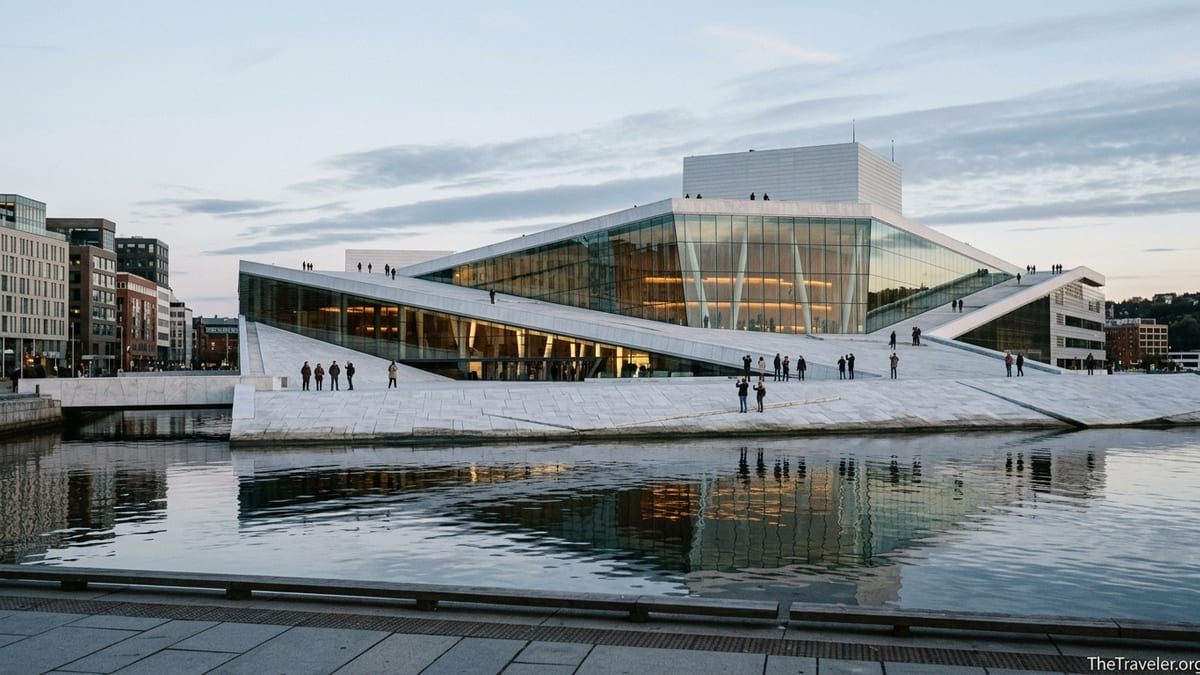
The Oslo Opera House sits right on the Oslofjord in the Bjørvika district, with an angled white roof that rises directly from the water and invites visitors to walk up and enjoy the view. You can access the roof and the public foyer without any ticket at all, which makes the building both a cultural venue and a public space that locals use daily. Many travelers first encounter it while strolling the waterfront boardwalk from the central station.
Inside, the building houses the Norwegian National Opera & Ballet, with a main auditorium of around 1,360 seats, a smaller second stage, and an intimate studio. The interior is clad in warm oak, with a horseshoe-shaped main hall that recalls classic European opera houses, but with state-of-the-art stage technology behind the scenes. Guided tours allow visitors to peek into workshops and rehearsal areas, which you cannot see on a casual walk-in.
Because the Opera House functions both as a landmark and a working theater, there are three distinct ways to experience it. You can explore the roof and foyer freely, you can book a guided tour that focuses on architecture and backstage life, or you can attend an evening performance of opera, ballet, or a concert. Each option has a different booking strategy, cost level, and timing to consider.
Most visitors combine at least two of these experiences. For example, a traveler on a weekend city break in July might visit the roof in the afternoon, join an English-language guided tour around 4 pm, then return in the evening another day for a ballet performance. With some advance planning and smart booking, it is relatively easy to secure good seats and tour spots at reasonable prices compared with other European capitals.
Booking Opera & Ballet Performances
The most immersive way to experience the Oslo Opera House is to attend a live performance by the Norwegian National Opera & Ballet. The season typically runs from early autumn to late spring, with a somewhat lighter schedule in July and August. The repertoire mixes classic titles like La Traviata and Swan Lake with contemporary Norwegian works and occasional large-scale concerts.
Tickets are usually released in seasonal batches, so travelers planning a trip months ahead should first check what is playing during their dates and then book as soon as their plans are fixed. Prices are moderate by European standards because the institution is heavily subsidized. As a rule of thumb, you can expect budget seats in the upper tiers to start around the low hundreds of Norwegian kroner, with prime stalls seats in the front rows running closer to four figures in kroner. For example, it is common to see entry-level prices around 250 to 350 NOK for restricted-view or upper gallery seats and 900 to 1,100 NOK for the best central stalls on high-demand nights.
When choosing seats, consider both acoustics and sightlines. The main auditorium’s horseshoe design means that side balcony seats can offer excellent sound but sometimes a partial view of the stage. A visitor on a tighter budget might choose a side balcony seat for an opera where sound is more important than visuals, while allocating a bit more for ballet, where a clear view of the dancers’ feet matters. Travelers with mobility concerns should look for designated accessible seating, which is clearly labeled during the booking process and can also be arranged with the box office by phone or in person.
Flexibility is your friend if you want to keep costs down or find last-minute tickets. Midweek performances tend to be easier to book than Friday or Saturday nights, and matinees are often less crowded. If a main-title opera is sold out online, some visitors queue at the box office on the day for returned tickets. This works best outside peak holiday weekends or for less hyped productions. If your Oslo stay is short and you are set on a specific show, secure tickets well in advance rather than relying on same-day availability.
How to Reserve Official Guided Tours
The Opera House offers official guided tours in Norwegian and English that typically last around 50 to 60 minutes. These tours go beyond the public foyer and may include backstage corridors, side stages, and sometimes glimpses of rehearsal spaces, depending on production schedules. Because this is a working theater, the route can change at short notice if rehearsals or technical work require areas to be closed.
Booking these tours directly with the Opera House is usually the most reliable option, especially in high season. On the official platform, you can see dates, languages, and time slots, often a few weeks ahead. In recent seasons, English tours have commonly been scheduled on multiple days per week, often in the afternoon. Prices have tended to sit in the broad range of roughly 150 to 200 NOK for adults, with reduced rates for children and, at times, discounts for holders of local city passes.
To secure a place, it is wise to book a few days to a couple of weeks in advance, particularly for weekend slots. For instance, if you are visiting in late July and want a Saturday tour, you might find that the most popular afternoon times sell out several days early, especially when cruise ships are in port. On weekdays outside school holidays, you may still find same-day availability in the morning or early afternoon, but relying on walk-up bookings alone is risky if the tour is a priority for your trip.
Group and private tours can often be arranged in additional languages such as German, French, Italian, or Finnish through direct contact with the Opera House or via specialized tour operators. These arrangements are popular with conference groups or multi-generational families who want a more tailored pace. Prices for private tours vary by group size but typically work out to be reasonable per person if you are a party of eight or more. It is essential to arrive at least 15 minutes before your scheduled time; late arrivals may shorten the tour rather than delaying the schedule.
Combining the Opera with City & Fjord Tours
Many visitors experience the Opera House as part of a broader city sightseeing program. Several hop-on hop-off bus services and walking tours include a stop by the Opera, pointing out its glacier-like architecture and roof access. These tours are useful if you have limited time and want a quick introduction to the building’s exterior and its role in the redevelopment of the Bjørvika waterfront.
For example, a traveler arriving by cruise ship might join a half-day city tour that stops at key sights like the Viking Ship Museum area, Vigeland Park, and the Opera House. The bus drops participants near the main plaza, allowing 20 to 30 minutes to walk on the roof and photograph the fjord views. While this gives a good overview, it does not replace an internal guided tour or a performance, so many cruise passengers book a separate Opera visit on a different day.
Another popular option is to combine a harbor or fjord cruise with time at the Opera House. Some tour companies package a short boat trip around the Oslofjord islands with walking time at the Opera or passes on local public transport. A realistic example might be a two-hour fjord sightseeing cruise in the late morning, followed by lunch in the nearby Bjørvika district and a 3 pm guided tour inside the Opera House. This sequence allows you to experience the building from the water first and then explore its interior in depth.
If you prefer a more independent approach, consider a self-planned architecture walk. Start at Oslo Central Station, cross the pedestrian bridge to the Opera House, explore the roof and foyer, and then continue along the waterfront toward the Munch Museum and the new library. You can time this around a pre-booked Opera tour or evening performance, using public trams and buses to return to your hotel afterwards.
Choosing Between Third-Party Tours and DIY Visits
Travelers face a common choice: book an Opera House visit through a third-party platform or arrange everything directly. Both approaches can work well, but each comes with trade-offs. Third-party platforms and city sightseeing companies sometimes bundle Opera tours with other attractions or transport, which can be convenient if you like having a single booking. However, the Opera-specific portion of these packages usually still draws on the Opera House’s own guided tours or on external guides who do not have the same backstage access as the official staff-led tours.
If your priority is to access behind-the-scenes areas and get detailed information from guides who work closely with the institution, booking the official guided tour is typically the better choice. This is especially true for theater and architecture enthusiasts. On the other hand, if you want a general overview of central Oslo with a stop at the Opera roof and a photo opportunity, a walking tour or bike tour that swings by the building may be sufficient.
DIY visits remain the most flexible and budget-friendly option. Since walking on the roof and entering the foyer are free, a traveler watching costs closely can still enjoy the architecture without paying anything. You might, for example, arrive just before sunset on a clear autumn evening, climb to the top of the roof for panoramic city views, then come back the next day for a coffee in the foyer cafe while watching rehearsal activity through the large windows. You can add a paid guided tour only if you decide the building merits deeper exploration.
Families and small groups often mix approaches. A couple on a short weekend break might book tickets for a Saturday night opera performance directly and then join a general city tour that briefly stops at the Opera roof as part of a larger itinerary. A family with teenagers, on the other hand, may prioritize a daytime backstage tour and skip a full-length opera performance if they are unsure the younger travelers will enjoy a multi-hour show in the evening.
Practical Tips on Timing, Seasons, and What to Expect
Timing matters for both tours and performances. On performance days, the building becomes noticeably busier from late afternoon onward, as audiences arrive, wardrobe and stage crews ramp up, and the foyer fills with people. If you prefer a quieter visit, aim for late morning or early afternoon on a non-matinee weekday. Guided tours are often scheduled to avoid direct overlap with peak rehearsal windows, but last-minute route changes are common to accommodate the artistic program.
The season of your visit also shapes the experience. In winter, the roof can be icy or partially closed for safety, so access may be limited even though the building remains open. Inside, performances continue, and the warm wooden interiors create a sharp contrast to the cold outside. In summer, long daylight hours make late-evening visits to the roof particularly memorable; you can sometimes walk up after an evening performance and look out over the fjord in lingering twilight.
Arrive early for both tours and performances. For a performance, arriving 30 to 40 minutes ahead gives you time to pick up or print tickets if needed, check coats, browse any program notes, and find your seat. Latecomers are usually held outside until a suitable pause in the music or between scenes, which can mean missing a substantial portion of the first act. For guided tours, many operators and the Opera House itself request that visitors meet 15 minutes in advance by a clearly marked point in the foyer, which allows time for security checks or group organization.
Dress codes are flexible. While some Norwegians dress up for premieres or special gala evenings, smart casual clothing is generally acceptable for most performances. Comfortable footwear is helpful for tours, since you may walk through long backstage corridors or stand for parts of the explanation. Photography is usually permitted on the roof and in the foyer, but restrictions often apply inside the auditorium during rehearsals or performances, so always follow staff instructions.
The Takeaway
Experiencing the Oslo Opera House properly is less about spending a lot and more about planning smartly. The building itself is free to enter, the roof is open to all, and performance tickets are relatively affordable compared with many European capitals. By combining a well-chosen performance with an official guided tour, you gain both the emotional impact of live opera or ballet and a deeper understanding of the architecture and backstage craft that make those performances possible.
The best booking strategy starts with your priorities. Culture lovers may want to secure prime seats for a flagship opera months in advance, then add a daytime tour on a quieter weekday. Budget-conscious travelers can stick to upper-tier seats or off-peak performances and still enjoy excellent acoustics. First-time visitors with only a short stop in Oslo might focus on the roof walk and foyer, perhaps complemented by a city tour that includes the Opera as a highlight.
Whatever your approach, build in extra time to simply inhabit the space: to stand on the marble roof with the fjord at your feet, to watch craftspeople and artists moving through the glass-walled foyers, and to feel how this modern building has become a central gathering place for the city. With thoughtful booking and realistic expectations about timing and availability, your visit to the Oslo Opera House can easily become the most memorable moment of your stay in Norway’s capital.
FAQ
Q1. Do I need a ticket to walk on the roof of the Oslo Opera House?
You do not need any ticket to walk on the roof. The sloping marble roof is public space and usually open at all hours, although access can be restricted in icy winter conditions for safety.
Q2. How far in advance should I book tickets for an opera or ballet performance?
For popular titles and weekend shows, it is sensible to book several weeks to a few months in advance, especially in peak travel periods. Midweek performances and less famous productions often have availability closer to the date, but relying on last-minute tickets is risky if your schedule is tight.
Q3. What does a typical guided tour of the Opera House include?
A standard guided tour usually lasts about 50 to 60 minutes and covers the main foyer, architectural highlights, and selected backstage areas such as side stages, workshops, or rehearsal corridors. The exact route can change daily depending on rehearsals and technical work.
Q4. Are guided tours available in English?
Yes. The Opera House regularly schedules English-language tours, especially during the main tourist seasons. These are clearly indicated when you book, and it is best to reserve in advance since peak-time English tours can sell out.
Q5. How much do guided tours generally cost?
Prices can vary by season, but adult tickets for official guided tours commonly fall in the approximate range of 150 to 200 NOK, with reduced prices for children and occasional discounts linked to local city passes or special promotions.
Q6. Is it cheaper to book directly with the Opera House or through a tour company?
For pure Opera House experiences such as performances and backstage tours, booking directly is often the most economical and gives you the clearest information on seat selection and tour content. Third-party packages may cost more but can be worthwhile if they combine the Opera with transport or other attractions you already plan to visit.
Q7. Can I visit inside the Opera House without joining a guided tour?
You can freely enter the foyer, cafes, and public areas during opening hours without joining a tour or buying a performance ticket. However, backstage areas and the main auditorium are generally only accessible via a guided tour or as part of attending a performance.
Q8. What should I wear to a performance at the Oslo Opera House?
There is no strict dress code. Many visitors choose smart casual clothing, such as neat trousers or a dress and a sweater or jacket. Some locals dress more formally for premieres, but you will see a wide range of styles, and comfort is important, especially in winter.
Q9. Are there discounts for students, children, or seniors?
The Opera often offers discounted tickets for children, young people, and sometimes students or seniors, particularly for selected performances or family-friendly productions. The availability and level of discount vary by show, so it is worth checking the specific performance details when booking.
Q10. What happens if I arrive late for a performance or tour?
Latecomers to performances are usually asked to wait until a suitable break, such as an interval or a pause between scenes, before being seated, which can mean missing part of the show. For guided tours, arriving late may shorten your experience or, in some cases, lead to refusal of entry, so it is important to be at the meeting point well before the scheduled start time.