


Step off the train at Oslo Central Station, walk five minutes toward the water, and you suddenly see it: a gleaming white slope of marble rising from the Oslofjord, already dotted with people holding up phones and cameras. The Oslo Opera House has only been open since 2008, but in less than two decades it has become one of Norway’s most photographed landmarks, a place where commuters, concert-goers, cruise passengers, and backpackers all pause to capture the same luminous surfaces and sweeping views in their own way.
Get the latest updates straight to your inbox!
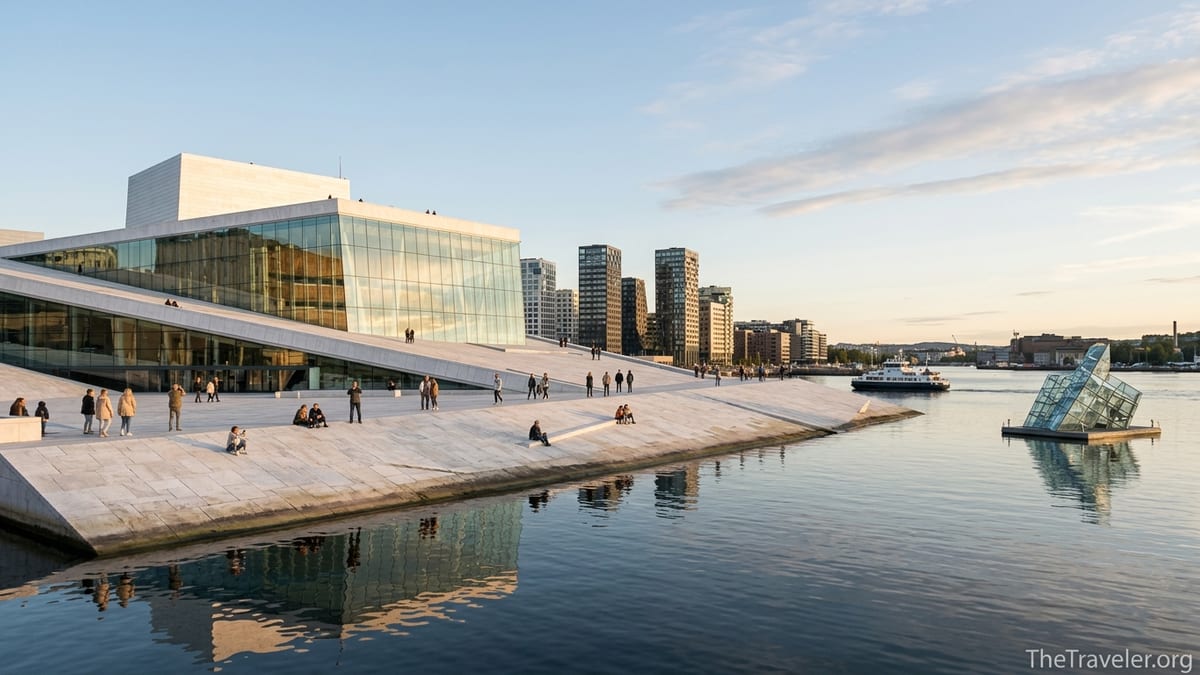
An Opera House Designed to Be Walked On
Most opera houses ask you to stand back and admire. Oslo’s invites you to climb. The defining feature of the building is its sloping roof, a vast surface of white Italian marble and granite that rises gently from the waterfront to a height of around 22 meters above the fjord. There are no gates and no ticket checks; this roof is legally public space, open day and night, so anyone can stroll up from the plaza to the highest point. For photographers, that means an endlessly accessible, ever-changing stage of light, weather, and human activity.
Norwegian architects Snøhetta, who won the international competition to design the building, set out from the beginning to create a “democratic” opera house that would belong to everyone in the city, not just ticket holders. The solution was to treat the roof as a piece of urban topography, like a man-made glacier pushing into the city center. Visitors arriving on a June evening often find teenagers on skateboards, families with strollers, and couples perched along the edges with takeaway pizza boxes and phones pointed at the sunset. Every one of those people is a potential photographer, and the roof is the frame.
The walkable design has turned the opera house into a default first stop for new arrivals. Many travelers get there before they have even checked into their hotel, dropping bags at Oslo S luggage lockers and heading straight to the water. Within minutes they are posting panoramic shots across the fjord, close-ups of the marble patterns under their shoes, or selfies against the glass-and-aluminum façade. Because the roof is free to access, it has none of the psychological barrier of a paid viewpoint; it feels as natural to wander up with a coffee as to cross a city square, which in turn multiplies the daily stream of images.
For locals, the roof functions as both shortcut and meeting place. Office workers cut across it between Bjørvika and central Oslo, students arrange to “meet at the top,” and running clubs use the slope for hill intervals. These everyday uses feed straight into the visual culture of the city: thousands of casual phone photos that, collectively, have cemented the opera as a visual symbol of modern Oslo.
Glacier Aesthetics and Photogenic Materials
Part of what makes the Oslo Opera House so irresistible to cameras is how clearly it reads in a photograph. From a distance, the main volume looks like a bright, low iceberg pushing into the harbor, with crisp, angular planes and strong diagonal lines. Those lines are simple enough that even a quick snapshot taken on a ferry or from the nearby Barcode district comes out with a dramatic, recognizable silhouette. It is the sort of shape that scales effortlessly from a tiny social media thumbnail to a full-page magazine spread.
Up close, the materials reward more careful photography. The roof is clad in pale stone with subtle grooves and inlays that catch low-angle sunlight. On clear summer evenings, when the sun drops behind the city around 9 or 10 pm, the marble shifts from stark white to soft gold, and every step leaves a faint shadow ridge that reads beautifully in side light. On overcast winter days, by contrast, the surface flattens into a near-monochrome field, ideal for minimalist compositions where a lone figure in a red jacket or bright umbrella becomes the focal point.
Photographers who enjoy details find plenty to work with. Metal railings are etched with patterns that reference traditional weaving and historical motifs. Glass balustrades along the roof edge reflect both the water and the Barcode towers behind, giving endless opportunities for layered reflections. Inside the foyer, a vast oak-clad “wave wall” curls around the main auditorium, and visitors routinely photograph its warm tones against the cool, milky exterior glazing. Even those waiting in line for a performance often end up shooting abstract patterns of wood, light, and shadow instead of selfies.
At night, the opera house glows from within, turning the glass façade into a lantern on the water. Travelers coming into the city on late-arriving cruise ships or the airport express train see the building as a lit sculpture in the dark harbor, and many immediately pull out their phones to take through-the-window photos. These conditions are particularly popular with amateur photographers testing long exposures on compact tripods along the promenade, capturing the illuminated building reflected in the fjord with floating lights from passing harbor ferries.
Where City Meets Sea: A Ready-Made Urban Viewpoint
Location is another reason the opera house appears in so many photographs. It sits at the edge of Bjørvika, right where the city center meets the Oslofjord. From the rooftop, photographers can spin in a full circle and collect several of Oslo’s other icons in a single panorama: the angular skyline of the Barcode high-rises, the glass tower of the MUNCH museum, the brick bulk of the old Ekeberg hills in the distance, and ships moored along the harbor.
For travelers with limited time in Oslo, this “one-stop view” is invaluable. A 30-minute visit can yield images that look as if they were taken from multiple vantage points. Stand on the south-facing edge of the roof and you can shoot out over the fjord toward the islands, often catching kayakers, sauna boats, or winter bathers in the same frame. Turn slightly east and you see sleek commuter ferries carving wakes across the water. Facing north, you frame the city’s newer cultural buildings, like the Deichman public library, with the opera’s own marble surface as a leading line into the city.
The ground-level plaza in front of the main entrance is already at the water’s edge, and at high tide waves sometimes lap almost up to the first steps of the marble. Long-lens shots from the opposite side of the harbor exaggerate this effect, making it seem as though the building is actually floating. Meanwhile, the floating glass-and-steel sculpture “She Lies,” anchored in the water just off the southwest corner, offers an extra layer of visual interest. Many visiting photographers frame the sculpture against the opera house to juxtapose two different interpretations of the same “iceberg” theme.
The area around the building has also been carefully staged for views. Benches and low concrete walls along the promenade act as natural camera stands, and there are almost no visual obstructions in front of the structure. Unlike many historic European landmarks hemmed in by traffic or signage, the Oslo Opera House has clean sightlines from land and water. Even a quick snapshot taken from a city sightseeing bus driving along the E18 coastal highway often ends up with a clear, billboard-worthy view of the building.
From Industrial Harbor to Instagram Backdrop
Before the opera house opened, Bjørvika was largely an industrial zone, filled with container storage, warehouses, and a tangle of highway ramps. Few visitors had any reason to walk to this end of the waterfront, and there were certainly no crowds lined up for sunset photos. The opening of the Opera House in 2008, as the first major cultural building in the district, instantly reset the visual identity of the area. What had been a working harbor turned into a public promenade almost overnight, with the white “glacier” as its defining anchor.
The transformation coincided almost perfectly with the explosion of smartphone cameras and social media. In the early years, the building featured in architecture magazines and design awards, but by the mid-2010s it had also become a regular presence in casual Instagram feeds, digital travel diaries, and YouTube vlogs. Backpackers filmed time-lapses of clouds moving over the roof, exchange students documented snowy winter walks up the slope, and cruise passengers stitched together roof-top panoramas into trip highlight reels.
Oslo’s tourism authorities quickly leaned into this momentum. Promotional campaigns routinely feature wide shots of people walking on the roof at sunset, and glossy brochures distributed in hotels and at the airport almost always include at least one image of the opera house. City tourism maps mark the building not only as a cultural venue but also as a “viewpoint” symbol, signaling to visitors that it is a prime location for photographs. As more travelers arrived expecting a photo opportunity, the cycle reinforced itself.
The building’s photogenic qualities have even influenced how nearby businesses present themselves. Cafes and restaurants along the waterfront advertise “opera views” in their descriptions, and new hotels in Bjørvika often highlight room categories with direct sightlines to the marble roof. It is not uncommon to see guests leaning out of large corner windows or standing on small balcony terraces to photograph the building in different weather, whether blanketed in fresh snow or gleaming after a summer rainstorm.
A Stage for People, Not Just Performances
Another reason the Oslo Opera House shows up in so many images is that it functions as a social stage, not just a building. Travelers arrive expecting to photograph architecture and find themselves photographing people instead. On a sunny Saturday in July, the roof transforms into a kind of hillside park: groups spread out on the sloping stone with blankets, children race up and down the inclines, and buskers sometimes perform near the highest point. Photographs taken on these days tend to capture a living, animated foreground against the still, geometric backdrop of the building and the fjord.
Locals often choose the roof for moments they want to remember. Engagement proposals, graduation celebrations, or simple after-work gatherings with colleagues commonly happen here. These personal occasions produce their own flood of images, from posed group shots in front of the harbor to candid snaps taken at the edge of the glass railings. For visiting photographers, the presence of so much human activity adds scale and emotion to what might otherwise be a purely formal piece of architecture.
Even in less-than-ideal weather, the roof stays visually engaging. On windy autumn days, shots of people leaning into the breeze on the open plateau or holding onto hoods and scarves on the steeper slopes give a sense of drama. In winter, a thin layer of snow can turn the surface into a near-blank canvas, on which footprints and sled tracks create spontaneous patterns that invite overhead or diagonal compositions. The building’s managers periodically close small sections of the roof to manage safety and maintenance, but large areas almost always remain open, ensuring there is nearly always a usable slice of public stage to photograph.
Inside, the public foyer operates as an all-weather backup for photography. Floor-to-ceiling glass brings in daylight, and the warm timber structures reflect a softer glow in the darker months. Visitors waiting out sleet or early sunsets often use this time to shoot interior scenes: reflections of the city in the glass, silhouettes of people ascending staircases, or details of the oak cladding curling around the balconies. These shots circulate alongside the better-known roof photos, subtly expanding the visual story of the building.
Free, Flexible and Open All Day
Accessibility has a very practical impact on how often a place is photographed, and in this respect the Oslo Opera House has an advantage over many famous viewpoints. Walking on the roof costs nothing, does not require advance booking, and is possible 24 hours a day in normal conditions. There are no set time slots or queues, so photographers can adapt their visit to weather and light rather than the other way around. A business traveler with a free hour between meetings can pop over for an early morning shoot; a backpacker staying in a nearby hostel can wander back each evening to see how the light is different.
This flexibility matters particularly in a city whose daylight changes so dramatically across the year. In June, golden hour can stretch deep into the late evening, and the roof becomes a magnet for both locals and tourists chasing that soft light. In December and January, when the sun sits low or barely rises, the opera’s white surfaces help bounce precious light around the harbor, and even a noon visit can have the long-shadow look of a traditional sunset photo. Because the roof remains open during these seasons (with caution when it is icy), it gives photographers rare access to atmospheric low-light scenes without the constraints of an indoor observation deck.
The cost-free nature of the rooftop also encourages repeat visits. A family staying in Oslo for several days might visit once on arrival, once at night, and again on their last morning for one final look at the city. Each of those stops produces a new set of images: fog crawling across the fjord on the first day, neon reflections from harbor ferries on the second, and crisp winter blue sky on the third. Multiplied across hundreds of thousands of visitors each year, this habit of coming back “just for a photo” has helped the building accumulate a formidable visual presence online.
Practical services nearby support this behavior. A small cluster of kiosks and cafes in Bjørvika sells coffee and snacks that easily become props in photos. The short distance to Oslo Central Station also means tripods and camera bags can be retrieved from lockers or hotel rooms with minimal effort, encouraging more serious photographers to plan repeat, gear-heavy sessions on the roof without sacrificing time to long commutes.
Tips for Capturing Your Own Iconic Shot
For travelers hoping to come home with more than a standard snapshot, timing and vantage point make a big difference. Early morning, especially before 9 am on weekdays, is ideal if you want cleaner architectural shots with relatively few people in the frame. The low sun often grazes the roof from the east, revealing the texture of the stone and casting long diagonal shadows. Walking up to the mid-level slopes and shooting slightly downward toward the fjord can produce dynamic images where the roof becomes a triangular foreground leading into the water and the islands beyond.
Evenings, particularly in summer, are better for atmosphere. Arrive an hour or so before sunset and you will find the light warming the marble and the cityscape beyond, while the fjord gradually turns into a mirror for sky colors. From the roof’s northern edge, you can frame the Barcode skyline with the opera’s own surface in the foreground, using pedestrians as small figures for scale. If you are comfortable with low-light photography, staying until the building lights come on will give you opportunities for reflection shots in the glass and water.
From ground level, consider walking a short distance east along the harbor promenade and looking back. This angle emphasizes how the building appears to slide into the water and often includes the “She Lies” sculpture, which can act as a secondary focal point. Conversely, crossing the pedestrian bridges toward the MUNCH museum lets you shoot the opera house from slightly above, revealing the full geometry of the roof and the patterns of people walking on it.
Weather should not deter you. Overcast skies remove harsh contrast and make it easier to expose for both the bright marble and the darker city beyond. Light rain can produce beautiful reflections on the stone, especially at night, though shoes with good grip are advisable. In winter, check local reports for icy conditions; the operators sometimes restrict the steepest sections, but there is usually still accessible space from which to photograph. Packing a lightweight microspike or good-soled boots can make rooftop exploration safer and more enjoyable in these months.
The Takeaway
The Oslo Opera House became one of Norway’s most photographed landmarks not because of a single spectacular angle, but because it weaves itself into daily life and travel routines. Its climbable marble roof turns world-class architecture into a public hillside, free to access at almost any hour. Its glacier-like form reads clearly in photographs taken from ferries, promenades, hotel windows, and train platforms alike. Its location at the hinge between city and sea offers a ready-made panorama of Oslo’s evolving skyline.
For travelers, the building is more than a backdrop; it is a place to linger, meet friends, watch the weather roll in, and mark personal moments against a memorable silhouette. Each of those quiet experiences generates its own images, and together those millions of individual photos have elevated the opera house into a visual shorthand for contemporary Norway. Whether you are composing a carefully planned long exposure or simply raising your phone on the way from the station, the building almost guarantees a frame worth keeping, which is exactly why it keeps appearing, again and again, in albums and feeds around the world.
FAQ
Q1. Do I need a ticket to walk on the Oslo Opera House roof?
Access to the roof is free and does not require a performance ticket. You can walk up at any time when conditions allow, even if you are not attending a show inside.
Q2. What is the best time of day to photograph the Oslo Opera House?
Early mornings offer quieter conditions and clear architectural lines, while late evenings in summer provide warm light, dramatic skies, and reflections on the fjord.
Q3. Can I visit the opera house roof in winter?
Yes, the roof is usually open in winter, but parts may be closed during icy conditions. Wear footwear with good grip and follow any posted safety signs or barriers.
Q4. How do I get to the Oslo Opera House from the city center?
From Oslo Central Station it is about a five-minute walk following signs toward the waterfront in Bjørvika. The white sloping roof is visible from much of the area, making it easy to find.
Q5. Are tripods allowed on the roof for photography?
Small tripods are generally tolerated on the roof as long as they do not block walkways or create hazards, but staff may ask you to move if an area is crowded or slippery.
Q6. Is it possible to take photos inside during performances?
Photography is usually allowed in the foyer and public areas before and after performances, but not during shows in the main auditorium. Always respect announcements and staff instructions.
Q7. What other landmarks can I photograph from the opera roof?
From the roof you can capture views of the Barcode district, the MUNCH museum, the Deichman public library, harbor ferries, and the islands of the inner Oslofjord.
Q8. Is the Oslo Opera House accessible for visitors with limited mobility?
The building has elevators and gently sloping areas that improve access for visitors with limited mobility, though some of the steepest rooftop sections may not be suitable for all.
Q9. Are there guided photo or architecture tours of the opera house?
Several local tour companies and independent guides offer architecture or city walks that include the opera house, and the venue itself sometimes runs guided tours of the interior.
Q10. Can I combine a visit to the opera house with other nearby attractions?
Yes, the opera house is within a short walk of the MUNCH museum, the Deichman library, and much of the Bjørvika waterfront, making it easy to plan a half-day of sightseeing in the area.