


Vigeland Sculpture Park in Oslo is one of those rare places that works as both an open-air art gallery and a neighborhood park. With more than 200 bronze and granite sculptures spread along an 850 meter axis inside Frogner Park, it is easy to wander aimlessly and still miss some of the most powerful pieces. A little planning, and a sense of how locals actually use the park, can turn a simple stroll into one of the most memorable walks of a Scandinavian trip.
Get the latest updates straight to your inbox!
Understanding Vigeland Sculpture Park Before You Go
Vigeland Sculpture Park is the world’s largest sculpture park created by a single artist, Norwegian sculptor Gustav Vigeland. Set within Frogner Park in Oslo’s west end, it is free to enter at any hour of the day, in every season. The sculptures were installed mainly between the 1920s and 1940s and explore human life from birth to old age. Instead of heroic figures or historical scenes, you see everyday people captured in moments of tenderness, frustration, play, and grief.
The park follows a clear central axis from the wrought-iron Main Gate on Kirkeveien, across a bridge lined with bronze figures, up past a massive fountain, and finally to the Monolith plateau and the Wheel of Life. Walking this axis is the most natural way to understand the park’s narrative, which gradually moves from childhood and family scenes to more abstract meditations on the human condition. Most visitors who arrive with a map or guide end up following this line without realizing how deliberately it was composed.
Despite its popularity, Vigeland Sculpture Park is still part of a larger local park. Oslo residents use Frogner Park for dog walking, jogging, and sunbathing. On a summer weekday afternoon you might see office workers in shirtsleeves eating takeaway sushi on the grass beside the lake, teenagers practicing tricks on scooters, and families pushing strollers over the bridge of sculptures. Keeping that dual identity in mind helps you approach the park with the right expectations: it is both a major cultural attraction and a lived-in public space.
Because the park is open around the clock and has no ticket gates, there is no clear “start” or “finish.” You can enter from several sides, including a quieter residential entrance near Frogner Stadium and smaller gates near the tram stops. For a first visit, though, starting at the Main Gate on Kirkeveien gives you the most coherent experience and the strongest first impression of Vigeland’s work.
The Classic Central Axis Walk: Gate to Wheel of Life
If you only have 60 to 90 minutes, follow the classic central axis route from the Main Gate to the Wheel of Life and back. This walk covers the park’s key installations in a logical order. Start at the ornate iron Main Gate on Kirkeveien, where tour buses usually stop. Step inside, take a moment to absorb the wide view of the bridge and the long line of sculptures stretching into the distance, then move at your own pace rather than letting a crowd carry you forward.
From the gate, walk straight ahead to the stone bridge spanning the pond. Lining the bridge are 58 bronze sculptures, each a small scene of human interaction. One of the most photographed pieces is “Sinnataggen,” the Angry Boy, a toddler stamping his foot in fury. Many visitors rub his hand for luck, which has polished the bronze to a shine. You will also see men wrestling with children, a father tossing a child into the air, and figures locked in embraces or disputes. This is one of the best stretches to slow down and move from sculpture to sculpture, noticing small details like the texture of the bronze in cold weather or the way light reflects off the figures at sunset.
Beyond the bridge, the path climbs gently toward the fountain. The central bronze group shows six giants holding up a large basin from which water cascades. Around the base are trees of life, each with children and adults woven into the branches. This is where you start to feel Vigeland’s interest in the cycle of life and time, especially if you circle the fountain and notice how the scenes progress from youth to old age. In summer, you may pass local joggers doing laps or parents parking strollers near the benches while children run around the paved square.
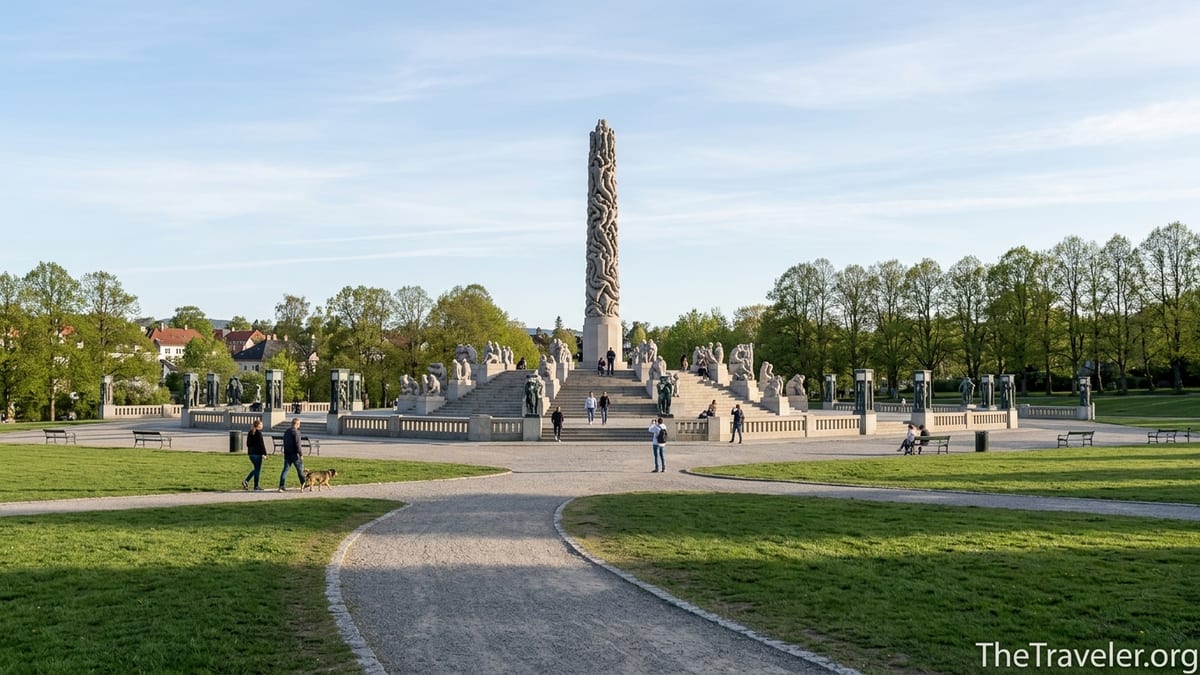
Climb the final stretch to the Monolith plateau, the emotional high point of the park. The 17 meter granite column rises from a wide terrace, its surface carved with more than 100 intertwined human figures. Around it are groups of granite sculptures: families in tight embraces, elderly couples leaning into each other, children climbing over one another in tangled play. The plateau is rarely empty. On a July afternoon you might find groups of cruise passengers, a local yoga class stretching on the steps, and a few residents cutting across as a shortcut home. Continue past the plateau, following the axis slightly downhill to the Sundial and then to the Wheel of Life, a ring of human figures symbolizing eternity. This final piece often feels calmer, with fewer people lingering so far from the main gate, making it a good place to pause before looping back along side paths rather than retracing your exact route.
A Slow, Local-Style Loop Through Frogner Park
Travelers with more time can experience the park the way many residents do: as part of a wider loop through Frogner Park. A relaxed circuit that combines the sculpture axis with quieter lawns and lakes takes about two to three hours with stops. Start again at the Main Gate, walk the central axis to the Monolith plateau, then instead of continuing straight to the Wheel of Life, veer down one of the side paths that slope toward the large lawns on the north side.
These grassy areas are where Oslo locals spread blankets on warm days, especially in June and July when evenings stay light past 22:00. You might see groups barbecuing on portable grills, which are sold at local supermarkets like Rema 1000 and Kiwi nearby. On spring mornings, elderly residents often walk small dogs off-leash along the tree-lined paths, stopping for conversation on park benches. Joining this flow, rather than sticking strictly to the sculptures, gives you a better sense of the park as part of everyday life.
From the northern lawns, curve back toward the pond beside the bridge. The water mirrors the bronze figures and the silhouettes of tall trees, and in autumn the reflections of orange and yellow leaves can be as striking as the sculptures themselves. This area is popular with photographers, so if you are shooting with a camera, come early in the day to avoid harsh midday contrast. Continue around the pond and rejoin the main path near the fountain, then wander down toward the southern side of Frogner Park where there are fewer tour groups.
To finish the loop like a local, exit near Frogner plass, a neighborhood square with bakeries and small cafes. In practice, many residents cap their park walk with a coffee and a cinnamon bun at a corner bakery, especially on weekend mornings. This route turns the Vigeland installation into one chapter in a larger city walk, rather than an isolated sightseeing stop, and suits travelers who prefer to soak up a neighborhood atmosphere along with the art.
Practical Logistics: Getting There, Timing, and Seasons
Vigeland Sculpture Park sits about 3 kilometers west of central Oslo City Hall. The most convenient public transport options from the center are the tram and the metro plus tram. Tram line 12 typically runs from the waterfront district through the city center to the stop called Vigelandsparken or Frogner plass, both just a short walk from the main entrance. Travelers staying near Oslo Central Station can ride a tram or bus toward Majorstuen and then transfer to a local tram or walk about 15 to 20 minutes to the park.
The park itself is open 24 hours and has no admission fee. This makes it ideal for travelers on a budget or those with awkward cruise or flight timings. For example, cruise passengers docking in Oslo for a single day often take a morning city walk to the opera house and Akershus Fortress, then ride the tram to Vigeland for an afternoon in the park without needing to worry about ticket windows or closing times. The adjacent Vigeland Museum, which displays original plaster models and drawings, does charge admission and keeps regular daytime opening hours, usually closing by late afternoon, so check the latest schedule before planning a combined visit.
Season matters a great deal to your experience. In winter, especially from December to February, snow can transform the sculptures, softening their lines and adding quiet to the park. Temperatures are often below freezing, so dress in layers, waterproof boots, and a warm hat, and keep in mind that some paths may be icy. In summer, long daylight hours mean you can visit as late as 21:00 or 22:00 and still have good light. This late window, after bus tours have left, is one of the best times for an unhurried walk along the axis.
Rain is common in spring and autumn, so bring a light waterproof jacket rather than relying on umbrellas, which can be awkward on breezy days in such a wide open space. Because Oslo weather can shift quickly, many locals check the forecast in the morning and then choose a window of a few dry hours for their stroll. If you have a flexible itinerary, plan your Vigeland visit for the clearest half-day and keep indoor attractions like the National Museum or Munch Museum as backup options should the forecast deteriorate.
Three Suggested Walking Routes for Different Travelers
The best way to experience Vigeland Sculpture Park depends on how much time and energy you have, and whether you are more interested in art, atmosphere, or exercise. Thinking in terms of simple routes helps you choose. For a quick orientation, the “Essential Axis” walk takes about one hour: start at the Main Gate, walk straight across the bridge, linger at the fountain, climb to the Monolith plateau, continue briefly to the Sundial and Wheel of Life, then loop back along a side path parallel to the main route. This works well if you have only a short stop in Oslo or are visiting with children who tire easily.
Art-focused travelers might prefer a “Slow Art Circuit” of around two hours. Begin again at the Main Gate, but instead of walking straight through, take ten or fifteen minutes to study the ironwork on the gates and fences. Then move very slowly across the bridge, spending several minutes at each sculpture and circling them to see how the figures change from different angles. At the fountain, walk fully around the basin to follow the progression of life scenes, then climb to the Monolith plateau and choose just a handful of the granite groups to focus on in detail. Finish by sitting on the steps below the Monolith and watching how other visitors interact with the art, which is often as revealing as the sculptures themselves.
For active travelers or runners, there is a “Frogner Fitness Loop” of roughly 4 to 5 kilometers using the central axis as a spine. Jog in from the city center along Kirkeveien or from Majorstuen, cross the bridge at an easy pace, jog around the fountain square, then circle out to the far edges of Frogner Park where wide gravel paths are lined with trees. Many Oslo residents use this area for interval training, especially early in the morning before 08:00, when tourists are scarce. Even if you simply walk the loop, this route shows you how integrated Vigeland’s sculptures are into the daily rhythms of the neighborhood.
Families might adapt any of these routes by including stops at playgrounds on the edges of Frogner Park and timing their visit around meals. There are grassy spots suitable for picnics near the pond and below the Monolith plateau, and small kiosks occasionally open in warmer months selling ice cream and snacks. Carry a reusable water bottle, as public drinking fountains can be seasonal and are not always obvious. With a flexible approach, you can blend structured sightseeing with moments of rest and play that suit children and adults alike.
Local Tips for Making the Most of Your Visit
Oslo residents often have a different rhythm in Vigeland Sculpture Park than first-time visitors, and borrowing some of their habits can improve your experience. One simple tip is to avoid the midday window between about 11:00 and 15:00 in the peak summer months, when large tour buses tend to arrive. Early morning, especially between 07:00 and 09:00, is usually quieter and filled mainly with joggers, dog walkers, and a few photographers. Late evening on a clear June or July day can also be magical, with long shadows stretching across the lawns and a softer light on the granite figures.
Another local habit is to approach the sculptures without rushing to pose for photos on every step. While it is common to see people jokingly mimicking the Angry Boy or climbing near some of the granite groups, Norwegians tend to keep a certain respectful distance. Taking a few moments simply to sit on a bench and watch how light moves over the figures can be more rewarding than collecting dozens of quick snapshots. If you do want pictures without crowds, walk beyond the Monolith to the Wheel of Life, which attracts fewer bus groups, and frame the sculptures with trees and sky rather than trying to capture everything at once.
Food and drink options inside the park are limited, so locals often bring their own. You can pick up pastries and coffee from bakeries in nearby streets and carry them in. Small supermarkets within walking distance sell pre-made sandwiches and salads that work well for impromptu picnics. Just remember that Norwegian regulations expect visitors to dispose of litter properly and to be considerate with portable grills, which should not be used directly on the grass without protective trays.
Finally, remember that the park is part of a residential area. Early in the morning and later at night, keep noise levels moderate, and be mindful when photographing people who are clearly locals out for exercise or walking children. Norwegians generally value privacy. A friendly nod of acknowledgment goes a long way, but if someone seems to want distance, it is polite to give it without taking offense.
Combining Vigeland with Nearby Sights
One of the best ways to integrate Vigeland Sculpture Park into your Oslo itinerary is to pair it with nearby attractions, turning a simple park visit into a richer half-day. The Vigeland Museum, housed in the sculptor’s former studio just a short walk from the southern edge of the park, is a natural companion stop. Inside, you can see original plaster models of the sculptures that stand outdoors, along with sketches and smaller works that give insight into Vigeland’s process. Many visitors find that seeing the museum before or after their park walk changes how they read the figures outside.
Also within Frogner Park is Oslo City Museum, located in a historic manor house. Its exhibits trace the development of Oslo from a modest town to a modern capital and often include models, photographs, and everyday objects that add context to the urban landscape you see around you. A common local approach is to stroll through Vigeland in the morning, stop for a simple lunch at a nearby cafe, then visit one of these museums in the early afternoon, especially on days when the weather is mixed and a break indoors is welcome.
If you are exploring Oslo by bicycle, Vigeland can fit neatly into a larger west-side loop that includes the waterfront at Bygdøy, where several of the city’s major museums are located. Bike rental stands and tour companies in the city center often suggest routes that pass through Frogner Park on the way back from the maritime museums. Riding through the park at a slow speed allows you to cover more ground while still stopping at key sculptures.
For cruise passengers and short-stay visitors, combining the park with central landmarks such as the Oslo Opera House and the new National Museum gives a balanced view of the city’s architecture, art, and green space. In practice, this might mean a morning of urban sightseeing followed by a tram ride to Frogner for a slower afternoon among trees and stone.
The Takeaway
Vigeland Sculpture Park rewards both quick visits and unhurried exploration. Walking the central axis from the Main Gate to the Wheel of Life gives a concise introduction to Gustav Vigeland’s vision, while looping through the broader lawns and lakes of Frogner Park shows how deeply woven his sculptures are into Oslo’s daily life. Arriving early or late in the day, following a route suited to your interests, and borrowing a few local habits around pacing and picnicking can transform a standard sightseeing stop into a personal encounter with one of Europe’s most distinctive public art projects.
Whether you come in winter when snow traces the lines of granite figures, or in high summer when the lawns fill with families and friends, the park invites repeat visits. Each walk brings out different aspects of the work: a detail in a bronze gesture you missed before, a new understanding of how the Monolith’s figures interlock, or simply a renewed appreciation for the way an artist’s life project can become an entire city’s shared backyard. Plan your route, give yourself time, and let the sculptures guide you through their quiet story of human life.
FAQ
Q1. Is there an entrance fee for Vigeland Sculpture Park?
There is no entrance fee for Vigeland Sculpture Park. The grounds are part of Frogner Park and remain open to the public free of charge.
Q2. What are the opening hours of the park?
The park itself is open 24 hours a day, every day of the year. You can walk among the sculptures at any time, including early mornings and late evenings.
Q3. How do I get to Vigeland Sculpture Park from central Oslo?
From central Oslo, you can take tram line 12 toward the west and get off at Vigelandsparken or Frogner plass. From either stop it is only a short walk to the main gate.
Q4. How much time should I plan for a visit?
Plan at least one hour to walk the main axis from the gate to the Wheel of Life and back. Two to three hours allow a slower pace, side paths, and photo stops.
Q5. Is the park suitable for children and strollers?
Yes. The main paths are wide and mostly flat, making them suitable for strollers. Families often visit with children, and there are open lawns nearby for play and picnics.
Q6. Are there guided tours available in the park?
Guided tours are sometimes offered by local tour companies and independent guides, especially in summer. Many visitors also use self-guided walking apps or printed maps to explore on their own.
Q7. Can I visit the Vigeland Museum on the same trip?
Yes. The Vigeland Museum is a short walk from the park and pairs well with a sculpture walk. It has separate opening hours and a ticketed entrance, so check current times in advance.
Q8. When is the best time of day to visit to avoid crowds?
Early morning before about 09:00 and later in the evening, especially in summer, are usually quieter. Midday in high season tends to be busier with tour buses.
Q9. Are there places to buy food and drinks nearby?
Food options inside the park are limited, but there are cafes, bakeries, and supermarkets in the surrounding Frogner neighborhood where you can buy snacks, coffee, or picnic supplies.
Q10. Is photography allowed in Vigeland Sculpture Park?
Photography for personal use is allowed throughout the park, and many visitors take photos of the sculptures and views. As a courtesy, avoid intrusive flash and be respectful of other visitors’ privacy.