


More news on this day
Switzerland’s Brig–Disentis railway, the high Alpine link that forms the central stretch of the Glacier Express route between Zermatt and St. Moritz, has celebrated its 100th anniversary, spotlighting a century of mountain engineering and tourism development in the heart of the Alps.
Get the latest news straight to your inbox!
From Furka Oberalp pioneer to Glacier Express backbone
The Brig–Disentis line opened in 1926 as part of the former Furka Oberalp Railway, completing a continuous metre-gauge connection across central Switzerland between the cantons of Valais and Graubünden. The route stitched together remote communities on the southern flank of the Alps, creating an all-important transverse link over the Furka and Oberalp passes at a time when year-round road access was still limited for much of the region.
That same geography made the line a natural spine for what would become one of the world’s best-known panoramic trains. When the Glacier Express was inaugurated in 1930, the Brig–Disentis section quickly emerged as its scenic and operational heart, carrying trains over some of the highest points and steepest gradients of the celebrated cross-country journey. Today, the line is operated by Matterhorn Gotthard Bahn and forms the central link between the western and eastern segments of the Glacier Express itinerary.
Publicly available historical material on the network highlights how the Brig–Disentis connection transformed from a regional lifeline into an international tourism corridor. Over the decades, the route has evolved in step with wider changes to Swiss mountain railways, including electrification, modern rolling stock and expanded year-round service patterns designed to cope with both local demand and the steady rise of global rail tourism.
The 100th anniversary has renewed attention on the line’s original purpose as well as its changing role. Rail historians point to the Brig–Disentis corridor as an early example of how narrow-gauge mountain railways helped anchor settlements, support seasonal economies and lay the foundations for the modern Alpine travel industry that today markets the Glacier Express as a flagship experience.
Engineering a high Alpine corridor between Brig and Disentis
Running between Brig in the Rhône valley and Disentis/Mustér in the upper Rhine region, the centenarian route crosses some of the most challenging topography in the Swiss network. The line climbs from the broad valley floor at Brig through tight side valleys, passes beneath avalanche galleries and negotiates multiple spiral tunnels and bridges before reaching high-altitude stations such as Andermatt and Oberalppass.
Historical overviews of the Furka Oberalp construction describe a phased building programme, with engineers forced to contend with steep gradients, heavy winter snowfall and unstable mountain slopes. Rack sections were installed on the steepest parts of the line to ensure safe traction, a feature that still distinguishes parts of the route from conventional mainline railways. This mix of adhesion and rack operation allows trains to maintain a continuous journey across terrain that would otherwise require separate transport modes.
Modern technical documentation from the current operators emphasizes ongoing maintenance demands on the Brig–Disentis section, including rockfall protection, tunnel rehabilitation and upgrades to power and signaling systems. The centenary year highlights how much of the original alignment remains intact, even as infrastructure has been steadily reinforced to meet contemporary safety and reliability standards.
For travelers, many of these engineering works are experienced only as fleeting moments: a brief dimming of the Alpine light in tunnels, the echo of wheels crossing steel bridges, or sudden transitions from river gorges to high plateau landscapes. The 100-year milestone has prompted new efforts by local tourism offices and railway museums to interpret these features for visitors, with exhibitions, printed guides and special events focusing on the route’s construction story and its role in opening up high mountain valleys.
A century of Glacier Express tourism along the central section
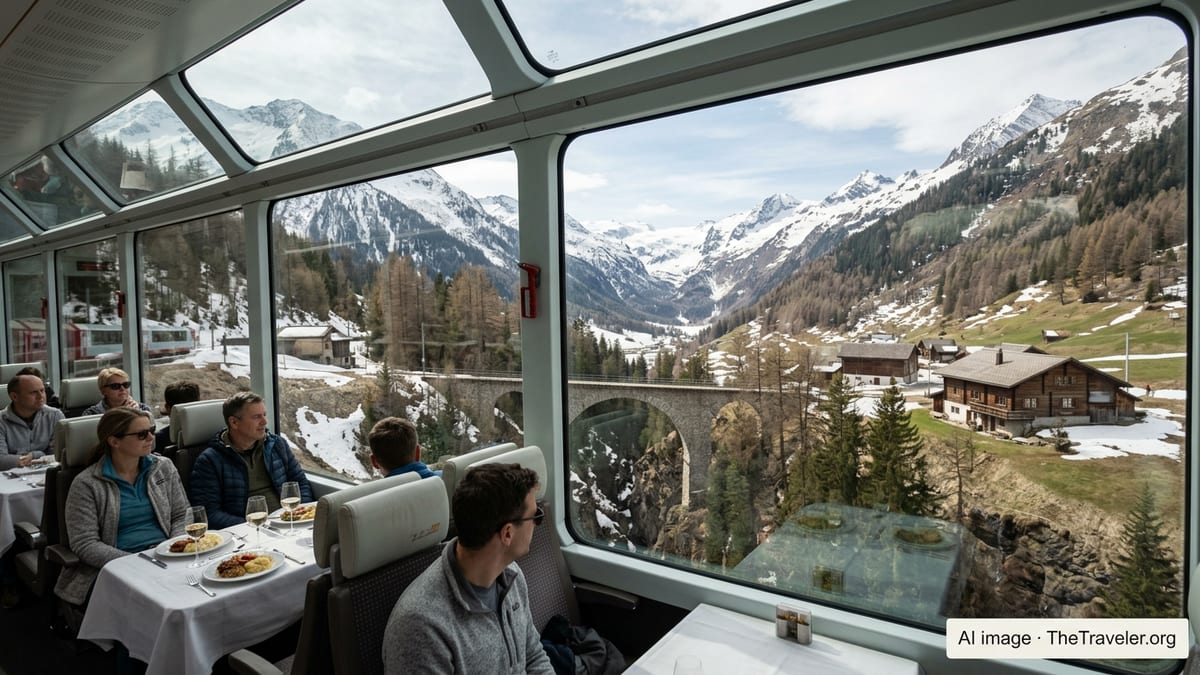
The Brig–Disentis line is widely regarded among passengers and rail enthusiasts as one of the most dramatic segments of the Glacier Express route. Travel reports and guidebooks frequently single out the stretch between Andermatt and Disentis for its combination of tight valleys, shifting river landscapes and wide views toward snow-covered peaks, particularly in late spring and early summer when the passes are still partially snow-lined.
Over 100 years, the character of tourism on the line has changed significantly. In the early decades, long-distance visitors were predominantly European, often combining Glacier Express journeys with extended mountain stays in spa towns and classic resorts such as Zermatt and St. Moritz. The postwar growth of international air travel gradually brought a more global clientele, with organized tour groups incorporating the train into multi-country itineraries, and independent travelers using Swiss rail passes to sample portions of the route.
Recent travel coverage points to a diversification of use patterns on the Brig–Disentis segment. While the named Glacier Express continues to attract passengers seeking a one-seat journey with panoramic cars and onboard commentary, regular regional services along the same corridor now draw hikers, skiers and residents moving between valleys. These hourly or more frequent trains allow travelers to step on and off the route, visiting side destinations such as the Oberalp Pass, the Rhine Gorge near Ilanz and the Aletsch area near Brig.
The centennial has also coincided with renewed marketing of “modular” Glacier Express experiences, encouraging visitors to travel selected legs rather than the full eight-hour journey. Promotional materials and rail forums increasingly highlight Brig–Andermatt–Disentis as a standalone itinerary, pointing to the section’s concentration of classic Alpine scenery within a relatively compact travel time.
Heritage, climate pressures and year-round operations
The 100-year anniversary arrives at a time when Alpine regions face growing climate-related pressures, with shrinking glaciers, evolving snow patterns and increased rockfall risks affecting both landscapes and infrastructure. Studies on the route’s wider environment note that the original namesake glacier views of the Glacier Express have largely retreated from the line itself, prompting a shift in emphasis toward river gorges, forested slopes and high pastures as signature sights.
Against this backdrop, rail-based tourism is often promoted in public discourse as a lower-impact alternative to car travel in fragile mountain ecosystems. The Brig–Disentis corridor, already electrified and integrated into Switzerland’s national timetable, fits prominently into regional strategies that encourage visitors to arrive and move around by train, bus and cable car rather than private vehicle.
Operationally, the line has moved from highly seasonal patterns to near year-round functionality thanks to infrastructure upgrades such as the Furka Base Tunnel, which provides an all-weather alternative to older high-altitude alignments. Timetable information and planning documents show that the Brig–Disentis section now supports a mix of local services, seasonal tourist trains and long-distance panoramic operations, with scheduled maintenance blocks in late autumn when demand is lower.
The centenary has brought additional focus to how the route can continue to serve both residents and visitors over the next century. Discussions in specialist rail media and at local events often center on topics such as energy-efficient rolling stock, protection of cultural landscapes along the line and the balance between high-volume visitor flows and quality of life in small mountain communities.
Looking ahead: innovation on a historic Alpine route
As the Brig–Disentis railway enters its second century, attention is turning to how technological innovation can coexist with the heritage character that many travelers seek out on the Glacier Express route. Recent upgrades have already introduced modern panoramic coaches, enhanced accessibility features at selected stations and improved real-time information for passengers connecting to regional buses and cable cars.
Railway planning documents indicate that future investments are likely to focus on incremental improvements rather than radical realignments. Priorities include continued reinforcement of tunnels and bridges, digitalization of signaling systems and targeted capacity enhancements on sections where tourist and commuter demand overlap during peak seasons. There is also growing interest in integrating the line more closely with hiking and cycling networks, through coordinated timetables, station wayfinding and luggage-transfer services.
For international visitors, the 100th anniversary offers a timely reminder that the Glacier Express experience is anchored in a living transport corridor rather than an isolated excursion. The Brig–Disentis link remains a daily artery for residents, schoolchildren and workers as much as for travelers photographing viaducts and passes from panoramic windows.
In that sense, the centenary of the Brig–Disentis railway underscores a broader story about Alpine mobility. Over the last century, the line has helped turn once-remote valleys into connected destinations, and its continued evolution suggests that high mountain railways will remain central to how Switzerland manages tourism, landscapes and local life along some of its most spectacular routes.