


More news on this day
Britons planning to travel to Spain on Thursday 11 November are being urged to prepare for significant disruption, with a national general strike, severe weather alerts and tighter border checks combining to create the risk of widespread travel chaos.
Get the latest news straight to your inbox!
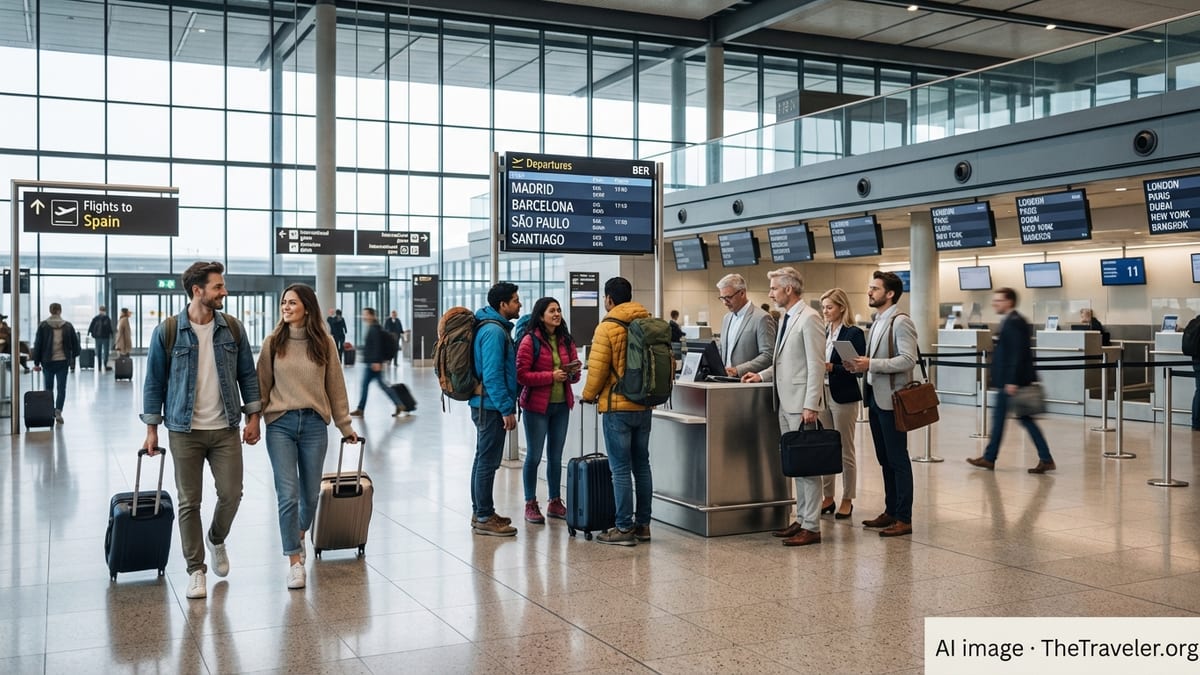
General strike set to hit air and rail services
Trade unions in Spain have called a 24-hour general strike for Thursday 11 November, affecting large parts of the country’s transport and public services network. Reports from Spanish and European media indicate that participation is expected from workers in aviation, rail, ports, public administration and urban transport, although the level of disruption will vary by region and operator.
Industry coverage in the UK notes that airlines serving Spanish destinations have activated disruption plans, with some carriers warning of schedule changes, reduced frequencies and short-notice cancellations around 11 November. Travellers booked to fly between the UK and major hubs such as Madrid, Barcelona, Palma de Mallorca, Málaga and the Canary Islands are being advised to monitor their booking details closely and allow additional time at the airport.
Rail passengers are also likely to be affected. Spanish media and travel-industry briefings highlight that services operated by state-owned Renfe, including high-speed AVE routes, are expected to run on reduced timetables under legally required minimum service levels. Regional and commuter networks around major cities may also see gaps in service and crowded trains at peak times.
While the strike is planned for a single day, knock-on effects could continue into Friday, with rolling delays and aircraft and train stock out of position. Travellers with tight connections or same-day onward journeys may be particularly exposed to disruption.
Foreign travel advice flags risk of delays and protests
Publicly available information from the UK’s Foreign, Commonwealth & Development Office highlights the potential for delays around the strike period, noting the likelihood of disruption to flights, rail journeys and wider public services in Spain. The travel advice also refers to the prospect of demonstrations and large gatherings linked to the industrial action and the country’s broader political and economic debate.
The advice stresses that protest activity can build at short notice in major cities including Madrid, Barcelona, Valencia, Seville and Bilbao. While such events are generally peaceful, they can lead to road closures, traffic diversions and temporary changes to public transport routes, particularly around central squares, government buildings and major transport interchanges.
Other national travel advisories, including those from Australia and Canada, have issued similar messages in recent days, pointing to a high baseline terrorism alert level in Spain and noting that strikes, marches and rallies can intensify pressure on local infrastructure. Travellers are encouraged to stay away from large demonstrations and to follow local announcements and station or airport signage where crowd-control measures are in place.
For UK holidaymakers, the key message across these advisories is to check with airlines, tour operators and rail companies before departure, and to be ready for last-minute timetable changes on and around 11 November.
Severe weather warnings compound transport pressures
The industrial unrest coincides with unsettled autumn weather across parts of the Iberian Peninsula. European meteorological networks and regional agencies have issued strong wind and heavy rain alerts for several Spanish regions this week, particularly on and around 10 and 11 November, as a deep Atlantic system moves east across the country.
Recent weather briefings reference red and orange warnings for intense rainfall, possible flash flooding and strong gusts in exposed coastal and mountain areas. Such alerts increase the likelihood of short-notice air-traffic control restrictions, diversions and go-arounds at affected airports, as well as localised road closures and speed limits on main highways.
Travel-disruption trackers monitoring European airspace have already flagged higher-than-normal delay levels at several Spanish airports in the days leading up to the strike, linking them to storm systems and congestion management measures. If adverse weather overlaps with reduced staffing and industrial action on 11 November, queues at check-in, security and border control could lengthen further.
Passengers connecting through Spain on multi-leg itineraries, particularly those involving regional feeder flights to or from Madrid and Barcelona, may be more exposed to cascading delays when weather and strike-related disruption interact.
UK travellers warned of queues at Spain’s external EU border
Alongside strike and weather risks, congestion at passport control remains a concern for British travellers heading to Spain. Since the UK left the European Union, UK passport holders have been treated as non-EU arrivals, subject to full entry checks and, increasingly, biometric registration at the external Schengen border.
European and UK travel-industry coverage reports that Spain’s introduction of enhanced digital border systems at key holiday gateways, including airports in the Balearic and Canary Islands, has contributed to long queues at peak times. With many Britons travelling on package holidays to destinations such as Mallorca, Tenerife and Gran Canaria, any slowdowns at e-gates or manual booths can quickly build into hour-long waits.
Industry associations have previously warned that the combination of additional data capture requirements, busy school-holiday traffic and staffing pressures can strain terminal capacity. On a day already affected by a general strike and potential weather disruption, passenger flow through arrivals and departures halls may come under further pressure.
Travel risk services advise UK visitors to factor in these conditions when planning their journey on 11 November, arriving early for departures, carrying any required documentation for onward connections, and being prepared for extended processing times at Spanish airports.
How travellers can prepare for a disrupted travel day
Consumer travel organisations and airline updates recommend that anyone due to travel between the UK and Spain on Thursday 11 November take a proactive approach to planning. This includes confirming flight status directly with the airline on the day of travel, ensuring contact details are up to date in booking systems, and downloading carrier or rail apps that provide real-time notifications.
Passengers are also being encouraged to build extra time into their itineraries. For flights, this means arriving at the departure airport earlier than usual, particularly for morning departures when security and border queues are often longest. Those connecting from regional UK airports onto Spanish services, or from Spanish domestic flights onto long-haul routes, may wish to leave a wider buffer between legs.
Travel insurance policies that include cover for industrial action and severe weather may prove valuable, especially where they provide compensation for significant delays or additional accommodation and rebooking costs. Travellers are being advised to review policy wording carefully to understand what is and is not covered in the context of strikes and weather alerts.
Despite the warnings, both official advisories and independent travel analysts emphasise that Spain remains open to visitors, and that many journeys on 11 November are still expected to operate. For Britons heading to the country, the focus is on preparation, flexibility and staying informed as conditions evolve throughout the day.