


More news on this day
The United States has placed 11 African countries and 12 others worldwide in its strictest Level 4 “Do Not Travel” category, according to recently updated federal travel advisories that cite armed conflict, terrorism, kidnappings, civil unrest and fragile health systems as key concerns for American travelers.
Get the latest news straight to your inbox!
Which African countries are on the Level 4 list?
Publicly available State Department advisory data and recent media coverage indicate that 11 African nations are currently classified as Level 4 “Do Not Travel.” These destinations are the Central African Republic, Burkina Faso, Mali, Niger, Sudan, South Sudan, Somalia, Libya, Guinea, Chad and the Democratic Republic of the Congo. Several of these advisories were refreshed in 2025 and 2026, reflecting ongoing instability rather than a one-time change.
The risk profiles across these states vary, but conflict and weak state control are common threads. Central African Republic, Mali, Burkina Faso, Niger and Chad have all seen prolonged violence involving armed groups and, in some cases, military juntas. In Sudan and South Sudan, internal conflict and shifting front lines have repeatedly disrupted basic services and transport, complicating any emergency support for foreign visitors.
In the Horn of Africa, Somalia remains under a long-running Level 4 warning driven by terrorist attacks, kidnappings and frequent clashes involving security forces and non-state armed groups. Libya’s advisory reflects years of political fragmentation, sporadic fighting between rival factions and the presence of militias that control territory and transport corridors, particularly outside major cities.
Guinea and the Democratic Republic of the Congo are listed for a combination of unrest, crime and health-related risks, including periodic outbreaks of infectious disease in areas where medical infrastructure is limited. In each case, the federal advisory emphasizes that the US government’s ability to provide emergency assistance can be severely constrained by insecurity, damaged infrastructure or restrictions on movement.
The 12 non-African countries facing ‘Do Not Travel’ warnings
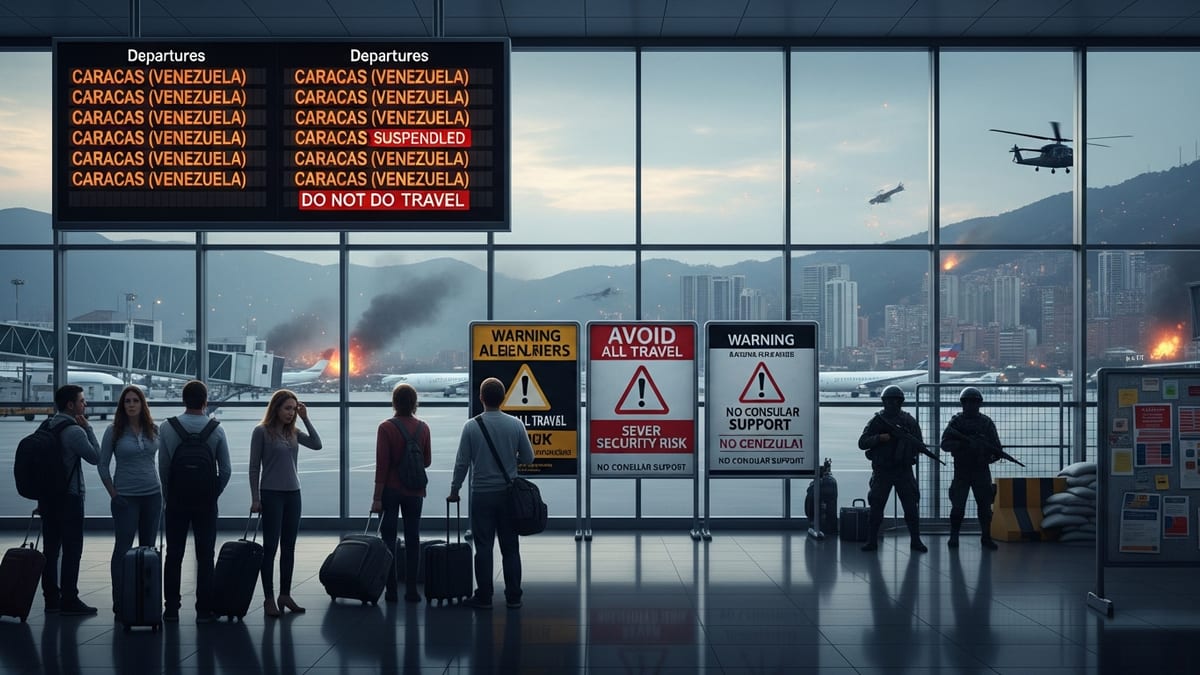
Beyond Africa, the same advisory system currently applies the Level 4 “Do Not Travel” label to a dozen other countries spread across the Middle East, Asia, Eastern Europe and the Caribbean. These include Afghanistan, Syria, Iraq, Yemen, Myanmar (Burma), North Korea, Russia, Ukraine, Iran, Haiti, Venezuela and Belarus. Publicly accessible advisory texts and independent tracking tools show that many of these countries have remained at Level 4 for several years.
In Afghanistan, Syria, Yemen and parts of Iraq, continuing conflict, terrorism and the presence of extremist organizations drive the highest-level warning. Access to airports and overland routes can change with little notice, and in some regions commercial flights are limited or suspended, complicating evacuation options during crises.
Russia and Ukraine are both at Level 4 because of the ongoing full-scale war that began in 2022. The advisories highlight missile and drone strikes, landmines, and restrictions on foreign nationals, as well as the risk of arbitrary enforcement of local laws. Belarus, which borders both Ukraine and European Union member states, is listed in part due to its close involvement in the conflict and tensions with Western governments.
Haiti’s designation reflects a sharp deterioration in security in and around Port-au-Prince, where armed gangs control key roads and neighborhoods, disrupting fuel deliveries and humanitarian work. Venezuela’s warning notes political tensions, shortages of essential goods and heightened risk of arrest or detention for foreign visitors in sensitive areas. For Myanmar and Iran, public documentation cites violent crackdowns on dissent, arbitrary detentions and, in some regions, ongoing clashes between government forces and armed groups.
What Level 4 ‘Do Not Travel’ means for Americans
The US travel advisory system uses four levels, from Level 1 “Exercise Normal Precautions” to Level 4 “Do Not Travel.” Official guidance materials explain that Level 4 is reserved for destinations where there is a higher likelihood of life-threatening risks and where the government may have very limited capacity to assist its citizens during an emergency. This may be due to closed embassies or consulates, restrictions on staff movement or the presence of active fighting.
Unlike visa bans or entry restrictions, these advisories do not prohibit private travel outright. They are strongly worded warnings, designed to inform individual decisions, insurance policies and institutional risk management. Universities, study abroad programs and many companies routinely use Level 3 and Level 4 listings when deciding whether to approve official trips, often suspending travel to Level 4 countries altogether for staff and students.
For destinations at Level 4, publicly available information notes that options for medical evacuation, commercial flights and overland travel may be extremely limited or unavailable without warning. In some conflict zones, airports and border crossings can close suddenly, while damaged roads and checkpoints make internal movement slow and unpredictable. Travelers who decide to go despite the warnings are urged in advisory documents to have contingency plans that do not depend on government-organized evacuations.
Insurance considerations are also significant. Many travel and health insurance policies exclude coverage for trips taken in defiance of official travel advisories, particularly those at the highest level. Travelers who book flights, tours or accommodation in countries listed as Level 4 may find that standard cancellation coverage does not apply if conditions worsen.
How the list is compiled and updated
According to explanatory material published by the State Department and universities that reference the system, each country receives a single overall advisory level, while individual regions within that country may be assessed differently. For example, a country might be rated Level 2 overall, with specific border areas marked at Level 4. In the case of the 23 countries highlighted in the latest coverage, the entire national territory is currently categorized as Level 4.
Advisories draw on security assessments, crime statistics, health data and information from diplomatic posts and partner agencies. The texts typically outline the main risks using standardized indicators such as “terrorism,” “crime,” “civil unrest,” “kidnapping” or “health,” and include recommendations for how to reduce exposure to those threats if travel is unavoidable.
Updates occur when local conditions change significantly or when new information becomes available. Recent media reports referencing advisory databases and independent archives show that some of the Level 4 countries on the current list were first placed there several years ago, with periodic revisions that reflect flare-ups in fighting, new disease outbreaks or shifts in political control. Others, particularly in Africa’s Sahel region and in Eastern Europe, have seen their warnings tightened as conflicts escalated.
Because advisories can change without warning, travelers and travel providers monitoring risk are encouraged in public guidance to check the most recent advisory shortly before departure and again during a trip. Archived data illustrate that even countries long associated with instability can see travel advice improve or worsen within a relatively short period.
What this means for travelers planning trips
For leisure travelers, the presence of a Level 4 warning generally signals that non-essential trips should be postponed or rerouted. Many tour operators, cruise lines and airlines avoid destinations facing the highest advisory level, especially where conflict or state collapse affects infrastructure, airspace and ports. If a country is on the “Do Not Travel” list, finding reliable local partners, comprehensive insurance and flexible transport options becomes substantially more difficult.
Travelers with family ties, humanitarian roles or business interests in affected countries often balance advisory information against local knowledge and obligations. Public safety experts commonly recommend that anyone who proceeds despite a Level 4 designation prepare detailed contingency plans, including secure accommodation, communication tools that can function during outages and pre-arranged exit strategies through multiple routes where possible.
For those who decide that travel is not essential, neighboring countries can sometimes provide alternative gateways to a region, particularly in Africa where Level 1 and Level 2 destinations offer safari, cultural and coastal experiences with significantly lower documented risk. However, travelers are still encouraged to review entry requirements, health recommendations and local security conditions for these alternatives, since advisories for border regions may differ from the safer urban or tourist centers that most visitors experience.
Given the pace of change in several of the affected countries, publicly available advisory material emphasizes that conditions can shift quickly. Anyone with future plans involving destinations near or within the current Level 4 list is advised in those materials to keep monitoring updates, remain flexible with itineraries and prioritize personal safety over fixed travel dates or non-refundable bookings.