


Stand on the rim of Bryce Canyon National Park and you are looking into Bryce Amphitheater, a vast bowl of flame-colored hoodoos that has inspired generations of travelers. Yet within this single natural amphitheater, two perspectives dominate every sunset conversation: the broad, accessible rim viewpoints that frame the Bryce Amphitheater, and the steeper, more elevated perspective from Inspiration Point. Which view is actually more impressive, especially if you have limited time or mobility, or you care most about photography, sunrise colors, or easy access with kids in tow? This guide breaks down the real-world differences to help you choose the view that fits your style of travel.
Get the latest updates straight to your inbox!
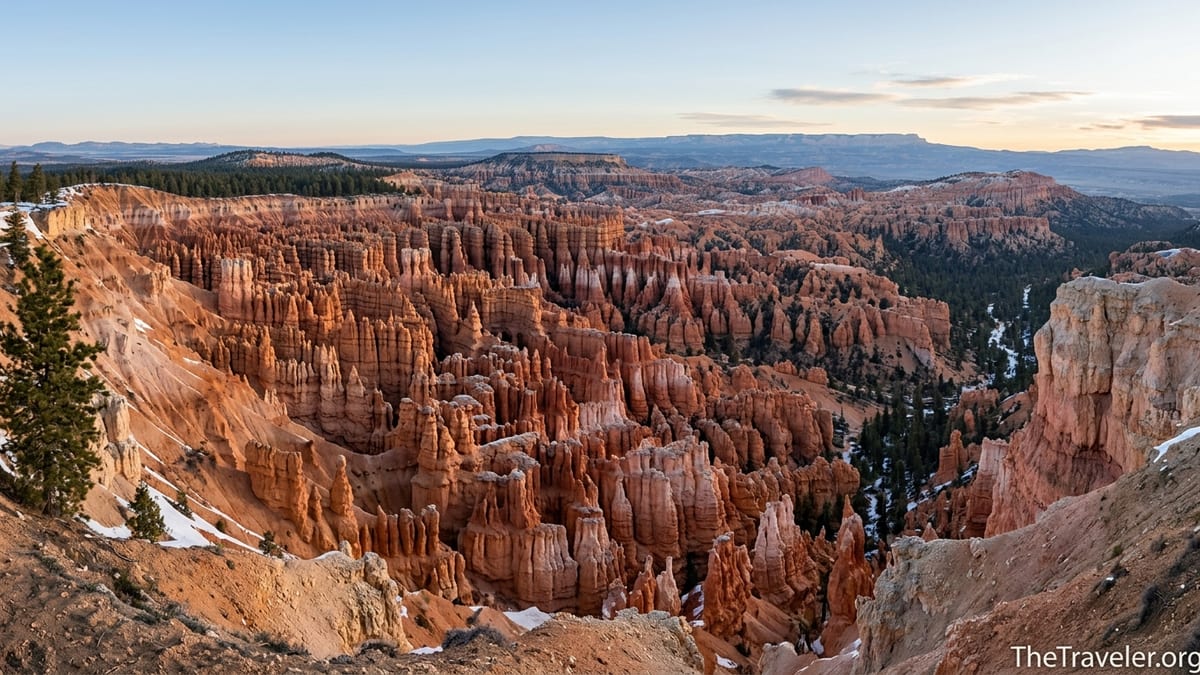
Understanding Bryce Amphitheater and Its Signature Viewpoints
Almost everything first-time visitors imagine when they think of Bryce Canyon sits inside Bryce Amphitheater, a massive natural bowl lined with thousands of eroded rock spires called hoodoos. The National Park Service highlights four primary rim viewpoints here: Sunrise Point, Sunset Point, Inspiration Point and Bryce Point, all along the first few miles of the park road. Together they offer slightly different angles into the same geological wonder, rather than completely separate sights.
Most visitors encounter Bryce Amphitheater first from the central rim, usually around Sunrise and Sunset Points. These are the classic viewpoints near Bryce Canyon Lodge, with large parking areas, restrooms and direct access to the park’s most popular day hikes down into the hoodoos. From here you look across dense clusters of rock spires toward the flat-topped mesa of Boat Mesa and the forested plateau beyond, a sweeping scene that becomes many travelers’ mental image of the park.
Inspiration Point, although physically part of the same amphitheater, feels noticeably different. Set on the rim just south of Sunset Point, it offers a higher, more oblique vantage onto the main hoodoo basin, with the Bryce Amphitheater falling away sharply below the overlook. This is where many photographers come for a sense of depth and texture, rather than just a straight-on postcard scene.
Because all these viewpoints are within a short drive and served by the Bryce Amphitheater shuttle from roughly April through mid-October, you do not have to choose only one. But if you are pressed for time or energy, understanding how the amphitheater viewpoints compare, and how Inspiration Point stands apart, can help you prioritize the single most impressive stop for your trip.
What Makes the Bryce Amphitheater Rim So Memorable?
For many travelers, “the” Bryce view means walking up to the railing at Sunset or Sunrise Point and peering straight down into a maze of hoodoos. At these central amphitheater viewpoints, the canyon feels close and intimate. You can easily pick out individual formations such as Thor’s Hammer or the Silent City, a dense cluster of spires directly below Sunset Point. Photographers appreciate how a moderate telephoto lens at these viewpoints can isolate small groups of hoodoos and capture intricate patterns of orange, pink and white rock.
Practicality also adds to the appeal. Sunrise and Sunset Points are among the most accessible viewpoints in the park. Paved paths, relatively level terrain and nearby parking mean that families with strollers, travelers using wheelchairs or scooters, and anyone sensitive to altitude can reach impressive views with minimal effort. The short paved Rim Trail section between Sunrise and Sunset Points is often recommended as one of the best easy walks in the park, because it serves continuous amphitheater views with almost no elevation change.
If you plan to hike, the Bryce Amphitheater rim is also the gateway to the park’s signature trails. The Queen’s Garden and Navajo Loop combination, which many guidebooks call one of the best short hikes in the U.S. Southwest, starts and ends between Sunrise and Sunset Points. In practical terms, this means you can watch the early glow on the hoodoos from the rim, then drop below the edge within minutes to walk among them. For travelers trying to fit Bryce Canyon into a single afternoon and morning, this compact layout is a major advantage.
Because of this blend of drama and convenience, the Bryce Amphitheater rim, especially around Sunrise and Sunset Points, is often the right choice for first-time visitors who want an impressive view without logistical complexity. You get classic Bryce scenery, easy access to services and trailheads, and plenty of foreground detail for photos, all within a short walk from your car or shuttle stop.
How Inspiration Point Changes Your Perspective
Walk or drive just a short distance south, and Inspiration Point gives the Bryce Amphitheater a different personality. Rather than standing close to individual hoodoos, you are pulled back and lifted higher above the basin. The amphitheater below reads more like a vast, carved tapestry than a collection of discrete rock sculptures. Long fin-like ridges, razor-thin walls and deep gullies are easier to see from this angle, and the way erosion has etched patterns across the landscape becomes more obvious.
Inspiration Point is built on three main tiers of viewpoints. The lower viewpoint is closest to the parking area and offers a strong panorama with relatively little climbing. The middle and upper viewpoints require hiking up a short but steep dirt path that can feel strenuous at over 8,000 feet of elevation. From the upper level, the view opens wide to the north and south, revealing not only the amphitheater directly below but also the plateau forest and distant mountains that frame the scene. Many photographers consider this elevated perspective the best single overlook for capturing the full scale of Bryce’s main amphitheater.
Lighting behaves differently here as well. At sunrise, side light from the east rakes across the amphitheater and picks out long shadows behind each hoodoo, emphasizing depth. Because you are somewhat offset from the main basin, you see more oblique, layered ridgelines rather than just a front-on wall of spires. At mid-morning or late afternoon, when the sun is higher, Inspiration Point can still be rewarding because the sheer density of hoodoos below provides continuous texture, even in softer light.
This perspective does come with trade-offs. From Inspiration Point you are farther from many of the named formations, so you will not be picking out Thor’s Hammer or individual arches with the naked eye as easily as at Sunset Point. For travelers who prefer recognizable landmarks or close-up drama, that distance can make the scene feel more abstract. But for those who crave a grand overview and a sense of the amphitheater’s true magnitude, Inspiration Point often feels more impressive than the central rim.
Accessibility, Effort and Safety: Which View Is Easier to Reach?
If mobility or altitude are concerns, the Bryce Amphitheater rim around Sunrise and Sunset Points generally wins on ease of access. The paved Rim Trail segment between these two viewpoints is mostly flat and suitable for wheelchairs and strollers with some assistance. Shuttle buses typically stop at both points in season, so you can step off, roll or walk directly to the railing, and enjoy sweeping views without any steep climbs. Restrooms, water refill stations in warm months and food options near the lodge further reduce the friction of a visit.
Inspiration Point demands more from your legs and lungs. The parking area itself is fairly level and close to the lower viewpoint, which has a hard-packed surface, but the climb to the upper viewpoints involves an uphill path with about 120–130 feet of elevation gain in roughly a quarter of a mile. At over 8,000 feet, that short distance can feel surprisingly intense, especially if you have heart or lung conditions, are recovering from illness, or are simply not used to altitude. In winter or after storms, the path can be icy or muddy, and the National Park Service specifically warns visitors to be cautious near the edge because there are steep, exposed drop-offs without tall railings.
Traveling with young children or older relatives, these factors matter. A multi-generational family road-tripping through southern Utah might find that grandparents are happiest soaking up the view from the paved rim at Sunset Point, while fitter adults or teens walk or drive over to Inspiration Point for a quick dash up to the upper overlook. The Bryce Amphitheater shuttle makes these flexible plans easier, since you can ride between viewpoints without worrying about crowded parking lots during peak summer afternoons.
If conditions are wintery, safety should guide your decision even more. The central Bryce Amphitheater rim is usually among the first areas to be plowed and sanded after snow, and the paved paths are easier to manage in traction devices than the dirt slope at Inspiration Point. When heavy snow or ice are present, rangers sometimes advise visitors with limited mobility to stick to the main viewpoints and avoid steeper, unpaved sections near cliff edges, which can make the classic rim viewpoints the more practical and comfortable choice.
Which View Is Better for Sunrise, Sunset and Photography?
Because both the Bryce Amphitheater rim and Inspiration Point look mostly east into the amphitheater, sunrise is generally more dramatic than sunset at either location. At dawn, the first low-angle light ignites the hoodoos from the side and below, turning the pink and orange rock into glowing pillars while the plateau rim behind you remains in shadow. At sunset, the hoodoos still glow but you are often looking into more backlit conditions or softer, flatter light, and clouds to the west become more important for color.
Inspiration Point shines for photographers who want depth and leading lines. From the upper overlook, the carved ridges and gullies run diagonally across the frame, creating natural composition guides. A wide-angle lens around 16–24mm on a full-frame camera can capture the sweeping amphitheater, while a mid-range zoom around 24–70mm isolates layers of hoodoos receding into haze. If you are comfortable arriving 30–45 minutes before sunrise, setting up on the upper tier of Inspiration Point is one of the most rewarding single-photo sessions in the park, especially on partly cloudy mornings when light moves in and out across the basin.
By contrast, the Bryce Amphitheater rim at Sunrise and Sunset Points is particularly friendly to casual photographers and smartphone users. Foreground hoodoos sit very close to the rim, so even a phone camera can capture strong, detailed compositions without needing a long lens. Short paths just below the rim near Sunrise Point, and the start of the Navajo Loop near Sunset Point, offer slightly different angles within just a few minutes’ walk. For families who want quick photos before heading down the Queen’s Garden trail or driving on to Zion, these central viewpoints provide excellent images with almost no planning.
For pure color, both vantage points can be spectacular on winter mornings, when snow outlines each rock fin and amplifies contrast. In summer, haze from regional wildfires or dust can soften midday views, and this is where Inspiration Point’s higher angle can still feel rewarding because it emphasizes layers and depth. If you are chasing star photography or Milky Way shots, the Bryce Amphitheater rim near Sunrise or Sunset Points offers more nearby services and safer, more obvious paths in the dark, while Inspiration Point appeals to photographers who are comfortable navigating a short, steep trail by headlamp and working close to unrailed drop-offs.
Pairing Views With Hikes, Shuttles and Trip Length
How much time you have in Bryce Canyon should strongly influence which view you prioritize. With only a few hours on a larger road trip, many travelers choose to park near Sunrise or Sunset Point, walk part of the easy rim, and then either drop briefly into the Queen’s Garden trail or simply soak up the view. In a morning or afternoon, this approach gives you both an impressive amphitheater panorama and a tangible sense of walking among hoodoos, all centered around the core Bryce Amphitheater viewpoints.
With a full day or overnight stay, adding Inspiration Point into the mix becomes easy and highly worthwhile. The Bryce Amphitheater shuttle runs from spring into fall and stops at all four major viewpoints, so you can create a loop: start at Bryce Point for sunrise or early light, ride or drive to Inspiration Point to see the amphitheater from above, then continue to Sunset and Sunrise Points for closer views and a hike. This kind of circuit works particularly well if you are staying at Bryce Canyon Lodge or a nearby hotel in Bryce Canyon City and want to leave your car parked during the busiest midday hours.
Travelers focused on photography often design their itinerary around specific light. A practical example: on a two-night stay, you might spend your first evening scouting the Bryce Amphitheater rim, then photograph sunrise the next morning from Inspiration Point’s upper tier. Later that day you hike the Queen’s Garden and Navajo Loop combination, returning to the rim near Sunset Point for golden-hour photos. On your final morning, you could catch a slightly later sunrise from Sunrise Point, where the walk from the lodge is short and easy even in the pre-dawn chill.
The good news is that entrance fees at Bryce Canyon cover all these options within a single visit period. Once you have paid the standard private vehicle fee at the entrance station, there is no additional charge to use the amphitheater shuttle or to visit multiple viewpoints. This means you do not need to agonize over a single “right” choice; instead you can decide which view to see first and which to prioritize for prime light, knowing you can easily sample others if time allows.
The Takeaway: So Which Bryce Canyon View Is More Impressive?
Ask a ranger at Bryce Canyon which view is best, and you will usually get a polite version of “it depends.” The amphitheater rim around Sunrise and Sunset Points delivers the quintessential Bryce experience: close, intricate hoodoos, easy access, paved paths and immediate connections to the park’s most famous trails. For first-time visitors with limited time, families with small children, or travelers with mobility concerns, this central rim is almost always the most satisfying and practical choice.
Inspiration Point, on the other hand, appeals to travelers willing to work a little harder for a broader, more dramatic panorama. From its upper tiers, you see the Bryce Amphitheater as a vast, sculpted basin, with ridges, fins and hoodoos arranged like an enormous stone amphitheater. Photographers, sunrise chasers and visitors who prioritize sweeping, layered vistas often walk away from Inspiration Point feeling they have seen the park at its most grand and three-dimensional.
If you have to choose just one view and want something accessible, social and iconic, the Bryce Amphitheater rim at Sunrise or Sunset Point is likely your best bet. If you can manage a short, steep climb and crave an overlook that reveals the full scale and artistry of the landscape, Inspiration Point will probably strike you as more impressive. With even half a day in the park, the ideal solution is to see both: start at the amphitheater rim to ground yourself in Bryce’s intricate hoodoos, then climb to Inspiration Point to understand just how vast and extraordinary this natural amphitheater really is.
FAQ
Q1. Is Inspiration Point worth visiting if I have already seen Sunrise and Sunset Points?
Yes. Sunrise and Sunset Points provide classic, close-up views of the hoodoos, while Inspiration Point offers a higher, more expansive perspective that reveals the amphitheater’s scale and layered ridges. Many travelers who have time for all three say Inspiration Point gave them their favorite single panorama of the trip.
Q2. Which viewpoint is better if I have limited mobility?
The Bryce Amphitheater rim around Sunrise and Sunset Points is generally better for limited mobility, thanks to paved paths, relatively level terrain and shuttle stops close to the overlooks. Inspiration Point’s lower viewpoint is reachable with a short walk, but the upper tiers require a steep, unpaved climb that can be difficult at high elevation.
Q3. Where should I go for the best sunrise view in Bryce Canyon?
Both the central amphitheater rim and Inspiration Point face east into the hoodoos, making sunrise impressive at either. If you prefer an easy approach in the dark and quick access from the lodge or parking, Sunrise or Sunset Point is ideal. If you are comfortable with a short uphill walk before dawn and want a wide, layered panorama, the upper level of Inspiration Point often delivers the most dramatic sunrise compositions.
Q4. Is Inspiration Point safe for young children?
With supervision and clear boundaries, many families visit Inspiration Point without problems, but parents should be extra cautious. The path to the upper viewpoints is steep, the surface can be loose or icy, and there are exposed drop-offs with limited railings. Families with very young children or anyone prone to running ahead may prefer to enjoy the lower viewpoint or stick to the paved rim between Sunrise and Sunset Points.
Q5. Can I walk between the Bryce Amphitheater viewpoints and Inspiration Point?
Yes. A section of the Rim Trail connects Sunrise, Sunset and Inspiration Points. The paved part between Sunrise and Sunset Points is mostly flat and suitable for most visitors. The continuation toward Inspiration Point adds more elevation changes and unpaved sections, so some travelers choose to hike only part of it and rely on the shuttle or their car to move between more distant viewpoints.
Q6. Which view is better for photography if I have only a smartphone?
If you are shooting primarily with a smartphone, the Bryce Amphitheater rim at Sunrise or Sunset Point usually works best. Hoodoos and rock formations sit closer to the rim here, so wide smartphone lenses can still capture detailed, compelling compositions. Inspiration Point’s broader, more distant view is beautiful but can feel harder to translate into strong images without the ability to zoom optically or compress layers with a longer lens.
Q7. How crowded do these viewpoints get, and can I avoid the crowds?
Sunrise and Sunset Points, being closest to the lodge and main services, are typically the busiest viewpoints, especially around mid-morning and late afternoon in peak season. Inspiration Point can also be busy but often feels a little quieter because of the short climb. To avoid crowds at any viewpoint, aim for sunrise, late evening or shoulder-season visits in spring and fall, and use the park shuttle to avoid circling for parking.
Q8. Do I need any special gear to visit Inspiration Point?
In dry summer conditions, sturdy walking shoes, sun protection and water are usually sufficient. In shoulder seasons or winter, traction devices for your shoes can make a big difference on icy or packed-snow paths, and warm layers are essential at this elevation. A small daypack is helpful so your hands remain free on the steep sections leading to the upper viewpoints.
Q9. Can I combine a visit to Inspiration Point with a hike below the rim?
Yes. Many visitors pair Inspiration Point with the Queen’s Garden and Navajo Loop combination, which begins and ends between Sunrise and Sunset Points. A practical itinerary is to visit Inspiration Point for an elevated overview first, then ride the shuttle or drive to Sunrise or Sunset Point and descend into the amphitheater on the loop trail, seeing the same landscape from above and below in a single outing.
Q10. If I only have one hour in Bryce Canyon, where should I go?
With just an hour, most travelers will get the most from the Bryce Amphitheater rim around Sunrise or Sunset Point. Parking is straightforward, the paths are easy, and you can quickly reach some of the park’s most iconic views. If parking is full or you strongly prefer a wide, sweeping overlook and are comfortable moving quickly uphill, driving or riding the shuttle to Inspiration Point and visiting the lower or middle viewpoint can also make for an unforgettable short stop.