


Standing on the rim of Bryce Canyon, it is easy to fall in love with the orange spires and rippling amphitheater but harder to choose the right trail. For many travelers, the real decision comes down to two classics: the long, scenic Fairyland Loop or the iconic, shorter Navajo Loop. Both plunge you into Bryce’s hoodoo wonderland. They simply do it in very different ways. Here is how to decide which one fits you better, based on time, fitness, season, and the kind of experience you want out of your Bryce Canyon day.
Get the latest updates straight to your inbox!
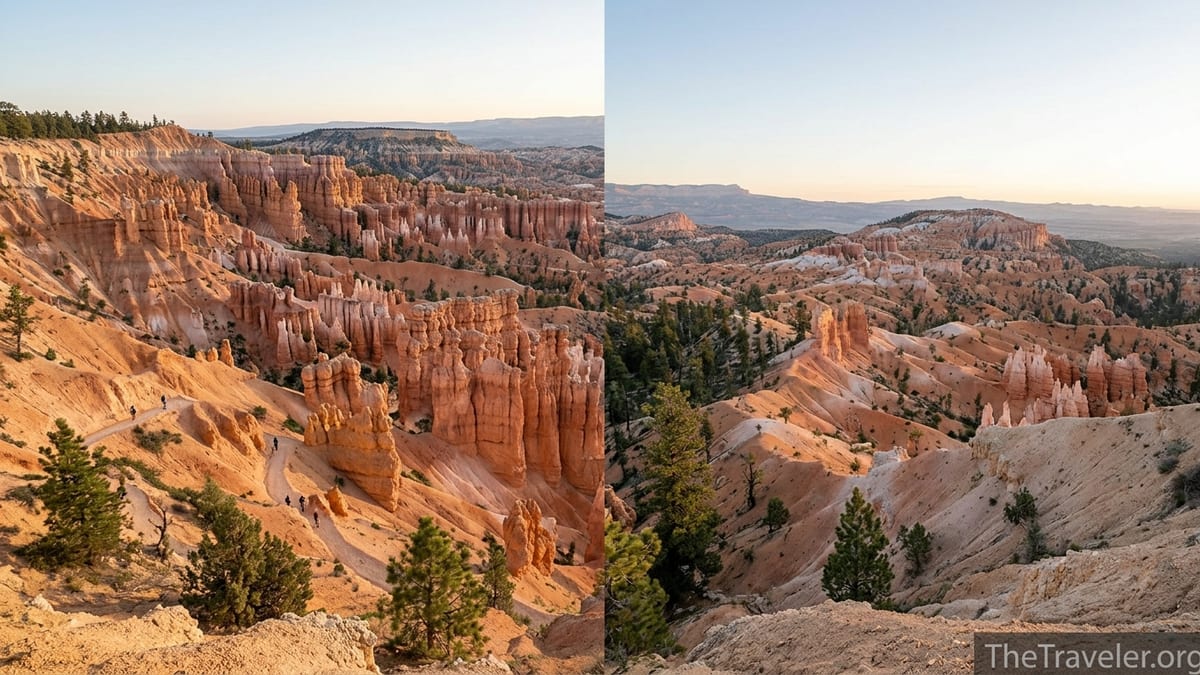
The Essentials: How Fairyland Loop and Navajo Loop Compare
Fairyland Loop is one of Bryce Canyon National Park’s longest established day hikes, usually listed at about 8 miles round trip when combined with the Rim Trail section. Expect roughly 1,500 feet of cumulative elevation gain spread across rolling ups and downs. Most hikers finish it in 4 to 5 hours, making it a true half-day outing rather than a quick leg-stretcher. At typical summer paces, that means starting between 7 and 8 a.m. if you want to be back at your car by lunchtime.
By contrast, the Navajo Loop is compact and intense. The National Park Service lists it at 1.3 miles with about 500 to 550 feet of elevation change between Sunset Point and the canyon floor. Most reasonably fit visitors complete it in 60 to 90 minutes. You feel that vertical in your lungs, especially at Bryce’s roughly 8,000-foot elevation, but the short distance keeps it accessible for many casual hikers and families with older kids.
In practical terms, that means Fairyland Loop is better suited to travelers who can commit half a day on foot and are comfortable with a longer, more sustained effort. Navajo Loop is the “must do” option if you have only one afternoon in the park or you are building a day that includes several viewpoints, a scenic drive, or another short hike such as Queen’s Garden.
If you are planning a single overnight at Bryce and driving in from Zion or Page the same day, Navajo Loop fits more easily into a compressed schedule. If Bryce is your main stop for the day and you like the idea of earning quieter views away from the crowds, Fairyland Loop can be the centerpiece experience.
Scenery: Iconic Hoodoos vs Wide-Open Fairyland
Navajo Loop delivers what many visitors picture when they dream about Bryce Canyon. Starting from Sunset Point, you look straight into the Bryce Amphitheater, with dense clusters of hoodoos and named formations like Thor’s Hammer and the Silent City rising below. Descending the Wall Street side, you weave down tight switchbacks between soaring orange walls, with tall Douglas fir trees improbably growing from the canyon floor. It feels dramatic and vertical, a short hike with a big sense of scale.
Fairyland Loop, on the other hand, trades that tight amphitheater drama for a more open, sweeping landscape. The trail meanders north of the main Bryce Amphitheater, dipping in and out of Fairyland Canyon and Campbell Canyon. You see eroded fins, colorful banded slopes, and scattered hoodoos that feel more wild and less sculpted than the formations near Sunset and Sunrise Points. From sections of the Rim Trail near Boat Mesa, you get long views back toward the main amphitheater while standing in a much quieter corner of the park.
Think of Navajo Loop as the classic first-timer’s postcard. It is where you stand beneath Thor’s Hammer, look up through the narrow walls of Wall Street, and come home with the photos friends recognize instantly. Fairyland Loop feels more like exploring the back of the postcard. You still get remarkable hoodoos and color, but with more variety in the terrain and a stronger sense of wandering through a broader landscape rather than dipping into a single amphitheater.
For photographers, that difference matters. On Navajo Loop, sunrise and late afternoon light bouncing off the narrow walls can be spectacular, but framing wide shots is limited because you are hemmed in by rock. Fairyland Loop offers more opportunities for wide compositions of ridges and canyons, especially in softer early or late light, when the shapes stand out and the crowds are minimal.
Difficulty, Fitness, and Altitude: Which Hike Fits Your Body?
Fairyland Loop is generally rated moderate to strenuous, mainly because of its length and cumulative elevation. While there are no single brutally steep climbs like the Wall Street switchbacks, you are almost always either ascending or descending gentle grades. Over 8 miles, that adds up. For a traveler who normally walks 2 to 3 miles at home, this can feel like a big jump, especially at high altitude.
Navajo Loop is officially listed as a moderate hike. The catch is that all the elevation is packed into a short distance. Dropping from Sunset Point you lose about 500 feet quickly, then must climb it back at the end when you are tired. Visitors coming from lower elevations often underestimate how much 8,000 feet affects their breathing. It is common to see people stop every few switchbacks on the way out, catching their breath and sipping water.
In practice, choose Fairyland Loop if you are used to 6 to 8 mile walks or hikes at home, or if you run or cycle regularly and like a sustained workout. This is the loop for someone who would happily spend a few hours on the trail in Zion or Grand Canyon and wants a comparable experience here. Choose Navajo Loop if you are comfortable with well-maintained but steep trails, can climb a few flights of stairs without much trouble, and prefer something under 2 hours.
One real-world example: a couple in their late 50s driving up from Las Vegas often opts for Navajo Loop on day one. They might reach Bryce midday, walk the 1.3-mile loop, then add a gentle stroll along the paved Rim Trail between Sunset and Sunrise Points. The next morning, once acclimated and rested, they might consider Fairyland Loop as a bigger adventure if their legs feel fresh and the forecast is mild.
Crowds, Parking, and Overall Experience
Navajo Loop starts and ends at Sunset Point, one of the park’s busiest overlooks. On a summer Saturday in July or over a holiday weekend, the small parking lot can be full by 9 a.m. The park’s free shuttle often becomes the easier way to reach the trailhead. Along the first quarter mile, you will likely be sharing the path with dozens of other visitors. People spread out a bit as you descend, but this is still one of Bryce Canyon’s signature hikes, and it feels like it.
Fairyland Loop generally sees far fewer hikers. Some people start from Fairyland Point at the northern edge of the main road, where parking is limited. Others begin at Sunrise Point, hiking the Rim Trail north before dropping into the canyon and looping back. In both cases, the number of people on the trail tends to thin dramatically once you are more than a mile from the trailhead. On a shoulder-season weekday in October, you might hike long stretches without seeing anyone else, especially in the middle section around the floor of Fairyland Canyon.
This has real practical benefits. On a busy summer afternoon, you may find yourself waiting at switchbacks on the Wall Street side of Navajo Loop while others climb up or down. If you are hiking with younger children, you will constantly remind them to stay away from the edge when the trail narrows. On Fairyland Loop, you deal more with open slopes and some exposure to sun, but less with narrow trail congestion and jostling for space at famous viewpoints.
If your ideal national park experience involves some solitude, the sound of wind through pines, and the ability to stop for long photo breaks without feeling in the way, Fairyland Loop has the edge. If, on the other hand, you enjoy the buzz of a popular viewpoint, prefer knowing that there will be plenty of other people around, and want an easy-to-navigate, heavily trafficked trail, Navajo Loop may fit your comfort level better.
Season, Weather, and Trail Conditions
Bryce Canyon sits higher than many visitors expect. Snow can linger on north-facing slopes well into April, and summer afternoons can be hot despite the elevation. Seasonal conditions matter when choosing between Navajo Loop and Fairyland Loop. For example, the famous Wall Street side of Navajo Loop often closes in winter because of ice and rockfall risk, leaving only the Two Bridges side open as a partial loop or out-and-back. In those months, you may descend via Two Bridges, explore the canyon floor briefly, and then return the same way, or combine that segment with another trail like Queen’s Garden.
Fairyland Loop, running across a variety of aspects and generally lower ridges than the main amphitheater, can be hikeable earlier in the season when deeper shaded trails remain icy. However, large stretches are exposed to sun. From late June through early September, when midday temperatures can climb into the 80s Fahrenheit, that exposure makes an 8-mile midday hike feel significantly harder. Planning a very early start becomes important to avoid heat, and carrying more water is essential.
Consider your travel dates. A family visiting in March might find that the full Navajo Loop is partially closed due to residual snow and mudslides, making Fairyland Loop or combinations like Queen’s Garden and other rim segments more attractive. On a clear morning in October, both trails can be magnificent, but Fairyland Loop often shines in cooler, crisp air and slanting autumn light.
In all seasons, traction devices such as light microspikes can make a bigger difference than people expect. If you visit in late fall, winter, or early spring and want to attempt either hike, check current National Park Service trail conditions at the visitor center and be prepared to pivot: you may find Navajo Loop limited, while Fairyland or other loops offer safer footing.
Time Budgeting, Itineraries, and When to Hike Each
Because these hikes differ so much in length, they fit into Bryce itineraries in different ways. Navajo Loop is straightforward to pair with other experiences. A common one-day itinerary from nearby lodging in Bryce Canyon City looks like this: sunrise at Sunrise Point, a quick breakfast, then a midmorning Navajo Loop starting around 9 a.m. After lunch, many visitors drive the main park road to viewpoints like Inspiration Point and Bryce Point, stopping for short rim strolls before returning to watch sunset again at Sunset Point.
Fairyland Loop, by contrast, works best when treated as the main event. One realistic half-day plan for a fit couple might be to start from Sunrise Point around 7 a.m., hike north along the Rim Trail while the air is cool and the light soft, then descend into Fairyland Canyon and complete the loop, stopping for snacks at shaded spots. With breaks and photos, they might finish around noon or 1 p.m., leaving the afternoon for shorter overlooks or a relaxing drive back toward Zion or Capitol Reef.
If you have two nights near Bryce, you can realistically do both, using them for different moods. Day one could feature Navajo Loop combined with Queen’s Garden into the popular 2.9-mile figure, then a scenic drive. Day two could be dedicated to Fairyland Loop as a more tranquil, exploratory option. This rhythm works well for travelers road-tripping across southern Utah’s national parks, giving them one highly famous, social hike followed by a quieter, more meditative one.
Solo travelers, especially those arriving without a car and relying on park shuttles, often gravitate toward Navajo Loop because it is closer to services and easier to bail out of if weather shifts. However, a solo hiker who is comfortable with longer distances and starts early can have a deeply rewarding day on Fairyland Loop, with less small talk and more space to enjoy the sound of their own footsteps on the sandy trail.
Families, New Hikers, and Risk Tolerance
For families debating whether to tackle Fairyland Loop or Navajo Loop, age, patience, and heat tolerance often matter more than pure difficulty ratings. Younger kids, particularly those under 10, typically handle Navajo Loop better because there is immediate visual payoff. Within minutes of leaving Sunset Point, they are winding through switchbacks and staring up at towering walls, which helps distract from the climb. You can always turn around and retrace your steps if anyone is struggling.
Fairyland Loop is trickier for children and newer hikers because it is long and does not offer an easy halfway bailout. Once you commit to the loop, the fastest way back to the car is usually to keep going. That is fine for older kids used to walking several miles, but it can become a slog for a child who loses motivation in full sun three hours into the hike. If you travel with a stroller or have family members who are nervous around cliff edges, sticking to the paved sections of the Rim Trail and a short partial descent on Navajo or Queen’s Garden might be a better compromise.
Risk tolerance comes into play too. Neither trail is particularly technical, but both involve drop-offs in places and, at times, loose gravel underfoot. On Navajo Loop, the main concern is congestion on steep switchbacks. You need to be comfortable managing your own pace and stepping aside for others. On Fairyland Loop, exposure to weather is a bigger factor. Summer thunderstorms can roll in quickly over the plateau; you will want to start early enough that you are not on exposed ridges in midafternoon if storms are in the forecast.
If anyone in your group has a known fear of heights, it is helpful to watch recent visitor videos of each trail before you go. Many travelers who are uneasy on exposed cliffside paths find the wider, forested bottom sections of Navajo Loop manageable, especially when hiking down Wall Street and up the slightly more open Two Bridges side. Fairyland Loop’s long open traverses can feel fine for some and a bit unnerving for others.
The Takeaway
If you picture Bryce Canyon as a quick but unforgettable detour on a broader road trip, Navajo Loop is almost certainly the better fit. It is short, steep, and spectacular, dropping you directly into the park’s most iconic amphitheater, with Thor’s Hammer, Wall Street, and classic viewpoints like Sunset Point all in one compact package. For first-time visitors with limited time or mixed fitness in the group, it is hard to argue against starting here.
If, instead, you dream of a longer, more immersive wander through Bryce’s hoodoo country, Fairyland Loop may become your favorite hike of the trip. Its 8-mile circuit strings together open ridges, quiet canyon bottoms, and big, sweeping views with far fewer people around. It requires a bit more fitness, more water, and better timing around weather, but it rewards that commitment with a sense of space and solitude that the amphitheater trails rarely offer.
Ultimately, neither choice is wrong. Many travelers fall in love with Bryce on Navajo Loop and return years later specifically to hike Fairyland Loop. Use your available time, fitness level, season, and appetite for crowds as your guide. If you can, plan your trip so that your first day features Navajo Loop’s dense, iconic scenery, and your next gives you the quiet magic of Fairyland. Together, they reveal two very different but equally memorable faces of Bryce Canyon.
FAQ
Q1. Is Fairyland Loop much harder than Navajo Loop?
Fairyland Loop is longer and has more cumulative elevation gain, so it feels harder overall, especially in heat, but it does not have the same short, steep climb as Navajo’s switchbacks.
Q2. How long do I need to hike each trail?
Navajo Loop usually takes 1 to 2 hours for most visitors, including photo stops, while Fairyland Loop typically requires 4 to 5 hours at a relaxed but steady pace.
Q3. Which trail is better for a first-time visitor with only half a day?
If you have just a half day and want the classic Bryce Canyon experience, Navajo Loop is usually the better choice, possibly combined with the nearby Rim Trail or Queen’s Garden.
Q4. Can I hike both Fairyland Loop and Navajo Loop in one day?
Fit hikers can combine them, but it makes for a very full day. Most travelers enjoy their visit more by doing Navajo Loop plus a short rim walk one day and saving Fairyland Loop for another morning.
Q5. Are there age limits or restrictions for kids on these trails?
There are no formal age limits, but Navajo Loop is usually more manageable for children because it is shorter. Fairyland Loop is best for motivated older kids and teens used to walking several miles.
Q6. What is the best time of day to hike each trail?
Early morning works best for both, especially in summer. Start Fairyland Loop around sunrise for cooler temperatures, and aim to begin Navajo Loop before midmorning to avoid crowding and midday heat.
Q7. Which trail offers better photo opportunities?
Navajo Loop excels for close-up views of hoodoos and the dramatic Wall Street section, while Fairyland Loop is stronger for wide, panoramic shots of ridges, canyons, and distant formations.
Q8. How should I choose if I am sensitive to altitude?
Both trails start high, but Navajo Loop is shorter, so you are exposed to exertion at altitude for less time. If you know altitude affects you, plan Navajo Loop first, move slowly, and bring extra water.
Q9. What gear do I need for each hike?
Sturdy footwear with good traction, sun protection, and at least one liter of water per person for Navajo Loop are reasonable. For Fairyland Loop, plan on more water, additional snacks, and layers for changing weather.
Q10. How do closures or weather affect my choice between the two?
In winter and early spring, parts of Navajo Loop may close due to ice or rockfall, while Fairyland Loop can be snow-covered or muddy. Always check current conditions at the visitor center and be prepared to switch plans based on trail advisories.