


Stand on the rim of Bryce Amphitheater on a clear morning and the scene barely looks real. Thousands of fire-colored spires crowd the basin below, light pours in from the east, and the air at 8,000 feet feels thin and crisp. It is the heart of Bryce Canyon National Park, the place that draws almost every visitor at some point in their trip. Many viewpoints in this Utah park are memorable, but the sweeping, ever-changing panorama of Bryce Amphitheater is the one that travelers talk about years later.
Get the latest updates straight to your inbox!
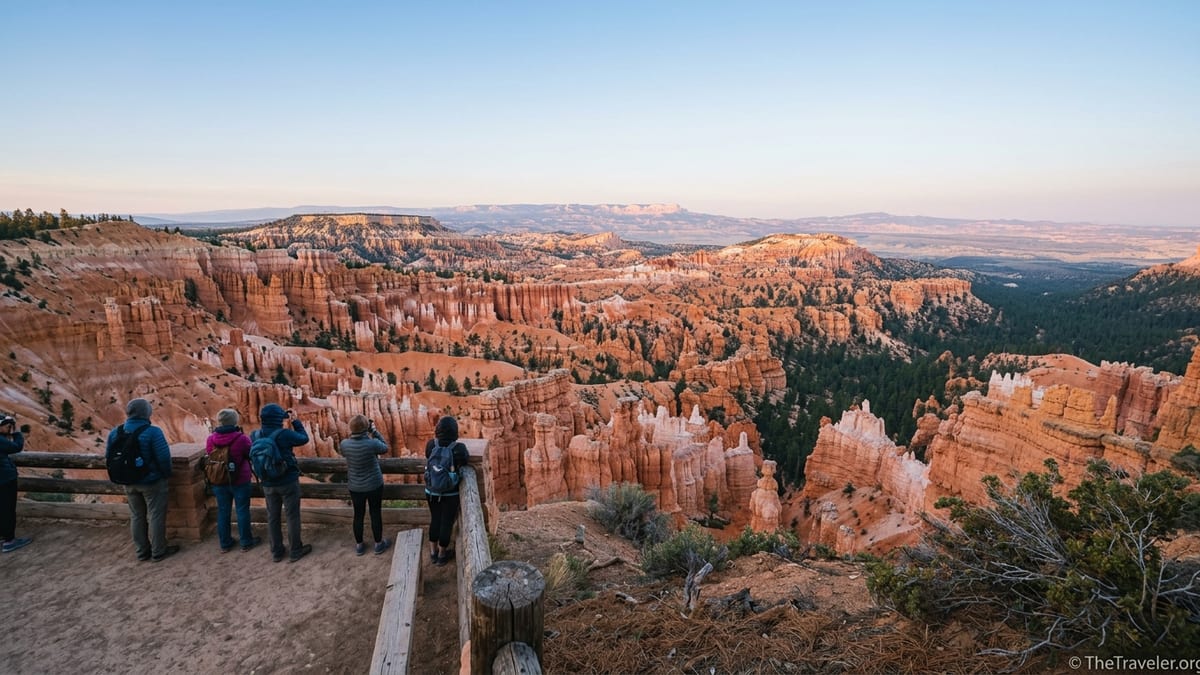
The Natural Architecture That Defines Bryce Canyon
Bryce Amphitheater is not a single viewpoint but a vast natural bowl cut into the Paunsaugunt Plateau, filled with the largest concentration of hoodoos in the park. From the rim, you can see these orange and pink limestone towers packed so tightly that they resemble a frozen city. At popular overlooks like Inspiration Point and Bryce Point, the view stretches across the entire amphitheater, giving you a sense of its scale in a way no photo fully captures.
What makes this view so extraordinary is the layering of shapes and colors. Eroded rock fins form walls and alleys, while isolated hoodoos rise like skyscrapers. Below the rim, pine trees cling to the slopes, adding deep green to the palette of reds and creams. On clear days you can see beyond the amphitheater to distant plateaus, so your eye is always traveling from close-up texture to wide open horizons. Even travelers who have visited Grand Canyon or Zion often say the amphitheater looks like nowhere else on earth.
The geology helps explain the drama. Over millions of years, freeze-thaw cycles fractured the soft Claron Formation, carving ridges into individual spires. The result is a view that feels both chaotic and perfectly ordered, with repeating patterns that change subtly with every step along the rim. It is this density of hoodoos, combined with the sheer drop from rim to basin, that makes the amphitheater the park’s visual centerpiece.
Four Iconic Rim Viewpoints, One Continuous Wonder
The most breathtaking part of Bryce Amphitheater runs along the first few miles of the park road, where four major viewpoints share different angles on the same natural stage: Sunrise Point, Sunset Point, Inspiration Point and Bryce Point. Each is easy to reach from the main parking areas or by the seasonal park shuttle, which typically runs from April through mid-October on frequent loops between the shuttle station outside the gate and these overlooks.
Sunrise Point sits at the northern edge of the amphitheater and offers a balanced view of hoodoos and the pastel plateaus beyond. From here, you look south over the basin and can spot landmarks like Boat Mesa and the Aquarius Plateau on a clear day. Walk just half a mile on the paved Rim Trail and you reach Sunset Point, where the view plunges straight down into some of the park’s most famous formations, including the much-photographed hoodoo known as Thor’s Hammer visible from the Navajo Loop trail below.
Farther along by shuttle or car, Inspiration Point gives a lofty, slightly more distant angle. Standing on its upper terrace, you look down into what many travelers describe as a “forest of stone,” ideal for appreciating just how many hoodoos cram into the basin. Bryce Point, at the end of the amphitheater section of the road, offers a panoramic view north across the full length of the bowl and out toward the Kaiparowits Plateau and Navajo Mountain on clear days. It is one of the best places to understand the amphitheater as a single, unified landscape.
The Magic of Sunrise, Sunset and Changing Light
What elevates Bryce Amphitheater from impressive to unforgettable is the way light transforms it throughout the day. At sunrise, particularly from Sunrise Point or Bryce Point, the first light hits the hoodoos from the east. The tops of the spires catch the glow while the basin remains in shadow, creating a band of fiery orange that slowly sinks down the walls as the sun climbs. Travelers who arrive just before the official sunrise time often find that the most beautiful colors appear 10 to 20 minutes after the sun peeks over the horizon, when the light is still soft and low.
By late morning, shadows shorten and the amphitheater brightens, which is ideal if you plan to hike into the basin on the Queen’s Garden or Navajo Loop trails. In midsummer, many visitors time their descent between about 8:30 and 10:30 a.m., when temperatures are rising but the high elevation still keeps conditions relatively cool compared with nearby desert parks. On clear days in October or November, you may find crisp air, patches of frost at the rim and a dusting of snow accenting each hoodoo, making the colors even more vivid.
Sunset brings a different kind of spectacle. Despite its name, Sunset Point does not offer a classic sun-dropping-over-the-horizon view, because the sun actually sets behind the forested plateau to the west. Instead, the magic is in the amphitheater itself. In the last hour of light, the hoodoos turn deeper orange, shadows lengthen and details stand out in high relief. Photographers often favor Inspiration Point or Sunset Point for this time of day, arriving 30 to 45 minutes before sunset to find a good vantage point along the railing and watch the colors shift with every minute.
Stepping Inside the View: Trails That Drop Into the Amphitheater
Unlike many grand vistas that are best seen from a distance, Bryce Amphitheater invites you to step directly into the scenery. Several of Bryce Canyon’s most famous day hikes begin right on the rim, turning the breathtaking view into an immersive experience. The Queen’s Garden trail descends from Sunrise Point in about 1.8 miles round trip, dropping roughly 450 feet into the basin. It is considered one of the least strenuous routes below the rim, though the climb back up at altitude still leaves many visitors catching their breath.
From Sunset Point, the Navajo Loop trail plunges into narrow switchbacks between towering orange walls. One side of the loop passes Thor’s Hammer, a hoodoo whose precarious stone “head” seems to balance on a narrow neck. In summer, the famous Wall Street section, a tight corridor of stone, usually opens after winter closures are lifted, creating a slot-like passage that feels worlds away from the open rim just a few minutes above. Many travelers combine Queen’s Garden and Navajo Loop into a 2.9-mile circuit, starting at Sunrise Point, dropping down Queen’s Garden and climbing out via Navajo to finish at Sunset Point before strolling the half-mile along the rim back to their starting point.
For a longer, more strenuous immersion, hikers at Bryce Point can descend into Peekaboo Loop, about 5.5 miles, where the crowds thin out and the amphitheater feels larger and quieter. Strong hikers sometimes link Peekaboo with Queen’s Garden and Navajo for an all-day challenge that might total 7 to 10 miles depending on the route. Even if you stick to the easier routes, the key highlight is the same: looking up from the canyon floor, you see the amphitheater’s walls towering above, with hoodoos silhouetted against the sky in all directions.
Practical Ways to Experience the Amphitheater at Its Best
Because Bryce Amphitheater is the park’s star attraction, a bit of planning can make the difference between a crowded overlook and a surprisingly quiet experience. The park’s entrance fee for a private vehicle is typically in the mid-30-dollar range for a seven-day pass, valid for everyone in the car, and many visitors pair this with an America the Beautiful annual interagency pass if they plan to visit multiple parks in a single trip. To avoid parking frustrations along the rim, especially from late morning to mid-afternoon in summer, it is wise to use the free park shuttle that runs between the shuttle station outside the gate, the lodge area, and all four main amphitheater viewpoints.
A common strategy is to park at the shuttle station just north of the entrance, swipe your already purchased park pass or buy one on site, then ride to Bryce Point early, walking the Rim Trail back toward Inspiration, Sunset and Sunrise Points. This 5.5-mile stretch ranges from easy to moderate and lets you experience the amphitheater from multiple angles without fighting for parking spots at each overlook. If you prefer shorter walks, you can shuttle-hop instead, stepping off at each stop for 20 to 30 minutes of viewing and photos before catching the next bus.
Timing matters for comfort as much as for scenery. Summer afternoons can bring thunderstorms and strong sun, so many travelers plan rim viewpoints for early morning and late day, filling the middle hours with shaded hikes, meals at the lodge area or naps back at nearby motels in Bryce Canyon City. In shoulder seasons like May, late September or early November, the amphitheater can be significantly less crowded, but overnight freezes and the possibility of snow mean packing layers, hats and gloves. In winter, the park sometimes limits road access beyond the main amphitheater section after storms, but that first three-mile stretch remains a highlight and the contrast of red rock and snow is dreamlike.
Stargazing and Silence Above the Hoodoos
What begins as a daytime spectacle turns into a different kind of wonder after dark. Bryce Canyon National Park is recognized for its dark skies, and Bryce Amphitheater, though close to the park’s main developed area, remains an excellent stargazing spot on clear nights once car traffic thins. On moonless evenings, visitors who walk a short distance away from lodge lights can look out from the rim and see the silhouette of the hoodoos against a sky densely packed with stars, including a bright swath of the Milky Way in summer.
During peak seasons, the park often hosts evening ranger programs at the visitor center or outdoor amphitheater, sometimes followed by telescope viewing led by volunteers if conditions cooperate. Travelers staying at nearby hotels frequently time their walks so they finish a dinner in Bryce Canyon City around 8 or 9 p.m., then drive or shuttle back up for an hour of stargazing. Temperatures drop quickly at elevation, even in July, so it is common to see visitors wrapped in puffy jackets and blankets, sipping thermoses of tea at the railings while their eyes adjust to the dark.
For many, this nighttime experience cements the amphitheater as Bryce’s most breathtaking view. By day its colors dominate; by night it becomes a quiet, black outline framing a sky that feels exceptionally deep. Unlike views in busier parks where nearby towns wash out the stars, Bryce Amphitheater’s relative remoteness and high elevation mean you can often see faint constellations that are invisible from most cities. Standing there, the wind carrying the scent of pine and the hoodoos invisible but somehow present, you understand why so many travelers plan return trips specifically for the night sky.
The Takeaway
Across Bryce Canyon National Park there are many rewarding viewpoints, from Fairyland Point in the north to Rainbow and Yovimpa Points along the park’s southern road. Yet again and again, visitors and rangers point to Bryce Amphitheater as the one view you simply cannot miss. It combines a dense concentration of hoodoos, easy access from multiple overlooks, classic sunrise and sunset light, and a network of trails that draw you down into the scene itself.
Whether you ride the shuttle between Sunrise, Sunset, Inspiration and Bryce Points or walk the full rim between them, the amphitheater reveals new details with every angle and every change in weather. In summer, it blazes with color; in winter, snow outlines each spire; at night, it frames some of the clearest stars you may ever see. If you have only one dawn or dusk in Bryce Canyon, claim a spot on the rim of Bryce Amphitheater. It is the view that will stay with you long after the red dust has been washed from your boots.
FAQ
Q1. What is Bryce Amphitheater and where is it in the park?
Bryce Amphitheater is the largest natural bowl of hoodoos in Bryce Canyon National Park, located near the park’s main entrance and accessed from viewpoints like Sunrise, Sunset, Inspiration and Bryce Points.
Q2. Which viewpoint offers the best overall view of Bryce Amphitheater?
For a sweeping perspective, many visitors favor Bryce Point or Inspiration Point, which look across nearly the entire amphitheater, while Sunrise and Sunset Points provide more intimate, close-up views of the hoodoos.
Q3. Do I need to hike to see the best views of Bryce Amphitheater?
No, the most famous views are available right from the rim railings at the main overlooks, all reachable by car or park shuttle, though short walks along the Rim Trail often enhance the experience.
Q4. When is the best time of day to see Bryce Amphitheater?
Sunrise and the hour after it usually offer the most dramatic light, especially from Sunrise Point and Bryce Point, while late afternoon and the hour before sunset create warm colors and long shadows at Sunset and Inspiration Points.
Q5. How long should I plan to spend at Bryce Amphitheater?
If you only visit the overlooks, plan at least two to three hours to see several viewpoints and walk a short section of the Rim Trail; add another two to four hours if you plan a hike like the Queen’s Garden and Navajo Loop combination.
Q6. Is the park shuttle a good way to visit the amphitheater?
Yes, during its operating season the free shuttle is one of the easiest ways to explore Bryce Amphitheater, reducing parking stress and allowing you to hop among Bryce, Inspiration, Sunset and Sunrise Points without moving your car.
Q7. Are the trails into Bryce Amphitheater suitable for beginners?
The Queen’s Garden trail is often recommended for relatively fit beginners because it is one of the least steep routes below the rim, but everyone should remember that the climb back up at high altitude can feel demanding and should be taken slowly.
Q8. What is the best season to experience Bryce Amphitheater?
Late spring through early fall usually brings the warmest temperatures and full shuttle and trail access, while late autumn and winter can offer quieter viewpoints and beautiful snow-dusted hoodoos for those prepared for cold conditions.
Q9. Can I see the stars from Bryce Amphitheater?
Yes, on clear nights Bryce Amphitheater is an excellent stargazing location, with dark skies that often reveal the Milky Way and a dense field of stars, especially once evening traffic subsides.
Q10. Do I need a special pass to visit Bryce Amphitheater?
No separate pass is required; a standard Bryce Canyon National Park entrance pass or an America the Beautiful interagency pass covers access to all amphitheater viewpoints and trails within the park.