


The journey between Budapest and Zagreb links two of Central Europe’s most appealing capitals, and by late 2026 travelers have a choice between a classic cross-border InterCity train and a dense network of long-distance buses. With the Schengen Area now covering both Hungary and Croatia, formal border checks have disappeared, but differences in departure stations, journey time, ticketing, and comfort still matter a great deal. This guide uses up to date rail and coach information to compare the options in detail, including realistic door-to-door timings, typical fares, baggage rules and which mode works best for different kinds of travelers.
Get the latest updates straight to your inbox!
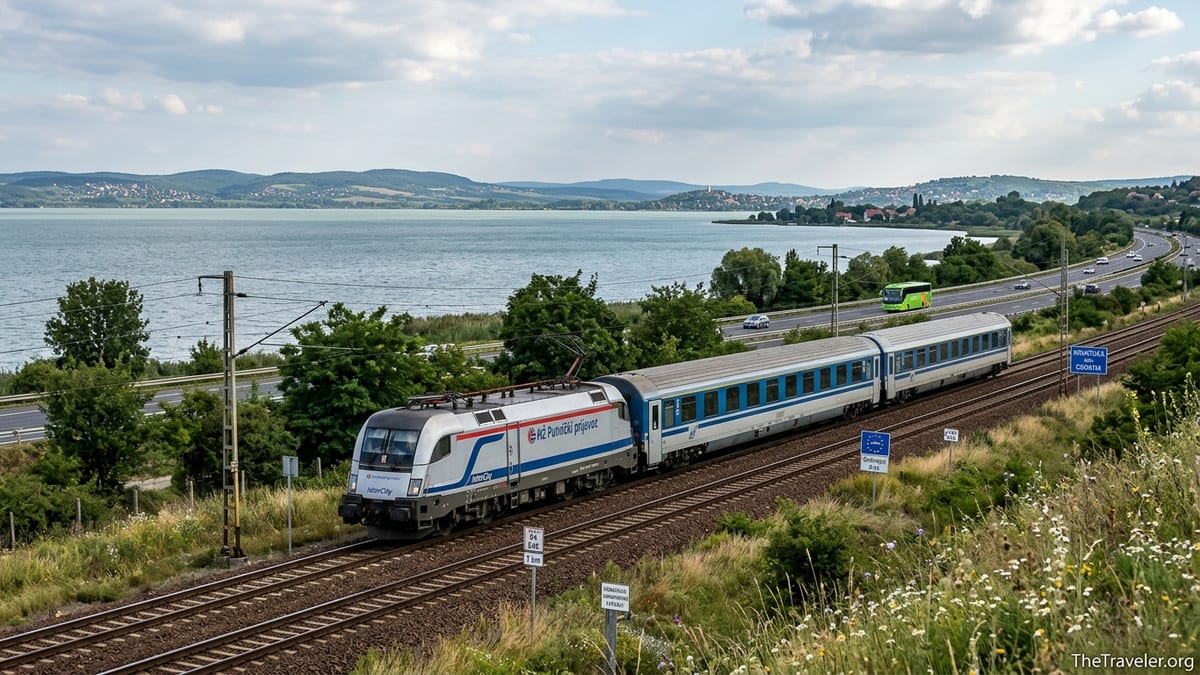
The Direct Budapest–Zagreb Train Today
At the time of writing in November 2026, there is one core direct day train between Budapest and Zagreb for most of the year. HŽ Putnički prijevoz, the Croatian railway operator, lists InterCity service IC 204 from Budapest Déli to Zagreb Glavni kolodvor in its 2025/2026 international timetable, with a departure around mid-afternoon (published at 15:35) and arrival in Zagreb a little after 22:00, for a scheduled travel time of roughly six and a half hours. MÁV, the Hungarian operator, mirrors this timing and also notes that engineering works can cause minor variations, so travelers should always check the exact time for their chosen date shortly before departure.
The route runs southwest from Budapest across Transdanubia, usually via Székesfehérvár and Lake Balaton’s southern shore before continuing toward Nagykanizsa and on to Koprivnica in Croatia, then across northern Croatia to Zagreb Glavni kolodvor. This gives a mix of suburban Budapest views, lakeside scenery and rural Croatian countryside instead of monotonous motorway, which many travelers regard as one of the train’s strongest selling points compared with direct buses on the highway.
In 2026, an additional seasonal service, marketed as IC 1206 and often referred to under the traditional Agram train name, operated from Budapest Keleti to Zagreb during part of the high summer period, with similar journey time but different departure and arrival times. For the 2026 season this extra train ran roughly from late June to late August, and advance information from rail booking platforms that track MÁV data suggests that a similar summer-period Keleti departure is planned for 2027, although the precise dates and train number may still be subject to final timetable confirmation closer to December 2026.
The standard, non-seasonal IC 204 is scheduled to continue in the 2025/2026 timetable valid until mid-December 2026, and draft international tables for 2026/2027 suggest continuity of at least one daily direct Budapest–Zagreb InterCity in 2027 as well. What can change from year to year is the use of Budapest Déli versus Keleti and slight shifts of 5 to 15 minutes in departure or arrival times as infrastructure works evolve. For that reason, travelers planning for 2027 should use the MÁV and HŽPP online journey planners rather than relying on a blog post or older guide.
Station Access and Why the Right Budapest Terminus Matters
One practical complication on this route is that Budapest has three main intercity stations: Keleti in the east, Nyugati near the city center and Déli on the Buda side. The core Budapest–Zagreb InterCity is currently diagrammed from Déli for most of the year, but during part of the summer 2026 season the extra IC 1206 used Keleti instead. This switch has already caught some travelers out when they arrived at the wrong station with just minutes to spare, then discovered that crossing the city by Metro and tram takes longer than expected in peak-hour traffic.
The difference matters because Déli and Keleti are on opposite sides of the Danube and not directly linked by a single suburban rail line. A visitor staying in Pest around Deák Ferenc tér or the Jewish Quarter might naturally head to Keleti, which is a short Metro ride east, and assume that all international trains leave from there. In fact, IC 204 usually leaves from Déli, which requires using Metro line M2 across the river and allowing at least 25 to 30 minutes from the city center including walking and ticket purchase. If you arrive at Keleti by mistake, reaching Déli in under 30 minutes is only realistic with good knowledge of the system and no delays.
Using an outdated station name can therefore cause a missed train in a very literal sense. Timetables several years old, or third-party blogs not updated for the current timetable, sometimes still describe the Zagreb train as always departing from Keleti, reflecting older operating patterns. A traveler who sees “Budapest–Zagreb, departs Keleti at 15:00” on an old page might plan their day around Keleti, only to find on arrival that there is no such train on the departure board and that the true service leaves from Déli closer to mid-afternoon. Since international InterCity services on this route are not “turn up and go” but once per day, a mistake like this can delay arrival in Zagreb by a full day or force last-minute bus alternatives.
On arrival in Zagreb, the picture is simpler. All direct trains from Budapest arrive at Zagreb Glavni kolodvor, the city’s main station just south of the historic center. From here, it is an easy walk or two- or three-stop tram ride to most central hotels and apartments. This gives the train a slight advantage over some buses that arrive at the city’s main bus station east of the center, although the difference in transfer time is usually no more than 10 to 15 minutes.
Journey Time, Frequency and Reliability: Train vs Bus
Viewed purely on in-vehicle travel time, the bus currently wins. FlixBus schedules for late 2026 show several daily Budapest–Zagreb services, with the fastest daytime journeys timetabled at around 4 hours 20 minutes between Budapest Népliget bus station and Zagreb’s central bus station. Many other departures, including those with intermediate stops, take around 5 to 6 hours. Rail timetables for IC 204 and the summer IC 1206 generally show scheduled train times of about 6 hours 30 minutes to 7 hours between Budapest and Zagreb, meaning that the bus is usually between 60 and 150 minutes faster when things run smoothly.
Frequency is another key difference. HŽPP and MÁV currently market a single core direct InterCity in each direction per day. By contrast, data aggregated from platforms such as Wanderu and CheckMyBus indicate that FlixBus alone operates more than ten daily departures on many dates, ranging across morning, afternoon, evening and overnight time slots, with additional capacity from regional operators on some days. This gives bus passengers much more flexibility to leave Budapest earlier in the morning, in the middle of the day or late at night to arrive in Zagreb at a time that suits their accommodation check-in.
Reliability is more nuanced. Train schedules are sometimes affected by planned track works on the Croatian side, particularly around Koprivnica and the approaches to Zagreb, and MÁV has published notices about temporary adjustments on the Koprivnica–Zagreb section through April 2026. However, once infrastructure works are built into the timetable, trains running on protected rail corridors are comparatively insulated from highway congestion, accidents or holiday traffic jams. Buses, on the other hand, can face long delays on peak summer weekends or at times of heavy traffic around Lake Balaton or approaching Zagreb.
Door-to-door, travelers should assume roughly seven and a half to eight hours for a train trip from a central Budapest hotel to central Zagreb accommodation, including local transit at both ends and a station-arrival buffer. For the bus, door-to-door time is often about six and a half to seven hours if traffic is light and connections to Népliget and from Zagreb bus station are efficient. This difference narrows if highway congestion or long coach boarding queues appear at popular times.
Tickets, Fares and Reservations on the Train
International rail fares between Hungary and Croatia are built from a conventional tariff, but both MÁV and HŽPP currently advertise promotional tickets that undercut the full price if booked in advance. Information distributed through HŽPP’s international pages refers to a joint MÁV–HŽPP offer with up to 40 percent discount on one-way and return tickets between the two countries, and a range of special priced tickets sold in limited quantities. Third-party retailers and booking platforms that sell MÁV-issued tickets typically quote advance promotional one-way fares from around 19 to 25 euros on selected dates, with the highest availability on midweek trains outside peak holiday periods.
Where promotional quotas have sold out, or for last-minute travel, travelers may still encounter the underlying standard one-way tariff of about 30 to 31 euros in second class. This aligns with the frequently cited base price of roughly 30.60 euros for a Budapest–Zagreb second-class ticket under the conventional international tariff. That fare does not include a compulsory reservation on some older tariffs, but current practice on IC 204 and IC 1206 is that seat reservations are either recommended or automatically included in most advance international ticket sales, especially when booked through MÁV online channels or at international ticket windows.
Seat reservations matter more in summer. On busy holiday weekends, IC 204 can be popular with both local Hungarian travelers heading to Lake Balaton and international passengers continuing to Croatia and the Adriatic coast. Having a reserved seat guarantees somewhere to sit together if you are traveling as a couple or family. In shoulder seasons, travelers occasionally report boarding with a flexible international ticket and finding seats without prior reservation, but this usually means less choice of seating and a higher chance of being separated. For peace of mind, particularly in 2027 when tourism is expected to be strong, it is sensible to pay the small additional fee for a seat reservation if it is not already bundled into the ticket.
Rail tickets between Budapest and Zagreb are valid on the whole direct route, including the scenic sections along Lake Balaton. Eurail and Interrail passes that cover both Hungary and Croatia are generally valid on IC 204 and IC 1206 subject to payment of any required seat reservation. Pass holders should still factor in reservation costs in their budgeting, but in most cases this remains modest compared with the base fares, and this option can represent excellent value for travelers planning a wider multi-country itinerary.
Bus Operators, Comfort and Conditions
FlixBus dominates the long-distance bus market between Budapest and Zagreb in late 2026, with schedules that show around 4 to 15 daily departures depending on the day of the week and season. Sample searches for mid-November 2026 indicate daytime fares in the range of about 25 to 45 US dollars, which equates roughly to 23 to 42 euros at current exchange rates, with the lowest promotional fares generally appearing on early-booked midweek departures. Some shoulder-season trips have base fares similar to or slightly above the most attractive rail promotion prices, but late bookings close to the date of travel can cost more than the standard train fare.
Buses typically depart from Budapest Népliget, a major bus terminal in Pest served by Metro line M3 and several tram and bus routes. A few services start from or call at other Budapest bus stops, but Népliget is the main point for international coach passengers. In Zagreb, most services arrive at Zagreb’s central bus station east of the center, which is linked to the main railway station and the central square by frequent tram lines. The bus station has ticket offices, simple cafes and luggage storage, though it feels more utilitarian than Zagreb Glavni kolodvor.
Onboard comfort on FlixBus services is adequate rather than luxurious. Coaches normally offer reclining seats, individual reading lights, climate control, at least one onboard toilet, and Wi-Fi where local roaming agreements allow. However, travelers report mixed experiences with Wi-Fi reliability and power outlets. FlixBus’s general conditions of carriage specify that each passenger can bring at least one piece of hand luggage and one checked suitcase free of charge within certain size and weight limits, with additional or oversized luggage subject to fees and space availability. Sports equipment, extra bags or very large suitcases must usually be booked in advance or cleared with customer service.
Refund and change conditions on bus tickets are stricter than many rail options. FlixBus often offers different ticket types, from non-refundable promotional fares to more flexible options that allow changes or cancellations up to a cut-off time before departure for a fee or voucher. A traveler who finds a very low price for a specific departure might save 5 to 10 euros compared with the train, but will have less freedom to switch to a later bus if their plans change or their inbound flight to Budapest is delayed. For families and travelers with fixed itineraries, these restrictions may be acceptable; for those who value flexibility, rail tickets or pass reservations can be more forgiving.
Schengen Borders, Police Checks and Travel Formalities
Since 1 January 2023, Croatia has been part of the Schengen Area for land borders, meaning that regular border checks at the Hungarian–Croatian frontier have been abolished. Official guidance from the Croatian Ministry of the Interior confirms that there are no more systematic border checks on Croatia’s borders with Hungary and Slovenia, and that travelers within the Schengen zone can cross these internal borders without routine passport control. Hungary has long been a Schengen member, so the train and bus routes between Budapest and Zagreb now operate entirely within the Schengen Area.
For most travelers, this means a smoother journey. Coaches no longer queue at border posts for all passengers to present passports as a matter of course, and trains no longer experience long halts solely for border checks when crossing between the two countries. However, both Hungarian and Croatian authorities retain the right to perform random police or identity checks anywhere on their territory, including on trains and buses, under Schengen rules about internal security. Travelers may occasionally encounter police officers boarding a coach near the border or walking through a train to verify identification.
It is therefore essential to carry a valid passport or national ID card even though there is no regular border control. Citizens of Schengen states can usually move freely as long as they are able to prove identity when requested. Third-country nationals must respect Schengen visa and stay limits, such as the well-known “90 days in any 180-day period” rule for many nationalities. While it is rare for these checks to cause serious delays on the Budapest–Zagreb route, travelers should assume that a short random inspection is always possible and keep documents accessible rather than packed deep in checked baggage.
An additional point for future planning is that temporary border controls can be reintroduced within Schengen at short notice in response to security or migration concerns, as illustrated by past examples elsewhere in the Schengen Area. Official EU reports on the state of Schengen show that such measures are typically time-limited and targeted at specific borders. As of late 2026 there is no general internal border control between Hungary and Croatia, but travelers with trips in 2027 should remain aware that political or security developments could lead to short-lived changes, which would most likely show up as minor timetable padding or advice from operators rather than dramatic disruptions.
Station Transfers, Urban Transit and Hidden Costs
For a realistic comparison, travelers need to consider how long it takes and how much it costs to reach the train or bus terminal at each end and then travel onward to accommodation. In Budapest, most visitors stay in Pest near Deák Ferenc tér, the Basilica, the Parliament area or the Jewish Quarter. From these locations, reaching Budapest Déli by public transport usually involves riding Metro line M2 from Deák Ferenc tér to Déli pu., which takes about 8 minutes of travel time plus walking and waiting. Adding a safe buffer, travelers should allow 25 to 30 minutes from central hotels to Déli, slightly longer if using trams or buses instead of the direct Metro.
Reaching Népliget bus station from the same central areas requires Metro line M3 from Deák Ferenc tér or interchange at Kálvin tér. The in-vehicle time is about 8 to 10 minutes, with total door-to-door time often around 25 minutes. Single tickets on Budapest public transport are relatively inexpensive, with single rides costing the equivalent of roughly 1 to 1.50 euros each depending on ticket type and any bundles available. For a solo traveler making a simple hotel-to-station trip, public transport costs might add 2 to 3 euros each way. A couple or family could economize further with travelcards, but as most visitors already buy passes for sightseeing, the marginal cost of the transfer may be effectively zero.
In Zagreb, both the main train station and the main bus station are located within the urban tram network and close to central accommodation. Zagreb Glavni kolodvor sits just south of the Lower Town, about a 10- to 15-minute walk from the main square and around the same by tram. The bus station is a little further east, usually about a 20-minute walk or a short tram ride. Single tram tickets in Zagreb cost only a couple of euros or less, so transfers rarely add more than 2 to 4 euros per person to the journey cost. Many travelers choose to walk if they are traveling light.
One hidden cost arises from inconvenient departure or arrival times. The afternoon IC 204 reaches Zagreb after 22:00, which can be awkward for travelers who prefer daytime check-in or do not want to walk through an unfamiliar city late at night. They may choose a central hotel with 24-hour reception or a taxi ride rather than public transport from the station. This might add 10 to 20 euros for a taxi and potentially a slightly higher room rate. By contrast, a well-timed afternoon bus that arrives in Zagreb around 17:00 or 18:00 can allow an easy check-in at a budget guesthouse and save on taxi costs. The trade-off between late arrival, accommodation preferences and perceived safety can shift the value equation in subtle ways.
Sample Itineraries and Total Cost Examples
Consider a solo traveler staying near Deák Ferenc tér in Budapest and heading to a mid-range hotel near Zagreb’s main square in early April. If they choose the train, they might leave their hotel around 14:30, take Metro M2 to Déli with a single ticket, arrive at the station shortly before 15:00 and have half an hour to find the platform. IC 204 then departs around 15:35 and arrives at Zagreb Glavni kolodvor slightly after 22:00. From there, the traveler either walks 15 minutes to their hotel or takes a short tram ride. The rail ticket could cost 19 to 25 euros if booked well in advance on a discounted quota, or around 30 to 31 euros if purchased at or near the last minute. Local transit adds roughly 3 euros in total. Door-to-door cost is therefore in the region of 22 to 34 euros, with a total travel time of about 7.5 hours.
The same traveler choosing a bus might book a daytime FlixBus departure around midday or early afternoon from Népliget, priced perhaps at around 30 to 40 euros based on late-2026 fare ranges. They would leave their hotel about 75 to 90 minutes before departure, ride Metro M3 to Népliget, then board the coach. With scheduled journey times between 4.5 and 5.5 hours depending on the specific service, they could expect to reach Zagreb’s bus station between about 17:00 and 19:00. A tram or short taxi ride then brings them to the city center. Local transit costs are similar to the train option, leaving a door-to-door time of roughly 6.5 to 7 hours and a total cost that might be very similar or slightly higher than the rail option if the train promotion fare is available.
For a couple, costs scale roughly in proportion, but accommodation factors become more important. Suppose a couple wants to maximize sightseeing time in Zagreb over a weekend. They might choose a Friday afternoon bus from Budapest that departs around 13:00 and arrives before 19:00, allowing them to check in, have dinner and take an evening stroll. Two bus tickets at a midrange price might total around 70 to 80 euros, plus a few euros for local transport. Taking the train instead would see them arrive after 22:00, which might push them toward a hotel with late self-check-in or overnight reception, potentially a little more expensive than a basic guesthouse that expects guests to arrive earlier. Over a two-night stay, the differences in fare and accommodation could more or less cancel out.
Unexpected delays can also impose overnight costs. Because there is only one direct train per day, missing IC 204 due to a misunderstanding about Budapest Déli versus Keleti, or underestimating the time needed to reach the station, may force the traveler to buy a same-day long-distance bus ticket at a higher walk-up price or to stay another night in Budapest. Similarly, missing an evening bus with a non-refundable ticket may require buying a walk-up ticket for the next bus or resorting to last-minute accommodation. In either case, building a 30- to 45-minute buffer into station or terminal arrival plans is a modest insurance premium against expensive disruptions.
A Two-Day Zagreb City Break from Budapest
Zagreb is compact enough that a two-day city break from Budapest is not only realistic but rewarding. A typical plan for visitors arriving by train might start with a Friday afternoon IC 204 from Budapest, arriving in Zagreb late in the evening. After checking into a central hotel a short tram ride from Glavni kolodvor, travelers can enjoy a relaxed late dinner in the Lower Town around Tkalčićeva Street or the main square, then get an early night ready for a full Saturday of exploration.
On the first full day, travelers could focus on the Upper Town and its surroundings: strolling from the main square up to St. Mark’s Church, exploring the Museum of Broken Relationships, and riding the tiny funicular. Cafes around the Dolac Market offer leisurely lunch options, while the avenues around Zrinjevac and Tomislav Square provide green space close to the station. In the evening, visitors might attend a performance at the Croatian National Theatre or simply enjoy bar-hopping in the Lower Town.
The second day could be spent exploring Maksimir Park, the Mirogoj Cemetery and the many small galleries and boutiques scattered through the Lower Town streets. A mid- or late-afternoon bus departure back to Budapest lets travelers enjoy most of Sunday before heading back, with arrival in Budapest late Sunday evening. Alternatively, travelers deeply committed to rail could stay until the Monday afternoon IC 204, trading a slower trip home for a calmer rail experience.
When deciding between train and bus for such a city-break pattern, the convenience of multiple bus departures is significant. Taking the bus both ways might allow a departure from Budapest early Friday morning, arrival in Zagreb by early afternoon, and return Sunday evening. The rail option, by contrast, often pushes at least one tiring late-night arrival or departure, unless travelers are willing to add extra nights in one of the cities, which increases accommodation costs but might be welcome for those on a longer Central Europe itinerary.
Comfort, Scenic Appeal and Final Verdict
Comfort and atmosphere often tip the balance between train and bus even when headline journey times and fares are similar. On the train, passengers enjoy the ability to walk along the corridor, visit a toilet without negotiating stairs, and rearrange luggage more easily. Compartments or open-plan coaches usually allow groups to sit together face to face, and large windows offer a relaxed view of Lake Balaton, small Hungarian towns and Croatian countryside. For travelers prone to motion sickness, the smoother rail ride can also feel more pleasant than hours of motorway coach travel.
Buses offer fewer opportunities to move around and can feel cramped on full departures, particularly for taller passengers. Legroom is generally acceptable but not generous, and while most services provide Wi-Fi, its speed and stability are variable. On busy holiday weekends, buses may feel hot and crowded, though modern fleets with air conditioning have improved comfort compared with older coaches. Family travelers might prefer the predictability of assigned seats together on a train, whereas on a bus there is sometimes a scramble for preferred spots if boarding is not tightly controlled.
When it comes to value, the train currently offers the best deal for rail enthusiasts, pass holders and budget travelers who can secure the 19 to 25 euro promotional tickets in advance. The combination of scenery, the ability to bring luggage without complex surcharges and the more relaxed on-board environment suits travelers who prioritize journey experience over sheer speed. Families with children may particularly appreciate the ability to walk the aisle or visit the toilet without negotiating a coach staircase at speed.
For those whose top priority is shorter overall travel time and flexible departure choices, the bus remains the stronger option. Frequent departures from Budapest Népliget and the prospect of arriving in Zagreb in four and a half to five hours door-to-door are compelling, even if fares on some departures now match or exceed standard rail prices. Budget-conscious travelers who book at short notice may also find that late-available bus tickets are cheaper than standard train fares, especially during shoulder seasons when demand is uneven.
Overall, the best value choice depends on traveler type. Budget travelers willing to plan ahead and book rail promotions will often find the direct Budapest–Zagreb train offers an unbeatable mix of price and comfort, despite its slower pace. Families and those who value space and scenery may lean the same way. Travelers who must minimize total journey time, fit the trip around work commitments, or need multiple departure options per day are likely to prefer FlixBus and other scheduled coaches, accepting variable comfort in return for speed and frequency. With both cities firmly inside Schengen and international connections improving, either mode can anchor a rewarding Central European itinerary in 2027 and beyond.