


Christchurch is the South Island’s main gateway and a city in the middle of an impressive reinvention. A decade after its devastating earthquakes, the rebuilt centre mixes historic facades and bold new architecture with a compact riverside core, inventive street art and green spaces that make it one of New Zealand’s most walkable cities. This guide focuses on what you can realistically see in three days, how to get around with or without a car, and how Christchurch fits into a wider South Island itinerary taking in Akaroa, Arthur’s Pass, Hanmer Springs, Lake Tekapo and beyond.
Get the latest updates straight to your inbox!
Why Christchurch Belongs in a South Island Itinerary
Christchurch sits on the east coast of New Zealand’s South Island, roughly halfway between Kaikōura to the north and Timaru to the south, with the Southern Alps rising to the west and Banks Peninsula’s bays to the east. For most international visitors it is the main arrival point, thanks to Christchurch Airport about 10 kilometres from the city centre. That location makes it a practical place to recover from a long flight, pick up a rental car and organise supplies before starting a loop toward Mount Cook, Queenstown or the West Coast, or to decompress at the end of a road trip.
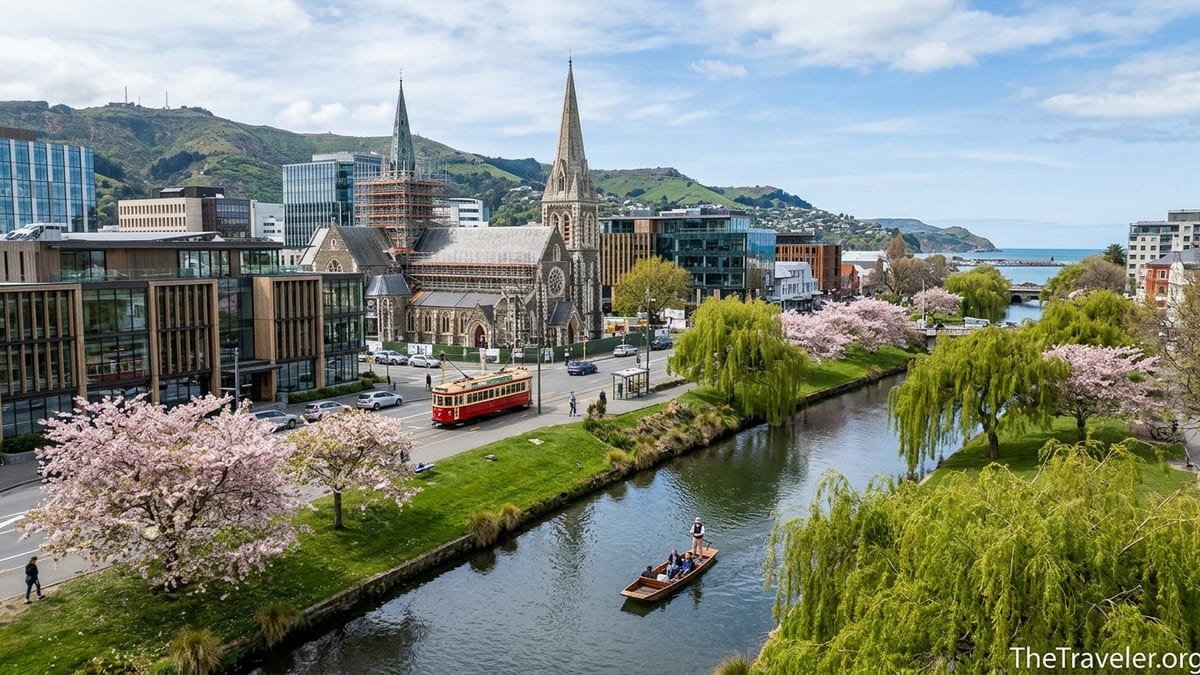
The city’s character has been shaped by the 2010 and 2011 earthquakes, which destroyed or damaged a large share of its historic core. Rather than simply rebuilding like for like, Christchurch has leaned into experimentation. You will see empty lots turned into gardens, modern glass-and-timber buildings alongside restored stone facades, and public spaces designed around people instead of cars. Street art has filled many blank walls, and outdoor dining lines the Avon River. For travellers this means the central city is easy to explore on foot, with plenty of cafes and green spaces for breaks.
Christchurch also works well as a hub for shorter regional adventures. Within two hours’ drive you can be soaking in thermal pools at Hanmer Springs, watching Hector’s dolphins in Akaroa Harbour, crossing alpine passes toward Arthur’s Pass, or stargazing at Lake Tekapo. Bus connections link Christchurch to Tekapo and Queenstown as well as Kaikōura, so even visitors without a car can link city time with landscapes that define the South Island.
Three nights in Christchurch is a sensible minimum if you want to see the rebuilt city centre without rushing. That allows one day focused on the compact core, one day exploring Port Hills, beaches and neighbouring Lyttelton, and one day for a nearby nature-focused side trip. If you are planning a longer driving loop, you can then add or subtract nights depending on your priorities and flight schedule.
Christchurch in Three Days: A Practical City Itinerary
Day one is best spent entirely within the central city so you can walk between sights and understand how Christchurch has changed. Start your morning in Cathedral Square, the old heart of the city. Here you can see the ChristChurch Cathedral, still under active restoration after the earthquakes. As of late 2026 the main structure is encased in scaffolding, with work progressing on stabilising the stone walls and rebuilding the tower, but you can view the site from the square and often see information boards about the project’s timeline and design. This is a good moment to talk about the earthquakes respectfully with guides or locals and appreciate how much of the city has been rebuilt from rubble.
From the square, walk a few minutes to Riverside Market on Oxford Terrace, a covered food hall and produce market that has become a local favourite. Arriving from mid-morning lets you browse coffee stands, bakery counters and international food stalls without the busiest lunch crowds. It is realistic to allow at least 60 to 90 minutes here for brunch or an early lunch, especially if you want to sit on the terraces overlooking the Avon River and people-watch.
After eating, follow the Avon River walkway west towards the Christchurch Botanic Gardens and Hagley Park, about 15 to 20 minutes on foot from Riverside. The gardens are free to enter and reward at least two hours of slow wandering, especially in spring when the daffodils and cherry blossom are out, or in autumn when the big deciduous trees change colour. Hagley Park wraps around the gardens with flat paths that suit wheelchairs and prams, and plenty of benches. On the northern edge of the park you will find the Canterbury Museum Pop-Up on Gloucester Street, where parts of the collection are displayed while the main museum building is redeveloped. Temporary exhibitions and collection highlights rotate here, and entry is free with donations encouraged, so you can drop in for an hour without worrying about fixed session times.
On your way back toward the river, detour through the city’s street art corridors. Large murals decorate laneways around the SALT District and near the former Re:START container mall site. A simple loop from the Botanic Gardens back to Cathedral Square via Worcester Boulevard and Hereford Street will take you past several pieces without needing a separate tour. In the late afternoon, head to New Regent Street, a short but distinctive pedestrian street of pastel Spanish Mission style buildings. This is one of the few intact heritage streetscapes to survive the quakes and now houses small bars, cafes and dessert spots. It makes a relaxed place for an early evening drink and dinner before strolling back to your accommodation.
Historic Tram, Avon River and City Sightseeing Choices
The Christchurch Tram is one of the city’s best known visitor products and also one of the most debated in terms of value. The restored heritage trams run on a loop through the compact central area, with drivers providing live commentary and the option to hop on and off at designated stops such as Cathedral Square, New Regent Street, the Margaret Mahy Playground and near the Botanic Gardens. Tickets are sold as a day pass rather than point to point fares, and as of late 2026 are typically priced in the tens of New Zealand dollars per adult, which makes the tram a sightseeing product rather than regular transport.
By contrast, the Metro bus network marketed by Environment Canterbury functions as Christchurch’s true public transport and uses standard bus fares. Central routes like those running along Colombo Street or from the Bus Interchange to the suburbs accept contactless payment, with flat adult fares around a few dollars per ride and free transfers within a set time window. Route 3 connects the airport to the city and continues to Sumner, while Route 8 links the central Bus Interchange with New Brighton and the Christchurch Gondola, and Route 29 connects directly between the airport and the city. For most visitors, using Metro buses is far cheaper than relying on the tram, though you trade commentary and vintage vehicles for standard city buses.
If you are short on time or travelling with small children or someone with limited mobility, using the tram as a hop-on, hop-off loop can make sense on day one. It will carry you between Cathedral Square, New Regent Street, the Botanic Gardens and the riverside dining precinct without needing to learn bus routes. However, if you are staying two or three days and comfortable with city buses, you can see the same sights by walking or riding Metro services for a fraction of the cost, and save money for experiences like a gondola ride or dolphin cruise.
The Avon River itself is another core Christchurch experience. Flat walking paths run on both banks through the city centre and into Hagley Park, making it easy to create short loops. Commercial punting operators offer 30 to 45 minute rides in shallow wooden boats, with guides using long poles to push along the river at a very gentle pace. Operating hours generally extend later into the evening in summer and shorten in winter, with prices that reflect the guided experience rather than simple transport. Punting is sheltered and slow, so it suits most ages and is one of the more accessible ways to enjoy the central green space for travellers who tire easily on foot.
Port Hills, Gondola, Coast and Accessible Nature
Day two is ideal for getting up onto the Port Hills and out to the Pacific coastline. The Christchurch Gondola on Bridle Path Road carries you from the base station up to the summit on Mount Cavendish. Standard adult tickets are currently priced in the tens of New Zealand dollars, with family passes reducing costs for two adults and children. The gondola usually opens mid-morning and runs through late afternoon, with the last cabin down roughly an hour after the posted closing time at the base. At the top you will find short walking tracks with views over Christchurch, Lyttelton Harbour and the Southern Alps on clear days, along with a cafe and a small interpretive ride about the region’s history.
Reaching the gondola without a car is straightforward. Metro’s Route 8 bus runs from the central Bus Interchange toward Lyttelton and stops near the gondola entrance, turning the trip into a roughly 20 minute bus ride plus a short walk. There is also a dedicated gondola shuttle that departs Cathedral Square on a regular timetable during the day in summer and shoulder seasons, though this costs more than a public bus. If you have a rental car, parking at the base station is free and the drive from the city centre takes about 15 minutes in normal traffic.
From the gondola summit you can walk segments of the Crater Rim tracks if you are comfortable with uneven paths and prepared for quickly changing weather. For a gentler outing, combine your visit with seaside time at Sumner or New Brighton. Both coastal suburbs are accessible by bus from the centre. Route 3 connects the city with Sumner via Ferry Road, passing through the redeveloped eastern suburbs, while buses to New Brighton and further north toward Pegasus and Waikuku run regularly as part of the wider Metro network. Sumner offers a sheltered beach backed by cafes and fish-and-chip shops, while New Brighton has a long pier, a revitalised foreshore and hot pool complex beside the beach.
Lyttelton, on the harbour side of the Port Hills, is another worthwhile half-day destination. With a car it is only a 15 to 20 minute drive via the tunnel. Without a car you can reach it by taking Metro Route 8 all the way to town. On Saturdays the Lyttelton Farmers Market fills the main street with food stalls and local produce, and on any day the waterfront and short harbour walks make a pleasant contrast to the flat Canterbury Plains.
Christchurch Airport, Transport and Getting Around Without a Car
Christchurch Airport sits to the northwest of the city centre and is linked by several Metro bus routes. Route 29 provides a direct connection between the airport and the Bus Interchange in the central city, while Routes 3 and 8 also serve the airport as part of longer routes. Journey time is typically 25 to 35 minutes depending on traffic. As of 2026, standard adult fares paid with contactless cards are about three New Zealand dollars from the airport to the city, significantly cheaper than taxis or ride shares, which can easily range from 40 to 60 dollars or more depending on distance and demand.
Shuttle vans operate between the airport and most central hotels and can be a good middle ground for couples or solo travellers with bulky luggage. These shared or prebooked shuttles usually charge per person and may stop several times en route, so door to door time can be longer than a taxi but still convenient. If you plan to pick up a rental car, agencies have desks at the airport as well as in the central city. New Zealand drives on the left, and roads in Christchurch tend to be wide and on a grid, although ongoing construction can mean sudden lane changes and temporary closures in the central area.
Travellers without a car can still see a great deal in three days by basing themselves near the central city and relying on walking and buses. The Bus Interchange sits just southeast of Cathedral Square and serves as the hub for almost all routes. Frequent buses link the centre to Riccarton, Sumner, New Brighton, the gondola and major malls. Limitations appear when you try to reach Banks Peninsula bays beyond Akaroa, wineries in North Canterbury or rural landscapes like Arthurs Pass National Park, where services are infrequent or geared to commuting rather than tourism.
For Banks Peninsula, public buses run from Christchurch to Akaroa, but services are usually limited to a couple of departures per day, and travel time is around two hours one way. Reaching smaller bays like Okains Bay or Le Bons Bay without a car is very difficult. Similarly, getting to Hanmer Springs or Lake Tekapo without driving requires prebooked intercity buses that may not allow enough free time on the ground to relax in the pools or walk around the lake. Realistically, if you want to explore beyond Akaroa using only public transport, you will need to accept slower schedules and maybe overnight stays instead of quick day trips.
Where to Stay: Central City, Riccarton, Merivale and Beyond
Accommodation in Christchurch spreads across several districts that each suit different travellers. The central city is ideal if you want to walk to Cathedral Square, Riverside Market, the Botanic Gardens and most tram stops. Here you will find mid-range chain hotels, new apartment-style properties and a growing number of boutique stays in rebuilt heritage buildings. Dining choices include riverside bistros, food-hall style eateries inside Riverside and casual bars around the SALT District. Prices are highest in peak summer and around major events but you gain the most convenience for a short visit.
Riccarton, west of Hagley Park and near the University of Canterbury, is popular with value-focused travellers. It has several motels along Riccarton Road, a large shopping mall and dozens of inexpensive Asian eateries, plus direct bus routes to the city centre and the airport. Staying here can shave a noticeable amount off nightly room rates compared with the very centre, although you will trade some of the atmospheric river views for a more practical suburban feel. Families often find Riccarton appealing because supermarkets, playgrounds and casual restaurants are all close at hand.
Merivale and neighbouring St Albans, just north of the central city, offer a mix of older guesthouses, modern motels and character B&Bs within a short bus ride or 20 to 30 minute walk to Cathedral Square. Merivale Mall anchors a small but upscale dining and shopping strip with wine bars and bistros. Prices can be similar to or slightly below the central-core hotels, and the streets are leafier and quieter in the evenings. For visitors with a car, Merivale also tends to have easier on-street parking than the compact inner core, where hotel parking can be limited or carry extra charges.
Further out, airport hotels and motels cluster near Christchurch Airport. These are convenient if you have a very early or late flight, or if you are dropping off a rental car and want a straightforward last night. However, staying out here without a car means relying on airport buses or shuttles every time you want to visit the city, so it is usually better suited to one end of your trip rather than a three-day base.
Budgets, Seasons, Families and Accessibility
Daily budgets in Christchurch vary significantly depending on where you stay and how many paid activities you choose. As a rough guide in 2026, a solo traveller staying in a central hostel or basic motel might spend around 60 to 100 New Zealand dollars on accommodation, 30 to 60 dollars on food and drink, under 10 dollars on public transport, and 30 to 70 dollars on activities such as the tram, gondola or museum exhibitions. A couple in a mid-range central hotel might budget 180 to 260 dollars per night for accommodation, 80 to 120 dollars for shared meals and drinks, and another 80 to 150 dollars for attractions and occasional taxis. Families will usually find self-contained apartments or motels more economical, with nightly rates from perhaps 220 dollars upward and the ability to prepare some meals, while family passes at attractions help soften ticket costs.
Christchurch’s climate is relatively mild, but you should plan around pronounced seasons. Summer from December to February brings long daylight hours, warm afternoons and busy school holiday periods, when family attractions and beaches are at their most crowded. Winter from June to August is cooler, with occasional frosts and short days, but also clearer views of snow on the Alps and quieter city streets. Spring and autumn can be particularly pleasant for walking, though weather fronts can bring wind and rain at short notice. New Zealand school holidays and three-day weekends see spikes in domestic travel, so book accommodation and rental cars earlier for those periods.
For families, the rebuilt city includes stand-out kid-friendly spaces such as the riverside Margaret Mahy Playground, which has large climbing structures and water play areas within walking distance of the central city. The Botanic Gardens, Hagley Park and city beaches also offer free open areas where children can run. Many paid attractions, including the gondola and tram, offer reduced child fares and family combinations. Parents should factor in the need for sun protection even on cool days, and for layers to manage changeable temperatures, particularly on the Port Hills where wind chill can be significant.
Christchurch has made visible efforts to improve accessibility as part of its rebuild. Many new buildings have level entrances or ramps, and main paths through the Botanic Gardens and Hagley Park are flat and paved or well compacted. The tram offers step access that may not suit all mobility devices, but buses kneel and have designated spaces for wheelchairs and prams. That said, some older heritage sites, temporary museum arrangements and hillside walks around the Port Hills still have stairs or uneven surfaces. If you or your companions have limited mobility, plan extra time for transfers and check in advance with specific attractions about accessible entrances and toilets.
Day Trips: Akaroa, Arthur’s Pass, Hanmer Springs, Lake Tekapo and the Coast
Akaroa on Banks Peninsula is one of the most popular day trips from Christchurch. The drive takes roughly 1 hour 20 minutes each way in good conditions, climbing over a scenic summit road then dropping into a sheltered harbour. The town has French heritage touches, small galleries and cafes, but its biggest draw is wildlife cruises to see Hector’s dolphins, one of the world’s smallest and rarest dolphin species. Operators such as Akaroa Nature Cruise and Akaroa Dolphins run boat trips most days of the year when sea and weather conditions permit, with adult prices around 120 to 130 New Zealand dollars and lower child fares. Departure times vary by season and demand, and cruises are usually cancelled if seas are too rough for safe or respectful wildlife viewing, so it is important to check schedules close to your travel date.
Ethical wildlife viewing is a serious focus in Akaroa. Reputable operators follow local regulations about approach distances and limit how many boats are near dolphins at any one time. They do not guarantee close encounters, although Hector’s dolphins live in the harbour year-round and are seen on most trips. Swimming tours, where offered, are managed with wet suits and floatation devices, and skippers brief passengers on not chasing or touching animals. If weather prevents boats from leaving the harbour on the day you booked, most companies offer refunds or rescheduling; plan an alternative land-based activity in Akaroa such as walking the waterfront, visiting local museums or exploring nearby bays by car.
Arthur’s Pass, about two hours’ drive inland, takes you quickly from the plains into alpine landscapes, with waterfalls, short walks and the chance to see kea, New Zealand’s alpine parrots. With your own vehicle, a day trip is feasible if you leave early and keep an eye on weather and road condition reports, particularly in winter when snow and ice may affect the pass. Without a car, intercity coaches and the TranzAlpine train provide spectacular journeys but limited time on the ground for walking before return departures. Many travellers therefore choose to stay at least one night in or near Arthur’s Pass if travelling without a private vehicle.
Hanmer Springs, about 1.5 to 2 hours’ drive north of Christchurch, combines a compact alpine village with a large thermal pools and spa complex. It makes an excellent full day trip if you have a car: you can drive up mid-morning, soak in the pools for several hours, walk Conical Hill for panoramic views or explore the nearby forest tracks, and be back in Christchurch for a late dinner. Intercity buses also link Christchurch and Hanmer, but schedules often give you a narrower window in town unless you stay overnight. Likewise, Kaikōura and the North Canterbury coast can be visited on a very long day trip by experienced drivers, especially in summer, but for whale watching and coastal walks many visitors prefer to plan an overnight stay to allow for weather cancellations.
Lake Tekapo sits about three and a half hours by road from Christchurch. This makes it technically possible as a day trip, but you would spend most of your time driving. Buses take a similar time and are commonly used by travellers continuing on to Mount Cook Village or Queenstown. For most itineraries it is more rewarding to schedule at least one night in Tekapo or Mount Cook, especially if you want to experience the area’s dark skies and stargazing experiences. From Christchurch you can also reach closer coastal spots such as New Brighton, Sumner, Birdlings Flat or the beaches south toward Ashburton for shorter half-day outings that pair well with city time.
How Long to Stay and Christchurch vs Queenstown
The number of nights you should spend in Christchurch depends on your flight timings and wider South Island route. If you are arriving on a long-haul flight, two to three nights at the start help you adjust to the time zone, see the central city and take one nearby nature excursion before driving long distances. From Christchurch you can then follow a inland route through Tekapo and Mount Cook to Queenstown, or head north to Kaikōura and onward to Picton and the ferry to the North Island. If you are ending a road trip in Christchurch before flying out, one to two nights is generally enough to return a rental car, explore the centre and maybe visit the Port Hills or New Brighton.
Compared with Queenstown, Christchurch offers a very different experience. Queenstown is a resort town tightly focused on adventure tourism, framed by a lake and mountains, with a compact centre packed with bars, restaurants and activity operators. If you have only four or five days in the South Island and want dramatic alpine scenery, hiking and adrenaline activities like bungy jumping, jet boating or heli-hiking, concentrating your time around Queenstown and nearby Wanaka will probably feel more satisfying, especially if you fly in and out of Queenstown Airport.
Christchurch, by contrast, is a living working city with a broader spread of neighbourhoods, larger green spaces and stronger links to the region’s agricultural and coastal landscapes. It is an excellent choice if you are interested in urban regeneration after natural disasters, architectural design, gardens and relaxed food culture, or if you are travelling with children or older relatives who appreciate flat walking and playgrounds alongside lighter adventure. It also tends to offer slightly more affordable accommodation and dining, particularly outside peak summer, which matters for longer trips or family groups.
For travellers trying to choose between the two with limited time, a useful approach is to align your base with your onward travel. If your flights are already booked into and out of Christchurch, commit to three or four nights there and use the city as your hub, building in one or two substantial day trips. If you are entirely flexible and your priority is alpine scenery and high-energy outdoor activities, two or three nights in Queenstown and one night in Christchurch purely for logistics might make more sense. Many South Island itineraries benefit from including both: starting with a gentle acclimatisation in Christchurch, then driving through Tekapo and Mount Cook to finish with a flourish in Queenstown’s mountains.