


Landing at Cairo International Airport can feel intense: jet lag, crowds, and a small army of taxi touts competing for your attention the moment you clear customs. For many travelers, ride‑hailing apps like Uber and Careem are the easiest way to get into the city without haggling. This guide walks you through exactly how to use them at Cairo International Airport in 2026, from terminal meeting points and app settings to realistic prices, luggage tips and safe taxi alternatives if the apps are busy or unavailable.
Get the latest updates straight to your inbox!
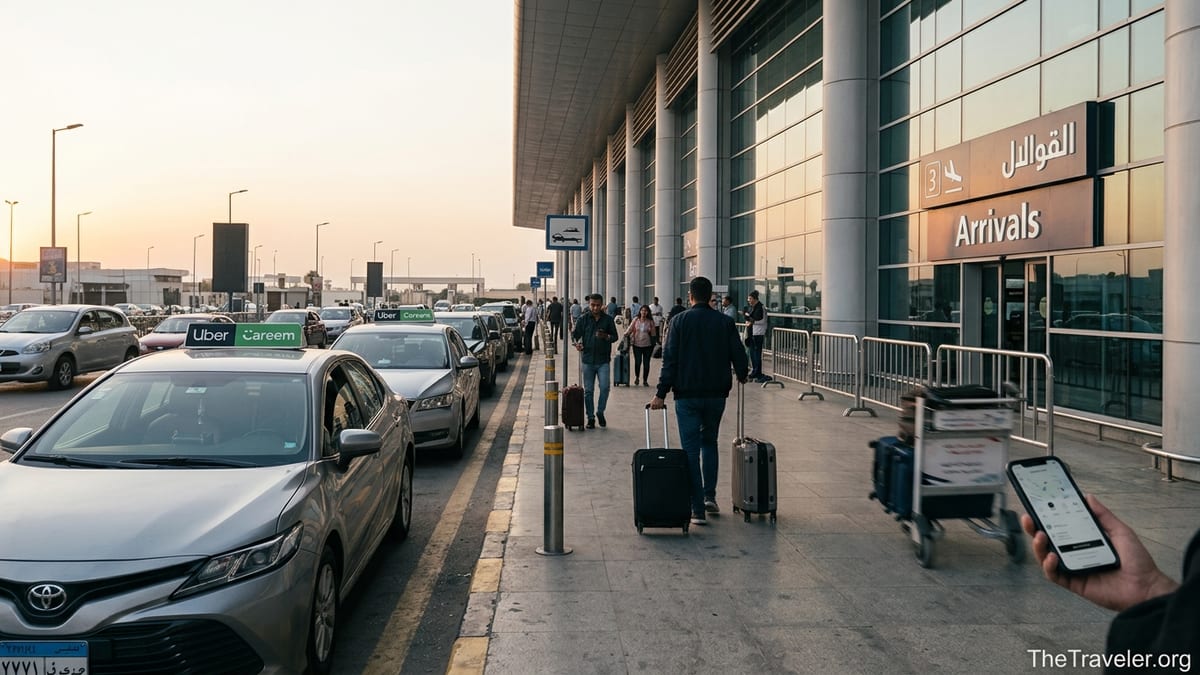
How Uber and Careem Work at Cairo International Airport
Cairo International Airport (CAI) sits roughly 15 to 25 kilometers from central districts such as Downtown, Zamalek and New Cairo. Uber and Careem both operate in Greater Cairo and are widely used by locals and visitors for airport transfers. The apps function largely as they do elsewhere: you connect to data, set your pickup location at CAI, see an estimated fare in Egyptian pounds (EGP), then meet your driver outside the terminal.
There is one key nuance many visitors do not expect. Official airport information and ride‑hailing guidance change from time to time, and local drivers often treat the curb outside Arrivals as a normal pickup point even when formal signage is limited. In practice, travelers arriving in 2025 and 2026 report that drivers pick up directly outside Terminals 2 and 3 on the arrivals level, or in the adjacent parking areas. The Uber or Careem app will show your driver’s live location; follow that rather than any one fixed written rule.
Both apps are available 24 hours a day, but wait times vary. Late evening and after midnight, you might see a car in two to five minutes to central Cairo. During rush hour or heavy traffic days, it can stretch to 15 minutes or more. Surge pricing occasionally appears during peak times or major events, so it is wise to check the fare estimate before you exit the terminal and decide whether to accept, wait a few minutes, or switch to an airport taxi or private transfer.
Payment is typically by card or digital wallet added to your Uber or Careem account, but many Egyptian drivers also appreciate cash for tips or incidental costs like parking. To avoid surprises, ensure your primary payment method is active before your flight, and carry small EGP notes in case you need to cover shortfalls or tip in cash once you arrive at your hotel.
Terminal‑by‑Terminal Pickup: Where to Meet Your Driver
Cairo International Airport currently has three main passenger terminals: Terminal 1 (older and used by some regional carriers), Terminal 2 (renovated, with many international airlines) and Terminal 3 (major hub for EgyptAir and Star Alliance). Ride‑hailing pickups work slightly differently at each, but the basic idea is the same: you walk out of arrivals, move away from the densest crowd of taxi touts, and meet your driver where they can safely stop.
At Terminal 3, which handles many EgyptAir and connecting flights, most travelers report the simplest approach is to collect your bags, clear customs, buy a SIM card if needed, then walk straight outside to the main curb. Once outside, step a little to the right or left of the primary exit doors until you find a quieter stretch of curb. Request your Uber or Careem there. Your driver may be waiting in the nearby parking area and pull up to the curb within a few minutes. If the app shows the car stuck in traffic directly outside, send a quick message explaining the nearest visible landmark, such as “in front of Exit 3” or “beside the coffee kiosk at arrivals exit.”
At Terminal 2, the flow can be slightly more confusing because of the mix of regular taxis, private transfers and hotel shuttles. After exiting arrivals, watch for signs toward the taxi and parking areas. Some drivers prefer to meet just across the first roadway, closer to the parking structure, where they can stop for a short time without attracting security attention. If your Uber or Careem driver sends you a text like “go to parking” or “come to C1,” they are usually referring to the nearest general parking level opposite the terminal. Move only in well‑lit public areas and confirm their car model and plate before you get in.
Terminal 1 sees fewer international tourists but a good number of regional flights and low‑cost carriers. The principle is the same: once you exit baggage claim, head outside and then slightly away from the main doors. Because signage here can be older or inconsistent, rely on the car icon in your app to orient yourself. If you are traveling as a group or with larger luggage, it may be easier to agree with your driver to meet near a recognizable fixed point, for example “in front of the departures entrance for Terminal 1” where it may be less crowded than arrivals.
Using the Apps: Booking, Meeting Points and Driver Communication
Before landing, install both Uber and Careem, add a working payment method, and take screenshots of your hotel name and Arabic address from your booking confirmation. Once you have mobile data at the airport, open the app and type “Cairo International Airport” or simply select the terminal that appears as your current location. Drag the pickup pin to the correct side of the terminal if needed; at CAI, the difference between arrivals and departures levels is often just a ramp or elevator ride apart, but misplacing the pin can cause confusion.
When you request a ride, the app will show a pickup point description such as “Cairo International Airport, Arrivals” and estimate the arrival time. If the app suggests a more specific meeting point such as a certain parking area or airport zone, read it carefully. Some drivers will message in Arabic using short phrases like “fein?” (where?) or “barrra” (outside). A polite, simple reply in English usually works, for example: “I am at Terminal 3 arrivals, outside main doors, by the right‑side exit.” Many drivers use basic English for airport trips and are used to foreign passengers, so do not hesitate to send clear, short messages.
If language does become a challenge, use physical landmarks and the live map. You can send voice notes via some messaging features, but in practice it is often enough to walk slowly along the curb while watching the car icon approach your dot. Once you see a car with the correct make, model and color pull in, double‑check the last three characters of the plate in the app and on the car itself. Egyptian plates often use Arabic numerals and Arabic letters, so if you are unfamiliar with the script, rely more on the car description and driver photo while still checking at least part of the plate for safety.
It is wise to avoid accepting rides from unofficial drivers who approach you inside the terminal claiming to be “Uber” or “Careem” without the app. Legitimate drivers wait outside and contact you only via the official in‑app messaging and call system. If someone asks you to cancel the trip in the app and pay cash only, decline and either insist on keeping the trip active or walk away and request another car. Keeping the journey in‑app preserves your pricing, safety tracking and access to support if anything goes wrong.
What Your Ride Will Cost: Realistic Price Ranges and Tipping
Fares in Cairo are volatile due to fuel prices and inflation, so instead of memorizing exact numbers, think in ranges and check the live estimate in your app. In 2026, many travelers report that a standard Uber or Careem from Cairo International Airport to central neighborhoods such as Downtown, Tahrir Square, Garden City or Zamalek typically shows somewhere in the low hundreds of Egyptian pounds off‑peak, sometimes rising higher at busy times. New Cairo and upscale compounds to the east can cost a bit more, while nearby districts such as Heliopolis or Nasr City are usually cheaper.
For example, a late‑evening mid‑week ride from Terminal 3 to a mid‑range hotel on Zamalek might appear in the app at a few hundred EGP, while a rush‑hour pickup to Giza or western Cairo can climb to the upper end of that band, particularly if there is heavy traffic on the Ring Road. Ultra‑long trips, such as directly from the airport to Alexandria or Ain Sokhna, are technically possible but may be impractical or expensive on standard Uber or Careem categories; many locals instead book intercity services, private transfers or trains for those routes and use an app ride only from the station or bus terminal.
Tipping culture in Egypt is strong but flexible. With Uber and Careem, a moderate tip of around 10 percent is appreciated for a smooth, safe airport ride, especially if the driver helps with bags or navigates late‑night traffic. Some app versions cap in‑app tips, so carrying a handful of 10 and 20 EGP notes can be handy if you want to leave a little extra. Avoid over‑tipping dramatically out of confusion right after landing. If a driver insists on extra money beyond what the app shows, refer back to the fare screen and politely decline unless you have knowingly asked for a substantial detour or extra stops.
Compared with official airport taxis, ride‑hailing fares are usually more transparent but not always cheaper, particularly during surges. Airport taxis typically quote fixed or negotiated prices that may land in a similar overall range for central Cairo, but you must agree the fare before leaving the curb. With Uber and Careem, you see the estimate before you request and can compare options. On arrival, it can be useful to check the app price to your district, then ask a taxi dispatcher what they charge. If the taxi quote is significantly higher without clear justification, the app ride is likely the better value.
Luggage, Vehicle Types and Traveling as a Group
Standard Uber and Careem categories in Cairo are usually small to mid‑sized sedans, which can technically seat four passengers but feel tight with three large checked suitcases. As a rule of thumb, if you have more than two large bags plus carry‑ons, it is more comfortable to either request a larger vehicle category where available in the app or book two separate cars. This is particularly important if you are traveling after a long international flight and want to avoid balancing bags on laps or cramming luggage into the back seat.
When you request your ride, you can send a message such as “we have 3 big suitcases” so the driver knows what to expect. Some drivers will honestly reply that your luggage is too much for their car, giving you a chance to cancel quickly and rebook. Others are surprisingly adept at rearranging the trunk to make everything fit, but be prepared that in smaller sedans one suitcase may need to ride on the front seat. If you are traveling with sports equipment, musical instruments or delicate camera gear, consider a private airport transfer or hotel car with guaranteed trunk space rather than relying on a random compact vehicle.
Families with young children should be aware that child seats are not standard in Cairo ride‑hailing cars. You are generally expected to bring your own if you require one. Some premium private transfer companies offer pre‑booked vehicles with child seats, which can be safer and less stressful after a long journey. If you do choose Uber or Careem with a child, buckle them in as securely as the car allows, request drivers who display good ratings and clean vehicles, and consider avoiding the city’s most chaotic rush‑hour windows if possible.
For large groups, a common local strategy is to request two standard cars instead of searching for a single large van service in the app. For instance, a family of five with several big bags might split as three plus luggage in one car and two plus hand baggage in another, each heading to the same hotel. Before leaving the curb, agree who is carrying the passports and booking confirmation, and make sure both drivers have the exact destination in Arabic and English to avoid having one car get lost.
Traditional Taxis, Private Transfers and Other Alternatives
Despite the rise of Uber and Careem, traditional taxis remain very visible at Cairo International Airport. The official airport rank usually features newer white taxis and, in some cases, branded airport cars with fixed‑zone pricing boards. In practice, though, fares to central Cairo are often negotiated rather than strictly metered. If you choose a taxi, confirm the total price in EGP before you put your bags in the trunk. A reasonable negotiated fare into central districts will usually sit in a similar band to app rides, depending on the exact neighborhood and time of day.
Many hotels, especially four‑ and five‑star properties along the Nile or in New Cairo, offer private airport transfers. These can cost more than a standard Uber or Careem but provide a predictable experience: a driver holding a sign at arrivals, a larger sedan or SUV, and sometimes inclusive bottled water and Wi‑Fi. This option is particularly appealing for first‑time visitors arriving late at night, for families, or for those carrying valuable equipment. If you are booking through your hotel, ask them clearly whether the transfer is handled by the hotel directly or outsourced to a local car service and confirm the price in writing.
Budget‑minded travelers sometimes combine public transport with ride‑hailing. While there is no metro station directly at Cairo International Airport, city buses and shuttle services connect the terminals with parts of Heliopolis and other districts, from which you can then take a short Uber or Careem ride to your final destination. This approach can significantly reduce the cost if you are comfortable navigating local buses and crowds with your luggage. For most first‑time visitors, however, the simplicity of a door‑to‑door car from the airport justifies the extra expense, especially after a red‑eye flight.
There are also newer intercity and premium‑taxi apps operating in Egypt that some locals prefer for long‑distance trips or higher‑end vehicles. If you are planning to travel directly from Cairo International Airport to cities like Alexandria or Hurghada, it may be more comfortable to pre‑book with one of these services or arrange a car through a reputable tour operator. You can then keep Uber or Careem as a backup option if your primary plan falls through or your flight is significantly delayed.
Staying Safe and Avoiding Common Pitfalls
Most Cairo ride‑hailing trips are routine and uneventful, but a few simple habits will make your airport experience smoother. First, use only the official apps, and do not accept rides from people who approach you inside the terminal saying “Uber, Uber” without a matching car and plate in the app. Second, always check that the driver name and vehicle details on your screen match the car that stops for you. If they do not, politely decline and request another ride.
Traffic around Cairo International Airport can be intense, especially during busy arrival banks or local holidays. Expect heavy braking, frequent lane changes and horns; this is normal local driving style, though you can always ask your driver calmly to slow down if you feel unsafe. Buckle up as soon as you get in, even in the back seat. Keep your passport, wallet and phone on your person rather than in the trunk, and avoid placing bags where they can be easily snatched if a window is open at a traffic light.
Another subtle pitfall involves miscommunication about destination. Cairo has many repeated or similar‑sounding street and hotel names. When entering your drop‑off point, select the exact pin from your hotel confirmation rather than a generic district name. If your accommodation is on a side street, it helps to show the driver a screenshot in both English and Arabic so they can match it to street signs. During the ride, follow progress on the app map; if you see a major deviation you did not request, ask the driver if they are avoiding traffic or if there has been a misunderstanding.
In the rare event of a disagreement or problem, keep the interaction calm and rely on in‑app support afterward rather than arguing at the curb. Both Uber and Careem allow you to report issues with route, pricing or driver conduct, and they often adjust fares or take action where appropriate. Taking note of the time, route and general details immediately after the trip helps you file a clear report once you reach your hotel’s Wi‑Fi.
The Takeaway
Using Uber or Careem from Cairo International Airport in 2026 is generally straightforward, provided you know what to expect. The core steps are simple: get connected, request a ride from the correct terminal, walk outside to a clear meeting point, confirm your driver and car, and keep your destination details ready in both English and Arabic. Expect app fares to fall within a broad but reasonable range for central Cairo, with occasional surges at busy times.
Ride‑hailing offers clear advantages over haggling with curbside taxis, particularly transparent pricing and built‑in safety features like trip tracking. At the same time, traditional airport taxis and pre‑booked hotel transfers remain valuable alternatives, especially if you have heavy luggage, small children or a very late‑night arrival. Whichever you choose, a bit of preparation around meeting points, communication and luggage planning will turn that first journey from CAI to the city into a manageable start to your Cairo adventure instead of a stressful battle at the curb.
FAQ
Q1. Is Uber available for pickups at Cairo International Airport?
Yes, Uber operates to and from Cairo International Airport, and many travelers routinely request pickups from the arrivals level of Terminals 2 and 3 or nearby parking areas. Availability and meeting points can vary slightly by time of day, so always follow the live location shown in the app.
Q2. Does Careem work at Cairo International Airport too?
Careem also serves Cairo International Airport and functions very similarly to Uber. You open the app, set your pickup location at the correct terminal, choose a car type and then meet your driver outside. Many locals keep both apps installed and request whichever shows the faster arrival time and better price.
Q3. Where exactly should I meet my Uber or Careem driver at Terminal 3?
At Terminal 3, most passengers meet drivers on the arrivals level just outside the main exit doors. After collecting your luggage and clearing customs, walk out to the curb, move a little away from the densest crowd of taxi touts, and request your ride. Use landmarks such as specific exit numbers or nearby kiosks in your messages so the driver can spot you easily.
Q4. How much does an Uber or Careem from Cairo Airport to downtown usually cost?
Prices change with traffic and inflation, but as a rough guide, standard app rides from Cairo International Airport to central districts like Downtown, Garden City or Zamalek typically appear in the low to mid hundreds of Egyptian pounds, depending on time of day and demand. Always rely on the live fare estimate in the app at the moment you book.
Q5. Is it safe to take Uber or Careem from Cairo Airport late at night?
Many travelers use Uber and Careem for late‑night and early‑morning flights, and the majority of trips are routine. Choose well‑rated drivers, sit in the back seat, buckle up, and share your trip details through the app with a friend or family member. If you feel uncomfortable at any point, you can end the trip in a busy, well‑lit area and contact in‑app support.
Q6. What if my driver does not speak English?
Plenty of Cairo drivers know basic English, especially for airport runs, but not all. To reduce stress, enter your destination carefully in the app and carry a screenshot of your hotel name and address in Arabic. Short, simple messages such as “Terminal 2 arrivals outside main doors” usually work, and you can point to signs and maps if needed.
Q7. Can I pay cash for my Uber or Careem ride from the airport?
Both apps support card payments, and in many cases cash payments too, depending on your account settings and local options at the time. Card is usually easiest for visitors, but carrying some small EGP notes for tipping or emergencies is wise. Avoid canceling the trip in the app to pay entirely off‑platform, as doing so removes price transparency and safety tracking.
Q8. Should I book an airport taxi instead of using a ride‑hailing app?
It depends on your priorities. Apps offer transparent pricing and route tracking, which many visitors prefer. Official airport taxis can be convenient if you are offline or your apps are not working, but you should agree the full fare in advance and be prepared to negotiate. For late‑night arrivals with lots of luggage, a pre‑booked hotel or private transfer may feel more comfortable than either option.
Q9. How long does it take to get from Cairo Airport to central Cairo?
Under light traffic, a ride from Cairo International Airport to central areas like Tahrir Square or Zamalek can take around 30 to 45 minutes. During rush hour or on particularly busy days, it can stretch to an hour or more. When planning onward connections, always allow a generous buffer for traffic, especially if you are catching a train or domestic flight.
Q10. What if I cannot find my driver at the meeting point?
If you cannot spot your driver, first check the live map in the app and confirm you are at the exact pickup pin. Message the driver with a clear description of your location and any nearby landmarks. If there is still confusion after a few minutes or the car seems not to move, you can cancel and request another ride. Do not follow anyone to a different vehicle than the one shown on your screen.