


Landing in Cairo and heading straight to the Giza Pyramids is one of the most common high-intent routes for first‑time visitors to Egypt. The airport sits on the far eastern side of the city, while the pyramids rise from the desert edge in the west, so crossing this sprawl efficiently takes some planning. With traffic, luggage, possible jet lag and visa formalities to think about, it is worth asking honestly: can you go directly from Cairo International Airport to the Giza Pyramids after landing, and when does it actually make sense to do so?
Get the latest updates straight to your inbox!
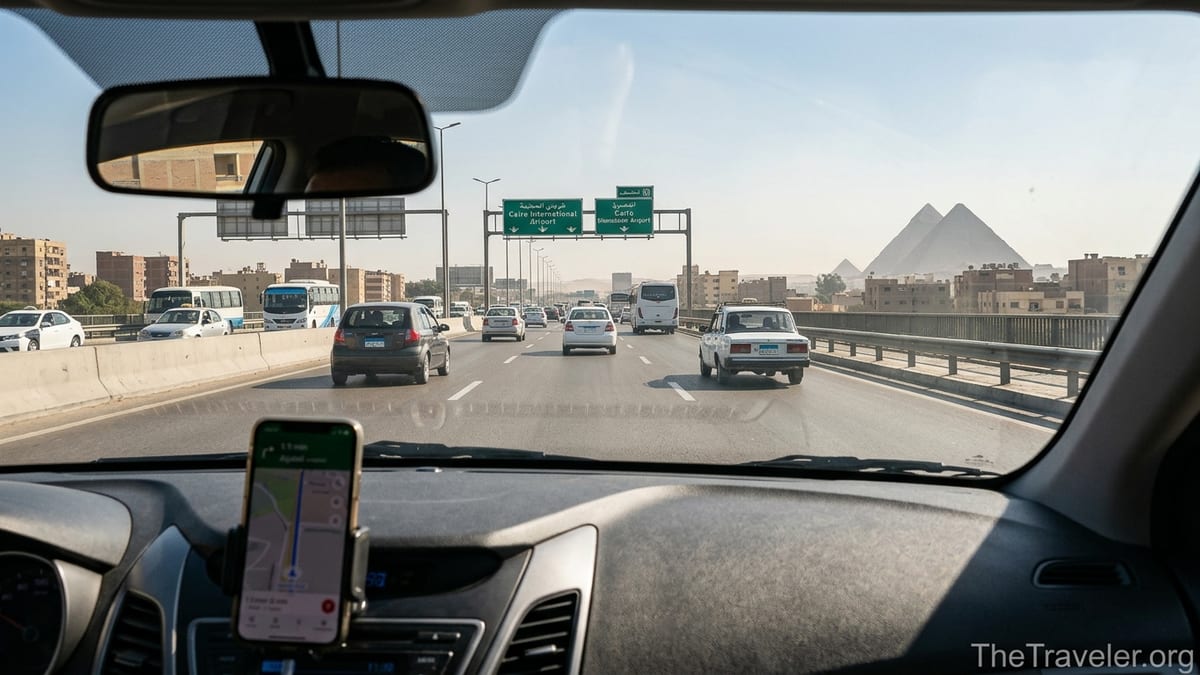
Can You Go Straight from Cairo Airport to the Giza Pyramids?
Cairo International Airport (CAI) lies to the northeast of the city near Heliopolis, while the Giza Plateau is on the western edge, roughly 40 to 50 kilometers away depending on the route your driver chooses. In practice, that means a drive of about 60 to 90 minutes in normal traffic. In heavier congestion, which is very common around morning and late‑afternoon rush hours, the same journey can stretch to 90 to 120 minutes.
Transport providers in Cairo confirm that going straight from the airport to the pyramids is not only possible but common. Ride‑hailing services like Uber and Careem, as well as private transfer companies, regularly handle airport pickups that go directly to the Giza Plateau or to nearby hotels such as those along the Cairo–Alexandria Desert Road. Recent guides aimed at airport passengers suggest that a typical Uber or Careem ride from CAI to the pyramids costs roughly 300 to 600 Egyptian pounds depending on time of day, car category and traffic conditions, which usually equates to around 12 to 20 US dollars.
In real‑world terms, travelers report paying around 350 to 450 Egyptian pounds with Uber or Careem during peak hours for this journey. One visitor transferring from Cairo Airport to a hotel near the pyramids recently described paying just under 400 Egyptian pounds during an evening rush, with the entire trip taking about 75 minutes from curbside pickup to hotel drop‑off. Another reported that a very early morning drive, leaving CAI around 5 am, took closer to 45 minutes and cost just over 300 Egyptian pounds.
Whether going direct after landing is wise depends on the time you land, how quickly you can exit the airport, and how much energy you have for sightseeing after a long flight. For some travelers, especially those on daytime layovers of 8 hours or more, heading straight to Giza is the most efficient way to turn a transit stop into a once‑in‑a‑lifetime visit. For others arriving late at night or after a long haul, it is more realistic to head to a hotel first and visit the pyramids rested the following morning.
Travel Time, Traffic Patterns and Opening Hours
Understanding Cairo’s traffic rhythms is essential. The distance from CAI to the Giza Pyramids is often quoted as around 45 kilometers, yet journey time is dictated more by congestion than by pure distance. During early mornings before about 7 am and late evenings after around 8 or 9 pm, the drive can take as little as 45 to 60 minutes. During weekday rush hours, particularly 8 to 10 am and 4 to 7 pm, it is common for the trip to stretch past 90 minutes as your driver negotiates ring roads, flyovers and bottlenecks approaching the Nile bridges.
The Pyramids of Giza site itself usually opens around 8 am and closes in the late afternoon, with exact hours varying slightly by season. Ticket offices typically stop selling entry tickets before official closing, often around one hour earlier. For example, in winter you might find last entry in the mid‑afternoon. If your flight lands at 11 am, you get your visa on arrival, and you are through immigration and baggage by 12:30 pm, going straight to the pyramids could see you at the gate shortly after 2 pm. That leaves just a couple of hours on site, which is enough for an overview but not a leisurely visit.
Conversely, if you land very early, say at 6 am, you might clear the airport by 7:30 am, arrive near Giza around 8:30 or 9 am and enjoy the plateau during the cooler part of the day before the main tour groups arrive. This timing is often ideal for long daytime layovers. In these scenarios, travelers frequently book a private airport transfer that includes waiting time and a driver on standby outside the site, or they arrange two separate ride‑hailing trips: one from CAI to the pyramids, and another from Giza to their hotel or back to the airport.
Heat is also a factor. From late spring through early autumn, the desert plateau can be extremely hot by midday, with little shade. If you have flown overnight from Europe or North America and have not slept well, stepping directly into 35 to 40 degree Celsius sun might make the experience feel overwhelming. A practical strategy many travelers now follow is to arrive in Cairo, transfer straight to a Giza‑area hotel, rest for a few hours, and then visit the pyramids in the late afternoon when the sun is lower and the light is particularly beautiful.
Taxi, Uber/Careem or Private Transfer: What Works Best?
From Cairo International Airport to Giza, you have three main categories of ground transport: regular taxis, app‑based ride‑hailing (Uber and Careem), and pre‑booked private transfers. Each has a distinct real‑world profile in terms of reliability, cost and stress level, and recent traveler reports suggest the choice can significantly shape your first impressions of Egypt.
The older style white city taxis and the airport’s own sedan services are easily available just outside arrivals. Some vehicles are metered, others work on a flat fare system. In theory, an official taxi from CAI to the pyramids might cost the equivalent of 9 to 15 US dollars at 2026 prices. In practice, visitors often describe arguments over pricing, attempts to avoid using the meter, pressure for extra tips for air conditioning, and mid‑journey demands for more money. One traveler recounted agreeing a price to Giza, only for the driver to stop halfway on the ring road and demand double, forcing the passenger to get out and arrange an Uber instead.
Uber and Careem have changed this dynamic. Both operate widely in Cairo and are now well established for airport runs. With these apps, you see a fare estimate upfront, track your driver’s route in real time, and pay via card or cash depending on how you set up your account. Fares from CAI to the Giza area typically fall in the 300 to 600 Egyptian pound range in 2026, with the lower end representing off‑peak travel in a basic category like UberX or Careem Go, and the higher end covering peak times or roomier options such as Comfort. Many seasoned visitors suggest ordering the car to the designated ride‑hailing pickup points outside each terminal, which staff and signage usually indicate.
For maximum simplicity, a pre‑booked private transfer or stopover tour can make sense, especially if you are traveling with family, carrying bulky luggage or feeling anxious about navigating apps after a long flight. Numerous Cairo‑based operators and hotels sell packages where a driver meets you at the arrivals hall holding a sign, loads your bags, and drives you directly to Giza. Some of these services bundle in a licensed guide and entry tickets, turning your airport transfer into a structured pyramids tour. Prices vary widely but often start around 25 to 50 US dollars one way for a simple transfer, rising for guiding and all‑inclusive sightseeing. Travelers on tight layovers commonly choose such services because the driver monitors the clock and returns them to the airport in time for the onward flight.
Managing Luggage, Hotels and Route Logistics
One practical complication in going straight from Cairo International Airport to the Giza Pyramids is what to do with your luggage. If Giza is your first proper stop in Egypt and you have booked a hotel overlooking the plateau, the simplest move is to ask your driver to take you there first. Many hotels near the pyramids, from simple guesthouses to well‑known brands, will store your bags before formal check‑in and help arrange a local taxi or hotel car to the site entrance a few minutes away. This lets you visit unencumbered by heavy suitcases and laptops.
If you are on a long‑haul itinerary and only have a daytime layover, leaving luggage at the airport or in the car can be more complicated. Cairo International Airport has luggage services from time to time, but travelers often report variable availability and queues. As a result, many choose to keep one small daypack with essentials and leave larger bags locked in the trunk of a private transfer vehicle whose driver they know will wait for them. This is one reason stopover tours and dedicated transfers have become quite popular for airport‑to‑pyramids runs. With Uber or Careem, the driver will usually not wait for several hours, so you would need to take all bags with you onto the plateau or book a second car later.
Another growing option is to structure your route around the new Sphinx International Airport near Giza, which now handles some flights and is far closer to the pyramids. However, most international arrivals still land at Cairo International Airport in Heliopolis, so for the majority of visitors the cross‑city transfer remains part of the experience. If you plan to spend several days in Cairo, it is common to book your first night or two in a downtown or Zamalek hotel and schedule the pyramids for a separate day. If you only have one day, routing airport to pyramids to central Cairo in one sweep can be efficient: you start at CAI in the morning, tour Giza, then have your driver continue on to your central hotel in the afternoon.
Real‑world examples from frequent visitors show how flexible this can be. One traveler on a mid‑morning arrival booked a car and guide who met them at CAI, drove them straight to the pyramids with luggage in the trunk, spent three hours walking the plateau, then transferred them to a downtown hotel where bags were offloaded at early evening check‑in. Another, with an overnight layover of about 18 hours, arrived in the afternoon, checked into a Giza‑view guesthouse to drop bags and shower, watched the Sound and Light show that evening, and visited the plateau at opening time before returning to CAI late morning for the onward flight.
Is a Direct Visit Sensible on a Layover or Long Arrival Day?
Whether it is sensible to go directly to the pyramids after landing depends heavily on your layover length and personal tolerance for a busy day. For a daytime layover of 8 to 12 hours, many experienced travelers and tour operators consider a pyramids visit realistic. For example, imagine you land at 7 am and depart on a 7 pm flight. If immigration and baggage take an hour, you could be in a car by 8:30 am, arrive at Giza around 9:30 or 10 am, spend three hours on the plateau, have a quick lunch nearby, and be back in a vehicle for the airport by 1:30 or 2 pm, reaching CAI around 3 pm. This leaves a margin for security and check‑in.
Shorter layovers are more challenging. Travelers describe attempting a pyramids visit on layovers of 6 to 7 hours and finding it stressful. Delays at immigration, traffic snags on the ring road or queues at security on your return can quickly erode your buffer. Egypt’s formalities themselves can also eat into your time if you need a visa on arrival, must collect and recheck luggage, or switch terminals. Airlines and many tour companies therefore recommend that if your layover is under 8 hours door‑to‑door, you strongly consider staying closer to the airport or limiting yourself to a shorter outing nearer central Cairo, such as a quick visit to a museum, rather than crossing the city to Giza.
For conventional arrivals that mark the start of a longer Egypt trip, the decision centers on jet lag and daylight. A traveler from Europe on a 4‑hour morning flight may feel fresh enough to tour the pyramids the same day. By contrast, someone arriving from North America after an overnight or multi‑segment journey may be better off checking into a hotel first. Many such visitors now adopt a hybrid strategy: they arrive, head to their hotel, rest and adjust, then visit the pyramids as the headline activity of their first full day, often in combination with the nearby Grand Egyptian Museum once it is fully operating.
There is also the emotional impact to consider. The Giza Pyramids are not just another attraction; for many, they are a childhood dream. Several travelers mention wanting to be alert and present, not rushing through on minimal sleep between flights. If your flight schedule, connection time and energy levels align, a direct airport‑to‑Giza run can be unforgettable. If they do not, it is perfectly reasonable to prioritize rest and plan your visit for when you can give the site the time and attention it deserves.
Practical Tips for a Smooth Airport to Giza Run
Regardless of which transport option you choose, a few practical habits can make the journey from Cairo International Airport to the Giza Pyramids smoother. First, arrange mobile data as early as possible. Many travelers now purchase an Egyptian SIM at official desks in the arrivals area, which allows them to use Uber or Careem, coordinate with drivers, and check live traffic routing in real time. Without data, you are more reliant on taxis and hotel drivers where pricing and route choices are harder to verify.
Second, plan your payment method. The local currency is the Egyptian pound, and while some drivers accept foreign currencies, you will almost always get a better effective rate in Egyptian pounds. Ride‑hailing apps in Egypt typically allow card payment, but many visitors prefer to carry enough cash for at least one full journey in case of app glitches or weak signal. Before accepting a taxi, have a clear agreement: either insist that the meter be used or, if the car does not have a functioning meter, confirm a total price in Egyptian pounds to your destination and ensure the driver understands it is all‑inclusive.
Third, think about your schedule at the pyramids themselves. The plateau is spread out, and walking from the main gate to panoramic viewpoints and back can be tiring in the heat. If you will arrive in the middle of the day after a flight, consider limiting your ambitions to the main viewpoints, the Great Pyramid area and the Sphinx rather than trying to enter every monument in a single tight window. Some visitors on layovers choose not to go inside the burial chambers at all, focusing on exterior views and photographs to keep the visit within two or three hours.
Finally, check current conditions just before you travel. Transport prices in Egypt have fluctuated in recent years, and fuel costs and exchange rates can change the real‑world cost of a taxi or Uber ride from one season to the next. Reading a couple of recent traveler reports or updated local transport guides in the month before your trip will give you a realistic sense of expected fares and any temporary roadworks or diversions affecting the route from CAI to Giza.
The Takeaway
Going straight from Cairo International Airport to the Giza Pyramids is not only possible but increasingly streamlined, thanks to the spread of ride‑hailing apps and the growth of organized private transfers. In distance terms, you are looking at roughly 40 to 50 kilometers and about an hour to an hour and a half on the road, with real‑world fares in 2026 often falling somewhere between 300 and 600 Egyptian pounds for a typical Uber or Careem ride. For travelers on generous layovers or early‑morning arrivals, this can be the most efficient way to transform a flight connection into a bucket‑list experience.
At the same time, Cairo’s legendary traffic, strong sun and the fatigue of long‑haul travel argue for caution. For some visitors, especially those with overnight flights or shorter layovers, it makes more sense to break the journey with a hotel stop, store luggage and tackle the pyramids when rested. There is no single right answer, only a spectrum of options ranging from fast and focused app‑based rides to fully escorted stopover tours that handle every detail.
Whichever approach you take, planning is your ally. Check opening hours and flight times side by side, leave buffer time for immigration and possible delays, think ahead about luggage and connectivity, and decide in advance whether you will prioritize cost, comfort or simplicity in your choice of transport. Do that, and a direct run from Cairo airport to the Giza Pyramids can be not just feasible, but one of the most memorable airport transfers of your life.
FAQ
Q1. Can I go directly from Cairo International Airport to the Giza Pyramids after landing? Yes, you can. Many travelers go straight from Cairo International Airport to the Giza Pyramids using Uber, Careem, taxis or private transfers, provided you have enough time before closing and feel rested enough to enjoy the visit.
Q2. How long does the drive from Cairo Airport to the Giza Pyramids usually take? In normal traffic the drive typically takes around 60 to 90 minutes. During peak rush hours or if there are traffic incidents on the ring road, it can extend to about 90 to 120 minutes.
Q3. How much should I expect to pay for a ride from Cairo Airport to the pyramids? Recent examples suggest that an Uber or Careem ride generally costs around 300 to 600 Egyptian pounds one way, depending on traffic, time of day and car type, while private transfers are usually more expensive but include meet‑and‑greet and sometimes guiding.
Q4. Is Uber or Careem better than taking a regular taxi from the airport? For most visitors, Uber and Careem feel more transparent and less stressful because you see the estimated fare in advance and track the route, which helps to avoid the common disputes over pricing that can happen with unmetered or informal taxis.
Q5. Is it realistic to visit the pyramids on a layover in Cairo? It can be realistic if your layover is at least 8 to 10 hours and you do not face complicated visa or baggage procedures. Layovers shorter than that make a pyramids visit risky because traffic and airport formalities can easily consume several hours.
Q6. What should I do with my luggage if I go straight to Giza from the airport? If you are staying at a Giza‑area hotel, the simplest option is to go there first, leave your luggage with reception, and then continue to the pyramids. On a same‑day layover, many travelers book a private transfer whose driver keeps luggage locked in the trunk while they visit the site.
Q7. Are the Giza Pyramids open in the evening for late arrivals? The main visiting hours are during daylight, typically from morning to late afternoon, and ticket sales usually stop before sunset. Evening access is limited mainly to special events like the Sound and Light show, which is separate from a standard daytime visit inside the plateau.
Q8. Is it safe to travel by car from Cairo Airport to the Giza Pyramids? For most visitors, the route is considered reasonably safe when using reputable services such as Uber, Careem, hotel cars or established transfer companies. Normal urban precautions apply, such as keeping valuables out of sight and using seat belts where available.
Q9. Should I book a private transfer or is it fine to arrange transport on arrival? Confident travelers who are comfortable with apps often use Uber or Careem on arrival without problems. If you prefer a smoother first impression, are with family, or have a tight layover, booking a private transfer or stopover tour in advance can reduce stress and save time.
Q10. What is the best time of day to visit the Giza Pyramids after landing? Early morning is usually best for cooler temperatures and lighter crowds, so arrivals that allow you to reach Giza around opening time are ideal. Late afternoon can also be pleasant, with softer light and slightly cooler conditions than midday.